CHART OF THE DAY: How Demographics Will Hinder GDP Growth Around The World For Decades
August 13, 2013 Leave a comment
CHART OF THE DAY: How Demographics Will Hinder GDP Growth Around The World For Decades
ROB WILE AUG. 12, 2013, 5:49 PM 1,598 6
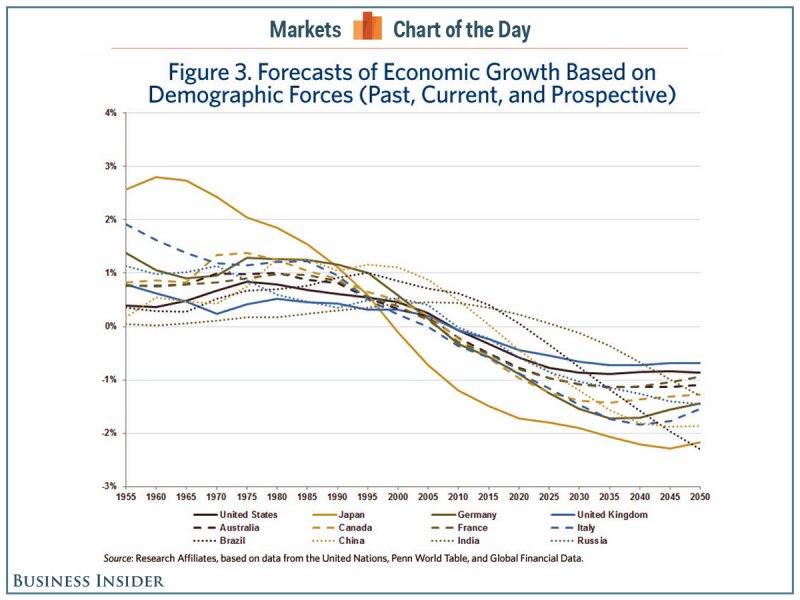
Are demographics the silent GDP killer? This weekend, Cumberland Advisors’ David Kotok pointed us to a recent note from Rob Arnott and Denis Chaves of Research Affiliates that seems to indicate that it’s so. First, they explained a model they developed, which shows that the contribution of real GDP growth per capita increases as ages increase into the mid-30s before turning down. “The average contribution to GDP growth becomes negative between 55 and 60,” they explain. “This does not mean that people begin to consume more GDP than they produce after age 55, only that—on average—workers above age 55 have passed their peak in productivity. Intuitively, the average 60-year-old is more productive than the average 40-year-old, but not so relative to the average 55-year-old. At ages 60 and above, the coefficients decline much more sharply: the mature worker exhibits falling productivity, and in retiring, a worker’s productivity simply falls off a cliff.” Arnott and Chaves then put together estimates of how much of a headwind (and looked back to how much of a tailwind) demographics are giving major economies, based on projected aging trends.
As one might expect, Japan sees the most debilitating impact from aging demographics, with a drag of more than 2% on GDP.
“A transition from a 3% tailwind to a 2% headwind is shocking: it suggests a 5 percentage point drop in normal real per capita GDP growth rates from the heady growth of the 1960s to the 1980s,” said Chaves about Japan. “Even if changes in policies and entitlements can halve these figures, it’s a formidable headwind.”
The rest of the world will see a more gradual but still substantial impact.
Brazil, China, Italy and Germany will each get down near the -2% level.
Arnott and Chives’ conclusion is that demographics actually gave major economies a huge lift in the previous 50 years, but that this ended up creating unreasonable expectations about what kind of growth is possible.
They argued that the coming headwinds merely represent a regression to the mean — and policies will have to adapt accordingly.
“The danger is not in the slower growth,” they wrote. “Slow growth is not a bad thing. It’s still growth. The danger is in an expectations gap, in which we consider slower growth unacceptable. If we expect our policy elite to deliver implausible growth, in an environment in which a demographic tailwind has become a demographic headwind, they will deliver temporary outsized “growth” with debt-financed consumption (deficit spending).
“If we resist the necessary policy changes that can moderate these headwinds, we risk magnifying their impact.”
 About bambooinnovator
 Bamboo Innovator