Free Work Entices Businesses to Hire Long-Term Unemployed

Free Work Entices Businesses to Hire Long-Term Unemployed: Jobs

After conducting almost 10,000 job interviews during 10 years as a human resources manager, Tom Kaminski says he thought he knew enough about the labor market to keep his own bout of unemployment short.

Instead, he wound up out of work for three years before enrolling in Platform to Employment, or P2E, a privately-funded Connecticut program to help long-term unemployed workers land jobs. The attraction for employers: A fully paid-for audition of as long as eight weeks for job applicants who complete the five-week program. Read more of this post

Fidelity Asks How Long Can Draghi’s Bond-Buying Bluff Hold?

Fidelity Asks How Long Can Draghi’s Bond-Buying Bluff Hold?

Tyler Durden on 08/15/2013 12:59 -0400

Authored by Michael Collins, Investment Commentator at Fidelity,

Capitalist banking systems are built on the confidence trick that people can get their money back at any time. Of course, if everyone sought their money at once, no one would get anything because the financial system would collapse.

The eurozone is being held together by a more-fragile bluff. This is the European Central Bank’s “outright monetary transactions” scheme that was announced in September last year. The scheme pledges to buy unlimited amounts of bonds of distressed sovereigns, a plan that was enacted by Mario Draghi to back up his comments two months earlier that the ECB would “do whatever it takes” to save the euro. Read more of this post

Deflating housing bubble at heart of Netherlands’ economic blues

August 15, 2013 3:58 pm

Deflating housing bubble at heart of Netherlands’ economic blues

By Matt Steinglass in Haarlem

Haarlem, officially the best shopping city in the Netherlands, looks like many picturesque Dutch towns: a medieval church surrounded by a hedonistic cornucopia of pedestrian shopping streets. Normally those streets are filled with confident window-shoppers, but these are not normal times, and Dutch consumers are feeling anything but confident. Household spending has been falling for three straight years, and it dropped again 2.4 per cent year on year in the second quarter, dragging the entire economy down with it. Read more of this post

How To Decide Whether A Company Is Valuable Or Vulnerable; Gandhi once said you can measure the civilization of a people by how they treat their animals. Translated into corporate terms: you can measure how ideas are given arms and legs so they can move forward

How To Decide Whether A Company Is Valuable Or Vulnerable

MICHELLE KERRIGANWORKPLACE CONFIDENCE 41 MINUTES AGO 0

Gandhi once said you can measure the civilization of a people by how they treat their animals. Translated into corporate terms: you can measure the success of leaders by how they value teamwork and day-to-day operations. Recently, a law firm partner who specializes in joint ventures and venture capital transactions asked me what I look for in workplace success. It was an operational due diligence exercise to help investors determine “am I on a winner?” I gave her a list of questions to consider when assessing quality, whether you’re an investor or a CEO wondering about your own operation. Here are four to get you started:

The management: are they leaders?

The team: are they organized and primed to execute?

What happens when people ask questions?

Is there an overall sense of unity and positive energy?

Most people might just focus on the first question. Totally understandable. But, if you’re investing in a company with a growing or changing operation, you may want to take a closer look at the day-to-day workplace. That’s where the magic happens. Where the vision you’re investing in comes to life, in the form of people, process, and teamwork. It’s where ideas are given arms and legs so they can move forward. The value in any company depends on it, and so does the value of leadership. Answers to the bottom 3 questions will tell you a lot about the #1. Read more of this post

Ogilvy & Mather Has Launched A Behavioral Science School

Ad Agency Launched A Behavioral Science School

JESSICA DAVIESTHE DRUM AUG. 15, 2013, 9:30 AM 185

Ogilvy & Mather’s behavioural sciences practice #ogilvychange has launched its first summer school, giving students the chance to work on live marketing briefs. The school has chosen six university students from 70 applicants, all of whom have proven they are well-read in behavioural sciences literature and can apply their knowledge beyond the theory and outside their own laboratories. The course, which kicked off this week, will begin with a crash-course in applying behavioural science, before moving on to work on live behaviour-change marketing briefs with specialist teams from across the Ogilvy Group businesses. The will work alongside leading advocates of behavioural economics, including Ogilvy’s vice chairman Rory Sutherland and Dr Nichola Raihani from UCL. Ogilvy & Mather UK’s vice chairman Rory Sutherland said the advertising and marketing industry would benefit from having more psychologists and behavioural economists. “The new media world, and the new behavioural tasks we are being required to solve, make this an imperative. “But there is another reason, too. I would like them to explain why in God’s name the marketing function has for 50 years assumed it has absolutely nothing to learn from academic psychology,” he said. The positions were publicised at “top-tier” universities that offer psychology and behavioural sciences degrees, across social media sites and the IPA student careers website. Ogilvy & Mather launched #ogilvychange earlier this year.

Apples losing their crunch to global warming: study

Apples losing their crunch to global warming: study

POSTED: 15 Aug 2013 10:41 PM
Global warming is causing apples to become less crunchy, but sweeter. PARIS, France: Global warming is causing apples to lose some of their crunch but is also making them sweeter, a study said Thursday. Analysing data gathered from 1970 to 2010 at two orchards in Japan, a research team said there was clear evidence that climate change was having an effect on apple taste and texture. “All such changes may have resulted from earlier blooming and higher temperatures” during the growth season, they wrote in the journal Nature Scientific Reports. About 60 million tonnes of apples are produced every year, making it the world’s third most popular fruit. Previous studies had shown that global warming was causing apple trees to flower earlier, and that harvests were also affected by changes in rainfall and air temperature. The orchards used in the study produce the Fuji and Tsugaru apples, the two most popular kinds in the world. The farms are located in Japan’s Nagano and Aomori prefectures, which had seen a mean air temperature rise of 0.31 and 0.34 degrees Celsius (0.5 and 0.6 degrees Fahrenheit), respectively, per decade. The orchards were chosen because there had been no changes in cultivars or management practices for extended periods, thus ruling out non-climate factors like technological improvements in the apple change. The data collected over the years included measures of acid and sugar concentration, fruit firmness and watercore — a disease that causes water-soaked areas in the flesh of an apple. The analysis showed a decrease in acidity, firmness and watercore, but a rise in sugar concentration over time. “We think that a sweeter apple is a positive thing and a loss of firmness is a negative thing,” study co-author Toshihiko Sugiura of the National Institute of Fruit Tree Science in Fujimoto told AFP. “We think most people like sweet and firm apple fruits, although everyone has his own taste. A soft apple is called ‘Boke’ in Japanese which means a dull or senile fruit.” The study said that the results “suggest that the taste and textural attributes of apples in the market are undergoing change from a long-term perspective, even though consumers might not perceive these subtle change.” The research claims to be the first to measure changes in the taste and texture of food as a result of climate change.
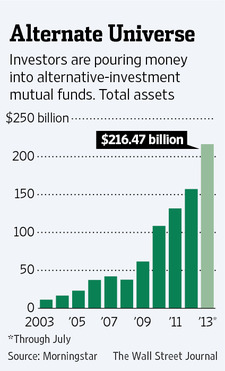
‘Alternative’ Investments Draw Flak;Individual investors are pouring tens of billions of dollars into a new generation of complex investment products, and regulators are raising concerns that not all buyers understand the costs and risk

August 15, 2013, 8:49 p.m. ET

‘Alternative’ Investments Draw Flak

Investors Flock to New Risky Products, and Regulators Are Raising Concerns

JAMES STERNGOLD

MI-BX897_ALTINV_NS_20130815183602

Individual investors are pouring tens of billions of dollars into a new generation of complex investment products, and regulators are raising concerns that not all buyers understand the costs and risks. Outside scrutiny is intensifying on securities firms’ sales practices and whether so-called alternative products—ranging from certain types of mutual funds to vehicles that invest in highly indebted companies—are suitable for all of the Americans flocking to them. Some state securities regulators are focusing their examinations on alternative-product brokers, while officials at Wall Street’s self-funded watchdog, the Financial Industry Regulatory Authority, say they are planning to file civil enforcement actions by year-end. Read more of this post

Do Brokers of Insiders Tip Other Clients?

Do Brokers of Insiders Tip Other Clients?

William J. McNally, Andriy Shkilko, Brian F. Smith*

September 2012

Abstract

This paper finds evidence that brokers who execute insider trades on the Toronto Stock Exchange engage in tipping and insider trading. We find that on the day when insiders buy (sell), there is a significant increase in the proportion of non-insider client buying (selling) handled by the insider’s brokerage firm. Since there is normally a multi-day delay in the publication of these insider trades, this finding is consistent with brokers tipping their other clients. Furthermore, we find that executing brokers double their market share of principal buying (selling) on the day of insider buys (sales).

Share Repurchase Motives by Taiwanese Firms

Share Repurchase Motives by Taiwanese Firms

Shih-Chin Lee Chihlee Institute of Technology

Jen-Chang Liu Takming University of Science and Technology – Department of Banking and Finance

March 27, 2013

Abstract: 
Taiwanese firms must follow strict regulations when implementing repurchase programs. The mean (median) of completion rates is 69.2% (82.7%) for the purpose of cancelling and 68.0% (80.0%) for the purpose of transferring. We try to identify the factors determining the completion rate of a repurchaser. We find that OTC firms tend to be younger and are on the stage of expansion; hence they are less likely to write off its shares. In contrast, TSE firms are more mature and are more ready to cancel the shares when they decide to buy back shares. Besides, a repurchaser is characterized by higher ratio retained earning to total equity, lower leverage. There exist a complementary relation between dividends and repurchases. It is highly unlikely to find a firm buying back shares without history of paying dividends. Finally, we find no evidence supporting the free cash flows hypothesis; that is, the ratio of cash to total assets has no association with the repurchase decision.

Informed Trading and False Signaling with Open Market Repurchases

Informed Trading and False Signaling with Open Market Repurchases

Fried, Jesse M.

Abstract

Public companies in the United States and elsewhere increasingly use open market stock buybacks, rather than dividends, to distribute cash to shareholders. Academic commentators have emphasized the possible benefits of such repurchases for shareholders. However, little attention has been paid to their potential drawbacks. This Article explains that managers currently are able to use open market repurchases and misleading repurchase announcements to enrich themselves at public shareholders’™ expense. Managers, aware their stock is underpriced, frequently use repurchases to indirectly buy stock for themselves at a bargain price. Managers have also been able to boost stock prices by announcing repurchase programs they did not intend to execute, perhaps to unload their own shares at a high price. Such bargain repurchases and inflated-price sales systematically transfer significant amounts of value from one set of shareholders (public investors) to another (managers). Low-price buybacks are also likely to reduce aggregate shareholder value by distorting managers’ payout and investment decisions, further reducing public shareholder returns. The Article concludes by proposing a new approach to regulating open market repurchases: requiring managers to disclose specific details of the firm’s buy orders in advance. This pre-repurchase disclosure rule would undermine managers’ ability to use repurchases for informed trading and false signaling, thereby reducing the resulting distortions and costs to shareholders. Moreover, it would achieve these objectives without eroding any of the potential benefits of repurchases.

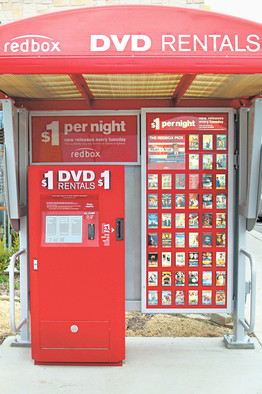
Coin Star/Outerwall’s Redbox video-rental kiosks could surprise short sellers and others betting on the DVD’s extinction. The owner of Redbox video-rental kiosks now controls 50% of the market

| SATURDAY, AUGUST 10, 2013

A Box Full of Money

By DAVID ENGLANDER | MORE ARTICLES BY AUTHOR

Outerwall’s Redbox video-rental kiosks could surprise short sellers and others betting on the DVD’s extinction. Why the shares could rally 20%.

DVD, R.I.P.? Think again. Outerwall’s Redbox video-rental business could surprise legions of skeptics.

BA-BC639_SmCaps_DV_20130810012016

Outerwall, formerly known as Coinstar, has emerged as the king of video rentals. The owner of Redbox video-rental kiosks now controls 50% of the market, having benefited from the demise of traditional video stores and a decline in the DVD business atNetflix (ticker: NFLX). Redbox’s low daily rental rate of $1.20 per video has made it a hit with cost-conscious consumers. Many on Wall Street think this movie will end badly, as viewers migrate to video on demand delivered by cable TV and the Internet. Investors betting on the DVD’s eventual extinction have sold short 40% of Outerwall’s public stock float. Read more of this post