“Beer is for children, Vodka is for real men.” The world’s top brewers once bet big on Russia’s famous love of drinking, investing hundreds of millions of dollars there. But now the Kremlin’s campaign against alcoholism has sapped the life out of the party.
August 18, 2013 Leave a comment
August 16, 2013, 8:28 p.m. ET
Russian Beer Fest Goes Flat for Brewers
Kremlin’s crackdown on alcoholism saps life out of the party
LUKAS I. ALPERT
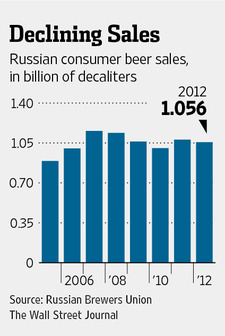
MOSCOW—The world’s top brewers once bet big on Russia’s famous love of drinking, pouring hundreds of millions of dollars into new plants and distribution networks as they sought to tap a growing taste for beer in a land where vodka long ruled. For years the investment paid off. But now the Kremlin’s campaign against alcoholism has sapped the life out of the party as a flood of new regulations and taxes aimed at turning around dismal life expectancy rates for men has made the beer market go flat, brewers say.“Without a doubt, it has become a tough place to do business,” said Jorgen Buhl Rasmussen, president of Carlsberg Group, CARL-A.KO -0.08% which has invested around $12 billion over the past 20 years in a region it counted on for 40% of its overall profit. “It is partly due to the global crisis, partly due to bad harvests, but very much due to extreme increases in duty and other regulations.”
Big Western beer companies like Carlsberg, SABMiller SAB.LN -0.88% andAnheuser-Busch InBev BUD -0.46% say the pace of the new regulations and tax increases has stung deeply in a country many brewers had hoped would on drive growth as sales flagged in Europe and the U.S. Across the industry, sales have fizzled 20% by volume in Russia since 2010 as per capita consumption slipped 13% due to rising prices.
Anheuser-Busch InBev’s local affiliate saw first-half sales drop 13% from a year earlier and has closed two breweries in Russia in the past year, blaming higher taxes and a regulatory regime it says is now “one of the toughest in the world.” Heineken’s Russian subsidiary recently sold one brewery and has put a second up for sale. SABMiller’s alliance with Turkey’s Andalou Efes said it won’t make its 2013 targets “due to the negative impact of regulatory changes” in Russia, and Carlsberg Group, whose Baltika Breweries controls 38% of the market, said it won’t meet global growth forecasts this year largely due to troubles here.
The market’s free fall was a sharp turnaround from the underregulated heyday of the mid-2000s when Russia didn’t even classify beer as an alcoholic beverage. Between 2005 and 2007, sales shot up nearly 30%, and it wasn’t uncommon to see Russians walking around drinking a bottle of beer at 10 a.m. as if it were a soft drink.
“Pre-2008 there was very little regulation. You didn’t need a license to sell beer, duties were low and there were no limits on marketing. It was often cheaper than soda,” said Ian Shackleton, a beer analyst at Nomura. “There was super, super growth and it was fabulous to be a brewer, but it was probably a bit too good to be true.”
In 2009, the Russian government declared war on alcoholism, which then-PresidentDmitry Medvedev called a “national disaster.” One in five deaths among men in Russia is related to alcohol, according to the World Health Organization, and average male life expectancy is just 64 years.
The following year, Vladimir Putin, who was then prime minister, signed off on a 10-year plan to cut alcohol consumption in half by 2020. In 2011, Mr. Medvedev signed a law classifying beer as an alcoholic beverage, placing it under tighter controls. Before that, any drink with less than 10% alcohol content was considered a foodstuff.
The new law immediately prohibited late-night beer sales. On Jan. 1, a ban on advertising and kiosk sales also went into effect.
But the real hit, industry executives say, has been a steady rise in excise duties. In 2009, the government charged just three rubles (nine U.S. cents) a liter of beer. In 2013, it shot up to 15 rubles a liter and will increase to 18 rubles in 2014 and to 20 rubles in 2015. That has led to a 10% jump in retail prices and a decline in sales, says Julija Drozdova of Euromonitor International.
Vodka has also seen steep tax increases—33% this year, possibly 25% more in 2014 and an additional 20% in 2015—as well as a substantial increase in minimum pricing from 125 rubles ($3.79) for a bottle to 170 rubles ($5.15) this year. That has led to a 28% decline in vodka production in the first half of this year. Vodka also made up less than half of all the alcohol consumed in Russia in the first half this year for the first time, while beer sales inched up to 32% of alcohol consumed, Russia’s Federal State Statistics Service data showed.
Beer makers warn that anti-alcohol measures could backfire, pointing to similar policies enacted in the Soviet Union by Mikhail Gorbachev that led to lower alcohol consumption, but also a sharp rise in the production of moonshine and organized crime. Earlier this month, Mr. Putin voiced similar concerns and suggested slower tax increases.
“We know what the old days were like, what the fight with alcohol led to—people just started brewing homemade vodka and drinking denatured alcohol,” Mr. Putin said. “Alcoholism prevention is difficult work. It demands great effort, financing, time and resourcefulness, but it will have a positive and lasting effect.”
Some attitudes remain unchanged, however.
“Beer is for children,” Dmitry Kozlov, a Russian soldier on leave said recently during an afternoon vodka drinking session in a central Moscow pub. “Vodka is for real men.”
 About bambooinnovator
 Bamboo Innovator