Indian Markets Battered by Signs of End to Easy Money; Stocks Fall 4%, Rupee at New Low, as Investors Question Economic Prospects
August 18, 2013 Leave a comment
Updated August 16, 2013, 7:19 p.m. ET
Indian Markets Battered by Signs of End to Easy Money
Stocks Fall 4%, Rupee at New Low, as Investors Question Economic Prospects
SHEFALI ANAND in Mumbai and PRABHA NATARAJAN in New York
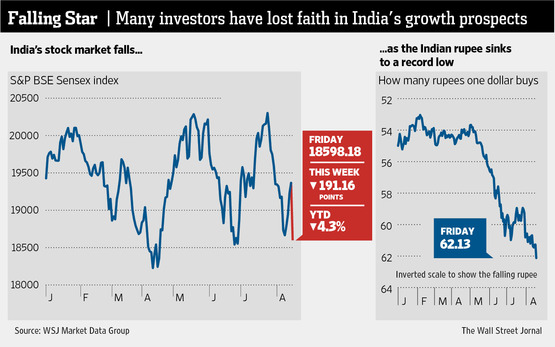
Indian shares fell sharply Friday as investors questioned whether the now-fragile economy of the world’s second most-populous country could withstand an end to global easy-money policies. The Bombay Stock Exchange’s S&P BSE Sensex index lost nearly 4%, its largest one-day drop in almost two years, while the Indian currency, the rupee, hit an all-time low against the U.S. dollar. Traders said an immediate trigger for the selloff was Thursday’s better-than-expected U.S. employment report—which was seen as raising the odds the U.S. Federal Reserve would more quickly tighten the monetary taps.But underscoring the unease were concerns about India’s slowing, import-reliant economy and a lack of faith that the government would succeed in reigniting growth.
“India is not an investible economy right now,” said Derrick Irwin, a portfolio manager at Wells Fargo Advantage Funds, which has $230.8 billion under management. Investors are worried that moves by India’s government and central bank “will choke off growth even further,” he said.
Mr. Irwin said he has been selling shares in Indian consumer-staple companies.
India is especially vulnerable to shifts in market sentiment because it needs large amounts of foreign capital to finance a yawning current-account deficit—a reflection of the fact that the country imports considerably more than it exports.
That is a situation similar to the one faced by some of the countries felled in the Asian financial crisis of 1997, when capital flight brought many economies in the region to a shuddering halt. And it has left policy makers in a tough spot, with measures aimed at bolstering the drooping currency and keeping capital in the country threatening to curb needed economic expansion.
Money began flowing out of emerging markets earlier this year, after the U.S. Fed signaled in May that it could soon wind down a bond-buying program which had kept the global financial system awash with cash. Investors hurried to move money into U.S. assets.
In India, that helped knock the wind out of nascent government efforts to overhaul investment rules and pull more foreign money into factories and other businesses.
It also hit the Indian rupee, which has fallen by more than 13% since May. On Friday it hit an all-time low, trading at 62.13 to the U.S. dollar. A weak currency makes India’s imports—such as the oil needed to power the nation—more expensive, helping fuel inflation. And since the country’s exports aren’t a big part of economic output, it receives little compensating boost from its products being cheaper abroad.
In June, the Reserve Bank of India stopped a cycle of interest-rate cuts. In July, it effectively reversed course, making it more expensive for banks to borrow, forcing rates up in an effort to boost the rupee.
But those measures also make it harder for companies to borrow to expand their businesses and repay their debt, adding to the headwinds facing the economy.
After a growth spurt from 2004 to 2011, when gross domestic product rose by an average of more than 8% a year and raised hopes of India becoming a new Asian tiger, the country lapsed back into a plodding pace as economic overhauls lost steam.
Economists have recently cut their target for India’s growth to as low as 5% for the year ended March 31, 2014, versus an expectation of 6.5% earlier this year.
In an effort to spark a comeback, officials last fall pledged fiscal rectitude and a more open economy. The government slashed fuel subsidies, helping shrink its budget gap to 4.9% of GDP in the year ended March 31, from a projected 5.2%.
Last fall, India moved to allow foreign companies such as Wal-Mart Stores Inc. to invest in Indian supermarkets for the first time, with a maximum stake of 51%. But so far no foreign company has made such an investment because of lack of clarity on policies such as how much of their products they would have to source locally.
“After all the reforms you did, you’re back to square one,” said Sachin Shukla, economist at Mumbai financial-services firm Axis Capital Ltd.
Since the rupee began sliding earlier this year, the government has responded with a hodgepodge of policies—from raising taxes on imports of gold and silver to unveiling plans to buy more oil from Iran using a quasi-barter arrangement.
In its latest move, the central bank late Wednesday reduced the amount of money that Indian residents and companies can send abroad.
In an effort to assuage concerns that India was moving toward capital controls, Arvind Mayaram, India’s federal economic-affairs secretary, told reporters Friday that India doesn’t plan to impose controls on money being repatriated by companies, such as dividends and royalties.
The Indian “government needs to work on making India an attractive investment destination rather than restricting flows of capital in and out of India,” Wells Fargo’s Mr. Irwin said.
Investors fear that upcoming federal elections, due before May 2014, will keep India from implementing any further overhauls because the government will be focused more on populist measures to win votes.
“Every time there is an election, there are handouts for votes that worsens India’s fiscal situation,” said Teresa Kong, portfolio manager of the $68 million Matthews Asia Strategic Income Fund.
Ms. Kong trimmed the allocation to India in her fund in the second quarter, and has only a small exposure to the country.
Foreign institutional investors have withdrawn $2.6 billion from Indian stocks since June, according to data from the Securities and Exchange Board of India. This compares with an inflow of $15.35 billion into Indian stocks in the first five months of the year.
Still, some investors say they like the long-term growth story of India and find its demographics attractive.
Edwin Gutierrez, a portfolio manager at Aberdeen Asset Management LLC, who oversees $10 billion in emerging-market debt, said he isn’t selling India.
“It isn’t a basket case. Once we get the uncertainty of the [upcoming federal] elections out of the way, we expect to see a pickup in investor confidence,” Mr. Gutierrez said.
August 16, 2013 4:00 pm
Gloomy India tries to staunch the economic bleeding
By Victor Mallet in New Delhi and James Crabtree in Chennai
India’s surprise decision to reimpose capital controls on local companies and individuals this week to protect the ailing rupee was prompted by warnings of an imminent surge in capital flight, according to senior policy makers in the capital.
The move on Wednesday night appears to have failed, at least in the short term. The rupee fell to a record low of Rs62.03 to the dollar on Friday once markets reopened after a holiday.
But the curbs on outward direct investment – which reversed a liberalisation of six years ago – reflected the desperate search by Indian authorities for a way to deal with the toxic combination of a falling rupee, a sharp slowdown in growth, swollen current account and budget deficits and persistently high inflation.
“We have to stop the haemorrhaging. We need to stabilise the patient,” one senior official said Friday.
Another complained that Indians had set up “shell companies” to take advantage of corporate allowances for outward investment, while financial advisers in the Middle East had told individuals to use their maximum annual personal allowances immediately.
“People were getting calls to take out $200,000 right now and bring it back when the rupee reaches 70 [to the dollar],” the official said.
The controls were the latest of a series of hastily devised measures to bolster the rupee – others include three rounds of duty increases on gold imports – but they have only deepened the sense of crisis afflicting the Indian economy.
“It seems that the government is groping in the dark, and coming up with measures without any serious consideration from industry, or people who can tell them the consequences of their actions,” said DG Shah, secretary-general of the Indian Pharmaceutical Alliance. “The capital controls are a classic example.”
Indian drugmakers have been aggressively acquiring small drug companies abroad to use their foreign distribution networks. Such plans could be impeded by the new restrictions, although officials insist they are not targeting bona fide corporate investors.
Commentators ranging from foreign economists to Indian chief executives accuse the government and the central bank of devising “Band-Aid” solutions and stopgap measures that promote a sense of panic, when what the country needs is an economic strategy that promotes long-term investment.
Palaniappan Chidambaram, finance minister, has been trying to do just that. But he has been unable to make much progress on the ground in the face of India’s agonisingly slow bureaucracy and hostility to reform from politicians, including some in the governing Congress party.
The US Federal Reserve’s advertised plans to begin bringing an end to its programme of bond-buying thanks to an improving economy there have only added to India’s problems, prompting an outflow of money from emerging markets.
“India is now getting hit on two sides, one being domestic problems of political uncertainty and indecision over the last two or three years . . . the other being the improvement in the US economy, which is taking capital out when we need it, “says billionaire industrialist Sajjan Jindal, who runs JSW Steel, the country’s second-largest private steelmaker by sales. “India is in a difficult place.”
It seems that the government is groping in the dark, and coming up with measures without any serious consideration from industry, or people who can tell them the consequences of their actions
– DG Shah, Indian Pharmaceutical Alliance secretary-general
The result is anxiety for policy makers, gloomy forecasts by Indian business leaders and concerns among regulators about the banking system.
“All the businesses we run that deal with other companies, rather than consumers, are under great stress,” says Jamshyd Godrej, who runs manufacturing businesses within the $3bn Mumbai-based Godrej conglomerate. “We’ve seen people have ordered equipment and now can’t pay for it, while worries about future growth rates are really putting capital expenditure on the back burner.”
Alan Rosling, co-founder of solar power company Kiran Energy, says the view from the countryside and from the consumer goods groups that serve India’s 1.3bn consumers is not as downbeat as it is in the big cities.
“I’ve been here 15 years and through booms and busts and I don’t remember such a negative sentiment in the business community,” he says. “That’s the typical view in [Mumbai] – that India’s lost its way . . . [But] the pessimism is overdone because the economy is not that bad.”
However, even Manmohan Singh, the prime minister, cannot hide his disappointment that annual economic growth has fallen to 5 per cent – half its level of three years ago – in the run-up to the next general election due by May 2014.
Economists and analysts, most of whom question the sense of the recent hodgepodge of measures to try to save the rupee, have in recent weeks begun warning of the risk of “stagflation”, an impoverishing mixture of low growth and inflation.
“We are on a glide path to 4 per cent GDP growth, perhaps lower, this quarter or next,” says Tarun Kataria, chief executive of investment bank Religare Capital India. “Reversing this requires a raft of reforms which unfortunately have not come through yet. Without this the pressure on the twin deficits and the currency will remain elevated.”
As Indian rupee hits another record low, foreign investors balk
2:06pm EDT
By Rafael Nam and Manoj Kumar
MUMBAI/NEW DELHI (Reuters) – India’s finance minister tried to talk up the rupee on Friday after it plumbed another record low on concerns the central bank’s latest measures to defend the currency could be a step towards outright capital controls.
Traders said the central bank was forced to step in to prop up the rupee as measures from the Reserve Bank of India (RBI) late on Wednesday restricting how much Indian citizens and companies can invest abroad were seen as yet another roll of the dice that is undermining investor confidence.
Concerns that policymakers were losing control over the currency spread to India’s stock market .NSEI, which dropped 4 percent, its biggest one-day decline in nearly two years.
Finance Minister Palaniappan Chidambaram told reporters that global developments, including the dollar spike after U.S. jobless claims data on Thursday, were behind the rupee falls.
“I have no doubt in my mind when calm is restored in the market, people will begin to understand that Indian market indicators must basically reflect Indian market conditions,” Chidambaram said.
“I think this is time for calm. This is time for reflection.”
Indian policymakers have cobbled together a slew of steps over the past month in a bid to halt the rupee’s slide, including the central bank’s extraordinary steps on July 15 to drain cash from the system and raise short-term interest rates in an economy already growing at a decade low.
Yet none of the steps or the rhetoric so far have convinced investors that India can attract overseas investments, which is seen as essential in narrowing a record high current account deficit that is the biggest source of the rupee weakness.
The approach is instead beginning to test the patience of foreign investors, just when emerging markets such as India are seen as particularly vulnerable to reduced cash inflows once the expected tapering of monetary stimulus by the U.S. Federal Reserve begins.
“They’re coming across as a bit panicky. That’s what is damaging sentiment for investors,” said Jonathan Schiessl, a fund manager at Ashburton Investments in Jersey, referring to the RBI’s actions to defend the rupee.
“Unless things improve, we will probably in all likelihood be withdrawing some weightings from our India positions.”
The partially convertible rupee fell to an all-time low of 62.03 to the dollar as trading began on Friday. It ended the session at 61.65, weaker than Wednesday’s close of 61.43/44. Markets were closed on Thursday for a holiday.
SLIP SLIDING AWAY
The prospect of the Fed stimulus rollback looms over India as the country struggles with a current account deficit that hit a record high of 4.8 percent of gross domestic product while its economic growth has slowed to a decade low of 5 percent.
Foreign investors have already sold a net $11.6 billion of Indian debt and equities since late May, sparking fears of further outflows.
India’s benchmark 10-year bond yields surged to their highest since May 2012 on Friday.
“India is losing control over the currency and you are starting to see the weakness transmitting to stock markets. There could be a self-perpetuating cycle where currency weakness flushes out equity investors and that takes the rupee weaker still,” said UBS strategist Manik Narain in London.
The RBI’s restrictions on capital outflows are likely to delay overseas acquisitions and investment plans by India Inc at a time when many companies are scouting markets abroad to beat the domestic economic slowdown.
Yet the biggest fear is that the RBI’s action could be the start of a far stronger move to restrain capital.
“The steps taken so far only target residents, but if this raises expectations that they could potentially resort to capital controls targeted at non-residents, that could have adverse near-term implications for capital flows,” HSBC’s Chief economist for India and ASEAN Leif Eskesen said.
“It will, therefore, be critical to tread very carefully when it comes to capital controls, to anchor expectations, and also not use it as a substitute for more appropriate and effective measures,” Eskesen said in a note to clients.
As policymakers struggle to stem the rupee’s falls, markets expect more weakness ahead. Overseas investors betting via one-month offshore non-deliverable forwards quoted the rupee trading at 62.46, while onshore bets see it 62.35.
A Reuters poll on Thursday showed short positions in the rupee had hit the highest in two months.
None of the measures unveiled by India so far have given markets assurance that the country can attract foreign flows in an increasingly difficult global environment, analysts said.
India last month unveiled plans to further ease restrictions on foreign direct investment (FDI) but previous measures have had mixed results. FDI fell to $36.9 billion in the fiscal year ending in March from $46.6 billion the previous year.
This week it announced measures to attract near-term capital inflows, including from state-run companies selling debt abroad.
Yet doing so could prove hard without major confidence-inspiring reforms, especially as RBI measures last month to drain cash raise the prospect that borrowing costs will rise.
“We remain underweight on Indian credits as the current spreads do not offer enough compensation in our view,” said Arthur Lau, head of fixed income for Asia ex-Japan for Pinebridge Investments in Hong Kong.
 About bambooinnovator
 Bamboo Innovator