Only a few countries are teaching children how to think

Only a few countries are teaching children how to think

Aug 17th 2013 |From the print edition

The Smartest Kids in the World: And How They Got That Way. By Amanda Ripley. Simon and Schuster; 320 pages; $28. Buy from Amazon.comAmazon.co.uk

BAMA Companies has been making pies and biscuits in Oklahoma since the 1920s. But the company is struggling to find Okies with the skills to fill even its most basic factory jobs. Such posts require workers to think critically, yet graduates of local schools are often unable to read or do simple maths. This is why the company recently decided to open a new factory in Poland—its first in Europe. “We hear that educated people are plentiful,” explains Paula Marshall, Bama’s boss. Read more of this post

When cities start to decline, economic diversity is the thing that can save them

When cities start to decline, economic diversity is the thing that can save them

Aug 17th 2013 |From the print edition

DETROIT’S newest industry is “ruin porn”—photos that document the city’s rotting physical infrastructure. The Motor City is an extreme example of a decline that has beset industrial cities across America’s Midwest and northern Europe. Their rise and fall (and, in some cases, renaissance) illuminate the deeper forces that hold cities together and pull them apart.

It is not obvious, to economists anyway, that cities should exist at all. Crowds of people mean congestion and costly land and labour. But there are also well-known advantages to bunching up. When transport costs are sufficiently high a firm can spend more money shipping goods to clusters of consumers than it saves on cheap land and labour. Workers with specialised skills flock to such clusters to be near to the sorts of firms that hire them. Such workers make a city still more attractive to growing companies. The deep pool of jobs and workers improves matches between employer and employee, boosting productivity and pay. Read more of this post

Out-of-Pocket Healthcare Costs Soar in Singapore as 3M Healthcare System Breaks Down and Chronic Patients Cannot Utilize Their Own Hard-Earned Money Tied Up In Healthcare System Used to Fund Investments

Whither our 3M healthcare system?

There are great expectations arising from the year-long Our Singapore Conversation. Many have expressed their concerns and wishes for the future development of healthcare. And recently, we have been deluged with many articles and commentaries on the advantages and disadvantages of the Singapore system, offering various diagnoses, prognoses and even policy lessons for other countries.

BY PHUA KAI HONG –

6 HOURS 53 MIN AGO

There are great expectations arising from the year-long Our Singapore Conversation. Many have expressed their concerns and wishes for the future development of healthcare. And recently, we have been deluged with many articles and commentaries on the advantages and disadvantages of the Singapore system, offering various diagnoses, prognoses and even policy lessons for other countries.

Healthcare consultant Dr Jeremy Lim, who has worked in the public and private sectors, will be launching his book, Myth or Magic: The Singapore Healthcare System, next month.

As a frequent commentator on the local health scene — having written several pieces for this paper, for instance — he recently noted that “it is not the invisible hand of the market that drives costs down in Singapore’s healthcare system. It is the very visible hand of a strong Government that does so, as regulator and in deciding what to subsidise and what not to subsidise”. Read more of this post

Performance alone won’t win trust: study; Investors worldwide believe there is much that can be done to restore trust in investment profession

PUBLISHED AUGUST 17, 2013

Performance alone won’t win trust: study

Investors worldwide believe there is much that can be done to restore trust in investment profession

MALMINDERJIT SINGH MSINGH@SPH.COM.SG

IF you are an investment manager, you may do well in building trust with your client as he or she is likely to value ethical behaviour and transparency more than the performance of the investments. A CFA Institute/Edelman Investor Trust study shows that investors worldwide have little trust in the investment profession and believe there is much that can be done to restore trust. According to the study, just 53 per cent of investors in the US, the UK, Hong Kong, Canada and Australia trust investment firms to do what is right. Retail investors appear to be less trusting of the industry, as only 51 per cent of them indicated so, compared with 61 per cent of their institutional counterparts.

CFA Institute & Edelman Investor Trust Study: Investor trust fragile, aligned interests valued highly

Executive Summary

52% Of investors trust the financial services industry

73% Agree they have fair opportunity to profit by investing in capital markets

38% Cite “trusted to act in my best interest” as most important attribute in hiring an investment manager

The CFA Institute & Edelman Investor Trust Study examines trust by investors in investment managers, and explores what dimensions influence that level of trust. This study builds on the Edelman Trust Barometer which explores the levels of trust informed members of the public have in a variety of business, NGO, and government institutions globally.

The Investor Trust Study surveyed over 2,100 retail and institutional investors in the United States, United Kingdom, Hong Kong, Australia, and Canada, and finds that while a slim majority of respondents trust investment managers, the level of trust is fragile. The study finds that beyond the usual financial issues of performance and fees, investors place value on alignment of interests in their consideration of which managers to hire.
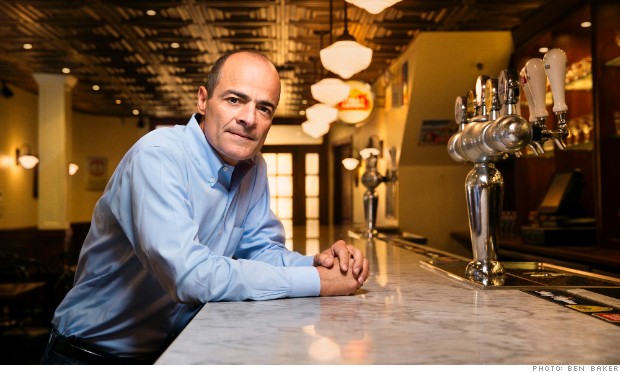
Attention to detail has become a hallmark of Brito’s leadership of Anheuser-Busch InBev (BUD), a sprawling beer behemoth forged from six mega-mergers in 25 years

Carlos Brito: (Brew)master of the universe

By Daniel Roberts, writer-reporter  @FortuneMagazine August 16, 2013: 9:08 AM ET

130814075507-bri02-carlos-brito-620xa

Carlos Brito, in his favored attire of blue jeans and button-down shirt, takes a break at Brabant Belgian Brasserie in New York City.

Carlos Brito is walking the aisles of a vast São Paulo supermarket, continually stopping to pick up pieces of trash — a paper cup, a plastic fork — or to pull certain cartons of beer to the front of the shelves for better visibility. These are the kinds of menial tasks most executives wouldn’t touch. But Brito, CEO of the world’s biggest beer company, isn’t like most executives.

Attention to detail has become a hallmark of Brito’s leadership of Anheuser-Busch InBev(BUD), a sprawling beer behemoth forged from six mega-mergers in 25 years. Despite the size of Brito’s enterprise, he handpicks promising young employees to promote early in their careers and greets each new class of global management trainees. When he visits diners and lunch counters all over the world that serve AB InBev beers, he walks behind the bar to personally inspect the boxes of empties. Read more of this post

‘I lost £150,000 due to Nineties pension sales frenzy’; A former a soldier lost his generous army pension because he was persuaded to switch to a private scheme – but he won’t win compensation

‘I lost £150,000 due to Nineties pension sales frenzy’

A former a soldier lost his generous army pension because he was persuaded to switch to a private scheme – but he won’t win compensation. Dan Hyde reports on the modern-day fallout from the 1988-94 pension mis-selling scandal.

PF-army-pension_2646258b

Sgt Phil Patrick, pictured with daughter Ayane, 5, has missed out on thousands of pounds Photo: Stuart Nicol

By Dan Hyde, Deputy Personal Finance Editor

6:11AM BST 17 Aug 2013

The harrowing legacy of the Eighties pensions revolution is resurfacing as a generation of savers nears retirement. An estimated 5 million people were sold pensions by commission-hungry salesmen between 1988 and 1994 in one of the biggest financial scandals ever to affect Britain. Typically, these workers were pulled out of generous company schemes – where their employer guaranteed a pension linked to their final salary – and enrolled instead in a substandard plan linked to stock market returns. Read more of this post

How Cath Kidston lured in high-powered women with a passion for polka dots as sales break £100m

How Cath Kidston lured in high-powered women with a passion for polka dots

Many of us spend our days staring at computer screens, but sipping coffee at our desks out of a flower-sprigged mug is bizarrely grounding, says entrepreneur Josephine Fairley, who explains the global phenomenon of Cath Kidston as sales break £100m.

kidston_2573326b

Cath Kidston has admitted that she is far from being a domestic goddess in her own home.  Photo: REX FEATURES

By Josephine Fairley

12:59PM BST 14 Aug 2013

So: just in time for her brand’s 20th birthday, Cath Kidston’s sales have broken through the £100m mark – with earnings (before interest, taxes etc) topping £21 million. Wow. This is a feat for any brand. But how has a relatively shy, seriously self-effacing (not to mention deceptively scatty-seeming, when you meet her in the flesh) woman grown her brand from a single store in then-down-at-heel Notting Hill into a global brand? Because it isn’t just Middle England which loves Cath Kidston MBE: sales are booming in Asia, too. As well as a flagship store in London’s Piccadilly, a major store is scheduled to open in Shanghai before the end of the year. Read more of this post

If You Want to Be an Entrepreneur, Don’t Go to Harvard

August 15, 2013, 4:11 PM

Trending Topic: If You Want to Be an Entrepreneur, Don’t Go to Harvard

VIVEK WADHWA: My greatest disappointment after joining academia was to see my most promising students accept jobs at Goldman Sachs or McKinsey. Engineering students with ambitions to save the world would instead become financial analysts—who used their skills to “engineer” our financial system. Or they would take grunt jobs in management consulting—another waste of valuable talent. Why would they sell their souls? Because they had no choice, the burden of debt they amassed while getting their degrees was just too great. They had six-figure student loans to repay and couldn’t take the risk of joining a startup or founding their own business. Read more of this post

Singapore’s $300,000-Salaried Politician Baey Yam Keng: I am surprised and flattered by the interest in my “selfies”

MP Baey Yam Keng the narcissist talks about his selfies

August 17th, 2013 |  Author: Contributions

baeynew2e 600x338 Read more of this post

The Remarkable Story Of How Lobster Went From Being Used As Fertilizer and Unsightly “Cockroaches of the Sea” To A Beloved Delicacy

The Remarkable Story Of How Lobster Went From Being Used As Fertilizer To A Beloved Delicacy

MEGAN WILLETT AUG. 16, 2013, 2:00 PM 3,639 5

It’s time to eat all of the fresh lobster, seafood, and summer fare we can before Labor Day. But here’s something to think about while downing every lobster roll in sight before summer’s end — our beloved shellfish was once a throw-away food. Back when the first European settlers reached North America, they wrote that lobsters were so plentiful that piles up to two feet high would wash ashore in Massachusetts Bay Colony. Instead of this leading to epic clam bakes with buckets filled with butter, the colonists were embarrassed by these unsightly “cockroaches of the sea.” Read more of this post

Singapore to try out driverless shuttle on public roads

Singapore to try out driverless shuttle on public roads

By Ben Coxworth

August 16, 2013

navia

Singapore’s Nanyang Technological University will be running a Navia autonomous shuttle to the nearby JTC Corporation’s CleanTech Park (Photo: NTU)

Should you be at Singapore’s Nanyang Technological University (NTU) sometime soon, and wish to take the shuttle bus to JTC Corporation’s CleanTech Park, you might find yourself in a vehicle that drives itself. Plans call for just such an autonomous shuttle to start running the 2-km (1.2-mile) route, as a real-world test of driverless public transportation. The electric 8-passenger vehicle is a model already being made by France’s Induct Technology, and is known as the Navia. Passengers get on board at a designated stop, and select their destination stop on a touchscreen display of the route. The vehicle then heads out onto public roads at a maximum speed of 12.5 mph (20 km/h). It uses four LIDAR (LIght Detection And Ranging) units, along with stereoscopic optical cameras, to generate a real-time 3D depth map of its surroundings. This allows it to avoid obstacles, stay in its lane, and generally keep from getting into trouble. Once it’s completed its route, the shuttle automatically heads to its wireless fast charging station. It doesn’t require any rails, overhead lines, or other changes to the roads. The project partners (NTU, JTC and Induct) hope that the Navia or something like it could be an effective form of last-mile transportation, ferrying commuters between transit hubs such as train stations, and their homes or workplaces. The Navia can be seen in use in the video below.

Birds of a feather land together: How flocking birds avoid colliding when they touch down

Birds of a feather land together: How flocking birds avoid colliding when they touch down

Aug 17th 2013 |From the print edition

LANDINGS are the most perilous parts of flying. Airline pilots have to practise hundreds before they can carry passengers. Even then, they have co-pilots, air-traffic controllers and all sorts of gadgetry to help them. And they do it one plane at a time, on clearly marked runways. Now imagine swarms of aircraft all trying to land together on a small stretch of water with no assistance and no gizmos. The result would surely be disastrous. Waterfowl, however, frequently land in groups on featureless bodies of water, yet they rarely collide. So how do they manage it? Read more of this post

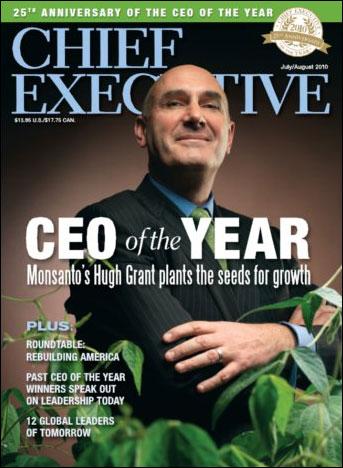
Monsanto CEO Hugh Grant aims to increase crop yields and feed a hungry planet. He’s now deft at countering critics—and enriching shareholders

SATURDAY, AUGUST 10, 2013

Planting the Seeds of Growth

By DYAN MACHAN | MORE ARTICLES BY AUTHOR

Monsanto CEO Hugh Grant aims to increase crop yields and feed a hungry planet. He’s now deft at countering critics—and enriching shareholders.

01ON-BB796_SPOTLI_G_20130810010512

Is Monsanto the Great Satan? Opponents of genetically modified seeds have called the company evil incarnate, notwithstanding its notable contributions toward lifting farmers out of poverty and expanding the food supply of a growing world. Environmental crusaders, movie stars, and politicians have all gotten in on the vilification act, charging that Monsanto’s seeds and the plants they produce are unsafe and violate farmers’ and consumers’ rights. Read more of this post

M&A as competitive advantage; Treating M&A as a strategic capability can give companies an edge that their peers will struggle to replicate

M&A as competitive advantage

Treating M&A as a strategic capability can give companies an edge that their peers will struggle to replicate.

August 2013 | byCristina Ferrer, Robert Uhlaner, and Andy West

Most companies approach deal making as an art rather than as a corporate capability deployed to support a strategy, and they see individual deals as discrete projects rather than integral parts of that strategy. Few have found a way to build and continuously improve, across businesses, an M&A capability that consistently creates value—and does so better than competitors. As a result, many lament how hard M&A is and worry about the statistics highlighting the failure rate of deals rather than how to build a capability that helps them win in the marketplace. Read more of this post

Lying about its lion, Chinese zoo closed for going to the dogs

Lying about its lion, Chinese zoo closed for going to the dogs

8:21am EDT

zooLuohe_2645858b tibetanmastiff_2644205c

BEIJING (Reuters) – A zoo in central China has been closed after visitors were outraged to discover its lion was really a bushy and barking Tibetan mastiff. The dog was not the only fake at People’s Park Zoo in the city of Luohe, which tried to pass off other common mammals and rodents as a leopard and snakes, Chinese media reported. Photographs showed the mastiff with its muzzle poking through the bars of its dingy enclosure. A grimy sign on the cage read “African Lion” in Chinese characters. The zoo apologized for the exhibits and was closed down for “rectification”, the Beijing News said, citing local officials. Animal rights activists have criticized Chinese zoos for their record of poor conditions and other abuses. Chinese zoo that substituted lions with dogs closes temporarily. The Chinese zoo which substituted its expensive and rare animals for cheaper “alternatives” has shut for one day, to allow the enclosure signs to be changed. Read more of this post

Dengue Fever Sweeps Southeast Asia; Thailand, Laos, Singapore See Surge in Mosquito-Borne Illness; Unusually Early Rains Are Blamed

August 16, 2013, 7:13 p.m. ET

Dengue Fever Sweeps Southeast Asia

Thailand, Laos, Singapore See Surge in Mosquito-Borne Illness; Unusually Early Rains Are Blamed

NOPPARAT CHAICHALEARMMONGKOL

An early rainy season in Southeast Asia has led to an unexpected jump in cases of dengue fever as governments struggle to control the mosquito populations that transmit the disease. Video by WSJ’s Nopparat Chaichalearmmongkol.

BANGKOK—Southeast Asia is scrambling to combat a deadly outbreak of dengue fever, the tropical illness transmitted by mosquitoes, which has hit parts of the region especially hard. Health experts suspect that an unusually early rainy season that brought mosquitoes out in April, months ahead of what is expected, contributed to the seriousness of the dengue challenge. Also, above-average temperatures that many experts blame on global warming encouraged early mosquito breeding. Meanwhile, dengue is thought to be mutating as a result of immunity that has built up in the region. And as the virus is spread by travelers, more countries are expected to be affected.

Read more of this post

Fox Invests In Vice, A Media Company That Makes Money Being Terrible And Brilliant; Billion-dollar-plus Vice is the new patron saint of content companies

Fox Invests In Vice, A Media Company That Makes Money Being Terrible And Brilliant

ANTHONY HA

posted yesterday

21st Century Fox has invested $70 million in youth-focused media company Vice Media, giving Fox a 5 percent stake in the company and valuing Vice at $1.4 billion, according to a report in the Financial Times. I emailed a company spokesperson to confirm the funding but they have not responded. Still, the news has been widely reported enough that it seems pretty solid. Although Vice started out as a print publication, most of its recent success has been online, especially in video (which led to a show on HBO). A recent profile in The New Yorker said that in 2012, the company brought in $175 million in revenue, more than 80 percent of it from the web. Read more of this post

The Global Dominance of ESPN; Why hasn’t anybody figured out how to beat “the worldwide leader in sports”?

The Global Dominance of ESPN

WHY HASN’T ANYBODY FIGURED OUT HOW TO BEAT “THE WORLDWIDE LEADER IN SPORTS”?

By Derek Thompson

This is the chart I was talking about. This is powerful.”

Artie Bulgrin, ESPN’s director of research, is hunched over an iPad in a wood-paneled conference room at the network’s New York City headquarters, on West 66th Street, swooshing through the slides of a presentation he’s prepared annually since 1998. Every year, in the second week of September, the company asks hundreds of random subjects for three “must have” TV networks. And every year, ESPN relearns just how much America loves ESPN. Read more of this post

Materialism is destroying China’s interest in reading books

Materialism is destroying China’s interest in reading books

By Helen Gao, The Atlantic 2 hours ago

BEIJING—In a chapter from his essay collection China in Ten Words, Yu Hua, an acclaimed Chinese writer, recounts the following anecdote from his childhood: In the wake of the Cultural Revolution, Western classic novels, previously denounced as “poisonous weed,” started to reappear in the remote village where he lived. Because of the shortage in supply, however, villagers had to purchase these books with ration tickets issued by the local bookstore. On the day the tickets were distributed, Yu arrived at the bookstore at dawn. A line was already snaking out from the entrance, formed by hundreds of villagers who had waited all night long. At 8 a.m., the bookstore owner announced that only 50 ration tickets were available. Yu remembered feeling as if “someone had poured a bucket of icy water over his head in the dead of winter.” The 51st person in line, staring at people ahead of him leaving with brand new copies of Anna Karenina and David Copperfield, looked so crushed that the number “51″ soon became a village slang for bad luck. Read more of this post

Everbright Securities “Fat Finger” Trading Error Roils Shanghai Stock Market

Everbright Securities Trading Error Roils Shanghai Stock Market

Everbright Securities Co. (601788), the state-controlled Chinese brokerage that’s part of a group including financial firms and hotels, is probing a trading error that roiled the country’s stock market yesterday. The China Securities Regulatory Commission is investigating a surge in the Shanghai Composite Index (SHCOMP) caused by large share purchases by Everbright, the regulator said in a statement yesterday. All other operations are normal, China’s fifth-largest brokerage by market value said in a statement to the bourse. Read more of this post

Chinese Retailers Are Paying People To Make Their Stores Look More Popular

Chinese Retailers Are Paying People To Make Their Stores Look More Popular

ANDREA FENNJING DAILY AUG. 16, 2013, 4:10 PM 1,063 1

Social recommendation in China is a much older invention than the “Share” button of social networks. But its significance might be also about to change.

While strolling down High Street, whenever deafened by barkers and blinded by neon signs, Chinese passers-by have infallibly resorted to a most social way of guiding their shopping behavior: picking the store with the longest queue outside. Read more of this post

China’s new economic zone fails to draw HK property tycoons

China’s new economic zone fails to draw HK property tycoons

5:07am EDT

By Yimou Lee and Michelle Chen

HONG KONG (Reuters) – A much-hyped land auction in a developing free-trade zone in southern China failed to attract any of Hong Kong’s powerful property developers, signaling growing investor caution towards the ambitious $45 billion project. More than 50 journalists vastly outnumbered the two mainland bidders present on Friday, with developer China Resources Land Ltd (1109.HK: QuoteProfileResearch,Stock Buzz) beating Shimao Property Holdings Ltd (0813.HK: QuoteProfileResearchStock Buzz) with a bid of 10.9 billion yuan ($1.8 billion) for the commercial site in the southern boom town of Shenzhen where the zone is located. Read more of this post

China’s Leader Embraces Mao as He Tightens Grip on Country

August 16, 2013, 10:31 p.m. ET

China’s Leader Embraces Mao as He Tightens Grip on Country

JEREMY PAGE

WUHAN, China—On a visit here in July, Chinese President Xi Jinping went to a lakeside villa where Mao Zedong spent summers in the 1950s enjoying such luxuries as a swimming pool and air conditioning. Opening a new exhibition there that makes no mention of the millions who died under Mao’s leadership, Mr. Xi declared that the villa should be a center for educating youth about patriotism and revolution. A week earlier, he went to a village from which Mao attacked Beijing in 1949. There, Mr. Xi vowed that “our red nation will never change color.” It isn’t just Mr. Xi’s rhetoric that has taken on a Maoist tinge in recent months. He has borrowed from Mao’s tactical playbook, launching a “rectification” campaign to purify the Communist Party, while tightening limits on discussion of ideas such as democracy, rule of law and enforcement of the constitution. Read more of this post

China’s elderly care market opens wider for investors

China’s elderly care market opens wider for investors

Saturday, Aug 17, 2013

Yang Yao

China Daily/Asia News Network

Foreign and private investors are being encouraged to invest in the elderly care market, a move top policymakers say can help boost domestic demand and create jobs. The government will simplify procedures and slash administrative charges to allow non-governmental groups to run homes for the elderly, according to a statement issued after an executive meeting of the State Council, presided over by Premier Li Keqiang, on Friday. “We encourage social investors to establish professional elderly care institutions and support overseas investors to invest in senior care,” the statement said. “Market access will be widened.” Read more of this post

China’s “Childish” Bond Market Crosses Tipping Point

China’s “Childish” Bond Market Crosses Tipping Point

Tyler Durden on 08/16/2013 17:59 -0400

MacroViewChartofWeek08142013

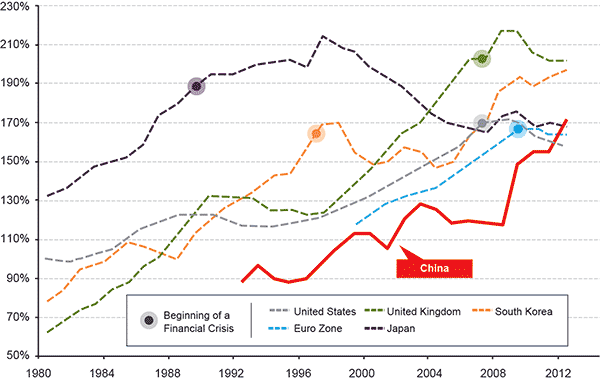
That China faces a number of serious economic (and potentially social) problems is no surprise and as Guggenheim’s Scott Minerd notes, trying to predict when persistent structural problems will lead to a shock for markets is extremely difficult (as we noted here). However, from a symbioticcollapse in the previously ‘virtuous’ bond-market-to-banking-system relationship, to the drying up of easy credit for all but the largest (and least over-capacity) firms, it appears that China’s private sector leverage has crossed the tipping point that signalled crises in the US, UK, Japan and South Korea. Although the recent data (believe it or not) show signs of a stabilization in the Chinese economy, the elevated debt burden should continue to cast doubt over its growth sustainability and the “childish” and non-transparent nature of China’s bond market offers little or no hope for a free market solution. Read more of this post

A police investigation into allegations of fraud by Shanghai’s largest insurance dealer has stirred the insurance market and created jitters over the possible loss of customers’ insurance contracts

08.16.2013 16:26

Probe Launched over Insurance Dealer for Sales Fraud

Shanghai Fanxin Insurance Agency Co. found by insurance regulator to have sold unauthorized fixed-income agreements

By staff reporter Wang Shenlu

1376642129204847

(Beijing) — A police investigation into allegations of fraud by Shanghai’s largest insurance dealer has stirred the insurance market and created jitters over the possible loss of customers’ insurance contracts. The Shanghai branch of the China Insurance Regulatory Commission said on August 15 that insurance sales agent Shanghai Fanxin Insurance Agency Co. was found selling unauthorized fixed-income financial agreements. Shanghai police have launched a formal investigation into the company’s alleged misconduct, said the regulator. Rumors have circulated in the market since August 14 that Chen Yi, general manager of Fanxin has fled to Canada with 500 million yuan. Caixin learned from a source close to the company that Chen is no longer the legal representative of the company and has left the country as the company is facing financial turmoil. Read more of this post

China’s Tencent Faces Obstacles Marketing WeChat Abroad; Provenance Could Put Off Users Who Fear Reach of Beijing’s Censors

August 16, 2013, 4:30 a.m. ET

China’s Tencent Faces Obstacles Marketing WeChat Abroad

Provenance Could Put Off Users Who Fear Reach of Beijing’s Censors

AARON BACK

BF-AF573_CHINAH_G_20130816180914

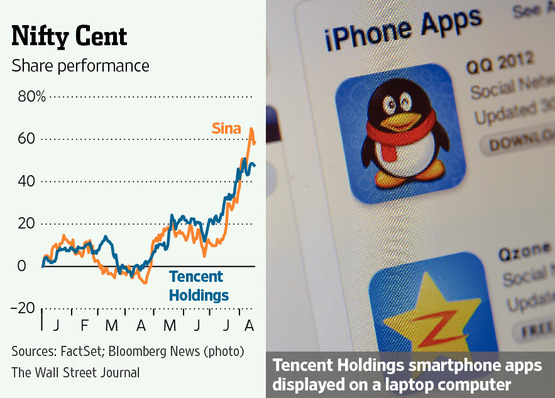
China’s Internet is a world unto itself, where foreign players are kept out by censors and a few large domestic companies wrestle for control. Now giant Tencent HoldingsTCEHY +0.86% is trying to expand abroad. Tencent plans to spend up to $200 million this year to advertise its mobile messaging service WeChat in emerging markets like Southeast Asia and Latin America. The company claims a total of 235.8 million monthly active users globally and says it already has more than 100 million registered users outside China, though it doesn’t disclose the number of active users overseas. Read more of this post

Web entrepreneurs are moving closer to duplicating the real-world feel of a mall, where shoppers can pop in and out of multiple stores, and browse with the advice of friends

August 16, 2013

Hanging Out at the E-Mall

By JENNA WORTHAM

Shopping online is easier than shopping in a mall — as long as you know exactly what you want to buy. The problem comes when you don’t know what you want. The Web has yet to duplicate the real-world feel of a mall, where shoppers can pop in and out of multiple stores, easily browsing racks of clothing, display cases of jewelry and shelves of housewares. And online, friends can’t join you in a dressing room to help you avoid buying fashion faux pas. But now, many entrepreneurs have their sights set on better replicating those experiences online, creating a category of e-commerce loosely known as social shopping. Venture capitalists are opening their pocketbooks for these new start-ups, and even some of the biggest players in e-commerce, like Amazon and eBay, have introduced their own social features. Read more of this post

Trying to Make Google Glass Fashionable; While people who own Google Glass love the glasses for their technological prowess, they feel incredibly self-conscious when wearing them in public

AUGUST 16, 2013, 4:34 PM

Trying to Make Google Glass Fashionable

By NICK BILTON

In the 2006 movie “The Devil Wears Prada,” with a high-end fashion magazine’s office as its backdrop, there’s a memorable scene when the character Miranda Priestly, played by Meryl Streep, is picking between two belts for a photo shoot that look almost identical. As she surveys them in her hand, her assistant, Andy Sachs, played by Anne Hathaway, starts to laugh quietly. Read more of this post

The world’s richest football league is embracing big data

The world’s richest football league is embracing big data

Aug 17th 2013 |From the print edition

WHEN Liverpool Football Club open the new season against Stoke on August 17th, it is not the 45,000 supporters at Anfield stadium who will be watching most closely. Nor will the band of armchair English Premier League (EPL) fans, spread across 800m homes in 212 countries, have the most detailed view of the game. The EPL has a new breed of observer: sophisticated data firms that meticulously track every movement, using statistics to discover the best way to win. Read more of this post