RFID company Savi Technology seeking to move beyond hardware into more complex software, data analytics; shift reflects the need for technology companies to continually reinvent themselves as their products mature

Newly independent, Savi pursues commercial work

By Marjorie Censer, Saturday, August 17, 10:21 AM

After cutting its teeth manufacturing special tags to track military equipment, Alexandria-based Savi Technology is moving beyond hardware and embracing data analytics, particularly hoping to attract more commercial work. The shift reflects the need for technology companies to continually reinvent themselves as their products mature. In Savi’s case, the 24-year-old company was one of the pioneers in selling radio-frequency identification, or RFID, tags to the military, which has relied on them to help manage supplies around the world. Read more of this post

Indian Markets Battered by Signs of End to Easy Money; Stocks Fall 4%, Rupee at New Low, as Investors Question Economic Prospects

Updated August 16, 2013, 7:19 p.m. ET

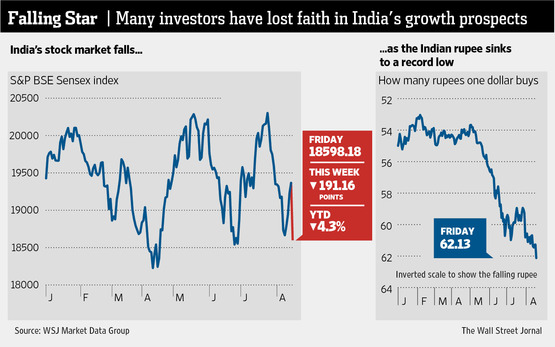
Indian Markets Battered by Signs of End to Easy Money

Stocks Fall 4%, Rupee at New Low, as Investors Question Economic Prospects

SHEFALI ANAND in Mumbai and PRABHA NATARAJAN in New York

BF-AF602_ISTOX_G_20130816183604

Indian shares fell sharply Friday as investors questioned whether the now-fragile economy of the world’s second most-populous country could withstand an end to global easy-money policies. The Bombay Stock Exchange’s S&P BSE Sensex index lost nearly 4%, its largest one-day drop in almost two years, while the Indian currency, the rupee, hit an all-time low against the U.S. dollar. Traders said an immediate trigger for the selloff was Thursday’s better-than-expected U.S. employment report—which was seen as raising the odds the U.S. Federal Reserve would more quickly tighten the monetary taps. Read more of this post

Reviving the Spirit of Independence Day in Indonesia

Reviving the Spirit of Independence Day

By Zakky Ramadhany on 11:55 am August 17, 2013.
The roads and alleyways of Cempaka Putih Barat, a North Jakarta neighborhood, are mainly deserted with most of its residents still spending Idul Fitri with their families in their hometowns. But by noon on Saturday — Independence Day — those who chose to stay will begin to flood the streets, carrying bamboo poles painted red and white. “The most important thing is to find solid bamboo suitable to be used as the flagpole, then paint the wood to make it look more beautiful. This is done to celebrate Independence Day,” said Nursaleh, a resident of the area, who is in charge of organizing the neighborhood’s Independence Day celebration every year. Read more of this post

Indonesia imitates India’s costly growth obsession

Indonesia imitates India’s costly growth obsession

Fri, Aug 16 2013

By Andy Mukherjee

SINGAPORE (Reuters Breakingviews) – Indonesia is failing to learn from India’s economic misery. That makes it a candidate for a disorderly decline in the currency, runaway inflation and financial instability. The country’s central bank, which has tightened monetary policy by just 75 basis points this year, left the benchmark interest rate unchanged at 6.5 percent in its August 15 meeting. It also asked banks to rein in credit if they don’t have adequate deposits. While the warning is welcome, it’s not a substitute for raising the price of money. Read more of this post

Layoffs Taboo, Japan Workers Are Sent to the Boredom Room; Facing a sluggish economy and increasing competition, Japan’s prime minister and major companies want to reduce longstanding restrictions on dismissing full-time workers

August 16, 2013

Layoffs Taboo, Japan Workers Are Sent to the Boredom Room

By HIROKO TABUCHI

TAGAJO, Japan — Shusaku Tani is employed at the Sony plant here, but he doesn’t really work. For more than two years, he has come to a small room, taken a seat and then passed the time reading newspapers, browsing the Web and poring over engineering textbooks from his college days. He files a report on his activities at the end of each day. Sony, Mr. Tani’s employer of 32 years, consigned him to this room because they can’t get rid of him. Sony had eliminated his position at the Sony Sendai Technology Center, which in better times produced magnetic tapes for videos and cassettes. But Mr. Tani, 51, refused to take an early retirement offer from Sony in late 2010 — his prerogative under Japanese labor law. So there he sits in what is called the “chasing-out room.” He spends his days there, with about 40 other holdouts. “I won’t leave,” Mr. Tani said. “Companies aren’t supposed to act this way. It’s inhumane.” Read more of this post

“Beer is for children, Vodka is for real men.” The world’s top brewers once bet big on Russia’s famous love of drinking, investing hundreds of millions of dollars there. But now the Kremlin’s campaign against alcoholism has sapped the life out of the party.

August 16, 2013, 8:28 p.m. ET

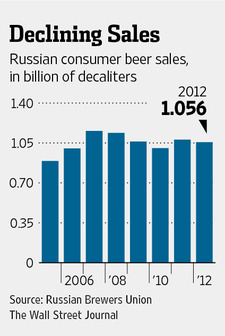
Russian Beer Fest Goes Flat for Brewers

Kremlin’s crackdown on alcoholism saps life out of the party

LUKAS I. ALPERT

BF-AF597_RUSBEE_NS_20130816180925

MOSCOW—The world’s top brewers once bet big on Russia’s famous love of drinking, pouring hundreds of millions of dollars into new plants and distribution networks as they sought to tap a growing taste for beer in a land where vodka long ruled. For years the investment paid off. But now the Kremlin’s campaign against alcoholism has sapped the life out of the party as a flood of new regulations and taxes aimed at turning around dismal life expectancy rates for men has made the beer market go flat, brewers say. Read more of this post

Metal bashing: Insinuations of market manipulation accelerate another upheaval in finance

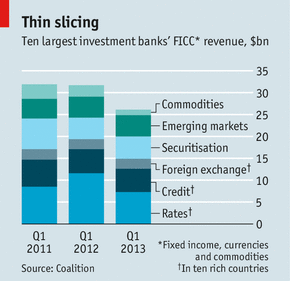
Metal bashing: Insinuations of market manipulation accelerate another upheaval in finance

Aug 17th 2013 | NEW YORK |From the print edition

20130817_FNC235

THE deepening relationship between America’s judicial system and its biggest banks has reached the world of metals. The Commodities Futures Trading Commission (CFTC) has reportedly issued subpoenas to Goldman Sachs, JPMorgan Chase and others as it investigates complaints that banks and other owners of metals warehouses have been hoarding metals and driving up prices. Private class-action suits filed in federal courts spanning New York, Michigan, Louisiana and Florida have made similar price-fixing allegations, which the banks vigorously deny. Read more of this post

Chief executive officers and chief financial officers in Singapore may soon be legally liable for their certifications that their companies’ financial statements are true and fair

Bosses may face legal liability for financial statements

Saturday, Aug 17, 2013

Michelle Quah

The Business Times

SINGAPORE – Chief executive officers and chief financial officers in Singapore may soon be legally liable for their certifications that their companies’ financial statements are true and fair. This possibility was touched upon by Minister of State for Finance and Transport Josephine Teo at the Public Accountants Conference on Wednesday. Mrs Teo, speaking to an 800-strong crowd of mostly practising accountants, said the profession’s regulator, the Accounting and Corporate Regulatory Authority (Acra), is exploring various approaches taken by other jurisdictions to further strengthen the quality of financial reporting – an issue of some concern here. Read more of this post

The west desperately needs more madcap schemes like the Hyperloop; Animal spirits built the the railways, highways and the Panama Canal

August 16, 2013 6:42 pm

The west desperately needs more madcap schemes like the Hyperloop

By Stian Westlake

Animal spirits built the the railways, highways and the Panama Canal, writes Stian Westlake

20130817_STP001_0

Silicon Valley product launches are a dime a dozen. But Monday’s announcement was something rather special. Elon Musk, founder of PayPal, Tesla and SpaceX, had promised the world he would publish thedesign for the Hyperloop, a revolutionary new form of transport – and it is hard not to love it. It’s fast. It’s solar-powered. And it’s a bargain: according to Mr Musk, it would cost 10 times less to build than the high-speed railways now beloved of the American and British governments. No wonder the world’s geeks and dreamers have been poring over the space-age sketches. Read more of this post

The FBI Manipulated Some Penny Stocks

15 Aug 2013 at 5:31 PM

The FBI Manipulated Some Penny Stocks

By Matt Levine

The SEC announced securities fraud charges against a fairly random assortment of South Florida crooks today and the message I took away from the assorted complaints is that it’d be a lot of fun to work in the South Florida office of the FBI. Basically the job seems to consist of setting up fake hedge funds and then using them to con people into giving you money, which is pretty much my dream job, and also the dream job of a lot of South Florida crooks I guess. Only in the FBI version the people you’re conning are themselves con men, and the money is illegal bribes, and then you arrest them, so it’s okay. Read more of this post

Price-to-Earnings Ratios Aren’t Always What They Seem; P/E Calculations Based on Differing Views of Earnings Paint Competing Pictures of the Market

BY MARK HULBERT

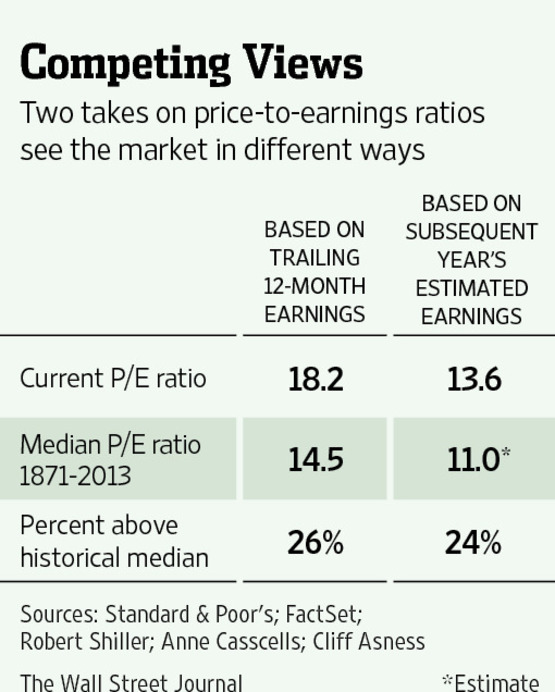
Price-to-Earnings Ratios Aren’t Always What They Seem

P/E Calculations Based on Differing Views of Earnings Paint Competing Pictures of the Market

MARK HULBERT

BF-AF571_HULBER_G_20130816143313

“The stock market is overvalued.” “The stock market is undervalued.”

Which one of these statements is true?

Both are, thanks to quirks of the most popular way of measuring a stock’s valuation: the price/earnings ratio.

While no one disagrees about what the “P” is when calculating the ratio, there is no consensus on how to define earnings-per-share. One of the biggest points of dispute: whether to use analysts’ earnings estimates for the coming year or reported company earnings from the previous 12 months. Comparing ratios calculated in these two ways is little better than comparing apples to oranges, according to Cliff Asness, managing partner at AQR Capital Management, an investment firm with $84 billion of assets under management. In an email, he went so far as to say that those who compare P/Es in this way are engaging in a “sleight of hand,” though he allowed that many may “not be aware of the mistake they are making.” Read more of this post

This Stunning Anecdote Shows Just How New The Concept Of A Bond Market Sell-Off Is To Everyone

This Stunning Anecdote Shows Just How New The Concept Of A Bond Market Sell-Off Is To Everyone

MATTHEW BOESLER AUG. 16, 2013, 12:40 PM 3,255 4

10-year-ust-yield

Business Insider/Matthew Boesler, data from Bloomberg

For the vast majority of the current crop of Wall Street traders, a bull market in bonds is really all there’s ever been. One has to go back more than 30 years – to the late 1970s and early 1980s – to find the last bear market in bonds. Yet things have changed in 2013. The consensus on Wall Street now expects the Federal Reserve to announce a tapering of the pace of monthly bond purchases it makes under its quantitative easing program at the September FOMC meeting. The mere thought of such a decision in the minds of traders and investors was enough to spark a violent sell-off in the Treasury market this summer – the yield on the 10-year note is up 118 basis points since May 2 alone at current levels near 2.8%. Now, the long bull market in bonds is widely perceived to have come to an end. “A remarkably low 3% of investors expect long-term bond yields to be lower in 12 months,” said BofA Merrill Lynch chief investment strategist Michael Hartnett of the bank’s August Global Fund Manager Survey. As Treasuries have declined in value this year, many bond investors have seen something they aren’t used to seeing: negative returns in their monthly statements. In fact, according to ConvergEx Group chief market strategist Nick Colas, there may be a lot of people out there who didn’t even know that was possible. I have had more than one high-net-worth broker tell me that his clients think the ‘Risk Free Rate’ means that you never see a mark down in the value of your Treasury portfolio,” says Colas. “They are only now discovering their error, and the realization is unwelcome.” The “risk-free rate” is a theoretical concept used in ubiquitous financial calculations like the capital asset pricing model to value securities. The “risk-free rate” in these models usually refers to the yield on U.S. Treasuries, where the rate of return (yield) is viewed as “riskless” because Treasuries don’t contain default risk. So, apparently there are investors out there who heard the term “risk-free rate” and assumed that an investment in Treasuries would never lose money. “Fixed income isn’t a one-way bet,” says Colas. “That fact spills over into everything from corporate capital allocation to equity market valuations. And it will take longer than to Labor Day to accommodate this new fact.”

Bonds Upended as AAA Yields Exceed AAs on Tapering

Bonds Upended as AAA Yields Exceed AAs on Tapering

Corporate bonds with AAA ratings are yielding more than debt graded a tier lower, a divergence that’s happened only twice in the past decade as investors sour on securities with the most to lose when interest rates rise.

The average yield of 2.86 percent for $34.2 billion of the highest-rated bonds in a Bank of America Merrill Lynch index on Aug. 13 was 0.27 percentage point more than the average for AA bonds. The last time that happened was in early 2009, when derivative traders roiled by the worst financial crisis since the Great Depression were treating then-AAA borrower General Electric Co. like junk. Read more of this post

The Long-Term Effects of Hedge Fund Activism

The Long-Term Effects of Hedge Fund Activism

Lucian A. Bebchuk Harvard Law School; National Bureau of Economic Research (NBER); European Corporate Governance Institute (ECGI)

Alon P. Brav Duke University – Fuqua School of Business

Wei Jiang Columbia Business School – Finance and Economics

July 9, 2013

Abstract: 
We test the empirical validity of a claim that has been playing a central role in debates on corporate governance – the claim that interventions by activist shareholders, and in particular activist hedge funds, have an adverse effect on the long-term interests of companies and their shareholders. While this “myopic activists” claim has been regularly invoked and has had considerable influence, its supporters have thus far failed to back it up with evidence. This paper presents a comprehensive empirical investigation of this claim and finds that it is not supported by the data.

We study the universe of about 2,000 interventions by activist hedge funds during the period 1994-2007, examining a long time window of five years following the intervention. We find no evidence that interventions are followed by declines in operating performance in the long term; to the contrary, activist interventions are followed by improved operating performance during the five-year period following these interventions. These improvements in long-term performance, we find, are present also when focusing on the two subsets of activist interventions that are most resisted and criticized – first, interventions that lower or constrain long-term investments by enhancing leverage, beefing up shareholder payouts, or reducing investments and, second, adversarial interventions employing hostile tactics.

We also find no evidence that the initial positive stock price spike accompanying activist interventions fails to appreciate their long-term costs and therefore tends to be followed by negative abnormal returns in the long term; the data is consistent with the initial spike reflecting correctly the intervention’s long-term consequences. Similarly, we find no evidence for pump-and-dump patterns in which the exit of an activist is followed by abnormal long-term negative returns. Finally, we find no evidence for concerns that activist interventions during the years preceding the financial crisis rendered companies more vulnerable and that the targeted companies therefore were more adversely affected by the crisis.

Our findings that the considered claims and concerns are not supported by the data have significant implications for ongoing policy debates on corporate governance, corporate law, and capital markets regulation. Policymakers and institutional investors should not accept the validity of the frequent assertions that activist interventions are costly to firms and their long-term shareholders in the long term; they should reject the use of such claims as a basis for limiting the rights and involvement of shareholders.