The west desperately needs more madcap schemes like the Hyperloop; Animal spirits built the the railways, highways and the Panama Canal
August 18, 2013 Leave a comment
August 16, 2013 6:42 pm
The west desperately needs more madcap schemes like the Hyperloop
By Stian Westlake
Animal spirits built the the railways, highways and the Panama Canal, writes Stian Westlake
Silicon Valley product launches are a dime a dozen. But Monday’s announcement was something rather special. Elon Musk, founder of PayPal, Tesla and SpaceX, had promised the world he would publish thedesign for the Hyperloop, a revolutionary new form of transport – and it is hard not to love it. It’s fast. It’s solar-powered. And it’s a bargain: according to Mr Musk, it would cost 10 times less to build than the high-speed railways now beloved of the American and British governments. No wonder the world’s geeks and dreamers have been poring over the space-age sketches.But there is a darker side to the hype. The excitement is an indicator of just how rarebig, ambitious, groundbreaking projects are. We hunger for schemes such as the Hyperloop because we live in an age where businesses and governments seem gripped by a lack of ambition and a wilful blindness to the future.
This is most visible when it comes to investment. Willingness to invest in the future is a powerful indicator of a business’s optimism – or of a country’s. By this measure, the US is in trouble: recent McKinsey Global Institute research suggests it is underinvesting in infrastructure to the tune of 1 percentage point of gross domestic product. The LSE Growth Commission, an independent panel of experts, said much the same about the UK; anyone regularly using Britain’s creaky, costly rail network will agree.
The business world is little better: corporate investment in both the US and the UK began falling well before the crisis of 2008, and has continued to drop, with companies piling up large cash balances at the expense of capital expenditure. Even in Silicon Valley, pioneers such as Mr Musk are the exception. For many entrepreneurs, innovation means a new app or a slightly slimmer phone.
Western states’ technological ambitions are contracting too. The US government once backed grand schemes to develop the technologies of the future. As the economist Mariana Mazzucato pointed out, the Defense Advanced Research Projects Agency bankrolled the creation of the internet and of the Global Positioning System. The Small Business Innovation Research programme gave tech giants such as Amgen and Qualcomm some of their earliest funding.
But in recent years, Darpa and SBIR have been criticised by everyone from Congress to Nature magazine for drawing back from big risks, and concentrating on opportunities that are closer to market. The UK government’s recent investment of £50m in Skylon, an inspiringly madcap reusable spaceplane, is a welcome exception but in the grand scheme of things this is a small sum. Even thinking about the future seems to be less popular: research by Ben Martin of the University of Sussex shows that the British government has been reducing its expenditure on technology foresight, just as China, Brazil and Singapore increase theirs.
This pessimism might be written off as good old Yankee pragmatism, or its British equivalent. But coolheadedness has only ever been one part of the Anglo-American psyche. It was animal spirits as much as pragmatism that built the first railways, the Panama Canal and the interstate highway system, and that brought first Britain and then the US to global dominance.
The opposition to grand designs runs deep in today’s intellectual culture. Indeed, a powerful theme of some of the most influential English-language best-sellers of recent years has been the limits of humans’ ability to plan. Writers such as Daniel Kahneman, Nicholas Nassim Taleb and Philip Tetlock have devoted themselves to explaining how poor we are at planning.
The implication of this argument is that politicians and managers should keep their options open and avoid making big commitments for the future, because they are very likely to be wrong. They should emulate Pandolfo Petrucci, the tyrant of Siena, who according to Machiavelli “conducted his government day by day, and his affairs hour by hour, because the times are more powerful than our brains”.
But making plans is not simply about prediction. The best investments do not anticipate the future: rather, they help shape it. Research by Tali Sharot, an economist at University College London, has shown that optimists are worse than pessimists at knowing what the future will hold, but they tend to be more successful anyhow, partly because they have the guts to try and partly because their can-do attitude carries others along. Anyway, imagination can be just as important as reasoned analysis. After all, it was science-fiction writers who first envisaged robots, satellites and cyber space.
This creates a problem for governments that cannot, or will not, think big. The modern state may be large, but its greatest power comes from moral suasion. A government of clerks and pessimists may look like good value for money, but it will not inspire. So getting things done requires more effort and often more expenditure: a point which America’s Tea Party and Britain’s TaxPayers’ Alliance would do well to note.
Political thinkers once knew this. Princes used to garner praise for the virtue of “magnanimity”. The word now means the propensity to overlook faults in another but it used to mean the ability to encompass and strive for lofty goals. The urbanist Jane Jacobs observed that being “magnificent” – literally, makers of great things – has been a characteristic of leaders throughout the ages, not because they love opulence but because they need to show the scope of their ambition to bring people along with them.
Who knows whether the Hyperloop really will deliver a cheaper, faster, greener means of transport? But perhaps it can accomplish something subtler but more important. If it can inspire businesses and governments to think more boldly about the future, to shed our fear of ambition and grandeur, it will be a tremendous breakthrough.
The writer is executive director of policy and research at Nesta, the UK’s foundation for innovation
The future of transport
No loopy idea
Elon Musk, electric-car entrepreneur and proponent of private colonies on Mars, now plans to redesign the railway
Aug 17th 2013 |From the print edition
HALF a century after they were pioneered in France and Japan, could high-speed trains be coming to America? Last year California’s legislators gave $7.7 billion to a project called California High Speed Rail (CHSR). If and when it is completed it will connect San Francisco to Los Angeles, with branch lines to Sacramento and San Diego. This first slice of what the budget suggests will eventually be a bill for $68 billion will be used to construct 210km (130 miles) of track between Fresno and Bakersfield. But just because the money has been allocated does not mean the line will actually get built. It is far from universally popular. Besides the estimated price (and even this is probably a shot in the dark, for big infrastructure projects are hardly known for coming in on budget), it may not even be that fast. The short distances between many of its stations mean trains will rarely be able to reach their planned top speed of 350kph.
Fortunately, California is home to many clever people. One of them is Elon Musk, the hyperactive boss of Tesla Motors, an electric-car company, and SpaceX, a rocketry business (he also sits on the board of Solar City, a solar-energy firm). There is nothing Mr Musk likes more than revolutionising high-tech industries. And he thinks he has come up with a better way to get California moving than a standard high-speed train. Mr Musk—who is as good at PR as he is at engineering—first mentioned his idea, called Hyperloop, last year, prompting excited speculation about what he might have had in mind.
Mr Musk’s atmospheric caper
On August 12th, in a short document published on the websites of Tesla and SpaceX, all was revealed. Essentially, Mr Musk proposes to revive an old science-fiction idea called the vac-train (short for “vacuum train”), albeit with a few important tweaks. The Hyperloop would carry passengers across California at more than 1,200kph—faster than a jet airliner—allowing them to zoom between San Francisco and Los Angeles in little over half an hour, compared with more than two-and-a-half hours for CHSR. It would be solar-powered, would take less land than a high-speed railway, and would be cheaper to boot. Mr Musk’s notional budget is around $6 billion, less than a tenth of what the high-speed train is supposed to cost.
Vac-trains, as first described in the 1910s by Robert Goddard (better known as a pioneer of rocketry), would send rolling stock (or hovering stock, perhaps) hurtling through hermetically sealed tubes from which the air has been evacuated. The trains would thus encounter no drag, and be able to reach immense speeds. Goddard reckoned his design—which also proposed magnetic levitation instead of wheels—was good for about 1,600kph.
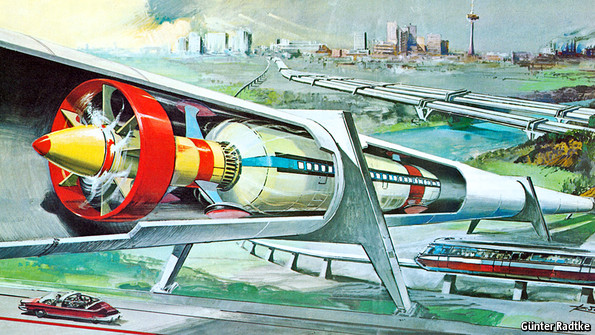
This and other designs for transporter tubes inspired much futuristic art, as the illustration above suggests. But none was ever built because maintaining a vacuum in a long tunnel is difficult. Pumps must work exponentially harder as the pressure falls, to evacuate the few air molecules that remain. And even a small leak would scupper a full-fledged vac-train, which relies on no air at all being able to build up in front of it, and thus slow it down. For that reason, the Hyperloop is not actually a true vac-train. Instead, Mr Musk plans to remove sufficient air from the tubes to give them a pressure roughly a sixth of that on the surface of his beloved Mars, or a thousandth of that on Earth at sea level. This would keep the air resistance low enough to deal with in other ways.
The chief of these would be to suck up the air that did accumulate in front of the tube’s rolling stock (putatively, individual pods that could hold 28 people each) using a fan, and then expel most of it from the pod’s rear end. Some of this air, though, would be diverted out of the sides through special skis, to create a cushion that would stop the pod touching the tunnel walls.
Each pod would be launched by a linear-induction motor (such motors are also being tested for use as catapults on aircraft carriers), and booster motors every 110km would keep its speed up. On reaching its destination, the pod would pass through a motor that worked in reverse, converting its kinetic energy back into electricity for storage in batteries or use in motors up the line. And, this being California, the whole thing would naturally be powered by solar panels mounted on the roof of the tube.
Loop the loop
That, at least, is the theory. There are doubters, of course. Some worry that passengers will not like the prospect of hurtling through a steel tube, in a cramped capsule, at almost the speed of sound. And there are inevitable questions about safety, though the pods would have wheels that could be deployed if needed, allowing them to limp to their destinations using batteries if the power failed. But, its breathtaking audacity aside, the thing does look feasible as an engineering project.
The tube would be held above ground, on pylons, reducing the amount of land it consumed, and would follow existing roads, which should simplify construction and make maintenance easier. The proposed route features only gentle curves. And the air cushion surrounding each pod should ensure that the ride is smooth. Moreover, although unexpected engineering problems would be bound to crop up, Mr Musk’s experience—and that of his engineers—with space flight and car design would bode well for overcoming them.
With projects like this, though, good engineering is never enough. Politics and economics are more forbidding obstacles. Being new, the Hyperloop is risky. Also, the CHSR has a tortuous history going back decades. Much political and reputational capital is invested in it. To replace it now with a completely different design would require an agility that California’s government is almost certainly incapable of. Nor is there any reason to believe that Hyperloop would be immune to the hypertrophication of cost that every other grand infrastructure project seems doomed to suffer. Building it alongside existing roads would certainly cheapen things as well as simplifying them, but critics who are poring over Mr Musk’s cost estimates, for everything from land permits to the construction itself, doubt the numbers stack up (though to be fair, both his electric cars and his space rockets have come in on budget). A few, presumably not Californian patriots, have even suggested that somewhere like Texas—where the bureaucracy is less stifling—might be a more feasible place to try the idea out.
Lastly, it is not clear just how serious Mr Musk really is. In the past he has said that, given his other commitments, he lacked the time to try to build the Hyperloop himself. The reason for putting it into the public domain was therefore to give someone else the chance to take it up. But it is hard to think of anyone else who has both his deep pockets and his technical track record. Or at least, that was the case before August 12th. In a conference call that day discussing the idea, he admitted that his thinking may be changing, at least a little. “I think it might help if I built a demonstration article,” he mused. “So I think I probably will do that, actually.”
 About bambooinnovator
 Bamboo Innovator