German Stocks Shift Toward Home; Market may be moving toward German stocks with strong domestic exposure
August 20, 2013 Leave a comment
August 18, 2013, 5:03 p.m. ET
German Stocks Shift Toward Home
Market may be moving toward German stocks with strong domestic exposure
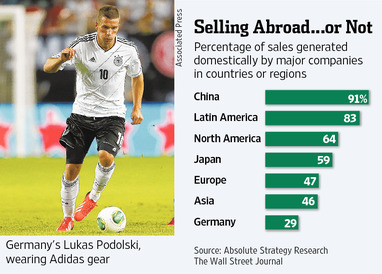
Germany may remain the powerhouse of the European economy, but you wouldn’t necessarily know it from looking at the share prices of its leading companies. Sure, the DAX 30, Germany’s benchmark stock index, is up 9.6% this year. But its rise lags other major indexes like the U.K.’s FTSE 100, France’s CAC 40 and the S&P 500 in the U.S. That is despite Germany’s relatively consistent economic performance. It grew by 0.7% quarter on quarter in the three months to June, faster than the European Union’s other major economies. The truth is that German companies aren’t all that German in one key respect. Like many leading European companies, Germany’s top firms, ranging from sportswear giant Adidas ADS.XE +0.40% to auto makers like Daimler, DAI.XE -0.36% are becoming ever more international. The country’s top 50 companies generate only around 29% of their sales domestically, according to analysts at Absolute Strategy Research. Companies in the FTSE 100 earn a similarly low level of revenue in the U.K. Top North American companies, by contrast, make 64% of their sales in their domestic market.German companies’ relative domestic exposure doesn’t seem to affect their share prices much. Around half of the DAX 30 companies break out their German sales in their geographical segmental reporting, based on a review by Heard on the Street. Those that outperformed the index make on average around a quarter of their sales in Germany—the same as those that underperformed it.
The DAX 30’s best performers in 2013 are those that are relatively more exposed to Asia, and less to Europe as a whole. On average, DAX 30 companies whose shares have outperformed the index make around 48% of their sales in Europe, and 21% in Asia. By contrast, underperformers make 63% of sales in Europe, and only 12% in Asia.
The question is whether investors will continue to favor those companies with an Eastern flavor.
The market still rewards German companies with a high exposure to Asia. Those companies making 20% or more of their sales in the region trade, on average, at 14.6 times 2014 expected earnings; companies less weighted toward Asia trade on an average multiple of 12.4 times. The analysis excludes Deutsche BankDBK.XE -1.05% and Allianz, ALV.XE -0.69% financial companies that can’t easily segment their revenue numbers geographically.
German companies that have done well in 2013 fit with the story of Asian economies, particularly China, becoming more driven by consumer spending. Skin-care companyBeiersdorf, BEI.XE -0.57% and auto-related stocks like Daimler and tire-makerContinental CON.XE +0.89% fit the pattern.
Still, the tide is starting to turn. In the last month, companies with still-significant European businesses have been among the DAX’s top performers. These stocks include the likes of Volkswagen, VOW.XE -0.11% ThyssenKrupp TKA.XE -3.12% andCommerzbank CBK.XE -0.92% .
Meanwhile, stocks of companies such as Adidas and Beiersdorf have slipped back into the ranks of the also-rans. That suggests building investor confidence in a European recovery, particularly after recently released economic data showed recession in the euro zone has ended.
If that proves to be the case, those German companies that have remained stuck in Europe may at last enjoy some investor love.
 About bambooinnovator
 Bamboo Innovator