Ship Travels Arctic From China to Europe; Northern Passage Shaves Two Weeks of Travel Time Off Journey
August 20, 2013 Leave a comment
Updated August 19, 2013, 8:12 p.m. ET
Ship Travels Arctic From China to Europe
Northern Passage Shaves Two Weeks of Travel Time Off Journey
COSTAS PARIS
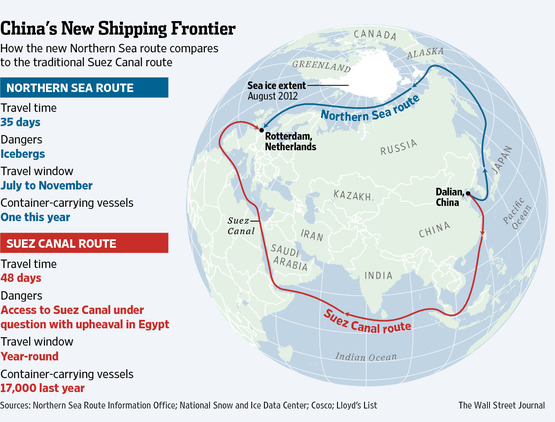
China’s Yong Sheng is an unremarkable ship that is about to make history. It is the first container-transporting vessel to sail to Europe from China through the arctic rather than taking the usual southerly route through the Suez Canal, shaving two weeks off the regular travel time in the process. The 19,000-ton Yong Sheng, operated by China’s state-controlled Cosco Group, left the port of Dalian Aug. 8 and is scheduled to reach Rotterdam, in the Netherlands, via the Bering Strait Sept. 11. The travel time of about 35 days compares with the average of 48 days it would normally take to journey through the Suez Canal and Mediterranean Sea.Chinese state media have described the approximately 3,400-mile Northern Sea Route, or NSR, as the “most economical solution” for China-Europe shipping. Cosco has said that Asian goods could be transported through the northern passage in significant volumes.
The NSR, at roughly 8,100 nautical miles, is about 2,400 nautical miles shorter than the Suez Canal for ships traveling the benchmark Shanghai-to-Rotterdam journey, according to the NSR Information Office.
“The arctic route can cut 12 to 15 days from traditional routes, so the maritime industry calls it the Golden Waterway,” Cosco said when the Yong Sheng’s voyage was announced earlier this year.
The Yong Sheng’s travel comes as shipping volumes on the arctic route are rising fast amid warmer weather, which has kept the passage relatively free of ice for longer than in recent decades.
The Russian-run NSR Administration has so far issued 393 permits this summer to use the waters above Siberia, compared with 46 last year and a mere four in 2010. The travel window usually opens in July and closes in late November when the ice concentration becomes prohibitive for sailing.
“Our best months are September and October, where there is barely any ice across the whole route,” said Sergey Balmasov, head of the NSR Information Office.
“We expect a substantial increase in permit applications if temperatures continue to rise in coming years,” he added. “But climate change could work both ways, so if temperatures come down the route will become impenetrable without ice-breaking escort ships.”
Mr. Balmasov said even ships without ice-breaking capabilities received permits as the weather became warmer. “This cuts the cost of operators as the seaway is free of ice and the voyage time significantly lower,” he said.
Arctic ice covered 860,000 square miles last year, off 53% from 1.8 million square miles in 1979, according to the National Snow and Ice Data Center of the U.S.
The rate of change has astounded the scientific community, said Mark Serreze, director of the Colorado-based center, which is funded through grants from groups including the National Aeronautics and Space Administration, the National Science Foundation and the National Oceanic and Atmospheric Administration.
“It’s warming very quickly in the arctic and I would not be surprised if we see summers with no ice at all over the next 20 years. That’s why shipping companies are so excited over the prospects of the route,” Mr. Serreze said.
“Over the past 50 years temperatures in the arctic have gone up by around four degrees Celsius, which is a dramatic increase,” he added. “This is much higher than the global average of around one degree.” A change of four degrees Celsius is equivalent to a change of 7.2 degrees in Fahrenheit.
The benchmark Asia-to-Europe shipping route accounts for 15% of total trade. Ships from China sail across the Bering Strait, through the East Siberian Sea and Vilkitsky Strait and then on to European ports.
China has made no secret of its interest in the new arctic passage. In May Beijing obtained “permanent observer” status at the Arctic Council, which consists of eight countries with territory in the region.
Shipowners recognize the potential of the route, but say it will take years to determine whether it will become commercially viable.
“We are looking into it but there are still many unknowns,” said a Greek shipowner whose vessels are chartered by a number of Chinese companies that trade with Europe. “The travel window is short and if ice forms unexpectedly your client will be left waiting and your cost will skyrocket to find an icebreaker. But if climate change continues to raise temperatures, the route will certainly become very busy.”
Lars Jensen, chief executive of Copenhagen-based SeaIntel Maritime Analysis, says owners are increasingly investing in bigger ships to cut transport costs but these larger vessels aren’t suited to sail in the arctic. Those ships burn on average 25% less fuel per container than older and smaller vessels using less-efficient engines. “Even though an arctic route is shorter, the fuel consumption per container on a much smaller vessel might simply not be attractive,” he said.
Lloyd’s List, a shipping-industry data provider, estimates that in 2021 about 15 million metric tons of cargo will be transported using the Arctic route. That will remain a small fraction of the volumes carried on the Suez Canal. More than 17,000 vessels carrying more than 900 million tons of cargo plied the canal route last year.
 About bambooinnovator
 Bamboo Innovator