U.S. program to curb stock price swings triggered frequently; The roll-out of a new program to limit wild price swings in publicly traded securities triggered dozens of trading halts as highly illiquid names were phased into the program

U.S. program to curb stock price swings triggered frequently

Mon, Aug 19 2013

NEW YORK (Reuters) – The roll-out of a new program to limit wild price swings in publicly traded securities triggered dozens of trading halts on Monday as highly illiquid names were phased into the program. By the session’s end, 48 exchange-traded products (ETPs) had been halted or paused on NYSE Arca, a unit of exchange operator NYSE Euronext, according to trading information provided by exchange operator Nasdaq OMX Group Inc. Seven other securities were halted on Nasdaq. Read more of this post
The Proxy Advisory Racket: Life’s easier when the feds encourage people to buy your product.

August 20, 2013, 7:12 p.m. ET

Review & Outlook: The Proxy Advisory Racket

Life’s easier when the feds encourage people to buy your product.

Federal regulators helped create the financial crisis by requiring banks to follow the advice of private credit-rating agencies. When these private firms like Standard & Poor’s and Moody’s guessed wrong about the mortgage market, the error was repeated across the financial system. Now one Washington regulator is warning that the government is making a similar mistake about another category of private firms. Read more of this post

Sovereign funds’ fortunes turn as emerging assets sour; “In private deals, agency issues become of the first order. Information is very poor. You can get screwed everywhere.”

Sovereign funds’ fortunes turn as emerging assets sour

2:01am EDT

By Natsuko Waki

LONDON (Reuters) – The world’s biggest sovereign wealth funds may see their bumper profits of 2012 diminish this year as recent diversification into high-growth emerging markets starts to produce disappointing returns. Their long-term horizon may allow many sovereign funds, which globally control $5 trillion of oil and other windfall assets, to weather losses. But the sheer size of these funds may increasingly limit the window of opportunities even when emerging markets recover. Read more of this post

Rising Markets Batter Short Sellers; Investors Betting Stocks Will Fall See Worst Losses in Decade

August 20, 2013, 9:24 p.m. ET

Rising Markets Batter Short Sellers

Investors Betting Stocks Will Fall See Worst Losses in Decade

JULIET CHUNG and  ROB BARRY

P1-BM802_SHORT_NS_20130820191204P1-BM803_SHORTj_G_20130820191504

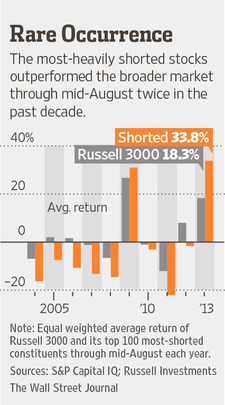
Short sellers are facing their worst losses in at least a decade, a Wall Street Journal analysis has found, as many of the rising stocks they bet against have only continued to soar. That has stung several high-profile hedge-fund managers, including William Ackman and David Einhorn, who have placed prominent short bets. In the Russell 3000 index, the 100 most heavily shorted stocks are sharply outperforming the average returns of stocks in the index, according to a Journal analysis of data provided by S&P Capital IQ. The shorted stocks are up by an average of 33.8% through Aug. 16, versus 18.3% for all stocks in the index. Read more of this post

Ripping Off Young America: The College-Loan Scandal

Ripping Off Young America: The College-Loan Scandal

The federal government has made it easier than ever to borrow money for higher education – saddling a generation with crushing debts and inflating a bubble that could bring down the economy

by MATT TAIBBI

AUGUST 15, 2013

20130814-nat-aff-306x-1376517780

On May 31st, president Barack Obama strolled into the bright sunlight of the Rose Garden, covered from head to toe in the slime and ooze of the Benghazi and IRS scandals. In a Karl Rove-ian masterstroke, he simply pretended they weren’t there and changed the subject. The topic? Student loans. Unless Congress took action soon, he warned, the relatively low 3.4 percent interest rates on key federal student loans would double. Obama knew the Republicans would make a scene over extending the subsidized loan program, and that he could corner them into looking like obstructionist meanies out to snatch the lollipop of higher education from America’s youth. “We cannot price the middle class or folks who are willing to work hard to get into the middle class,” he said sternly, “out of a college education.” Read more of this post

Medical Marijuana Spawning Pump-and-Dump Scams: Finra

Medical Marijuana Spawning Pump-and-Dump Scams: Finra

Con artists are taking advantage of the legalization of medical marijuana to lure investors into buying stock in weed-related companies, regulators said.

The scammers may be promoting the shares, then selling them to gullible investors in what’s called a “pump-and-dump” scheme, the Financial Industry Regulatory Authority said today in an e-mailed statement. The companies are touting their growth potential as more states allow pot for medical or recreational use, Wall Street’s self-funded regulator said.

“We’ve seen a rise over the last couple of months in marijuana-related potential stock scams,” Gerri Walsh, Finra’s senior vice president for investor education, said in a phone interview. “We often see with these stock-fraud scams that the next big thing, the cons tend to circle around.” Read more of this post

Italian business: No way back; Time is being called on the cross-shareholdings that have bound the top companies together

August 20, 2013 7:06 pm

Italian business: No way back

By Rachel Sanderson

Time is being called on the cross-shareholdings that have bound the top companies together

Cuccia

A finger in every pie: Enrico Cuccia, the founder of Mediobanca, who built the cross-holdings that linked Italian business

Over six decades, Cesare Geronzi ascended to the summit of Italian finance. Every step of the way, he took three scarlet chairs with him. They were in his antechamber when he was chairman of Capitalia, the Roman bank. They graced his waiting room at Mediobanca, the Milanese investment bank where, despite two fraud convictions, he became president. When he manoeuvred his way to the presidency of Generali, Italy’s largest financial group, the chairs sat in an office where Mr Geronzi’s windows opened on to a much-envied view of the Colosseum. Read more of this post

‘Work until I die’: Why older Americans are refusing to retire and how it’s changing the face of labour

‘Work until I die’: Why older Americans are refusing to retire and how it’s changing the face of labour

Tom Moroney, Bloomberg News | 13/08/20 | Last Updated: 13/08/20 2:44 PM ET
He’s on County Road 1680 moving like a black-tailed jackrabbit under the big-bowl Oklahoma sky, a tiny dot in his Ford Ranger out on the edge of the world when the flying red stinger ants show up.

One, two, now three, they invade. Jim Ed Bull swats with a big hand. “They can hurt ya bad,” he says. Read more of this post

BRIC: Is the fastest period of emerging-market growth behind us? Emerging Markets: A Contrarian Special?

BRIC: Is the fastest period of emerging-market growth behind us?

Defending the motion

Ruchir Sharma, Head of emerging markets and global macro at Morgan Stanley Investment Management

It is rare for emerging nations to sustain growth faster than 5% for even one decade, much less two or three, and only six countries have grown that fast for as long as four decades in a row.

Against the motion

Kishore Mahbubani, Dean and Professor, Lee Kuan Yew School of Public Policy, National University of Singapore

In 2013, China’s economy will grow by 7.8%, India’s by 5.6% and Brazil’s by 2.5%. In response, Western media headlines have begun screaming that the emerging-market story is over. Oh dear, here comes Western wishful thinking again.

The moderator’s opening remarks

Aug 20th 2013 | Ryan Avent

Since the early 2000s emerging markets have powered global economic growth. Emerging economies grew faster than the rich world, and from 2003 to 2011 they raised their share of global output by a percentage point each year. As a result, emerging markets now account for more of the world’s GDP than advanced economies. Yet as The Economist recently noted, a “great deceleration” seems to be under way. The Chinese and Indian economies have slowed dramatically from double-digit growth rates prior to the financial crisis; the IMF expects China to grow by just 7.8% this year and India by 5.6%. Most other large emerging economies are also slowing sharply. Read more of this post

CREDIT SUISSE: The End Of Zero Interest Rates May Create A ‘Huge Financial Disruption Akin To The End Of A War’

CREDIT SUISSE: The End Of Zero Interest Rates May Create A ‘Huge Financial Disruption Akin To The End Of A War’

ASHLEY KINDERGANTHE FINANCIALIST AUG. 19, 2013, 5:56 PM 8,665 8

It wasn’t so long ago that the challenge of making money with interest rates stuck around zero was investors’ top concern. Those days are gone. Today, they’re worried about the opposite: the threat that now-rising rates pose for fixed income investments. That, and the downturn in emerging markets that many only recently embraced in the hunt for yield caused by those near-zero rates.

It’s easy to identify the date that things changed: May 22, the day that the Federal Reserve first alerted markets that it might soon start “tapering” the $85 billion in monthly asset purchases it has been making since December to juice the economy. And soon looks to be getting even sooner. A steady improvement in U.S. employment figures—unemployment fell from 7.6 percent in June to 7.4 percent in July—has brought into focus the 6.5 percent unemployment target the Fed set as a prerequisite for raising short-term interest rates. On Thursday, the U.S. Bureau of Labor Statistics released yet another piece of good news on the employment front: New applications for unemployment benefits sank to their lowest levels in six years in July. Read more of this post

EM storms could spread to Europe; Periphery eurozone bond markets could be next in line for sell-off

August 20, 2013 2:17 pm

EM storms could spread to Europe

By Ralph Atkins in London

Periphery eurozone bond markets could be next in line for sell-off

At the start of this year, emerging market turmoil was on few investors’ worry lists. Top preoccupations were US fiscal woes, the rumbling eurozone debt crisis and a possible “hard” landing for China’s economy. Nobody really considered what would happen if all those threats did not materialise. The financial storms hitting India and other developing economies this week are the answer. Read more of this post

What indebted politically-connected business elites have so far ignored is that their obligations carry with them a significant and pressing danger: currency risk

August 20, 2013

A Global Boom Is Facing the End of Easy Lending

By LANDON THOMAS Jr.

In a city where skyscrapers sprout like weeds, none grew as high as the Sapphire tower in Istanbul.

Today, it stands as a symbol of how far the mighty may fall. Like a vast majority of new buildings that have blanketed the Istanbul hills in recent years, the Sapphire — at 856 feet it is the tallest in Turkey and among the loftiest in Europe — was built on the back of cheap loans, in dollars, that have flooded Turkey and other fast-growing markets like Brazil, India and South Korea. The money began to flow when the Federal Reserve and other major central banks cut interest rates to the bone in 2009 and cranked up the printing presses in a bid to spur recovery in the United States and other advanced industrial nations. But now, with expectations mounting that the Federal Reserve, led by its departing chairman Ben S. Bernanke, may soon begin to tighten its monetary spigot, Istanbul’s skyline could well be a harbinger of an emerging-market bust brought on by unpaid loans, weakening currencies, and, eventually, the possible failure of developers and banks.

Read more of this post

Erdogan’s Witch Hunt Endangers Turkish Economy

08/20/2013 06:10 PM

Erdogan’s Witch Hunt Endangers Economy

By Özlem Gezer and Maximilian Popp

Turkish Prime Minister Recep Erdogan has begun scouring the financial industry for scapegoats to blame for the political unrest in his country. Banks and industrialists are being controlled and intimidated, and foreign investors are being scared off.

Long after sunset, the day’s heat lingers in the urban canyons of Istanbul’s Levent financial district. Beneath billboards depicting lingerie models, black sedans crawl, bumper-to-bumper, along Büyükdere Caddesi, a four-lane highway. In a café some distance from the office towers, Umut Keles, a Turkish analyst with an American investment bank, removes the battery from his mobile phone, afraid of being wiretapped by the Turkish government. He is speaking with us under two conditions: That we not use his real name or that of his employer. The investment banker believes that the government would take action against him if it knew his identity. “There’s a witch hunt underway here at the moment,” he says. Read more of this post