Leveraged ETFs, the Flash Crash, and 1987
August 22, 2013 Leave a comment
Aug 20, 2013
Leveraged ETFs, the Flash Crash, and 1987
By Paul Vigna
Okay, this is going to be a wonky post. But it brings together a high-risk investing strategy, the flash crash, and the Crash of 1987, and shows how little-known corners of the investing world can still have a big market impact.
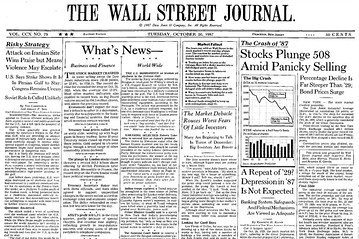
You could be forgiven if you’ve never heard of leveraged ETFs. But this smallish corner of the investing universe could, under the right circumstances, do to the market what portfolio insurance did to the market in 1987: that is, force a liquidation that sparks a big selloff.At least, that’s the suggestion of a new paper from the Federal Reserve Board, written by staffer Tugkan Tuzun. He likens leveraged ETFs to the portfolio insurance schemes of the 1980s, which are believed to have either contributed to or even caused the great crash of October 1987, when the Dow Jones Industrial Average dropped 22% in one day.
Portfolio insurance was a popular hedging strategy in the ’80s that used options, and “synthetic options,” to protect against losses. But it involved a daily rebalancing that, in October 1987, led to a “cascade” of sell orders that exacerbated what happened on Oct. 19, 1987.
That kind of one-day drop would be much harder to produce today, given the circuit breakers that were installed specifically in response to the ’87 crash. But the point of the Fed paper is that leveraged ETFs could, under the right conditions, produce a similar cascade of sell orders, amplifying the severity of any market drop.
Leveraged ETFs date back only to 2006, and have only about $20 billion in total assets. The key here, though, is what’s called rebalancing, which these funds typically do on a daily basis. Because these funds promise a certain multiple over the underlying exchange it’s tracking, the funds use derivatives and borrowed money to amplify their returns. Also, to maintain those returns, the fund managers must buy when the market is going up, and sell when it’s going down.
That’s where the 1987 connection comes in. What is generally believed to have happened in 1987 – it is still a debated subject – was that once the selling started, the portfolio insurance strategies demanded investors sell, resulting in a massive wave of sell orders.
Leveraged ETFs could bring about the same dynamic, Tuzun writes. Imagine a situation where the market is selling off. “LETF rebalancing in response to a large market move could amplify the move and force them to further rebalance, which may trigger a ‘cascade’ reaction.” If the fund is using swaps, counterparties are likely hedging their positions in equities or futures markets. Thus, a forced selloff of leveraged ETFs could, through derivatives and counterparties, wind up moving the cash stock markets.
Moreover, because most of this daily rebalancing occurs in the last hour or so of trading, a cascade of selling could amplify late volatility and drive indexes down near the close, leading to “disproportionate” price changes.
“A significant price reduction at market close may also impair investor confidence. If the market closes with depressed prices, the stock market could experience large investor outflows overnight.”
The May 2010 “flash crash,” Tuzun points out, was sparked by a sell order of 75,000 E-Mini S&P 500 Futures, totaling $4.1 billion. That was only 3% of the total daily trading volume for that contract. “With a large market move, such as 4%, the total rebalancing flows of LETFs would be equivalent to this flash-crash order,” he writes.
“Although the LETFs are not as large as portfolio insurance strategies of the 1980s in terms of size and impact, daily LETF rebalancing leaves its imprint on all stock categories.”
 About bambooinnovator
 Bamboo Innovator