Asset-management companies in China: Lipstick on a pig; China is still dealing with the mess left by previous bank bail-outs
August 23, 2013 Leave a comment
Asset-management companies in China: Lipstick on a pig; China is still dealing with the mess left by previous bank bail-outs
Aug 24th 2013 | SHANGHAI |From the print edition
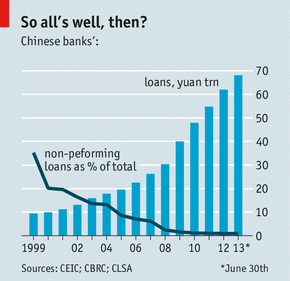
NEWS surfaced this week that Cinda, an asset-management company (AMC) created during China’s last round of banking bail-outs, is talking to bankers about a stockmarket flotation. That raises an intriguing question: how would the Chinese government handle its next banking crisis? If experience is a guide, it will be through a combination of enormous injections of public money, the creation of complicated structures and the obfuscation of data.In the 1990s the government shut down many inefficient state-owned enterprises (SOEs). That forced banks to acknowledge loans to those entities as duds. Non-performing loan (NPL) ratios soared, so officials engineered an elaborate bail-out. Central Huijin, an SOE capitalised by the central bank and finance ministry, put money into the banks. On one estimate, these equity infusions topped $150 billion.
NPLs were hived off into four new AMCs: Huarong, China Orient, China Great Wall and Cinda. From 1999 to 2004 loans worth over 2 trillion yuan ($242 billion) were transferred. Though mostly bad, the loans were usually sold at full face value. They were paid for with ten-year bonds, backed by the finance ministry, that the AMCs issued to the big state-owned banks. But since most NPLs failed to recover in that time, these bonds were extended another decade. In short, the bail-out is still going on.
What the AMCs have done with their assets is unclear, as they have not released proper accounts. Some NPLs have been sold but reportedly at only 20% of face value. To deal with the resulting cash crunch, Cinda sold bonds to the finance ministry. Anne Stevenson-Yang of J Capital, a research firm, observes that these bonds have since been wiped clean from its balance-sheet without any explanation for where they went: “The AMCs seem to be virtual holding-tanks where the debt doesn’t stay and doesn’t depart either.” Some think they may be insolvent.
That hasn’t stopped the AMCs expanding into other areas. They have gobbled up small banks and expanded into fund management, broking, commodities trading and insurance. Cynics speculate that all this has been done to give an illusion of rounded prosperity, perhaps as a prelude to a wave of public offerings.
In preparation for Cinda’s flotation on the Hong Kong exchange, the government poured 15 billion yuan into the firm in 2010 as it became a joint-stock company. Another 10 billion yuan was invested in it last year by strategic investors (including Standard Chartered, UBS and Citic Capital, a private-equity firm). Huarong is also rumoured to be seeking strategic investors, ahead of a possible listing next year.
Why now? With loans soaring and bad debts likely to follow suit (see chart), Chinese officials realise that the next banking crisis may be near. They may well be hoping to lure in fresh investors, to draw a line under previous bail-outs and raise capital for new ones. Huarong and Cinda now claim to make profits, but given their murky accounts, that is hard to verify. A headline in the South China Morning Post sounded this warning: “China’s insolvent toxic-waste dump Cinda for sale”.
 About bambooinnovator
 Bamboo Innovator