Translating Cookpad, Japan’s top cooking and recipe-sharing site with 20 million users, including 80-90% of all Jap women in their 20s and 30s, and more than 1.5 million registered recipes
August 23, 2013 Leave a comment
Translating Japan’s top cooking site
BY MAKIKO ITOH
AUG 22, 2013
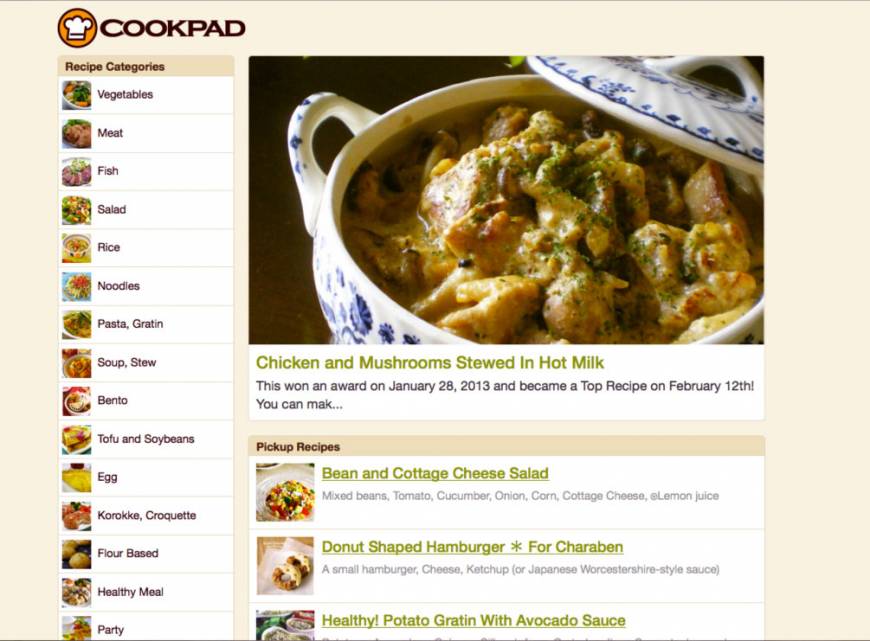
The Internet isn’t all kitten videos and saucy stuff, you know. In Japan, food and cooking makes up a large part of the Net — and recipe-sharing site Cookpad is its biggest juggernaut. With 20 million users — including an astonishing 80 to 90 percent of all Japanese women in their 20s and 30s — and more than 1.5 million registered recipes, it’s the go-to source for Japanese home cooks. Earlier this month it launched an English-language website (en.cookpad.com), a pared-down version with around 1,600 recipes initially translated from the mother site; this number is promised to grow to at least 30,000. I’ve been involved in working on several of the translations myself.While the site’s primary objective, according to project and product manager Jun Kaneko, is to share Japanese recipes with the world, I think the people who will get the most out of the site are English-speakers living in Japan who want to cook at home using local ingredients and methods. Almost all the recipes on Cookpad are contributed by regular people, not cooking professionals.
The recipes are selected for translation by Cookpad based on their popularity on the Japanese site, giving you a glimpse into the surprisingly wide variety of cuisine types and cooking methods that are popular in the Japanese home kitchens of today.
Once we get a recipe to translate, we generally try to describe ingredients and methods as accurately as possible; so for instance, the brown sauce that is often described as Worcestershire (or “wooster”) sauce in Japan (and usually known simply as “sauce”) is transcribed as “Japanese Worcestershire-style sauce,” since it’s quite different from the original English variety.
We try to describe unfamiliar ingredients as much as possible too, such as the difference between tarako (salt-cured cod roe) and mentaiko (salt-cured spicy cod roe). And although it’s not required to understand the recipes, we try to convey the buoyant tone of the original text, including the cute emoticons and musical punctuations that pepper the directions and personal notes such as “My son hates mushrooms but he gobbled them up in this recipe! Yay!”
To take full advantage of Cookpad, you may want to stock your kitchen accordingly. Standard Japanese ingredients such as soy sauce, sake, mirin, miso and instant dashi stock powder are a must of course, but so are mayonnaise (used as a cooking condiment), curry powder, ketchup, the aforementioned “sauce,” mentsuyu (noodle-sauce concentrate), oyster sauce, olive oil, gochujang (Korean hot-pepper paste) and doubanjiang (Sichuan hot-bean paste).
Meat portions are small, around 50 to 80 grams or less. Most meat recipes call for very thin slices (usugiri); blocks of meat are rarely used. Ground meat means pork, mixed pork and beef or chicken. White chicken breast meat is less desirable and cheaper than dark thigh meat.
Pre-cut fish filets are almost always used over whole fish to save time, but shrimp are always bought with their shells on. Typical Japanese fish-paste products such as chikuwa, imitation crab sticks, kamaboko and pink fish sausage are staples too, as are small pork wiener sausages. Tofu is very popular because it’s so cheap, as are bean sprouts — it’s taken for granted that readers will have one or the other on hand at all times.
Chances are your neighbors are clicking through Cookpad looking for inspiration for tonight’s dinner. Now you can click along in English.
Makiko Itoh is the author of “The Just Bento Cookbook” (Kodansha USA). She writes about bentō lunches atwww.justbento.com and about Japanese cooking and more at www.justhungry.com.
 About bambooinnovator
 Bamboo Innovator