ESPN President: Wage Stagnation, Not Technology, Is the Biggest Threat to the TV Business
August 24, 2013 Leave a comment
ESPN President: Wage Stagnation, Not Technology, Is the Biggest Threat to the TV Business
By Derek Thompson
BRISTOL, CONN. – When John Skipper, the president of ESPN, wants to worry about the future of the most valuable media company in the world — not just think anxiously, but actively worry — he doesn’t focus on Google trying to buy exclusive rights to the NFL. He doesn’t think about Apple going head-to-head with the cable companies. He doesn’t think about CBS, or NBC, or FS1. If there’s any acronym that truly scares him, it’s CBO.Yep. John Skipper thinks about income distribution tables.
The statistic that frightens him the most, he told a group of reporters in Bristol yesterday (which he also told me in a previous interview), is that the bottom 20 percent of American households still makes less than $15,000. And the poorest households are seeing the slowest wage growth in the country.
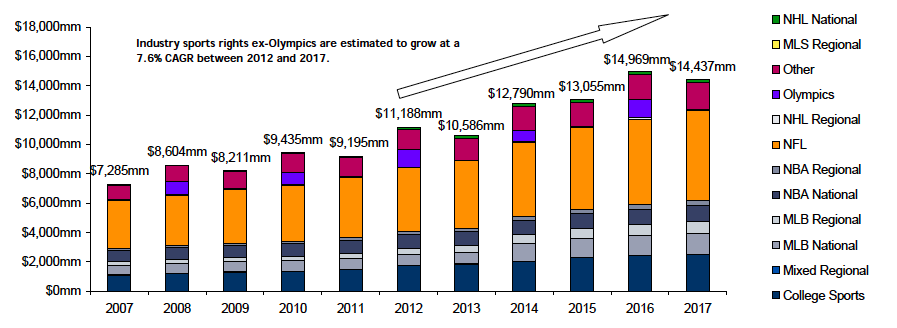
That’s a problem, because ESPN and other networks are selling a mass product, the cable bundle, whose price has tripled in the last decade and a half. And the number-one driver of rising cable costs today are the sports rights that make ESPN so valuable. The cost of exclusive rights to show sports are growing about 7% annually through the rest of the decade, 4X faster than private sector compensation growth (graph below via RBC/click to expand):
The cable bundle is under assault from technology and viewer habits. Mobile phones and tablets are stealing screen time. Tech biggies like Google and Apple are making a play to put all your channels online, where consumers could potentially watch and buy a la carte, as Quartz reports. Meanwhile, Netflix, Hulu, and the the Web offer so many hours of video entertainment (much of it financed by the cable bundle) that many young people have chucked the whole bundle altogether.
But Skipper is persuaded that if more Americans were simply making a little more money, there would be no fraught discussion about cord-cutters and cable-nevers. “The real issue is economics,” he said. “Most of the cord-cutting has been financial.” Not only does the bottom quintile make less than 15,000 a year, as Skipper often points out, but also about a third of households make less than $30,000 in after-tax income, according to the Tax Policy Center‘s distributional analysis.
“ESPN is a mass product,” he said. Wage stagnation threatens to make it a luxury product.
Cable: So Cheap, Yet So Expensive
Skipper’s acknowledgement that macroeconomics is intruding on entertainment economics is so fascinating, because the most common thing you hear from a TV exec is that their product is super-affordable.
On a per-hour-watched-per-person basis, cable TV costs less than $0.30 — 30X cheaper than buying a two-hour movie for $10. When they’re feeling bullish and defensive, the cable guys make a point best summed up by this graph below. Wage growth might be plateauing, but that plateau still sits miles above annual cable costs.
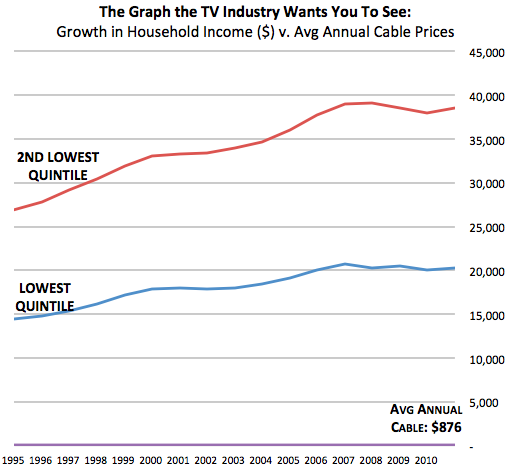
But $876 a year isn’t nothing. And most American families don’t make financial decisions by calculating per-hour per-person experience costs. They answer an easier question: Is this familiar number, my cable bill, eating into my disposable income?
The answer is yes. Here’s the growth in TV costs vs. the growth in bottom 40 percent household income over the same time period as the graph above.

That’s the picture that keeps John Skipper up at night.
The Near Future of TV
These are both boom years and nervous times for the richest media companies in America. Apple is meeting with ESPN and Viacom about putting sports on Apple TV, as Quartz reported today. Google is looking to steal the NFL from DirecTV. Essentially, everybody is having the same realization: Pay-TV, old-fashioned and fraught as it appears, could be the best business in America. One hundred million families pay at least $800 every year to the cable and media companies in exchange for a bundle of entertainment. This amounts to an $80 billion flat tax to fund the creation and transport of high-quality TV, and it’s unquestionably contributed to a Golden Age that a la carte programming would struggle to uphold.
“A la carte is not a good solution for whatever the issue is here, and it’s not particularly beneficial to anybody,” Skipper said. Although he said he thought ESPN could still thrive because its fan base is large and rabid enough to pay through the nose for the worldwide leader, smaller niche channels (even those with great critical renown) might not fare so well if left to fend for themselves without the bundle’s security. “We will be fine,” he said. “I think Showtime and HBO would be fine. But channels 65 through 250 would go out of business, or they will start producing lousy content. Niche households wouldn’t get what they want.”
Skipper’s business anxiety might be macroeconomic in nature, but his media philosophy is fundamentally conservative. He doesn’t think much is going to change in the near future.
“Leagues [like the NFL] love to float the possibility that they’ll sell to a digital provider but they never have and they won’t in the near future,” he claimed. The Internet is an supplement to television, but as YouTube’s new (severely under-watched) channels demonstrate, it’s not a substitute for great video entertainment. At the same time, he said he didn’t expect the cost of sports rights to level off, comparing the special quality of live sports (which are exclusive in a way news cannot be) to a beach-side property or a Cezanne painting that gets more expensive every decade, no matter what.
But that’s just the problem: ESPN is the most massive of all mass entertainment products in America, aimed right at middle-class families sitting in the nose-bleed sections. Sports should be more like a stadium than a beach-side property. But if the economics don’t change for another decade, cable will be for the people in the luxury boxes, not the bleachers.
And that’s why John Skipper has to think like a businessman and worry like an economist.
 About bambooinnovator
 Bamboo Innovator