China graft crackdown hits Hong Kong’s “Dried Seafood Street”

China graft crackdown hits Hong Kong’s “Dried Seafood Street”

POSTED: 25 Aug 2013 12:43 PM
In a narrow Hong Kong street filled with the tang of dried sea creatures, shopkeepers are blaming China’s recent corruption crackdown for falling sales of expensive banquet foods such as shark fin and abalone. HONG KONG: In a narrow Hong Kong street filled with the tang of dried sea creatures, shopkeepers are blaming China’s recent corruption crackdown for falling sales of expensive banquet foods such as shark fin and abalone. Such items have fallen off the menu since China’s new leadership came to power demanding austerity from Communist Party and military officials as a means of reigning in graft and dampening public anger over corruption. Read more of this post

9 out of top 10 Korean conglomerates’ market capitalization tumble down

9 out of top 10 conglomerates’ market capitalization tumble down

2013.08.25

South Korea’s 10 biggest family-owned conglomerates saw their stock market capitalization plummet this year, with the sole exception of SK Group. The combined market capitalization of the conglomerates’ 90 listed subsidiaries came to 630.9 trillion won ($567 billion) as of Friday, the latest trading day, said the Korea Exchange (KRX) and local financial data provider FnGuide Sunday. This is 9.4 percent, or 65.6 trillion won, down from 696.5 trillion won early this year. During the same period, the benchmark KOSPI retreated 7.9 percent. Of the top 10 conglomerates, Samsung Group suffered the largest market capitalization loss worth 46 trillion won, or 14.1 percent, followed by LG Group (6.6 trillion won), GS Group (2.9 trillion won), and Lotte Group (2.8 trillion won). Samsung Electronics’ share prices tumbled down, accounting for the biggest of proportion of Samsung Group’s market value loss. The market capitalization of Samsung Electronics declined 17.8 percent, or 41.4 trillion won, from 232.1 trillion won early this year to 190.8 trillion won as of now. LG Group’s market value fell, driven by LG Chem’s loss of 4.3 trillion won and that of LG Household & Health Care worth 2.3 trillion won. GS Group was mainly hurt by GS E&C, as the construction subsidiary has won contracts with lower profitability and remained in red ink for a prolonged period, and as a result its market capitalization tumbled down 47.2 percent, or 1.4 trillion won. SK Group was the single conglomerate whose market value increased. Most of the group’s subsidiaries fared poorly in the stock market, yet the market value of SK Telecom jumped 38.2 percent, or 4.6 trillion won, from that of early this year, contributing to a modest increase in market capitalization at a group-wide level.

Outdoor brands target ‘glampers’ in Korea

2013-08-25 18:50

Outdoor brands target ‘glampers’

By Rachel Lee

The country’s market for outdoor sporting goods has become ever more diversified and competitive as it has grown over the last few years. As more people enjoy “naports” and “glamping,” fashion and lifestyle companies are striving to attract those outdoor and leisure enthusiasts by launching new products that are made with unusual materials. The naports, a combination of night and sports, refers to a group of people who play sports at night after work due to their tight schedules. Glamping, in which glamor meets camping, straddles two worlds: the rough outdoors and the keep-your-hands-clean comfort of home. “People who go glamping like me use canvas tents and a real bed instead of a bedroll,” said Kim Jung-hyun, a 32-year-old office worker. Kim goes glamping with his friends twice a month. “I think the glamping group cares more about the quality of the vacation while getting the most from the outdoor experience.” Read more of this post

The Strike That Rattled Singapore: A WSJ Investigation

August 26, 2013, 8:00 AM

The Strike That Rattled Singapore: A WSJ Investigation

Top of Form

By Chun Han Wong

singstrike_GINI_NSsingstrike_foreign_NS

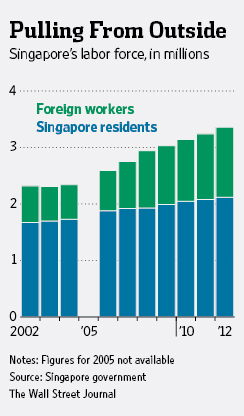
This story of a strike by Chinese bus drivers in Singapore offers a close-up look at a major issue facing the Southeast Asian city-state today: The growing number of migrant workers who underpin Singapore’s economy and the social tensions that their presence can generate. What happened over two days in late November 2012 rattled the foundations of Singapore’s economic success – its business-friendly governance and industrial harmony – and prompted a robust response from the government. The strike, a rarity in Singapore, resonated across Asia, where other countries are grappling with a growing dependence on foreign labor, too. And it provided a window into ordinary lives seldom-seen: the migrants who fan out from China in search of a fatter paycheck abroad. How to balance the need for new workers from overseas with the preservation of established ways, presents a major dilemma that policymakers and citizens will wrestle with for years to come. Read more of this post

‘RM1.23 billion Iskandar intra-city rail line plan scrapped’

‘Iskandar intra-city rail line plan scrapped’

By Sharen Kaur

Published: 2013/08/26

KUALA LUMPUR: The RM1.23 billion intra-city rail line for Iskandar Malaysia in Johor, as proposed by a private party, will be scrapped, said people with first hand knowledge on the matter.

This is because the government wants to focus on the high-speed rail system linking Kuala Lumpur and Singapore, which will likely have a stop in Iskandar Malaysia, and the Rapid Transit System from Johor Baru to Woodlands, Singapore.  “It does not make sense to have too many railway lines in Johor. It will be congested. We also have the Gemas-Johor Baru double-tracking project coming up,” a source told Business Times. Metropolitan Commuter Network (MCN), a 60:40 joint venture between Malaysia Steel Works (KL) Bhd (Masteel) and KUB Malaysia Bhd, had proposed to build the intra-city rail project. The joint venture first mooted the idea in 2009.  Read more of this post

Why do shadow banking activities always need a backstop?

What is shadow banking?

Stijn Claessens, Lev Ratnovski, 23 August 2013

There is much confusion about what shadow banking is and why it might create systemic risks. This column presents shadow banking as ‘all financial activities, except traditional banking, which require a private or public backstop to operate’. The idea that shadow banking is something that needs a backstop changes how we think about regulation. Although it won’t be easy, regulation is possible.

There is much confusion about what shadow banking is. Some equate it with securitisation, others with non-traditional bank activities, and yet others with non-bank lending. Regardless, most think of shadow banking as activities that can create systemic risk. This column proposes to describe shadow banking as ‘all financial activities, except traditional banking, which require a private or public backstop to operate’. Backstops can come in the form of franchise value of a bank or insurance company, or a government guarantee. The need for a backstop is a crucial feature of shadow banking, which distinguishes it from the “usual” intermediated capital market activities, such as custodians, hedge funds, leasing companies, etc. It has been very hard to ‘define’ shadow banking. The Financial Stability Board (2012) describes shadow banking as “credit intermediation involving entities and activities (fully or partially) outside the regular banking system”. This is a useful benchmark, but has two weaknesses: Read more of this post

Trades from 1990s come back to haunt Wall Street

Trades from 1990s come back to haunt Wall Street

7:04am EDT

By Lauren Tara LaCapra and Dan Wilchins

(Reuters) – In the 1990s, U.S. banks came up with a clever idea: using life insurance to bet that their employees would eventually die. Now those wagers are coming back to haunt Wall Street banks for reasons that have little to do with their employees’ longevity. For more than a decade, the lenders purchased life insurance policies, known as “bank-owned life insurance,” on employees in bulk. These policies were unusual: banks chose how the premium would be invested; and were on the hook for investment losses or gains over time, unlike typical policies where the insurer invests the premium. Read more of this post

Stagnant Wages Are Crimping Economic Growth

August 25, 2013, 4:19 p.m. ET

Stagnant Wages Are Crimping Economic Growth

Employers Seem Wary to Raise Pay

NEIL SHAH

Americans are spending enough to keep the economy rolling, but don’t expect them to splurge unless their paychecks start to grow. Four years into the economic recovery, U.S. workers’ pay still isn’t even keeping up with inflation. The average hourly pay for a nongovernment, non-supervisory worker, adjusted for price increases, declined to $8.77 last month from $8.85 at the end of the recession in June 2009, Labor Department data show. Stagnant wages erode the spending power of consumers. That means it is harder for them to make purchases ranging from refrigerators to restaurant meals that account for most of the nation’s economic growth. Read more of this post

Multiples Expanding Fastest Since Dot-Com Bubble as Rally Ages

Multiples Expanding Fastest Since Dot-Com Bubble as Rally Ages

Price gains of stocks in the Standard & Poor’s 500 Index (SPX) are outpacing profits by the fastest rate in 14 years as the bull market extends beyond the average length of rallies since Harry S. Truman was president.

The benchmark gauge for U.S. equities has risen 14 percent relative to income over the past 12 months to 16 times earnings, according to data compiled by Bloomberg. Valuations last climbed this fast in the final year of the 1990s technology bubble, just before the index began a 49 percent tumble. The rally that started in March 2009 has now outlasted the average gain since 1946, the data show. Read more of this post

Long leash for shadow banks

Updated: Monday August 26, 2013 MYT 6:46:56 AM

Long leash for shadow banks

LONDON: World leaders are expected to take a softly-softly approach to regulating the so-called shadow banking sector when they meet in Russia next month to avoid damaging the flow of finance to the global economy. While governments have cracked down on risk-taking by traditional banks in the wake of the financial crisis, the shadow banking sector, an assortment of financial intermediaries that handle US$60 trillion of transactions a year – roughly the same size as the world economy – remains a source of systemic risk for taxpayers. Read more of this post

Fed Officials Rebuff Coordination Calls as Stimulus Taper Looms

Fed Officials Rebuff Coordination Calls as Stimulus Taper Looms

Federal Reserve officials rebuffed international calls to take the threat of fallout in emerging markets into account when tapering U.S. monetary stimulus.

The risk that the Fed’s trimming of bond buying will hurt economies from India to Turkey by sparking an exodus of cash and higher borrowing costs was a dominant theme at the annual meeting of central bankers and economists in Jackson Hole, Wyoming, that ended Aug. 24. An index of emerging-market stocks last week fell 2.7 percent, the steepest in two months, compared with a 0.5 percent gain in the Standard & Poor’s 500 Index. Read more of this post

Bond Yields Show Selloff Beating ’09 Peaking Until Rate Rise

Bond Yields Show Selloff Beating ’09 Peaking Until Rate Rise

As the U.S. bond market suffers its worst rout since 2009, the gauge that historically signals more pain for fixed-income investors is instead suggesting yields (USGG10YR) are near their peak.

The gap between two- and 10-year Treasury yields widened to 2.55 percentage points this month, double the median of 1.23 points since 1990 and approaching the record 2.93 points in February 2010, data compiled by Bloomberg show. The yield curve is steepening at the fastest pace since 2009 as the Federal Reserve signals its intent to keep the target interest rate for overnight loans between banks at about zero into 2015 while reducing the bond-buying economic stimulus that drove 10-year yields to the highest level in more than two years. Read more of this post

Best Banks ‘Barely’ Covering Capital Cost in Risk-Weight Study

Best Banks ‘Barely’ Covering Capital Cost in Risk-Weight Study

Scandinavia’s biggest banks, which rank highest in a Bain & Co. a study comparing returns on risk-weighted assets, are still hardly making enough money to cover the cost of holding capital.

Nordic banks had an average return on risk-weighted assets of 1.9 percent in 2012, the highest ratio in western Europe, according to Bain’s calculations. For European banks, the average was 0.5 percent last year and zero in 2008, the report showed. Swedbank AB (SWEDA) and Svenska Handelsbanken AB (SHBA), both based in Stockholm, had the highest returns among western Europe’s biggest banks, at 4 percent and 3.6 percent, respectively. Read more of this post

Quality Minus Junk

Quality Minus Junk

Clifford S. Asness AQR Capital Management, LLC

Andrea Frazzini AQR Capital Management, LLC

Lasse Heje Pedersen New York University (NYU); Copenhagen Business School; AQR Capital Management, LLC; Centre for Economic Policy Research (CEPR); National Bureau of Economic Research (NBER)

August 21, 2013

Abstract: 
We define a quality security as one that has characteristics that, all-else-equal, an investor should be willing to pay a higher price for: stocks that are safe, profitable, growing, and well managed. High-quality stocks do have higher prices on average, but not by a very large margin. Perhaps because of this puzzlingly modest impact of quality on price, high-quality stocks have high risk-adjusted returns. Indeed, a quality-minus-junk (QMJ) factor that goes long high-quality stocks and shorts low-quality stocks earns significant risk-adjusted returns in the U.S. and globally across 24 countries. The price of quality – i.e., how much investors pay extra for higher quality stocks – varies over time, reaching a low during the internet bubble. Further, a low price of quality predicts a high future return of QMJ.