Adults salivate at Lego’s robot kits; Mindstorms sets more complex, powerful
August 27, 2013 Leave a comment
Mindstorms sets more complex, powerful
Adults salivate at Lego’s robot kits
AP AUG 25, 2013
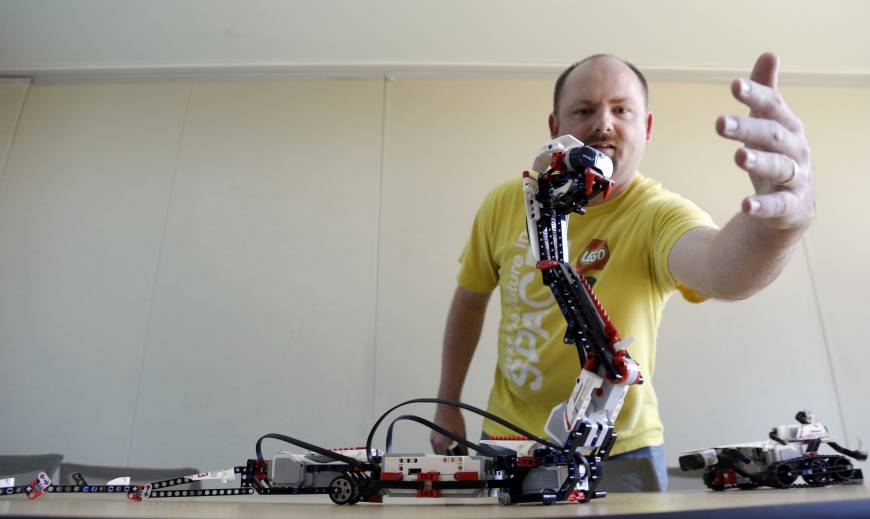
Robot world: Will Gorman plays with a Mindstorms cobralike robot in
SAN JOSE, CALIFORNIA – Few are more excited about Lego’s new Mindstorms sets rolling out next month than Silicon Valley engineers. Many of them were drawn to the tech sector by the flagship kits that came on the market in 1998, introducing computerized movement to the traditional snap-together toy blocks and allowing the young innovators to build their first robots. Now, 15 years later, those robot geeks are entrepreneurs and designers, and the colorful plastic bricks have an significant influence in their lives.Techies tinker at Lego play stations in workplaces. Engineers mentor competitive Lego League teams. Designers use them to mock up larger project ideas. And executives stand Lego creations on their desks alongside family photos.
“Everyone I work with played with them as children. We sit around talking Lego. It’s a shared common experience,” said Travis Schuh, who reaches into his bin of plastic blocks when he needs a quick prototype at the Silicon Valley medical robotic firm where he works.
The new Mindstorms sets, which go on sale Sept. 1, are simpler for the younger crowd and more versatile for sophisticated users than two earlier versions.
The sets are designed for kids over 10 years old and make it easy to build basic, remote-controlled robots, including a cobralike contraption that snaps Lego-brick fangs. Some shoot balls, others drive along color-coded lines.
But for $349, far more expensive than typical building toys, customers get a much more complex and powerful system.
“There’s actually a lot of engineering that goes into Lego bricks and the systems you can prototype out of them are pretty sophisticated,” said Stanford University engineering professor Christian Gerdes, who uses them in his classroom.
Professional hackers will also find plenty to do with the new Mindstorms, as the open-source software uses Linux for the first time, and controller apps are integrated for tablets and mobile phones.
San Francisco-based software engineer Will Gorman is one of those adult users. He has torn apart Mindstorms kits to create a Lego toilet flusher, a Wii-playing robot that bowled a perfect game and a Lego Mars Curiosity rover.
“I don’t consider myself an adult, really,” said the 36-year-old father of two recently, setting up yet another creation on a table in a sunny Redwood City library overlooking San Francisco’s bay wetlands.
ProtoTank co-founder Adam Ellsworth, whose headquarters are on the third floor of TechShop San Francisco, said, “There is a culture of design in the Silicon Valley, and Lego bricks are how so many of us started.”
“This place is just one big Lego station,” he added, raising his voice above the buzz of laser cutters and 3-D printers. “Taking an idea, a concept, and finding the right way to turn it into something real — that’s fundamentally what you’re doing with Lego bricks.”
Denmark-based Lego first sold their plastic bricks 55 years ago, and watched them grow into one of the world’s most popular toys. But company officials say Mindstorms, designed for children but quickly snapped up by adults, changed their market.
“In the last 15 years, we have worked hard to balance the needs and wants of this shadow market while at the same time engaging kids,” said Michael McNally, a brand director at LEGO Systems, Inc.
Kellen Asercion, a Stanford University engineering graduate student, first snapped Lego bricks together around the time he started kindergarten, and he was still building when he graduated from high school.
“Lego sets are almost single-handedly responsible for my interest in engineering,” he said.
Many Bay Area engineers also grew up competing in the First Lego League, which also launched in 1998 with 200 teams. Since then, the league has expanded and last year more than 280,000 children around the world, between ages 6 and 18, participated.
Organizers expect 600 teams the participate in Northern California this fall.
“We have a culture that only celebrates superheroes in the worlds of entertainment and sports. We need to create superheroes in the world of innovation,” said Dean Kamen, who founded FIRST (For Inspiration and Recognition of Science and Technology), which includes the First Lego League.
Nagy Hakim first played with Mindstorms at a robotics summer camp when he was in 6th grade. Since then, the college-bound 18-year-old from Santa Clara, California, has joined — and even mentored — Lego leagues.
Is this something he is going to grow out of?
“Time will tell,” said Hakim with a laugh. This fall, he will head to Olin College of Engineering in Boston, where professors posit theoretical Lego problems, students are encouraged to mentor Lego teams and the library stocks Mindstorms kits.
 About bambooinnovator
 Bamboo Innovator