Summer Is the Real Season for Bad Colds, Not Winter; Summer viruses linger longer, and pack more of a punch, than winter ones
August 27, 2013 Leave a comment
August 26, 2013, 7:23 p.m. ET
Summer Is the Real Season for Bad Colds, Not Winter
Summer viruses linger longer, and pack more of a punch, than winter ones
ANGELA CHEN
Having trouble kicking that summer cold? It’s not your imagination. Summer colds are caused by different viruses than winter colds and tend to last longer than the winter variety. Angela Chen reports. Photo: AP.
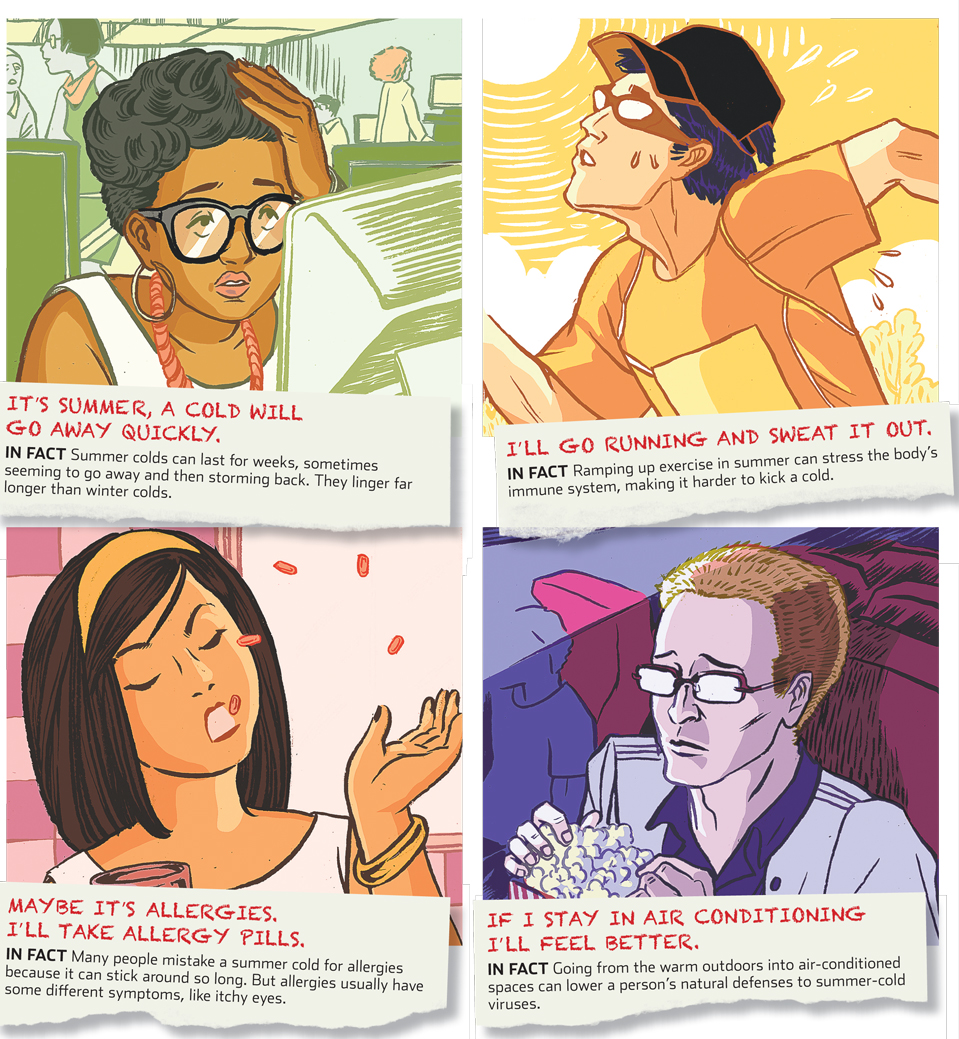
Something summery may be lingering even as the season fades—the summer cold. Colds in summertime can last for weeks, at times seemingly going away and then suddenly storming back with a vengeance, infectious-disease experts say. A winter cold, by contrast, is typically gone in a few days. The reason for the difference: Summer colds are caused by different viruses from the ones that bring on sniffling and sneezing in the colder months. And some of the things people commonly do in the summer can prolong the illness, like being physically active and going in and out of air-conditioned buildings.“A winter cold is nasty, brutish and short,” says Bruce Hirsch, infectious-disease specialist at North Shore University Hospital in Manhasset, N.Y. “But summer colds tend to linger. They can go on for weeks and reoccur.”
Summer colds, which can hit between June and October, occur only about 25% as often as the winter variety. But summer colds can have more severe, flu-like symptoms, in addition to sneezing and coughing. Many people also mistake a summer cold for allergies, because it just doesn’t seem to leave.Samantha McGovern, 30 years old, is still trying to shake off a cold she developed in late July. It started as a small case of the sniffles, so she didn’t pay it much mind and continued exercising and playing on the Majority Whips, her Washington, D.C.-based roller-derby team. But then she developed a fever—uncommon for her, she says—and a cough and she became exhausted. At first she thought it was pneumonia. By the time she went to the doctor, she was taking a cocktail of Mucinex, cough syrup, Tylenol and Sudafed. The doctor prescribed a different cough syrup, which didn’t work, and then eventually put her on antibiotics, she says.
Ms. McGovern ended up taking a week off from her media-relations job and missed three weeks of roller-derby practice. “It takes a lot for me to not do stuff, but I was significantly sick for three weeks and still have a cough now,” she says. Her husband, who caught the cold the second week of her illness, also hasn’t fully recovered.
Some people ramp up their exercise routines, hoping to sweat out a summer cold. This might instead prolong the illness, says Roger Baxter, co-director of the Kaiser Permanente Vaccine Study Center in Oakland, Calif. The body tries to use all its metabolic resources to fight off disease, so a hard run or long gym session diverts some of that energy away from fighting the sickness, he says. Although consistent, moderate exercise tends to protect the body from illness, a sudden and strenuous workout can decrease the body’s immunity.
And moving between the warm outdoors and air-conditioned inside spaces can make people more vulnerable to sickness in summer, says Ronald Eccles, director of the Common Cold Centre at the University of Cardiff in Wales. The sudden chilling “lowers the defenses in the nose and throat by causing constriction of the blood vessels,” he says. “If a virus is already present, this reduces our immunity.”
A summer cold’s symptoms also can be surprising. Along with the sniffles, sufferers may also get a fever, diarrhea and achy body. Symptoms can also vary depending on people’s ages, says Dr. Baxter. A baby may get a runny nose and slight temperature, but an older child or an adult can have a high fever and rash, he says.
Because summer colds stick around longer than many people expect, they are often mistaken for allergies, and vice versa, says Richard Weber, president of the American College of Allergy, Asthma & Immunology, a professional organization. Some ways to tell the difference: If your eyelids are puffy and eyes bloodshot, it’s probably allergies. Mucus color also is different—green for allergies, clear for summer cold, says Dr. Weber, a professor at the University of Colorado at Denver. “If your nose and eyes and ears feel itchy or tickly, that really points to allergies,” he says.
Both the enterovirus, which usually causes the summer cold, and the rhinovirus, which is responsible for winter sickness, are spread by people sneezing and coughing and through direct contact with germy surfaces. But summer colds also can be transmitted through fecal contact, which can occur from contaminated bathroom door handles and such.
Taking zinc, which is often advised for warding off winter colds, may not work for the summer variety. “The literature on zinc is mixed, but the proposed mechanism is that it might interfere with how the virus attaches” inside the body, says Dr. Baxter. Since the summer virus attaches differently, “I don’t think it would work as well, if it works at all.”
Enteroviruses and rhinoviruses are around all year. Experts say it isn’t clear why summer colds tend to be caused by one virus and not the other. Dr. Hirsch suggests that the summer-cold virus may be more physically delicate.
Winter colds may occur more frequently than summer colds because colder weather and lack of sunlight decreases the body’s immunity, says Dr. Eccles. But both types of virus thrive where large numbers of people gather, such as schools, public transportation, sports games and airlines flights. “Anywhere there’s crowding, you’re likely to pick up a cold,” he says.
 About bambooinnovator
 Bamboo Innovator