Europe Haggles Over New Rules Aimed at Saving Fish Stocks; A Ban on Discarding Unwanted Fish Overboard Raises Questions of Cost and Enforceability
August 28, 2013 Leave a comment
August 27, 2013, 9:29 p.m. ET
Europe Haggles Over New Rules Aimed at Saving Fish Stocks
A Ban on Discarding Unwanted Fish Overboard Raises Questions of Cost and Enforceability
ASHLEY DALTON
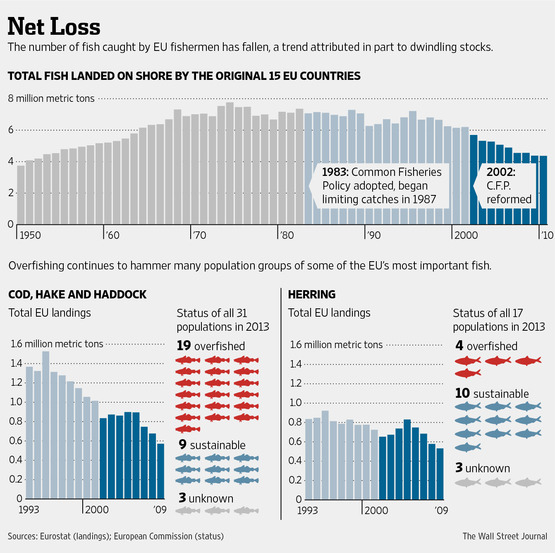
ZEEBRUGGE, Belgium—Less than five months before a landmark overhaul of Europe’s fishing industry starts to take effect, policy makers and industry groups are haggling over how to replenish depleted fish stocks without crippling the business. A ban on discarding unwanted fish overboard is the most contentious new rule agreed to in late May after years of negotiation. Fishermen currently discard nearly a quarter of Europe’s total catch on average, and as much as 70% of the hauls in some areas, European Commission data show. Scientists and environmental groups blame the practice for speeding the decline of fish stocks.Industry groups say the rule, which will be phased in over the next six years, is coming down too quickly and will ratchet up costs, especially for the small-scale outfits that make up the bulk of the European fleet.
“The law has been made by someone who doesn’t know fisheries,” said fisherman Geert Luickx as he painted his boat here in this North Sea port. Without financial assistance, more crew, and a bigger boat, he said, he won’t be able to comply with the new law.
The European Commission has earmarked €6.5 billion ($8.6 billion) to be handed out through 2020 to help the industry comply with the new policy. This first update to the bloc’s fishing laws in a decade starts to kick in on Jan. 1 of next year. Its aim is to restore fish stocks and build up catches and fishing income so the industry can cut its reliance on EU subsidies of roughly €700 million a year.
But how the money will be spent, and how the new rules, which some environmental groups say are full of loopholes, will be enforced remain open questions. “There are a lot of problems we have to solve,” said EU Fisheries Commissioner Maria Damanaki.
Fast action is required to try to bring fish populations back from the brink, many scientists and environmental groups say. Commission data show 80% of stocks in the Mediterranean, including swordfish, and 47% of stocks in the Atlantic, including whiting off Scotland’s western coast, are being exploited at levels that will lead to extinction.
European officials say the new policy’s ban on discards, combined with a more flexible quota system, will help restore fish stocks to health. Instead of being dumped overboard, less-lucrative fish such as roachßand plaice—plus fish deemed too small under current quotas to land—will have to be brought to shore. Much of this unwanted catch will likely be sold to fish farmers to feed high-value fish like salmon.
The new policy includes incentives to help fishermen buy new gear to cut the amount of unwanted fish caught in the first place. It also creates regional commissions aimed at addressing complaints that the current, EU-wide policies can’t address the ecological and economic complexities of a continent.
The new policy “is a huge paradigm shift in a policy that, so far, has been considered a failed policy of the European Union,” said Markus Knigge, an adviser to the Pew Charitable Trusts in Brussels. “It has made significant progress towards sustainability,” though there are no legally binding targets for rebuilding fishing stocks.
Fisheries and aquaculture account for less than 1% of the EU’s gross domestic product, but the industry has an outsize impact in some countries, with Denmark, the U.K., Spain, France and the Netherlands accounting for 60% of the bloc’s catches.
A popular push to end discarding has added pressure on policy makers. One campaign by British celebrity chef Hugh Fearnley-Whittingstall to end the “insane” practice attracted nearly 900,000 online supporters.
The European Parliament proposed using a portion of the €6.5 billion—which will be divvied up among member states—to go toward building new fishing vessels. EU member states rejected this last month in the face of opposition from environmentalists and some policy makers, who say it would end up contributing to overfishing.
How to enforce the new discards law is also under debate. Installing video cameras on all vessels or employing observers to ensure fisherman follow the law has been proposed, but nothing yet has been settled.
“We do not have the resources for this kind of enforcement,” Ms. Damanaki said.
A small number of fishermen embrace the ban on discards. Klaus Berglund, who fishes in the Baltic Sea off Finland, said the number of valuable fish such as pike, eel and flounder he catches has gone up since he started cutting discards six years ago.
Fishing-industry groups say they need more time to prepare for the new rules. Andrew Locker, president of the U.K.’s National Federation of Fishermen’s Organizations notes that Norway—which, along with Iceland, is one of two non-EU nations to ban discards—took 20 years to eliminate them.
“Fishermen are concerned because they know they’re going to have to change,” said Simon Coveney, the Irish fisheries minister who was an architect of the overhaul. He said that with the extra funding and help from new regional commissions, fisheries of all sizes can adapt.
And Ms. Damanaki said officials will be cautious when implementing the new rules. “We don’t want to destroy the sector,” she said. At the same time: “Fishermen will have to cooperate…or there will be no fish.”
 About bambooinnovator
 Bamboo Innovator