Property Stocks Decline on Latest Housing Curbs to cut the maximum tenure for new loans to purchase homes built by the state to 25 years from 30 years; Mortgage payments capped at 30% of their gross monthly income, down from 35%
August 28, 2013 Leave a comment
Property Stocks Decline on Latest Housing Curbs: Singapore Mover
Singapore’s property stocks fell, driving an index tracking developers to a one-year low, after the government tightened its public housing policy by reducing tenures for new loans and restricting purchases by foreigners. The Singapore property index tracking 43 stocks fell 1.2 percent to 694.15 as of 9:13 a.m. local time, set for the lowest since Sept. 11. Singapore will cut the maximum tenure for new loans to purchase homes built by the state to 25 years from 30 years, the Housing & Development Board said in a statement on its website. Mortgage payments are capped at 30 percent of their gross monthly income, down from 35 percent.With 82 percent of Singaporeans living in government-built apartments, housing rules has been used to encourage the development of families and other government policies. Public housing regulations also affect private developers because the companies rely on these homeowners to upgrade to condominiums.
“These measures continue to be negative for the Singapore private residential market, given that upgrader demand has contributed to a significant portion of mass-market private residential housing demand,” Citigroup Inc. analysts Adrian Chua and Ivan K. Lim said in a report yesterday. “A weaker HDB resale will impinge on upgrader households’ ability to monetize their flats.”
CapitaLand Ltd. (CAPL), the city’s biggest developer, lost 1.7 percent to S$2.95, set for the lowest since July 25, 2012. City Developments Ltd., the second largest, dropped 1.4 percent to S$9.84.
Foreigner Restrictions
Foreigners will be allowed to buy existing HDB flats three years after they obtain permanent residential status in the island city, the board said. Previously, they could buy the apartments after becoming permanent residents. The measure took effect 5:30 p.m. local time yesterday.
“We are introducing two measures to further stabilize the HDB resale market,” the board said in the statement. “These measures are in line with those introduced by the Monetary Authority of Singapore to encourage financial prudence among borrowers, which is especially important given the current low interest rate environment is unlikely to be sustained.”
The city’s private home sales in July slid to the lowest since December 2009 as investors balked at new curbs on property loans and developers marketed fewer projects. Home sales fell to 481 units last month, 73 percent lower from a month earlier, according to data from the Urban Redevelopment Authority on Aug. 15.
‘Weak Market’
“In an already weak market, we expect the incremental measure to be taken negatively by the market,” Credit Suisse Group AG analysts Yvonne Voon and Sing Ping Chok said in a research report today. “We still expect near-term property prices to be flattish supported by low vacancy and healthy balance sheet.”
Record home prices amid low interest rates raised concerns of a housing bubble and prompted the government to widen a four-year campaign in January to curb speculation in Asia’s second-most expensive housing market. Singapore in June also unveiled new rules governing how financial institutions grant property loans to individuals, extending the efforts.
Singapore has been attempting to rein in prices since 2009, when the government barred interest-only loans for some housing projects and stopped allowing developers to absorb interest payments for apartments still being built.
To contact the reporter on this story: Kyunghee Park in Singapore at kpark3@bloomberg.net
HDB cuts loan tenure as interest rate hikes loom
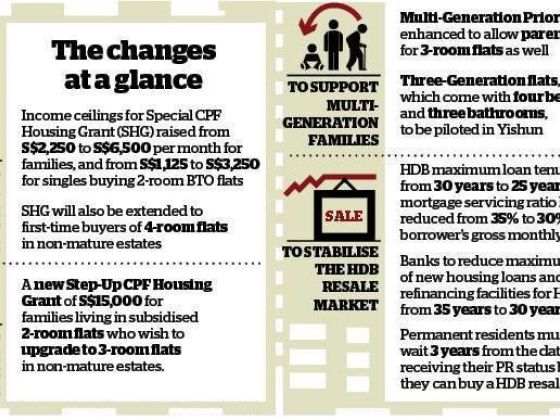
SINGAPORE — To encourage financial prudence and mitigate an impending rise in interest rates, the Housing and Development Board (HDB) announced yesterday that it would cut, with immediate effect, the maximum loan tenure from 30 years to 25 years for its housing loans, and reduce the mortgage servicing ratio (MSR) limit from 35 per cent to 30 per cent of the borrower’s gross monthly salary.
BY SUMITA D/O SREEDHARAN –
6 HOURS 44 MIN AGO
SINGAPORE — To encourage financial prudence and mitigate an impending rise in interest rates, the Housing and Development Board (HDB) announced yesterday that it would cut, with immediate effect, the maximum loan tenure from 30 years to 25 years for its housing loans, and reduce the mortgage servicing ratio (MSR) limit from 35 per cent to 30 per cent of the borrower’s gross monthly salary.
And with effect from today, financial institutions will shorten the maximum tenure of their new housing loans and re-financing facilities from 35 years to 30 years.
The measures were announced yesterday by the HDB as part of a raft of housing initiatives — including details of the enhanced Special CPF Housing Grant that was announced during the National Day Rally and a pilot launch of multi-generation flats — that sought to achieve various outcomes such as improving affordability and encouraging extended families to live together or in close proximity.
Permanent resident (PR) households will now also have to wait three years after obtaining their PR status before they can buy a resale flat — a move that National Development Minister Khaw Boon Wan described as a “judgment call” to allow PRs to sink roots here and save up before buying a flat. Previously, PR households could buy resale HDB flats as soon as they acquired PR status.
The objective of the revised mortgage loan terms was to “ensure financial prudence in purchase of public housing and discourage over-consumption”, the HDB and the Ministry of National Development said in a joint press release. This comes after the Monetary Authority of Singapore introduced a Total Debt Servicing Ratio (TDSR) framework about two months ago to cap total debt obligations at not more than 60 per cent of an individual’s gross monthly income.
It was only in January that the authorities announced that the MSR limits for housing loans from banks and the HDB would be capped at 30 per cent and 35 per cent of a flat buyer’s gross monthly income, respectively. With yesterday’s announcement, the MSR limit for HDB loans will be the same as for bank loans.
Speaking to reporters at Toa Payoh HDB Hub, Mr Khaw reiterated that the changes were meant to align HDB loan policy with that of the banks.
Referring to the current “unrealistic and artificial” interest rates, he said: “People think they can buy a bigger flat or a condo, when we all know that over the lifetime of the mortgage, interest rates won’t stay that low and then what? Then there will be trouble.”
Engineer Michael Foo, 28, and his wife are currently living with their parents in their Bukit Merah flat. He said the measures “put a damper” on the couple’s plans to buy a five-room Build-to-Order flat. They will try to save up more money in the coming years to buy their dream home, he said.
“I am all for financial prudence but I am not willing to give up the home that we want. Maybe that will change in time, if it truly gets beyond my reach, but for now, I believe a few years of scrimping and saving will eventually get us what we want,” he said.
Analysts whom TODAY spoke to reiterated that the latest measures were primarily targeted at “preparing the ground” for the looming interest rate hikes.
Nevertheless, Mr Nicholas Mak, Executive Director of Research and Consultancy at SLP International Property Consultants, said the measures, taken as a whole, would rein in the prices of resale HDB flats.
On the new waiting period for PR households, Ms Christine Li, Head of Research and Consultancy at OrangeTee, said: “Some PRs might then be pushed to the private residential market. (They) will also head to the rental market instead. Coupled with the lower MSR limit and shorter loan tenure, demand for resale flats will be further reduced, especially the larger HDB units.”
Mr Mak said it was akin to freezing a section of the demand for resale flats over the next three years.
Mr Colin Tan, Head of Research and Consultancy at Suntec Real Estate Consultants, noted that the supply of resale flats was still an issue, with many homeowners unwilling to sell in the current property climate.
“So, supply is just going to get smaller and smaller,” said Mr Tan.
HDB raises income ceiling for Special CPF Housing Grant
SINGAPORE — To help middle-income families afford their first home, the income ceiling for the Special CPF Housing Grant (SHG) has been raised from S$2,250 to S$6,500 a month for first-timers, including families buying four-room flats in non-mature estates, the Housing and Development Board (HDB) said yesterday.
BY AMANDA LEE –
6 HOURS 47 MIN AGO
SINGAPORE — To help middle-income families afford their first home, the income ceiling for the Special CPF Housing Grant (SHG) has been raised from S$2,250 to S$6,500 a month for first-timers, including families buying four-room flats in non-mature estates, the Housing and Development Board (HDB) said yesterday.
According to the HDB, more than five in 10 households here have a monthly income of up to S$6,500.
Correspondingly, the SHG income ceiling for singles buying two-room Build-to-Order (BTO) flats under the Single Singapore Citizen (SSC) Scheme will be raised to S$3,250 from S$1,125.
The changes were announced by Prime Minister Lee Hsien Loong during the National Day Rally earlier this month, along with the new Step-Up CPF Housing Grant that will be given to families living in subsidised two-room flats who wish to upgrade to three-room units in non-mature estates.
Providing the details of the measures, the HDB said those applying for the Step-Up grant of S$15,000 must be in continuous employment for 12 months before the flat application and remain employed at the time of application — a condition similar to the SHG and the Additional CPF Housing Grant.
Nevertheless, the HDB reiterated that the resale levy policy will stay in order to maintain a “fair allocation of public housing subsidies between first- and second-timers”. Flat applicants in last month’s BTO exercise will be the first batch to enjoy the extended SHG and the Step-Up grant.
Speaking to reporters at the Toa Payoh HDB Hub, National Development Minister Khaw Boon Wan noted that the Government has “always been very targeted” at ensuring the lower-income families can afford two- or three-room flats.
“It is a major move … going beyond the low-income to also what we call the middle-income,” he said. He added that the new SHG income ceiling of S$6,500 was “as good a level as one can set”.
PropNex Realty CEO Mohamed Ismail said that the new level income ceiling for the SHG “pleasantly surprised” him. It was “true to the concept of including the middle-income”, he noted.
Ms Christine Li, Head of Research and Consultancy at OrangeTee, said the measures represent a “fundamental shift in policy approach that takes us a step closer to being a more inclusive society”. She noted that the median monthly household income for the 41st to 50th percentile of households is S$6,800.
“It is very clear that the Government wants to ease the burden of the lower-middle and middle-income families to own their HDB flats,” said Ms Li, adding that the enhanced SHG could attract more middle-income couples to buy BTO flats instead of resale units.
 About bambooinnovator
 Bamboo Innovator