Foreign workers in Indonesia must comply with local regulations and follow cultural norms based on Pancasila, the philosophical foundation of the Indonesian state
August 29, 2013 Leave a comment
Pancasila Plan to Affect Foreigners
By Edi Hardum on 8:35 am August 29, 2013.
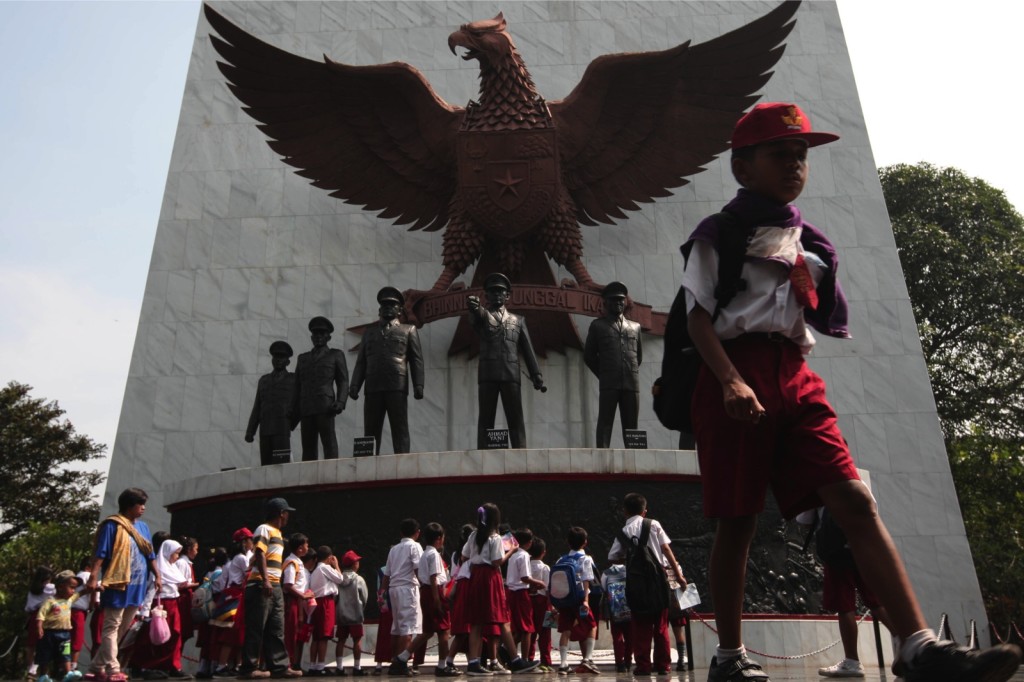
Students visit the Pancasila Monument in East Jakarta on April 3, 2013. Foreign workers in Indonesia must comply with local regulations and follow cultural norms based on Pancasila, the philosophical foundation of the Indonesian state, Irianto Simbolon, the director general in charge of industrial relations and workers’ social security at the Manpower and Transmigration Ministry, said on Wednesday. (JG Photo/Safir Makki)
Foreign workers in Indonesia must comply with local regulations and follow cultural norms based on Pancasila, the philosophical foundation of the Indonesian state, a government official said on Wednesday. Irianto Simbolon, the director general in charge of industrial relations and workers’ social security at the Manpower and Transmigration Ministry said the department was rolling out socialization training necessary to help foreigners adapt to Indonesia and to prevent intercultural conflict that could hurt foreign investment.“Regulations and norms that apply in Indonesia are all based on Pancasila,” Irianto said at his office.
He said foreign workers in Indonesia must understand how to behave as prescribed by the principles of Pancasila.
Promulgated by President Sukarno in 1945, Pancasila features prominently in the national discourse, and espouses five principles aimed at uniting the diverse archipelago.
The principles of the Pancasila fuse together elements of socialism, nationalism and monotheism.
Irianto said foreign workers were expected to understand the five principles in order to maintain communication ethics between themselves and local workers.
“If this can be done, it could synergize industrial relations between the workers at their work places,” Irianto said.
The ministry has so far rolled out the socialization guidelines in regions with the highest number of foreign workers such as Cikarang and Bogor in West Java and Batam in Riau, where clashes between foreigners and locals have occurred in the past.
Irianto said several multinational companies in Indonesia had held cross-cultural training programs.
He added that the training and guidelines would work to prevent intercultural friction and conflict at workplaces and at home between foreign and local workers, adding that such conflicts could lead to social unrest which would eventually affect the business and investment environment in the country.
In a pilot program in Batam last week, the Pancasila socialization training was attended by 175 people.
The ministry is targeting workers from Asian and European nations, who form the bulk of foreign workers in the country.
The largest number of foreign nationals in Indonesia are reportedly Japanese, Korean, Indian and Chinese.
“It was issued as a social interaction guideline for foreign workers in Indonesia so that they can adjust easily when interacting socially at work in accordance with Indonesian law,” Irianto said.
 About bambooinnovator
 Bamboo Innovator