Have you fed your Cash-Eating Organism today? Fraud, failure and bankruptcy pay well for CEOs
August 29, 2013 Leave a comment
Aug. 28, 2013, 6:15 a.m. EDT
Fraud, failure and bankruptcy pay well for CEOs
Commentary: Have you fed your Cash-Eating Organism today?
By Al Lewis
Richard Fuld had a $66 million payday in 2000 because, well, he was a great chief executive officer, now wasn’t he?
Though the Internet bubble popped and the Nasdaq peaked in 2001, he made another $105.2 million. In 2002, he bagged yet another $28.7 million; 2003, $52.9 million; 2004, $41.8 million; 2005, $104.4 million; 2006, $27.3 million; 2007, $40 million. His tab for eight years of CEO work came to $466.3 million. You may still remember the name of his company. It was called Lehman Brothers. In 2008, it set a record as history’s largest bankruptcy, setting off the nuclear reaction we now call the financial crisis and cementing America’s future as a socialist state for giant banks and corporations.Fuld is among the cast of characters enumerated in a retrospective report released by the Institute for Policy Studies: “Executive Excess 2013. Bailed Out, Booted, Busted: A 20-Year Review of America’s Top-Paid CEOs.” Before 2008, he made the list of America’s top 25 highest-paid executives for eight years in a row.
“To be in the top 25 for eight consecutive years before you crash and burn the economy, it’s just unbelievable,” said Sarah Anderson, one of the report’s authors.
Her study analyzed 500 corporate executive positions that have been listed in The Wall Street Journal’s annual executive pay surveys over the past 20 years.
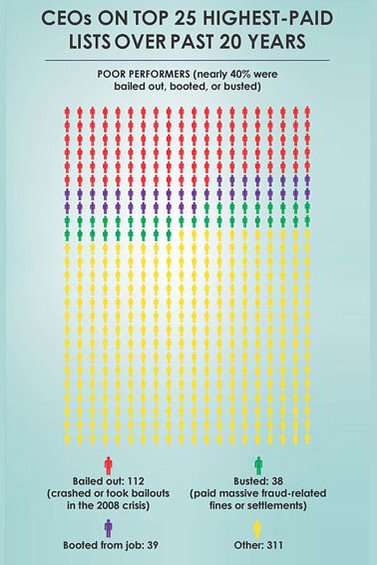
When she began this research, she expected bailed-out, booted and busted CEOs would make up maybe 15% of the sample. But no, it tallied 38%.
Watch a video report on the study.
“These poorly performing chief executives either wound up getting fired, had to pay massive settlements or fines related to fraud charges, or led firms that crashed or had to be bailed out during the 2008 financial crisis,” the report says.
• CEOs whose firms received taxpayer bailouts or ceased to exist held 22% of these 500 slots over the past two decades.
• CEOs who were forced out of their jobs made up 8%. (This is not bad work, if you can get it: The average golden parachute was valued at $48 million.)
• CEOs who led companies paying significant fraud-related fines or settlements comprised another 8% of the sample. (Most of these settlements totaled more than $100 million.)
Nearly 40% of the top-paid executives were bailed out, booted out or busted.
This isn’t even counting what the study calls “The Taxpayer Trough Club,” or CEOs who make their living with companies landing enormous government contracts. These firms — mostly defense related — garnered $255 billion in taxpayer-funded contracts. Their CEOs made up 12% of the sample.
The tally also didn’t count notoriously overpaid ne’er-do-wells such as Angelo Mozilo, former CEO of Countrywide Financial; Bernie Ebbers, the imprisoned founder of WorldCom; and “Chainsaw” Al Dunlap, who fired thousands of people at Scott Paper and other companies, and whose reign at Sunbeam ended in the company settling accounting fraud charges. They didn’t make The Wall Street Journal’s annual reports, so they weren’t in this study, Anderson said.
The tally does, however, include a long list of executives with names familiar to anyone who regularly reads the business news.
There’s Sanford Weill who bagged $1.5 billion in compensation over the years building Travelers and Citigroup (NYSE:C) with one overvalued merger after the next, and then lobbying for the repeal of financial regulations that many credit for causing the financial crisis.
Then there’s Ken Lay, the late former CEO of Enron; Dennis Kozlowski, who went to prison for looting Tyco International; and Joe Nacchio, recently release from prison after convictions on insider-trading charges at Qwest Communications.
Only four women made the list of top-paid CEOs (it still very much a boys’ club) and they behaved a lot like the boys. Andrea Jung at Avon (NYSE:AVP) , for instance, was making about $26 million a year until she was fired last year for declining profits and a mishandled regulatory investigation into foreign bribery allegations.
For years I have referred to CEOs as Cash-Eating Organisms.
You put money in their paths, and they find a way to make it their own. Boards of directors never bother to ask whether a CEO will be more concerned with his own fortune or the fortunes of the shareholders. And, too often, the more one pays a CEO, the worse he performs: Kind of like that Ron Johnson guy at J.C. Penney (NYSE:JCP) who was essentially paid millions upfront and then nearly took down the iconic retailer.
There have been scant few reforms addressing CEO pay since the financial crisis. The Securities and Exchange Commission, for example, will reportedly soon propose a rule forcing companies to report the pay gap between CEOs and employees. This is just a rule asking for more information. It was supposed to be a requirement of the 2010 Dodd-Frank financial reform act. And do you know what big companies and their lobbyists are saying all these years later?
It’s too onerous. It’s too expensive. It will take way too many accountants to figure out this ratio.
Funny how they never seem to notice the expenses of feeding their Cash-Eating Organisms.
The Institute for Policy Studies has been putting out “Executive Excess” reports for 20 years, and a lot of good that has done.
Two decades ago, the pay gap between big-company CEOs and the average American was 195 to 1, and now it’s 354-to-1, according to the study’s calculations.
Brilliant CEOs who build great companies are not the problem.
It’s the CEOs who get paid to take crazy risks with other people’s money — endangering industries and the economy, sometimes committing fraud, destroying careers and lives, and leaving trails of debt and despair in their wakes. Then, when all the dust settles, they either float away on their golden parachutes or run to the government for a bailout. And no matter how much anyone complains about it, CEO pay just keeps inching higher.
“Two decades have essentially recalibrated our nation’s moral sensibilities,” the study said. “The outrageous has become the everyday.”
Nothing seems outrageous when it happens every day. I can’t wait to see what it looks like in another
 About bambooinnovator
 Bamboo Innovator