Google’s investment arm and TPG have led a $258m investment in Uber, the taxi-hailing app that has both delighted customers andenraged regulators around the world

August 23, 2013 11:58 pm

Google investment helps fuel Uber

By Tim Bradshaw and Richard Waters in San Francisco

Google’s investment arm and TPG, the private equity group, have led a $258m investment in Uber, the taxi-hailing app that has both delighted customers andenraged regulators around the world. The move values the three-year-old company at around $3.5bn, according to one person familiar with the deal, vaulting Uber into the ranks of the most valuable private tech companies alongside the likes of Airbnb, the travel company, Square, the mobile payments firm, and Spotify, the digital music service. Read more of this post

Foreign workers in Singapore rush to cash in weak rupee, rupiah

Foreign workers in Singapore rush to cash in weak rupee, rupiah

Amelia Tan, The Straits Times/ANN, Singapore | Business | Fri, August 23 2013, 1:48 PM

India and Indonesia nationals working in Singapore are scrambling to change money as their currencies languish at multi-year lows. Others are rushing to send funds home after the rupee and rupiah declined sharply over the past week. Remittance shops and money changers in areas such as Serangoon Road said that they had been serving up to double the usual number of customers from both countries since Monday. Read more of this post

Currency sell-off: Tragedy in three acts; Emerging market darlings have lost their lustre as investors ponder life without US quantitative easing

August 23, 2013 5:52 pm

Currency sell-off: Tragedy in three acts

By Victor Mallet

Emerging market darlings have lost their lustre as investors ponder life without US quantitative easing

Droopy rupee: India’s currency plumbed record lows this week as investors withdrew money from emerging markets

India, 1991. Thailand and east Asia, 1997. Russia, 1998. Lehman Brothers, 2008. The eurozone from 2009. And now, perhaps, India and the emerging markets all over again. Each financial crisis manifests itself in new places and different forms. Back in 2010, José Sócrates, who was struggling as Portugal’s prime minister to avert a humiliating international bailout, ruefully explained how he had just learned to use his mobile telephone for instant updates on European sovereign bond yields. It did him no good. Six months later he was gone and Portugal was asking for help from the International Monetary Fund. This year it is the turn of Indian ministers and central bankers to stare glumly at the screens of their BlackBerrys and iPhones, although their preoccupation is the rate of the rupee against the dollar. Read more of this post

Malaysia’s second-largest bank CIMB May Miss Break-Even Target on 2012 Purchase of RBS Investment Banking Units

CIMB May Miss Break-Even Target on RBS Banking Units Buy

CIMB Group Holdings Bhd. (CIMB), Malaysia’s second-largest bank by assets, may not break even as planned by the end of this year on its 2012 purchase of most of Royal Bank of Scotland Group Plc (RBS)’s Asia-Pacific investment banking assets. As stocks and currencies slide, “I don’t know” if the businesses will cover costs associated with the acquisition, Chief Executive Officer Nazir Razak said in an interview with Bloomberg TV’s Haslinda Amin yesterday. Read more of this post

Newspapers and radio still on growth path in Malaysia

Updated: Saturday August 24, 2013 MYT 9:09:10 AM

Newspapers and radio still on growth path

BY M. HAFIDZ MAHPAR AND EUGENE MAHALINGAM
STARBIZ@THESTAR.COM.MY

adspendnielsen240813

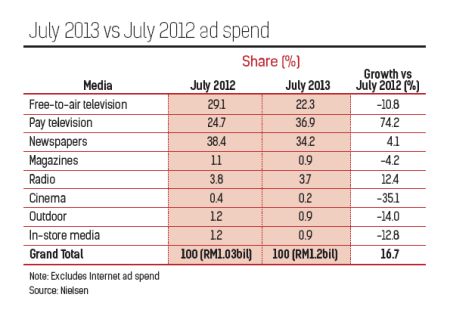
TRADITIONAL media, namely newspapers and radio, are still the advertisers’ preferred choice. They are the only media monitored by Nielsen − other than pay TV − to register advertising expenditure (adex) growth last month. According to Nielsen, newspaper and radio adex in July grew 4.1% and 12.4% respectively compared with a year earlier, while ad spend for pay TV surged 74.2%. The increase in share of voice for pay TV in 2013 was partly due to additional channels being monitored, according to Nielsen. Read more of this post

Netflix’s New ‘My Profile’ Feature Means Fewer Outrageously Bad Recommendations

Netflix’s New ‘My Profile’ Feature Means Fewer Outrageously Bad Recommendations

By Aaron Pressman | The Exchange – 14 hours ago

dc210cd9-cf6f-443a-8dfb-f582fa166386_1-MaxRow

Netflix (NFLX) subscribers get annoyed when their kids flip on the TV and see a suggested list of raunchy comedies alongside rows of more-appropriate fare. Or when the suggestions mix PBS’s pre-school cartoon “Caillou” with AMC’s drug-dealer saga “Breaking Bad.” But don’t worry – it drives Todd Yellin, Netflix’s vice president of product innovation, crazy, too. The mix-ups happen when Netflix’s automated algorithms attempt to analyze the viewing patterns of a whole household of people watching different kinds of shows through one account. Mom and Dad’s late-night “Scandal” binge gets thrown in with a tween’s “Cheetah Girls” fixation. The online programming service’s new profiles feature should help end the confusion, Yellin says. Starting this month, U.S. subscribers can set up different profiles for each viewer. Remember to hit the icon for the proper person before selecting a show, and the suggestions algorithms will suddenly seem much smarter. Read more of this post

Intel Media opens offices in LA, New York in TV push

Intel Media opens offices in LA, New York in TV push

3:22pm EDT

By Noel Randewich

SAN FRANCISCO (Reuters) – Intel Corp’s media arm is opening offices in New York and Los Angeles as the company pushes ahead with an Internet television service that it plans to launch later this year, an Intel spokesman said on Friday. Setting up shop in Los Angeles’ Santa Monica and New York’s Nolita brings Intel closer to the major TV networks and production studios that the world’s biggest chipmaker must strike deals with to gather content for its live and on-demand service, Intel spokesman Jon Carvill said. Read more of this post

Why Is the Golden Age of Television So Dark?

Why Is the Golden Age of Television So Dark?

By Megan McArdle – Aug 23, 2013

The Official Blog Spouse and I are nothing if not loyal members of our television-watching demographic. “The Wire” is our favorite show of all time. We watch “Boardwalk Empire,” “Game of Thrones” and “Homeland” together; I also watch “Mad Men” by myself, as Peter finds it too dull. We are working our way through “Breaking Bad.” I really do like all these shows, and yet, when I watch this list I have to ask myself: Why does almost everything we watch involve criminals and violence? No, not just involve them, but elevate them to the center of the story? Read more of this post

Inside Comcast’s $30 Billion TV Bet; NBCU’s Steve Burke Has Weeded Out Executives and Scrubbed the Culture

Updated August 23, 2013, 7:59 p.m. ET

Inside Comcast’s $30 Billion TV Bet

NBCU’s Steve Burke Has Weeded Out Executives and Scrubbed the Culture

MERISSA MARR and CHRISTOPHER S. STEWART

BF-AF634_BURKE_G_20130823161455

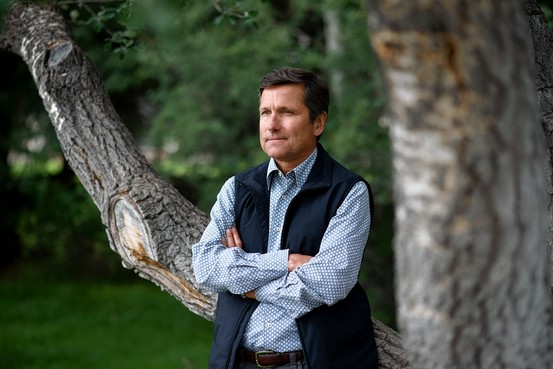
NBCU Chief Steve Burke, shown in Sun Valley, Idaho, last month, has purged senior executives and sought to scrub competing fiefdoms.

Cameras popped as celebrities stepped out of tinted-window vehicles at a Manhattan ballroom where E! cable network was hosting an event for advertisers. Kim Kardashian preened on the red carpet while Ryan Seacrest chatted with fans. But Steve Burke, the CEO of E’s parent, NBCUniversal, was decidedly not in a partying mood. “I want to kill myself,” he said before ducking into an elevator. “They tried to get me to do the red carpet, but I said ‘no’,” he laughed. When the doors opened, a woman asked him to pose for a picture with the Olympian swimmer Ryan Lochte. “You’re a good sport to put up with all of these suits,” he told Mr. Lochte, leaning in for the photo. In the two years since Comcast Corp.CMCSA -0.38% bought NBCUniversal, Mr. Burke has shown a zeal for shaking things up with little sentimentality, weeding out some of the company’s most well-known personalities in the process.

BF-AF641_BURKE_NS_20130823163306 BF-AF642A_BURKE_G_20130823192106 Read more of this post

ESPN President: Wage Stagnation, Not Technology, Is the Biggest Threat to the TV Business

ESPN President: Wage Stagnation, Not Technology, Is the Biggest Threat to the TV Business

By Derek Thompson

BRISTOL, CONN. – When John Skipper, the president of ESPN, wants to worry about the future of the most valuable media company in the world — not just think anxiously, but actively worry — he doesn’t focus on Google trying to buy exclusive rights to the NFL. He doesn’t think about Apple going head-to-head with the cable companies. He doesn’t think about CBS, or NBC, or FS1. If there’s any acronym that truly scares him, it’s CBO. Read more of this post

Cablevision Clock Ticking as Paulson Sees Sale: Real M&A

Cablevision Clock Ticking as Paulson Sees Sale: Real M&A

Time may be running out for Cablevision Systems Corp. (CVC) to find a buyer.

With its highest valuation in two years, the $4.8 billion cable operator founded four decades ago by Charles Dolan should take advantage of a surge in cable matchmaking to sell, according to Macquarie Group Ltd. Bethpage, New York-based Cablevision jumped 42 percent in just eight weeks as speculation heated up about deals in the industry and shareholders Paulson & Co. and Gamco Investors Inc. said a sale is likely. Read more of this post

Spanish football offside as excesses cast shadow on new season; Spain’s economic crisis hits debt-fuelled clubs hard

August 23, 2013 2:14 pm

Spanish football offside as excesses cast shadow on new season

By Tobias Buck in Madrid

When FC Barcelona travel to Málaga on Sunday for their second match of the Spanish football season, fans are likely to witness a profoundly uneven contest.

Barcelona are the reigning champions ofSpain and hailed as one of the best sides to have ever played the game. The team includes Lionel Messi, the four-time European footballer of the year, as well as Neymar, a Brazilian forward who joined Barca for an eye-popping €57m this summer. Read more of this post

Since Citi Bike launched in late May, the number of complaints about America’s largest bike-share system have decreased sharply—even as ridership increased

Updated August 23, 2013, 10:17 p.m. ET

Bike-Share Complaints Drop, for Now

Calls to City’s 311 Line Fall Sharply Even as Ridership Shoots Up

DEREK KRAVITZ

NY-CN602A_NYCIT_NS_20130823170903

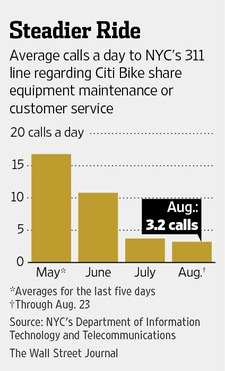
When Citi Bike launched during the last five days of May, users called 311 an average of 17 times a day to complain about malfunctioning stations, app glitches and other kinks, according to city data. But since then, the number of complaints about the nation’s largest bike-share system have decreased sharply—even as ridership increased, according to city data. Read more of this post

Richard Vedder: The Real Reason College Costs So Much; The expert on the economics of higher education explains how subsidies fuel rising prices and why there’s a ‘bubble’ in student loans and college enrollment

August 23, 2013, 7:08 p.m. ET

Richard Vedder: The Real Reason College Costs So Much

The expert on the economics of higher education explains how subsidies fuel rising prices and why there’s a ‘bubble’ in student loans and college enrollment.

ALLYSIA FINLEY

Another school year beckons, which means it’s time for President Obama to go on another college retreat. “He loves college tours,” says Ohio University’s Richard Vedder, who directs the Center for College Affordability and Productivity. “Colleges are an escape from reality. Believe me, I’ve lived in one for half a century. It’s like living in Disneyland. They’re these little isolated enclaves of nonreality.” Read more of this post

Lofty Profit Margins and Shrinking Share of GDP Going to Worker Compensation Hint at Pain to Come for Stocks

Updated August 23, 2013, 5:24 p.m. ET

Lofty Profit Margins Hint at Pain to Come for Stocks

With Margins Near Record Levels, It Looks Like There’s Only One Direction for Shares to Go

MARK HULBERT

BF-AF624_HULBER_G_20130823160303

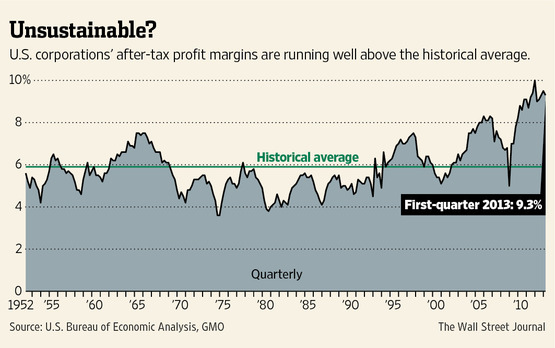
Profit margins at near-record levels—watch out below! If you are wondering what might prove to be the stock market’s Achilles’ heel, look no further than its dependency on near-record corporate profit margins. Any sizable decline would almost certainly translate into big losses for the stock market. Given the current high levels, such a retreat seems likely. Investors therefore may want to begin building up a healthy cash position to take advantage of lower prices in coming years. Read more of this post

Discount stores thrived during the recession, but that may be approaching an end for all the wrong reasons. It highlights the nation’s uneven economic recovery; many Americans still aren’t benefiting from riding the wave of higher stock and home prices

The end of the dollar store recovery

By Nin-Hai Tseng, Writer August 23, 2013: 10:18 AM ET

Discount stores thrived during the recession, but that may be approaching an end for all the wrong reasons.

FORTUNE – Dollar stores were one of the few bright spots in U.S. retail during the Great Recession as cash-strapped consumers looked to do more with less. And while many are still going to these discounters for bargains, they’re also buying less. On Thursday, Dollar Tree (DLTR) reported that its second-quarter profit rose 4.6% from a year earlier — its stock jumped after the discount retailer raised its forecast for the rest of the year, but profits reflected a relatively modest increase for a company that saw double-digit earnings growth for the past five years. Read more of this post

Indonesia unveils emergency fiscal package to revive confidence

August 23, 2013 12:19 pm

Indonesia unveils emergency fiscal package to revive confidence

JAKARTA, August 23 – Indonesia’s government unveiled an emergency fiscal package on Friday to promote foreign investment, reduce imports and prop up itstumbling rupiah currency, as it struggles to revive confidence in southeast Asia’s largest economy. The intervention follows a punishing week for emerging markets, with currencies from Brazil to India shaken by fears of higher global borrowing costs and a reduction in cheap cash from the US. Read more of this post

Top 10 Reasons Why Leaders Fail

Top 10 Reasons Why Leaders Fail

DAN SCHAWBELTHE FAST TRACK 10 MINUTES AGO 0

Not everyone is meant to be a leader, but for those of you who are already leaders or aspiring to be leaders, there are a lot of lessons you can learn. Today, I’ve written ten reasons why leaders fail. It’s a collection of issues that leaders tend to have, especially in their first few years in those roles. It’s easy to get caught up in the act of leadership because you gain power, confidence and control, all of which can be your undoing. Here are 10 things that will get in the way of your success and hurt your team:

1. Leaders become selfish.

Leaders who have responsibilities seem to forget that they are there to support their team instead of themselves. They become power hungry and seek control instead of giving advice, mentoring and ensuring that the team benefits from their leadership. Read more of this post

Value Partners’ Cheah Cheng Hye: A global financial crisis bigger than the one in 2008 is conceivable in five to 10 years.

Updated: Friday August 23, 2013 MYT 7:04:00 AM

A bigger global crisis possible

BY DAVID TAN
DAVIDTAN@THESTAR.COM.MY

bizd_pc_2308_p6

GEORGE TOWN: A global financial crisis bigger than the one in 2008 is conceivable in five to 10 years. Value Partners Group chairman and co-investment officer Cheah Cheng Hye said the crisis, which would not be V-shaped in nature, would bring about capital flights, volatile markets, rising inflation and social unrest. “The global financial crisis would have to do with the very serious deficits that cannot be financed. Developed and developing countries have over the years accumulated such deficits by making promises that cannot be realised in order to get re-elected. “These deficits would sow the seeds of future social and political unrest,” he said at a public lecture entitled From Journalist to Fund Manager, which was officiated by Penang Chief Minister Lim Guan Eng. Also present was Penang Institute chief executive officer Zairil Khir Johari. On Malaysia, Cheah said Value Partners was not bullish about the country. “Malaysia’s Government and household debts are higher than those in Indonesia, China and Thailand. Half of the country’s government bonds are held by foreigners, who would be the first to run in a crisis. “The Malaysian workforce is now less productive than the workforce in Thailand and the Philippines. Malaysia is also importing more oil than selling it,” he said. Read more of this post

Microsoft is fully acknowledging that the traditional software business model is dead with the rise of subscription-based cloud services; “The board is committed to the effective transformation of Microsoft to a successful devices and services company”

And Microsoft Is Giving Up On The Software Business!

HENRY BLODGET AUG. 23, 2013, 9:36 AM 2,357 7

Mario Tama/Getty

Yes, the headline news at Microsoft is that CEO Steve Ballmer is out. But a line lower down in the press release is also startling: “The board is committed to the effective transformation of Microsoft to a successful devices and services company,” one of the company’s board members said.

The effective transformation of Microsoft to a devices and services company.

In other words, Microsoft is fully acknowledging that the model that powered the company for more than 3 decades and made it one of the most powerful and richest companies in the world–sales of software–is effectively dead. That’s big news. Microsoft has used the “devices and services” language before–Steve Ballmer wrote about it in this year’s shareholder letter–but the challenge and magnitude of this transformation is much more profound than most people appreciate. And the idea of Microsoft as a “devices and services company,” especially one led by “devices,” would have been unthinkable only a few years ago. The traditional software model is, in fact, dead–or at least dying–but it’s only recently that Microsoft has acknowledged this so forthrightly. For more than a decade, Microsoft has been transitioning away from one-time sales of packaged software (Windows disks, for example) to multi-year services contracts. This has reduced the company’s dependence on one-time unit sales of personal computers and software licenses and allowed it to build a business in which more of its revenue is recurring. But the transformation of the tech industry from packaged software to services is now moving far beyond mere payment models. Cloud-based services are now supplanting local software installations and licenses across the industry, not just for consumers who use services like Google and Facebook but for massive corporations. And this is forcing Microsoft and other major IT vendors to retool their product architectures, as well as the way they plan, develop, and roll out new product features. Meanwhile, the trend recently re-established by Apple of selling integrated hardware and software devices has forced Microsoft to start building and selling its own integrated gadgets. This is a major transition, too. Continuing to “transform” Microsoft from being a company driven by massive releases of packaged software every few years to a “devices and services” company will not be easy. The company’s struggles in recent years will likely continue for many more years, regardless of who is CEO. But it’s encouraging to see that Microsoft now fully recognizes the challenge it faces. And it’s probably wise for the company to address this challenge with a change right at the top.

Here’s The Letter Steve Ballmer Wrote To Microsoft Employees Explaining Why He’s About To Retire Read more of this post
Why China’s wine exchange is crashing: 110-proof grain alcohol all tastes much the same

Why China’s wine exchange is crashing: 110-proof grain alcohol all tastes much the same

By Gwynn Guilford @sinoceros 12 hours ago

Imagine a stock that jumps 25.5% on its first day of trading, coming to rest at $159 a share. Three months later, though, shares tank, plummeting to $54. Now, 17 months after going public, it’s worth $58.70. Nope, it’s not Groupon. It’s “Crystal Shede 2012 Collector’s Edition,” a 110-proof rice wine (or baijiu, as it’s known) made by a Sichuan distiller called Tuopai Shede, and it brought in 77 million yuan ($12.4 million) from its public offering on the Shanghai International Wine Exchange (SIWE). Read more of this post

China Feels Emerging-Market Headwinds

Aug 23, 2013

China Feels Emerging-Market Headwinds

By Richard Silk

The wind-down of an extraordinary period of monetary stimulus in the U.S. could cast a shadow over China’s fragile growth, raising fears of renewed stress in financial markets and a hit to the budding recovery in exports. The flow of funds out of Asia—anticipating higher U.S. interest rates—has not yet hammered China as badly as some of its neighbors. That’s largely because China imposes broad controls on capital, limiting foreign investments in stocks, bonds and property as well as the money Chinese investors can send overseas. Read more of this post

Chinese Consumers Step Back, Pinching Firms; Canon, Nike and Apple Feel Squeeze in Economic Slowdown

August 22, 2013, 5:48 p.m. ET

Chinese Consumers Step Back, Pinching Firms

Canon, Nike and Apple Feel Squeeze in Economic Slowdown

RICHARD SILK

BEIJING—Companies as diverse as retailers and gadget makers are reporting weakened results from China, as the economic slowdown there blunts Beijing’s drive to make the nation’s consumers a bigger driver of growth. Last month, Canon Inc. 7751.TO +1.07% cut the Japanese company’s year-end profit forecast to ¥380 billion ($3.89 billion), off 16% from forecasts three months earlier, citing in part the slowdown in China. Nike Inc. NKE -0.72% reported falling China sales in its latest results, while British supermarket chain Tesco TSCO.LN +1.42%PLC is in talks with a local company, China Resources Enterprise Ltd.,0291.HK -1.51% about folding its 131 underperforming Chinese stores into a joint venture. Read more of this post

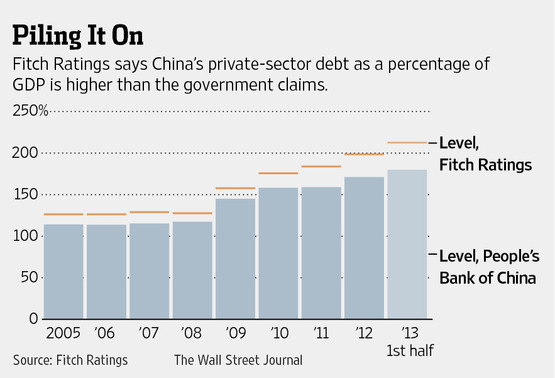
Fitch’s Charlene Chu Is the ‘Rock Star’ of Chinese Debt Analysis; At worst, Ms Chu predicts, a crisis is brewing. At best, China is at risk of a long, debt-laden economic slowdown.

August 22, 2013, 11:17 p.m. ET

Charlene Chu Is the ‘Rock Star’ of Chinese Debt Analysis

The Fitch Staffer Has Emerged as One of the Most Sought-after Experts on Chinese Finance

ALEX FRANGOS

MI-BY047_CHARLE_G_20130822180604

When top officials at the U.S. Federal Reserve want to understand the Chinese financial system, they meet Charlene Chu. Goldman SachsGS -0.74% which isn’t short of China experts, interviewed her and sent the transcript to its clients. And one of the world’s most influential investment firms calls her a rock star. From her cubicle in a Beijing office tower, Ms. Chu, who works for bond-rating firm Fitch Ratings, has emerged as one of the most sought-after experts on China’s increasingly risky financial system. Read more of this post

Radioactive groundwater under Fukushima nears sea

RADIOACTIVE GROUNDWATER UNDER FUKUSHIMA NEARS SEA

By MARI YAMAGUCHI

— Aug. 23 7:02 AM EDT

TOKYO (AP) — Deep beneath Fukushima’s crippled nuclear power station a massive underground reservoir of contaminated water that began spilling from the plant’s reactors after the 2011 earthquake and tsunami has been creeping slowly toward the sea. Now, 2 1/2 years later, experts fear it is about to reach the Pacific and greatly worsen what is fast becoming a new crisis at Fukushima: the inability to contain vast quantities of radioactive water. Read more of this post

Fed Burned Once Over Taper Now Twice Shy on QE3

Fed Burned Once Over Taper Now Twice Shy on QE3

U.S. central bankers have $3 trillion of losses reminding them they had better get their communications right should they decide to taper their bond purchases.

That’s how much global equity markets declined in the five days after Federal Reserve Chairman Ben S. Bernanke’s June 19 remarks that he may reduce his $85 billion in monthly securities buying this year and halt it altogether by mid-2014. His comments pushed the yield on the benchmark 10-year Treasury to a 22-month high. Read more of this post

S. Korea’s traditional markets go high-tech

S. Korea’s traditional markets go high-tech

Friday, August 23, 2013 – 16:02

AFP

SEOUL – Seoul’s traditional markets – bustling, narrow streets of small vendors selling cheap, fresh produce – have largely opted out of the high-tech charge to make the South Korean capital one of the most wired cities on earth. But squeezed by big-box stores and dwindling custom, these mom-and-pop operations are slowly going digital, replacing well-thumbed ledgers with tablet computers, and cash pouches with sleek smartphones that can scan credit cards. Read more of this post

Newspaper Association of America CEO Caroline Little: Newspapers aren’t dying and Jeff Bezos isn’t crazy

Newspapers aren’t dying and Jeff Bezos isn’t crazy

August 22, 2013: 12:09 PM ET

Companies change with the times, and newspapers are no different. But they are now emerging in a strong position.

By Caroline Little

FORTUNE — Jeff Bezos, John Henry, and Warren Buffett are not investing in dying businesses. They don’t do that. They are investing in assets poised for a rebound. Despite the recent spate of media last week about the spiraling of newspapers, there are a few facts for industry pundits to consider. Newspaper media comprised a $38.6 billion industry in 2012. While those revenues saw a 2% decline compared to 2011 revenues ($39.5 billion), we’re also starting to see promising shifts in the newspaper business model: growing revenue streams across several categories — some of which have only emerged in recent years. Read more of this post

India to Import Onions for First Time Since 2011 as Prices Surge; Onion prices in Delhi surged to 60 rupees (93 cents) a kilogram (2.2 pounds) from 16 rupees three months ago; “The government isn’t caring enough about us.”

India to Import Onions for First Time Since 2011 as Prices Surge

India is preparing to import onions for the first time in two years as a surge in prices threatens to trigger a backlash against Prime Minister Manmohan Singh before next year’s elections.

Prices of the vegetable have almost quadrupled in three months in New Delhi as the government struggles to tackle the highest inflation among the biggest emerging markets. State-run trading company PEC Ltd. this week sought overseas suppliers to deliver as much as 300,000 tons of onions, while National Agricultural Cooperative Marketing Federation of India Ltd. said the country may buy from China, Iran, Egypt and Pakistan. Read more of this post

Indian Billionaire Costs Climb as $18 Billion of Debt Due

Billionaire Costs Climb as $18 Billion of Debt Due: India Credit

Default risk for Indian companies has risen to a one-year high as a plunging rupee increases the cost of repaying $18 billion of debt due by March.

Companies led by billionaires Mukesh Ambani and Anil Agarwal are among borrowers with $10.6 billion of bonds and loans maturing by Dec. 31 and $7.4 billion in the following three months, data compiled by Bloomberg show. The average cost of insuring notes of seven Indian issuers against non-payment has risen 90 basis points in 2013 to 360 basis points as of Aug. 21, the highest since September, according to data provider CMA. A similar measure for Asia fell 23 basis points to 135. Read more of this post