A Century of International Potash Intrigue

A Century of International Potash Intrigue

In case you didn’t notice, the world’s potash markets went haywire last week, after the announcement that Russia’s OAO Uralkali, the world’s largest producer of this crucial ingredient in fertilizer, suspended its participation in an alleged cartel with its long-time Belarus partner Belaruskali. Their joint marketing venture, the Belarusian Potash Co., produced at its peak 40 percent of the world’s potash, with much of the balance coming from Canpotex Ltd., another syndicate based in North America. Together these two set production quotas and divided global markets, ensuring stable prices and steady profits. Read more of this post

Indonesia: A rise in economic nationalism compounds broader worries about South-East Asia’s giant

A rise in economic nationalism compounds broader worries about South-East Asia’s giant

Aug 24th 2013 | JAKARTA |From the print edition

HOW quickly the mood can turn. Barely a year ago Indonesia was the toast of emerging-market investors. The country revelled in the world’s demand for its vast reserves of coal, oil and other resources, and celebrated with a consumer boom: economic growth clipped along at over 6%. Politics was stable, macroeconomic policy sound. Foreign investors were scrabbling to get into a market of 240m people and apparently boundless potential. Read more of this post

Indonesia to See Big Growth in Digital Media: PwC

Indonesia to See Big Growth in Digital Media: PwC

By Jakarta Globe on 9:24 am August 23, 2013.
With increasing access to the Internet and an explosive growth in mobile devices and entertainment, most notably in the BRIC countries, businesses must engage in constant innovation in order to keep pace with evolving markets, PricewaterhouseCooper projected on Thursday. In its annual Global Entertainment and Media Outlook 2013-2017, PwC said that growth in the industry will come from spending on digitally delivered media in the next five years, although most spending will continue to be on on-digital media. Read more of this post

In Indonesia, buzzers are not heard, but tweet for money

In Indonesia, buzzers are not heard, but tweet for money

5:43pm EDT

By Andjarsari Paramaditha

JAKARTA (Reuters) – In Indonesia’s capital Jakarta, a buzzer is not an alarm or a bell, but someone with a Twitter account and more than 2,000 followers who is paid to tweet. Jakarta is the world’s tweet capital and advertisers eager to reach the under-30 crowd are paying popular Twitter users to spread their word through social media, starting at about $21 per tweet. While celebrity endorsements via Twitter are common worldwide, Indonesia is unusual because advertisers are paying the Average Joes too. Read more of this post

Taiwan Data Reflects Decoupling from U.S.; “Demand from the U.S. is actually stabilizing, but that’s not seen in Taiwan’s exports. It has to do with the competitiveness of products from Taiwan.”

August 23, 2013, 2:03 AM

Taiwan Data Reflects Decoupling from U.S.

By Aries Poon

Gone are the days when Taiwan’s trade and production data acted as a barometer of the health of developed economies, particularly the U.S. Last year, as the U.S. economy expanded 2.8%, Taiwan’s exports to the U.S. dropped 9.3%. In the first seven months of this year the island’s exports to the U.S. were off 1.1% from a year earlier, despite the quickening U.S. recovery.

Read more of this post

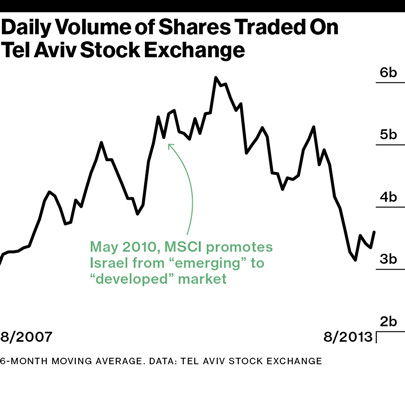
Israel Struggles With Upgrade From Emerging to Developed Market

Israel Struggles With Upgrade From Emerging to Developed Market

By Shoshanna Solomon on August 22, 2013

mf_telaviv35_405_inline

In the minds of many investors, Israel left the ranks of emerging markets in 2010. In May of that year, MSCI (MSCI), the New York-based firm that builds popular investing indexes, added the country to its benchmark of developed nations. The promotion was a sign of Israel’s success: Its economy had recovered from the financial crisis faster than most advanced nations, and foreign money was pouring into its stock market. In 2009, Israel’s benchmark TA-25 stock index gained 75 percent. “We’re playing with the big boys now,” said Ester Levanon, then the chief executive officer of the Tel Aviv Stock Exchange (TASE), after winning MSCI’s approval. Read more of this post

Is Germany Repeating American Errors at Bretton Woods?

Is Germany Repeating American Errors at Bretton Woods?

At the founding of the Bretton Woods international monetary system in 1944, the world’s dominant creditor nation, the U.S., set out to revive a fixed exchange-rate system by offering a war-torn, debt-ridden world a new deal in monetary relations, one to be supported by concessionary dollar loans from a new International Monetary Fund.

Today, Germany is trying to resuscitate the periphery of the crisis-stricken euro area in much the same way, and it is worth looking back at the formation of Bretton Woods for clues as to how this will play out. Read more of this post

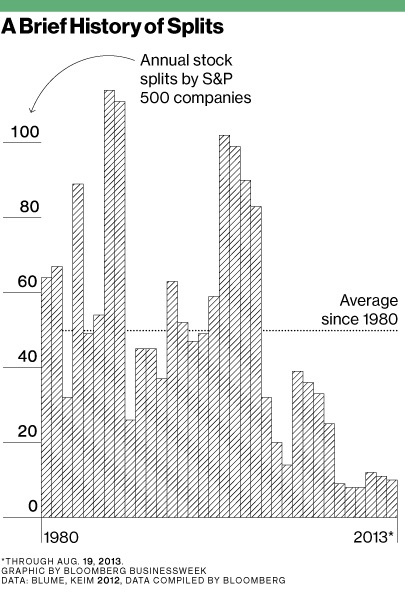
Stock Splits Lose Their Allure for Companies Trading Above $100; Just 10 companies in the S&P 500 have carried out stock splits this year, compared with an average of 48 since 1980.

Stock Splits Lose Their Allure for Companies Trading Above $100

By Whitney Kisling and Alex Barinka on August 22, 2013

mf_splitchart35_405

Priceline.com (PCLN), Apple (AAPL), and MasterCard (MA) would seem ideal candidates for a stock split. The latter two are trading at more than $500 per share, and online travel site Priceline is flirting with $1,000, making the inveterate dot-com-era survivor the most expensive stock in the Standard & Poor’s 500-stock index. Yet splits have lost their allure to executives even amid a four-year-plus bull market that has sent the number of stocks trading above $100 to a record. Sixty-three companies in the S&P 500 are now above that threshold, twice the level in 2010, according to data compiled by Bloomberg. Just 10 have split their stock this year, compared with an average of 48 annually since 1980.

Read more of this post

What does NASDAQ meltdown mean for future IPOs? In Markets’ Tuned-Up Machinery, Stubborn Ghosts Remain

AUGUST 22, 2013, 8:38 PM

In Markets’ Tuned-Up Machinery, Stubborn Ghosts Remain

By FLOYD NORRIS

A generation ago, when the stock market crashed on Oct. 19, 1987, the Nasdaq stock market appeared to have done much better than the New York Stock Exchange. While the Dow Jones industrial average fell 23 percent that day, the Nasdaq composite index was off just 11 percent.

It was not, it turned out, that Nasdaq stocks were more highly regarded. It was, instead, a question of the technology used. Read more of this post

Central banks in the developing world have lost $81bn of emergency reserves through capital outflows and currency market interventions since early May, even before renewed turmoil in emerging markets

Last updated: August 22, 2013 8:06 pm

Emerging markets central banks’ emergency reserves drop by $81bn

By Robin Wigglesworth in London

Central banks in the developing world have lost $81bn of emergency reserves through capital outflows and currency market interventions since early May, even before renewed turmoil in emerging markets. The figure, which excludes China, is equal to roughly 2 per cent of all developing country central bank reserves, according to Morgan Stanley analysts, who compiled the data from central bank filings for May, June and July. However, some countries have suffered more precipitous drops. Indonesia has lost 13.6 per cent of its central bank reserves from the end of April until the end of July, Turkey spent 12.7 per cent and Ukraine burnt through almost 10 per cent. India, another country that has seen its currency pummelled in recent months, has shed almost 5.5 per cent of its reserves. Read more of this post

Private equity: have investors learned from their mistakes? Buyouts on the rise again, but sector insists that the recession put paid to ‘simplistic financial engineering’ in takeovers

Private equity: have investors learned from their mistakes?

Buyouts on the rise again, but sector insists that the recession put paid to ‘simplistic financial engineering’ in takeovers

Sean Farrell

The Guardian, Thursday 22 August 2013 20.34 BST

The buyout frenzy reached its peak in 2007 when US firm KKR and Axa Private Equity backed the £11.1bn buyout of Alliance Boots. Photograph: Ian West/PA

It seems a long time ago when private equity was the unacceptable face of capitalism in Britain. But on the eve of the banking crisis, in June 2007, prominent British representatives of the industry were hauled before parliament’s Treasury select committee to explain themselves as political and public disquiet over the sector reached a peak. Read more of this post

Now the Brics party is over, they must wind down the state’s role

August 22, 2013 1:48 pm

Now the Brics party is over, they must wind down the state’s role

By Anders Aslund

Nations did not take advantage of the good years to improve their economies, says Anders Aslund

After a decade of infatuation, investors have suddenly turned their backs onemerging markets. In the Bric countries – Brazil, Russia, India and China – growth rates have quickly fallen and current account balances have deteriorated. The surprise is not that the romance is over but that it could have lasted for so long. From 2000 to 2008 the world went through one of the greatest commodity and credit booms of all times. Genesis warns that after seven years of plenty, “seven years of famine will come . . . and the famine will ravage the land”. Perhaps the combined commodity and credit cycle, from which the Bric countries have benefited more than their due, is divinely appointed. Read more of this post

Moody’s Mulls Downgrade of Big Banks as U.S. Support Wanes

Moody’s Mulls Downgrade of Big Banks as U.S. Support Wanes

Moody’s Investors Service may cut debt ratings on at least four of the six largest U.S. banks as it examines whether the government would be less likely to ensure creditors are repaid in a crisis. Goldman Sachs Group Inc. (GS), JPMorgan Chase & Co. (JPM), Morgan Stanley (MS) and Wells Fargo & Co. (WFC) may be downgraded, Moody’s said today in a statement. Bank of America Corp. (BAC) and Citigroup Inc. (C) are under review, with the direction of any rating change uncertain, Moody’s said. Bank of New York Mellon Corp. and State Street Corp. were already under review, Moody’s said. Read more of this post

CCP: UK lenders got up to 60% commission for mis-sold insurance

August 22, 2013 8:16 pm

CCP: UK lenders got up to 60% commission for mis-sold insurance

By Sharlene Goff

UK lenders that have agreed to pay up to £1.3bn to customers who were mis-sold credit card insurance received commission rates of up to 60 per cent, according to the regulator.

The Financial Conduct Authority said on Thursday that 13 banks and other card issuers would refund credit card customers who they referred to CPP, an insurance provider, for extra protection against stolen cards and identity theft. Read more of this post

Asset-management companies in China: Lipstick on a pig; China is still dealing with the mess left by previous bank bail-outs

Asset-management companies in China: Lipstick on a pig; China is still dealing with the mess left by previous bank bail-outs

Aug 24th 2013 | SHANGHAI |From the print edition

20130824_FNC268

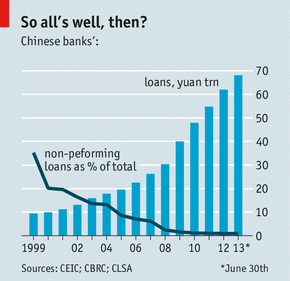
NEWS surfaced this week that Cinda, an asset-management company (AMC) created during China’s last round of banking bail-outs, is talking to bankers about a stockmarket flotation. That raises an intriguing question: how would the Chinese government handle its next banking crisis? If experience is a guide, it will be through a combination of enormous injections of public money, the creation of complicated structures and the obfuscation of data. Read more of this post

Judging music competitions: The sound of silence; Top musicians are judged as much for their movements as for their melodies

Judging music competitions: The sound of silence; Top musicians are judged as much for their movements as for their melodies

Aug 24th 2013 |From the print edition

SOME music has always been about the performance. Watching a rock band live, for example, is not just a matter of appreciating the quality of the sound. What the musicians get up to on stage is almost as important. But you might think that classical music would be immune from such distractions—doubly so when a performance is being judged as part of a competition. However, a study by Chia-Jung Tsay, a concert pianist who is also a researcher at University College, London, suggests that even judges awarding prizes can be swayed by what they see as well as what they hear. Dr Tsay’s study, just published in the Proceedings of the National Academy of Sciences, employed over 1,000 volunteers (half novices and half experts) to evaluate the performances of candidates in ten prestigious music competitions, to see if they agreed with the judges’ decisions. Each volunteer assessed 30 performances—the top three from each competition. The catch was that only a third of volunteers were shown the performances accompanied by the soundtrack. The other two-thirds got either to see each performance or to hear it, but not both. Novices who saw and heard the whole thing, or merely heard it, did little better than chance at working out who had won—guessing right slightly more than a third of the time. Those who only saw it, however, did much better. They agreed with the actual decision almost half the time. Even more intriguingly the experts, who one might think would be trained to screen out histrionic flummery on the part of performers and concentrate entirely on the sound of the music itself, did worse than the novices when they could hear the performance, whether or not they could see it as well: they guessed right slightly under a third of the time. When they could see but not hear it, they did precisely as well as the novices, agreeing with the judges just under half the time. Still worse, for those who believe competitions truly pick the best musician, when both novice and expert participants watched silent videos that showed only the performers’ outlines (as illustrated at the top of the article), they still got it right just under half the time. What they seemed to be picking up on were gestures that they thought conveyed passion. It was these that gave a performer his or her edge.

One moral of this story, then, is that music competitions really are a bit of a lottery. If even experts cannot pick the winner from the top three when they can see and hear the performances, it suggests that real judges in such competitions might, once they have winnowed out the no-hopers, just as well toss a coin to decide who is actually top. The other lesson, given that this is never really going to happen, is that competitors should brush up on their stage skills as well as their musical ones.
A problem of cosmic proportions: Three experiments are starting to study dark energy, the most abundant stuff in the universe. But a theory has just been published purporting to show it does not exist

A problem of cosmic proportions: Three experiments are starting to study dark energy, the most abundant stuff in the universe. But a theory has just been published purporting to show it does not exist

Aug 24th 2013 |From the print edition

20130824_STD004_0

IN THE 1920s astronomers realised that the universe was running away from them. The farther off a galaxy was, the faster it retreated. Logically, this implied everything had once been in one place. That discovery, which led to the Big Bang theory, was the start of modern cosmology. In 1998, however, a new generation of astronomers discovered that not only is the universe expanding, it is doing so at an ever faster clip. No one knows what is causing this accelerating expansion, but whatever it is has been given a name. It is known as dark energy, and even though its nature is mysterious, its effect is such that its quantity can be calculated. As far as can be determined, it makes up two-thirds of the mass (and therefore, E being equal to mc2, two-thirds of the energy) in the universe. It is thus, literally, a big deal. If you do not understand dark energy, you cannot truly understand reality. Read more of this post

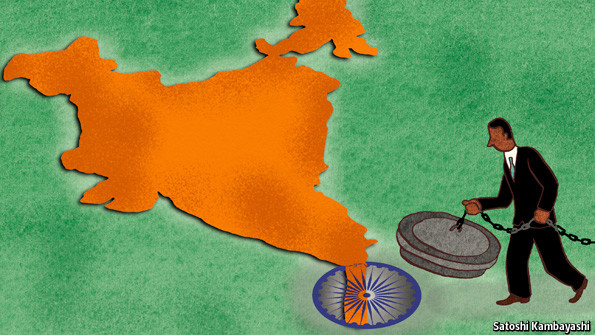
The reckoning: Why India is particularly vulnerable to the turbulence rattling emerging markets

The reckoning: Why India is particularly vulnerable to the turbulence rattling emerging markets

Aug 24th 2013 | MUMBAI |From the print edition

20130824_FNC263 20130824_FNC265 20130824_FND001_020130824_LDP001_0

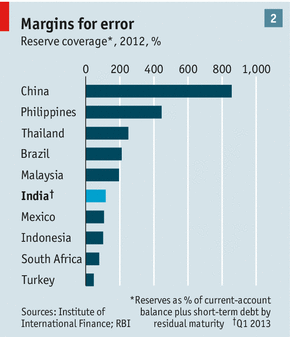
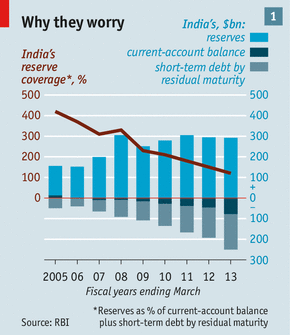
ON THE morning of August 17th most of India’s economic policymakers gathered in the prime minister’s house in Delhi. They were there to launch an official economic history of 1981-97, a period which included the balance-of-payments crisis of 1991. The mood was tense. India, said Manmohan Singh, the prime minister, faced “very difficult circumstances”. “Does history repeat itself?” asked Duvvuri Subbarao, the outgoing head of the Reserve Bank of India (RBI). “As if we learn nothing from one crisis to another?” Read more of this post

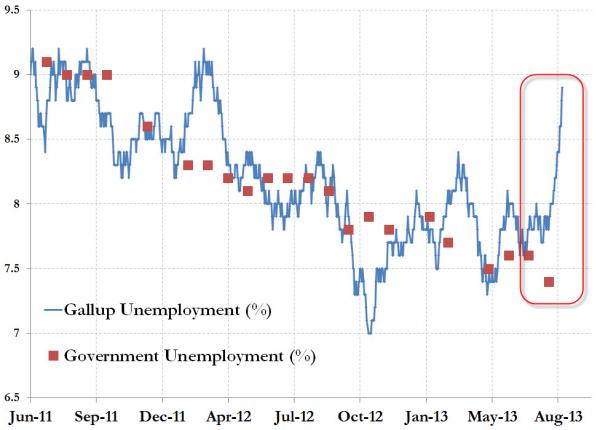
Gallup Unemployment Vs BLS Unemplyment: Polled Unemployment Soars To March 2012 Levels

BLS, We Have A Problem: Polled Unemployment Soars To March 2012 Levels

Tyler Durden on 08/22/2013 09:27 -0400

20130822_unemp_0

Gallup tracks daily the percentage of U.S. adults, aged 18 and older, who are underemployed, unemployed, and employed full-time for an employer, without seasonal adjustment. Due to the lack of Arima-X ‘magic’ the results are specifically not comparable to the BLS data, but, as the chart below suggests, the correlation is high. What is most worrying about the latest data is the rapid rise in both unemployment and underemployment that the Gallup poll finds (to 8.9% unemployment and 17.9% underemploymentUnemployment rates have jumped notably in the last month to their highest in 13 months. Will the Fed ‘allow’ this data to filter into the BLS data and ‘avoid the Taper’ or are there non-economic reasons (G-20, deficits, technicals, sentiment) that the Fed needs to SepTaper.

Why do some people thrive when the temperature soars, while others can’t think straight without air-conditioning?

Updated August 21, 2013, 7:09 p.m. ET

Hot or Not? Why Our Inner Thermostats Differ

Some people thrive when the temperature soars; others can’t think straight.

ALINA DIZIK

Why do some people thrive when the temperature soars, while others can’t think straight without air-conditioning? Variables such as where a person grew up, their amount of body fat and even their hydration level can influence how they feel in hot or cold temperatures, says Michael Sawka, a professor at the School of Applied Physiology at Georgia Institute of Technology in Atlanta. People who avoid going outside when it’s hot—preferring to move straight from an arctic office to air-conditioned transportation to a well-chilled restaurant, store or home—can quickly lose their ability to acclimate, Dr. Sawka says. Without regularly experiencing heat, the body becomes less efficient at sweating and has more difficulty increasing blood flow to the skin—both functions that help the body cool itself. Read more of this post

China bird flu analysis finds more virus threats lurking

China bird flu analysis finds more virus threats lurking

Wed, Aug 21 2013

By Kate Kelland

LONDON (Reuters) – A deadly new bird flu virus in China evolved from migratory birds via waterfowl to poultry and into people, and there are other bird flu viruses circulating that could follow the same path, scientists have found.

The study – an analysis of the evolutionary history of the H7N9 bird flu that has so far killed 44 people – identified several other H7 flu viruses circulating in birds that the researchers said “may pose threats beyond the current outbreak”. Read more of this post

China industry body quizzes medical device makers over pricing

China industry body quizzes medical device makers over pricing

Wed, Aug 21 2013

By Megha Rajagopalan

BEIJING (Reuters) – A Chinese industry group is collecting information on the pricing and business practices of foreign and local makers of medical equipment for the government in a survey that sources said was unusual in the amount of detail it sought.

Two industry sources who have seen the questionnaire said it was unclear if regulators were about to investigate China’s $20 billion medical devices market following multiple probes into corruption and possible price fixing in the pharmaceuticals sector. Read more of this post

China’s movie market booms with local content, cinema expansion

China’s movie market booms with local content, cinema expansion

2:11am EDT

By Grace Li

HONG KONG (Reuters) – In “American Dreams in China”, Cheng Dongqing is giving a lecture in an abandoned factory in Beijing. Snow falls through the damaged roof and a power cut sends students reaching for their flashlights.

The movie, about how young Chinese in the 1990s tried every means to learn English so they could study overseas, is part of a boom in domestic productions that is outpacing foreign films at the box office in China – the world’s second-largest market after the United States and Canada. Read more of this post

Options Market Suffers Biggest Disruption Since April

Options Market Suffers Biggest Disruption Since April

When Scott Maidel of Russell Investments answered the phone 20 minutes after the start of U.S. equity trading on Aug. 20, there was a Goldman Sachs (GS) Group Inc. employee on the line with a request: stop sending orders for stock options.

Confusion was sweeping trading desks as prices for equity derivatives swung without reason, leading to speculation a computer program had gone haywire at one of the 12 U.S. options exchanges. Contracts traded for $26 one minute and $1 the next. Read more of this post

Proving CEOs Overpaid for Luck Helped Stir Pay Backlash

Proving CEOs Overpaid for Luck Helped Stir Pay Backlash

Marianne Bertrand helped unleash a shareholder backlash against CEO pay with research she began while still in graduate school.

In a 2001 paper based on her work as a Ph.D. candidate at Harvard University, the 43-year-old labor economist documented that chief executive officers at U.S. oil companies got raises when their company’s fortunes improved because of changes in global oil prices beyond their control. The same pay-for-luck phenomenon occurred with multinational businesses when currency fluctuations, rather than management strategies, boosted results, she found. Read more of this post

India’s Richest Man Loses $5.6 Billion as Rupee Stumbles

India’s Richest Man Loses $5.6 Billion as Rupee Stumbles

Mukesh Ambani, India’s richest man, is the biggest loser among the country’s billionaires as the rupee’s slump to record lows erased 24 percent of his fortune.

The chairman of Reliance Industries Ltd. (RIL), operator of the world’s biggest oil refinery complex, has lost $5.6 billion of his wealth since May 1, as the rupee’s plunge accelerated. The 56-year-old is left with a net worth of $17.5 billion, according to the Bloomberg Billionaires Index. Read more of this post

Indonesia Stocks Enter Bear Market After Losing 20% Since May

Indonesia Stocks Enter Bear Market After Losing 20% Since May

Indonesian stocks fell, with the benchmark index entering a bear market after losing 20 percent from a record high three months ago.

The Jakarta Composite Index (JCI) declined 1.1 percent to close at 4,171.41, the lowest since Sept. 13, 2012. Animal feed producer PT Charoen Pokphand Indonesia dropped 13 percent and was the biggest drag on the index. PT Bank Rakyat Indonesia, the country’s second largest lender by assets, fell 4.4 percent.

A record current-account deficit in the second quarter and worse-than-expected economic growth and inflation data spurred investors to offload stocks and send the rupiah to its weakest level since April 2009. Foreign investors sold a net of $434.7 million worth of equities this week through yesterday. Read more of this post

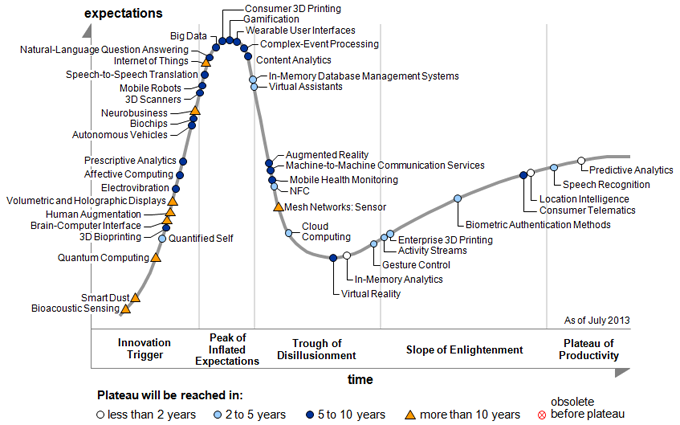
Gartner’s 2013 Hype Cycle for Emerging Technologies Maps Out Evolving Relationship Between Humans and Machines

STAMFORD, Conn., August 19, 2013

Gartner’s 2013 Hype Cycle for Emerging Technologies Maps Out Evolving Relationship Between Humans and Machines

2013 Hype Cycle Special Report Evaluates the Maturity of More Than 1,900 Technologies

Gartner to Host Complimentary Webinar “Emerging Technologies Hype Cycle for 2013: Redefining the Relationship,” August 21 at 10 a.m. EDT and 1 p.m. EDT

hype-cycle-pr

The evolving relationship between humans and machines is the key theme of Gartner, Inc.’s “Hype Cycle for Emerging Technologies, 2013.” Gartner has chosen to feature the relationship between humans and machines due to the increased hype around smart machines, cognitive computing and the Internet of Things. Analysts believe that the relationship is being redefined through emerging technologies, narrowing the divide between humans and machines.  Read more of this post

At Apple, Tim Cook leads a quiet cultural revolution

At Apple, Tim Cook leads a quiet cultural revolution

3:08am EDT

By Poornima Gupta and Peter Henderson

SAN FRANCISCO (Reuters) – Shortly after signing on as chief operating officer at Facebook, Sheryl Sandberg was looking to connect with people in a similar role – No. 2 to a brilliant and passionate young founder. She called Tim Cook. “He basically explained nicely that my job was to do the things that Mark (Zuckerberg) did not want to focus on as much,” Sandberg said of the 2007 meeting that lasted several hours with the chief operating officer of Apple Inc. “That was his job with Steve (Jobs). And he explained that the job would change over time and I should be prepared for that.” While Sandberg has enjoyed a steady run at Facebook, it is Cook’s job that has changed radically since then. Now, the man who was handed one of the more daunting tasks in business – filling the shoes of the late Steve Jobs and keeping Apple on top – may himself need a spot of advice. Two years into Cook’s tenure, Apple is expected to unveil a redesigned iPhone next month. It will be a key moment for Cook. The company he inherited has become a very different creature: a mature corporate behemoth rather than a scrappy industry pioneer, with its share price down 5 percent this year, despite a recent rally. The S&P 500 is up about 15 percent this year. Read more of this post

When it comes to apps, consumers have shorter attention spans

When it comes to apps, consumers have shorter attention spans

Tue, Aug 20 2013

By Natasha Baker

TORONTO (Reuters) – Consumers are using apps for shorter bursts of time and opting to “snack” on content more frequently, according to newly released data. A record 70 billion smartphone and tablet apps are expected to be downloaded globally this year, according to market research firm ABI Research. But consumers’ attention spans for apps are dropping.

Read more of this post