A Stunning Chart That Shows How Nepotism Really Works

A Stunning Chart That Shows How Nepotism Really Works

JOE WEISENTHAL AUG. 19, 2013, 2:33 PM 11,010 10

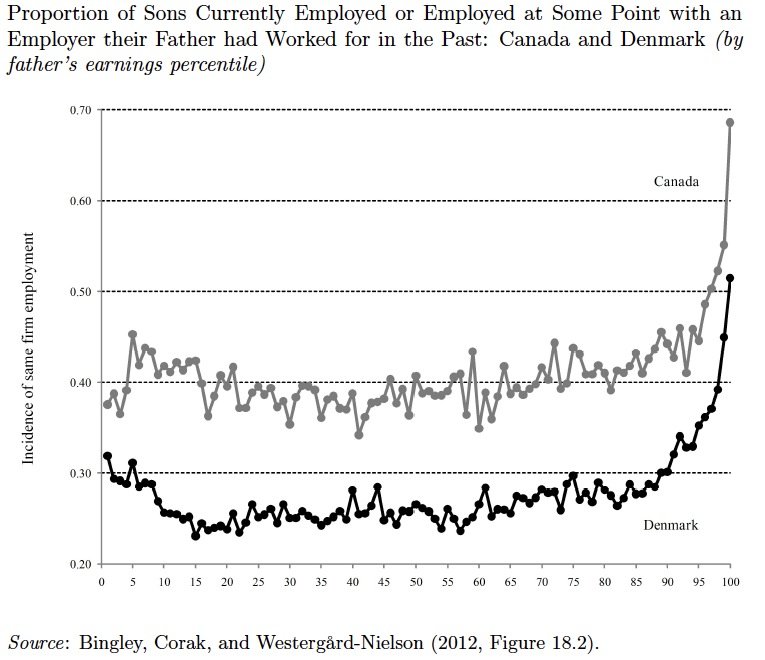
Here’s one way the rich hold onto their wealth: By hiring their spawn. This way, the wealth and the accumulated power stay in the family, rather than dissipate outwords. Toby Nangle tweeted out this great chart from economist Miles Corak, who has done a lot of work on wealth mobility. It shows the likelihood that a son at some point in their life works for the same firm that their father once worked for across various income levels. The conclusion couldn’t be more clear: The richer the father is, the more likely it is that their son will work at a firm they worked for at some point in their life. As you get to the very elite, the % of sons sharing an employer with their father just soars. The numbers in the survey are from Canada or Denmark, but the similarity across countries indicates that this is a pattern not confirmed to just those two.
screen shot 2013-08-19 at 2.30.24 pm


Taking the Xerox business model out of its box

Taking the Xerox business model out of its box

Dan Ovsey | 13/08/19 | Last Updated: 13/08/16 7:45 PM ET

DC_Ursula_Burns05.jpg

Darren Calabrese/National PostXerox CEO Ursula Burns says the inventor of the photocopier is divesting itself of traditional DocuTech processes and investing much more heavily in high-end printing and other services that cater to businesses in an era of customized, on-demand and just-in-time needs. When Ursula Burns began her career at Xerox in 1981 as part of the product development team, the company was known almost exclusively for its flagship photocopiers. Since then, she has seen the advent of the Internet, digital communication, on-demand service models and just-in-time business processes. Now the company’s CEO — and the first African-American woman to lead a Fortune 500 company — Ms. Burns has the unenviable task of transforming and re-branding Xerox into a services-based tech company that must partially distance itself from what has made its brand famous, in order to remain relevant in the future. During a recent trip to Toronto, she spoke with FP’s Dan Ovsey about the rationale and genesis behind Xerox’s service push, where it’s making strategic investments and how it will identify the people and processes to make the shift work. Following is an edited transcript of their conversation. Read more of this post

Is Economics More Like History Than Physics?

Is Economics More Like History Than Physics?

By Jag Bhalla | August 16, 2013 |  12

Is economics like physics, or more like history? Steven Pinker says, “No sane thinker would try to explain World War I in the language of physics.” Yet some economists aim close to such craziness.

Pinker says the ”mindset of science” eliminates errors by “open debate, peer review, and double-blind methods,” and especially, experimentation. But experiments require repetition and control over all relevant variables. We can experiment on individual behavior, but not with history or macroeconomics. Read more of this post

We’re not a start-up nation, Or even a nation at all, as the envy and spite aroused by the IBM-Trusteer deal reveal

We’re not a start-up nation

The Trusteer deal exposes Israel of 2013 as a collection of cultures, countries, world views, and tribes.

20 August 13 12:57, Yanki Margalit

Congratulations to Shlomo Kramer and Mickey Boodaei, the investors, and the hundreds of employees of Trusteer Ltd. An impressive business success. You established and built a real, global information security company with a reputation. Congratulations to IBM (NYSE: IBM) on its 14th acquisition in Israel and on the establishment of an information security center in the country. Read more of this post

The Beauty of Limits

August 19, 2013

The Beauty of Limits

By CARL RICHARDS

Haow often do we hear ourselves saying we want more? More freedom, more money, more time. More seems as if it would always be great, until we get it. Then we’re faced with a new set of problems that comes with having more. My work is location-independent. My wife and I could live anywhere that our budget will allow, and that ends up being a lot of places. Normally having more options is what we want, but this has actually led to a consistent problem that we spend a lot of time discussing. Read more of this post

Talking About Your Goals Makes You Less Likely To Achieve Them; the personal satisfaction of achievement is infinitely sweeter than public acclaim

Say What? Talking About Your Goals Makes You Less Likely To Achieve Them

JEFF HADENLINKEDIN AUG. 20, 2013, 10:53 AM 1,422 1

We all have a huge personal goal we want to accomplish: A big, challenging, amazing goal. We think about it, dream about it, obsess about it… but we never accomplish it. That could be because we also talked about it, because according to some studies, people who talk about their intentions are less likely to follow through on those intentions. Say you want to thru-hike the Appalachian Trail, a grueling five- to seven-month trek from Georgia to Maine. (Having completed about 2% of it, I’m not so well on my section-hiking way, much less thru-hiking.) You’re having dinner with friends and you tell them all about it. “Oh, wow!” one exclaims. “That sounds amazing. But won’t it be super hard?” Read more of this post

London Is A Better Place To Visit Than Paris [INFOGRAPHIC]

London Is A Better Place To Visit Than Paris [INFOGRAPHIC]

MELISSA STANGER AUG. 20, 2013, 3:01 PM 1,902 6

London is known for its beautiful and historic architecture. Paris is famous for its exquisite cuisine. Each city is unique in different ways, but when put head to head, which comes out on top? It’s a close call, but London clearly has the advantage, according to a new infographic by Ally Biring of travel booking site HouseTrip.com. Biring compared different aspects of each city, including restaurants, cuisine, landmarks, architecture, and local sights, and found that London topped Paris in most of these categories. London has more museums, more landmarks and attractions, and more UNESCO sites, like the Tower of London and Westminster Abbey, than Paris. It also has more restaurants, lots of free parks and museums, and it’s cheaper for tourists to get around. However, Paris made a compelling case for itself. It’s the home of Disneyland Paris and the iconic Eiffel Tower. A city well-known for its food, Paris may not have as many restaurants as London, but it has more Michelin-starred restaurants and many world-class culinary schools. Take a look at HouseTrip’s infographic to see how the two cities measure up in each category.

paris vs. london final (logo - 990px)

How ‘Power Poses’ Can Help Your Career; Posture actually affects a person’s hormones and behavior, new research shows

August 20, 2013, 6:57 p.m. ET

How ‘Power Poses’ Can Help Your Career

Posture actually affects a person’s hormones and behavior, new research shows

SUE SHELLENBARGER

New research shows posture has a bigger impact than anyone believed: It actually changes a person’s hormones and behavior, and even has an impact on how you are perceived in the workplace. WSJ’s Sue Shellenbarger and marketing executive Kathy Keim discuss. Photo: Jarrard Cole/The Wall Street Journal.

Print

Can how you stand or sit affect your success? New research shows posture has a bigger impact on body and mind than previously believed. Striking a powerful, expansive pose actually changes a person’s hormones and behavior, just as if he or she had real power. Merely practicing a “power pose” for a few minutes in private—such as standing tall and leaning slightly forward with hands at one’s side, or leaning forward over a desk with hands planted firmly on its surface—led to higher levels of testosterone and lower levels of the stress hormone cortisol in study participants. These physiological changes are linked to better performance and more confident, assertive behavior, recent studies show. Read more of this post

Command of written Chinese declines in digital era; Many Chinese resort to pinyin, or romanised Putonghua, when using a keyboard but their grasp of the written language is weakening as a result

Command of written Chinese declines in digital era

Tuesday, 20 August, 2013, 12:00am

Mandy Zuo mandy.zuo@scmp.com

Many Chinese resort to pinyin, or romanised Putonghua, when using a keyboard but their grasp of the written language is weakening as a result

A popular spelling competition run on state broadcaster CCTV has reinforced fears Chinese are losing their grasp of their own written language – thanks, it appears, to computer and mobile device keyboards. Seventy per cent of adults in the audience of Chinese Characters Dictation Competition have been unable to write, by hand, the characters for the word “toad” correctly . Read more of this post

The Vulnerability of Asian Markets Then (1997) and Now (2013)

Aug 20, 2013

The Vulnerability of Asian Markets Then (1997) and Now (2013)

By Vincent Cignarella

It was a toxic combination that sparked the Asian financial crisis in 1997. The bad news is that same combination–of Federal Reserve monetary tightening and Japanese fiscal tightening–is looming once again. Rewind to March 1997. Then, the Fed’s communications policy bore little resemblance to the current era of transparency, so inevitably some investors were taken aback when the central bank raised the discount rate, the rate at which the Fed lends money to commercial banks, to 5.5% from 5.25% after two years of trimming rates. (Remember, this was before fed funds targeting was in vogue.) Read more of this post

Happy Meal Convertible Offerings Make People Angry

20 Aug 2013 at 11:40 AM

Happy Meal Convertible Offerings Make People Angry

By Matt Levine

It is not every day that the Wall Street Journal has afront-page article about “happy meal” convertible offerings with registered stock borrow facilities so I’m going to tell you about them. Here is what they are:1 A company sells a convertible bond to convertible arbitrageurs. At the same time, it lends shares of its own stock to the arbs so they can establish their hedge for the convertible. As the Journal points out, these deals go pear-shaped with horrific frequency – a third of them go bankrupt within five years, versus 7% of all convertible issuers.2And now people are all mad and suing and stuff, and there are insinuations that evil hedge funds made lots of evil money on these evil deals. All of this is very confused so let’s talk about it in excruciating detail shall we? Read more of this post

Asia’s debt conundrum reawakens ghosts of 1990s crisis

August 20, 2013 1:21 pm

Asia’s debt conundrum reawakens ghosts of 1990s crisis

By Josh Noble in Hong Kong

When China unleashed the largest stimulus package in its history in response to the2008 crisis and slowing export markets in the west, it came at a price. Today China is grappling with a bill that some economists say has driven total debt to gross domestic product past 200 per cent. While China offers the most extreme example of using debt to fund growth, it is a pattern that has been repeated across Asia. Without exports, central banks turned on the taps, leading to a jump in household and corporate borrowing. Read more of this post

As investors mull QE finale, Asia’s miracle shows signs of wear

As investors mull QE finale, Asia’s miracle shows signs of wear

5:04pm EDT

By Wayne Arnold and Tomasz Janowski

HONG KONG/TOKYO (Reuters) – Asia’s economic miracle looks increasingly vulnerable to the end of a decidedly earthly phenomenon – five years of ultra-cheap financing sparked by the U.S. monetary policy dubbed “quantitative easing”. The notion that a region associated with thrift, low debt and high savings is vulnerable to an ebbing tide of global credit is controversial. But the sell-off gripping emerging foreign exchange and equity markets this week has exposed an Asia that, despite amassing huge currency reserves and devising policies to insulate it from the kind of fund flight that triggered the Asian financial crisis in 1997 and 1998, has once again become susceptible to the rapid reversal of capital inflows. Read more of this post

Heavy debt weighs on Southeast Asian consumers; Betting on Asean growth may have become questionable

August 20, 2013 3:20 pm

Heavy debt weighs on Southeast Asian consumers

By Jeremy Grant

Betting on Asean growth may have become questionable

When Dhanin Chearavanont, Thailand’s richest man, committed this year to buying back a domestic discount store chain he once owned, it was clear he wanted it very badly. Mr Dhanin’s offer represented a whopping 44 times expected 2013 profits at Siam Makro, which is now a unit of Charoen Pokphand, Thailand’s largest agribusiness and food company of which he is chairman. The big idea was to expand the Makro concept of membership-only, cash-and-carry stores out of Thailand, where it has 57 stores, and across Southeast Asia, to take advantage of the region’s rising middle class. We hear a lot about the middle class in the countries of the Association of Southeast Asian Nations these days. As a way of describing how people are being lifted from rural poverty by moving to higher-paying jobs in cities, where they buy microwaves and kitchen utensils, it points to a trend. But betting too heavily on it may have become a questionable exercise, for two reasons. Read more of this post

King of Knives collapse: administrators to cut stores and staff

Ben Hurley Reporter

King of Knives collapse: administrators to cut stores and staff

Published 20 August 2013 12:02, Updated 20 August 2013 13:08

The King of Knives chain will continue to trade as administrators assess the state of the business.Photo: Kitty Hill

The creditors of national homewares franchise King of Knives will meet this Friday to determine the future of the company after it went into voluntary administration last week. The 25-year-old business, which has 60 stores in Australia and New Zealand, has been struggling through a difficult retail climate in recent years. But it was a decision from its bankers to withdraw finance that pushed it over the edge. “That put them in a cash crunch position which the directors had to fund personally, and they did,” says Antony Resnick, partner at appointed voluntary administrator BRI Ferrier. “We’re currently meeting with the key landlords to try to keep the group alive. We’re trading all stores at the moment. Read more of this post

Protege-Backed Expedition Shuts Asia Volatility Fund After Loss

Protege-Backed Expedition Shuts Asia Volatility Fund After Loss

Expedition Advisors Ltd., backed by New York-based Protege Partners LP, is returning investor capital in its Asia volatility hedge fund after losses. Expedition’s hedge fund, which sought to profit from stock swings in Asia outside of Japan, lost 14 percent since its May 2012 inception, according to its March newsletter, the last one sent out to investors and non-investors in the fund and obtained by Bloomberg News. “A prolonged period of suppressed volatility combined with a low ’vol of vol’ environment created a very difficult backdrop for our core strategy,” Craig James, Hong Kong-based chief investment officer of Expedition, said in an e-mailed statement. “Given the current climate, it was decided that money would be returned to our strategic investor.” Read more of this post

Super funds head Australia’s top 500 private companies

Super funds head Australia’s top 500 private companies

PUBLISHED: 1 HOUR 43 MINUTES AGO | UPDATE: 1 HOUR 17 MINUTES AGO

BEN WOODHEAD

Superannuation funds have again dominated the pointy end of Australia’s top 500 private companies, with Anthony Pratt-helmed Visy Industries the only non-super fund to squeeze into the top 10. Measured by total revenue, BRW’s annual list of the top 500 companies found AustralianSuper was once again the biggest private business in Australia, with total annual revenue of $24.9 billion in the 2012-2013 financial year. First State Super Fund was a distant second with $11 billion in revenue, while UniSuper moved up one rung on the ladder to come in at number three among the biggest private companies with revenue of $8.5 billion. Read more of this post

Xinhua reveals China’s ‘Area 51’ in Inner Mongolia

Xinhua reveals China’s ‘Area 51’ in Inner Mongolia

Staff Reporter

2013-08-21

area51-152809_copy2

A satellite image of the secret Badan Jilin Desert range. (Internet photo)

After the Central Intelligence Agency acknowledged the existence of Area 51 as a testing site for U-2 spy planes, a secret Chinese missile range in the Badan Jilin Desert in Inner Mongolia has become the world’s next great site of unexplained mystery, according to Duowei News, a media outlet operated by overseas Chinese. Photo of this secret military site were first revealed by the official news agency Xinhua on Aug. 19 in a report which said the site is never featured on any official maps approved by the government and its purpose had never previously been mentioned in any media report. This secret military facility was established in 2003 for the People’s Liberation Army to test its ballistic missiles and fighters, Xinhua said. Photos published by Xinhua showed the words “those who steal secrets will be caught and executed” outside the entrance of the facility. The history of the base goes back to 1958, when it was originally designed as two shooting ranges, one for ballistic missiles and the other for aircraft. After the integration of the sites in 2003, China’s first indigenous fourth-generation fighter completed its last air-to-air missile tests over the Badan Jilin Desert on Dec. 25 of that year. Various Chinese aircraft and aviation equipment have been tested at the site before entering production. Air combat exercises similar to the Red Flag exercise held at Nellis Air Force Base in Nevada and Eielson Air Force Base in Alaska can also be conducted at the Badan Jilin range, according to Xinhua.

Wine exchange market booming in China with many winemakers able to borrow significant finances from the capital market

Wine exchange market booming in China

Staff Reporter

2013-08-21

The wine exchange market is booming in China, with many winemakers able to borrow significant finances from the capital market, reports the Guangzhou-based Southern Metropolis Daily. Between 2011 and 2012, investors channeled funds into sought-after wine brands, pushing up their prices to record highs. The price of a special 2012 edition of crystal white wine touched 1,200 yuan (US$196) a bottle in March and closed at 979 yuan (US$159) a bottle during its first trading day. This was a 25.5% jump from the wine’s original price. Some 14,079 bottles of the special edition wine were traded that day, with an exchange rate of 14.08%. Read more of this post

Tough-talking China pricing regulator sought confessions from foreign firms

Tough-talking China pricing regulator sought confessions from foreign firms

12:49am EDT

By Michael Martina

BEIJING (Reuters) – A senior Chinese official put pressure on around 30 foreign firms including General Electric and Siemens at a recent meeting to confess to any antitrust violations and warned them against using external lawyers to fight accusations from regulators, sources said. The meeting is evidence of what many antitrust lawyers in China see as increasingly aggressive tactics to enforce a 2008 anti-monopoly law and highlight a worsening relationship between foreign companies and China’s array of regulators. Two sources who were at the July 24-25 closed-door meeting said the senior official showed in-house lawyers how to write what they called “self-criticisms” and displayed copies of letters from companies admitting guilt in past antitrust cases. Lawyers employed by some of those firms were in the room. Read more of this post

Many Wall St. Banks Woo Children of Chinese Leaders

AUGUST 20, 2013, 8:46 PM

Many Wall St. Banks Woo Children of Chinese Leaders

By DAVID BARBOZA

For more than a decade, Wall Street’s biggest banks have hired the sons and daughters of senior Chinese government officials in the hopes that they can open doors and secure deals in the world’s fastest-growing major economy. The hirings were not well publicized, but they were no secret. The grandson of former Chinese President Jiang Zemin once worked for Goldman Sachs; the daughter of former Prime Minister Wen Jiabao used to work forCredit Suisse; and in 2006, the son-in-law of Wu Bangguo, then a member of the Politburo of the Communist Party, helped Merrill Lynch win a deal to arrange a $22 billion listing of the state-owned banking giant I.C.B.C. Read more of this post

Inner Mongolia: Where Bankers Sold Bunk; Shady banking practices have come to light at the fraud trial of a wealthy woman, and the regulator says insider crimes are a nationwide concern

08.21.2013 12:03

Inner Mongolia: Where Bankers Sold Bunk

Shady banking practices have come to light at the fraud trial of a wealthy woman, and the regulator says insider crimes are a nationwide concern

By staff reporters Wen Xiu and Wang Heyan

(Hohhot) – Underlying the trial of a woman authorities say drained bank accounts and kidnapped a banker’s wife are vexing questions about account security and teller supervision at China’s state-run bank branches in Inner Mongolia. Hundreds of millions of yuan were stolen from customer accounts at the Bank of China’s (BOC) branch and the Agricultural Bank of China’s (ABC) branch in the city of Bayan Nur between 2007 and 2011, say prosecutors who have charged Tu Ya and 23 alleged accomplices. These include Tu’s husband Jin Junping, a boyfriend named Li Shengrong and 11 former BOC employees. Read more of this post

Fraud Inquiry into Shanghai Insurance Firm Rattles Industry; Regulator takes closer look at companies after head of one dealer bolted to Fiji with a reported 500 million yuan

08.20.2013 19:00

Fraud Inquiry into Shanghai Insurance Firm Rattles Industry

Regulator takes closer look at companies after head of one dealer bolted to Fiji with a reported 500 million yuan

By staff reporter Wang Shenlu

Beijing – A fraud investigation into Shanghai’s largest insurance dealer has roiled the country’s insurance industry, prompting the regulator to meet and order closer scrutiny of such firms. Chen Yi, the general manger of Fanxin Insurance Agency Co., was escorted from Fiji back to China by Chinese police on August 19, Xinhua reported. On August 15, the Shanghai branch of the China Insurance Regulatory Commission (CIRC) said the company was selling unauthorized fixed-income financial agreements. A source close to the company said Fanxin engaged in sales fraud to get high commission fees from insurance companies. Public security officials in Shanghai said they received reports on August 12 that Chen had left the country with 500 million yuan. They have not been able to confirm that figure.

Read more of this post

China’s Corporate Crackdown

China’s Corporate Crackdown

20 August 2013

Simon Zadek

BEIJING – Multinational corporations are under siege in China. In recent months, the government has leveled a series of allegations of corporate misconduct – ranging from food-product contamination to price rigging, bribery, and environmental shortfalls – against foreign-owned companies, with important implications for the development of China’s business environment. Does the government’s recent behavior reflect a commitment to strengthening business ethics, marking the start of a long-overdue regulatory catch-up process? Or is it intended merely to create a convenient populist distraction from China’s current economic woes? Or are these revelations of often long-known corporate misdemeanors part of a complex power play involving competing Chinese interests? Read more of this post

Bitcoin Spawns China Virtual IPOs as U.S. Scrutiny Grows

Bitcoin Spawns China Virtual IPOs as U.S. Scrutiny Grows

The Bitcoin craze is catching on in China.

Sun Minjie is a 28-year-old Internet worker who lives in Beijing. Eager to profit from growing demand for the digital currency, Sun has invested more than $3,000 in a company called 796 Xchange Ltd., an online exchange for trading stocks and other financial instruments related to Bitcoin, where initial public offerings are also being held.

He’s part of a small but growing group of investors in China who have put the country into contention with the U.S. as the biggest downloader of the virtual money that’s being used to buy a growing range of goods and services online. While intensified scrutiny by U.S. regulators casts doubt on the currency’s future there, China’s Bitcoin industry is expanding. Read more of this post

Eat, drink, man, woman, meatballs; Ikea has figured out ‘glocal’ in a way that has eluded foreign retailers

August 20, 2013 5:30 pm

Eat, drink, man, woman, meatballs

By Patti Waldmeir in Shanghai

Ikea has figured out ‘glocal’ in a way that has eluded foreign retailers, writes Patti Waldmeir

What modern institution in China provides food, housing, love and babysitting, all under one roof? The Communist party may have dashed the Maoist “ iron rice bowl” to the ground, but Ikea is stepping in to take up the slack. The world’s largest furniture retailer not only invites Chinese consumers to nap on its beds and snack on its dinnerware; it lets pensioners hold matchmaking sessions over free coffee in its canteens, and even provides day care for the only grandchild, to make the whole Eat Drink Man Womanthing go that much more smoothly. Read more of this post

On Wall Street, a Reversal of Fortune; Slump in Aluminum Deliveries Marks Unraveling of Profitable Business

August 20, 2013, 5:12 p.m. ET

On Wall Street, a Reversal of Fortune

Slump in Aluminum Deliveries Marks Unraveling of Profitable Business

CHRISTIAN BERTHELSEN And TATYANA SHUMSKY

MI-BX983A_BANKT_G_20130820180027

Aluminum deliveries into warehouses run by big banks and trading firms have plunged this summer, highlighting Wall Street’s retreat from the once-lucrative commodities business amid stagnant markets, new rules and regulatory scrutiny. The slump marks the unraveling of a practice that boosted profits for several years at warehouse operators including Goldman Sachs Group Inc. GS +0.59% and Glencore Xstrata PLC. GLNCY -1.88% Bank warehousing practices now are the subject of investigations by several U.S. authorities, including a Senate panel. Read more of this post

As India’s Rupee Drops, Foreign Firms Reel; Fear of Fed Retreat Roils India; Economic Weakness in Developing Nations Is Laid Bare as Easy Money Dries Up; Rupee exposes India’s corporate debt stack

August 20, 2013, 1:59 p.m. ET

As India’s Rupee Drops, Foreign Firms Reel

SEAN MCLAIN

MK-CF705_INDOCO_NS_20130820173903 MK-CF706_INDOCO_NS_20130820171503

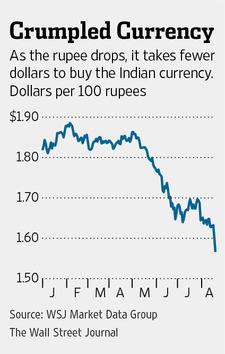
NEW DELHI—As India’s economy shifted into low gear earlier this year, sales at the country’s largest car manufacturer also lost steam, falling nearly 7% in the second quarter from a year earlier. Now the auto maker, Maruti Suzuki India Ltd., 532500.BY -0.81% faces trouble on a new front: the rapid drop in the Indian currency. The rupee has slumped nearly 3% against the dollar since last Wednesday and roughly 15% since May. “If the rupee remains where it is, it is going to hurt everybody across sectors,” Maruti Suzuki Chief Financial Officer Ajay Seth said Tuesday. “All the fundamentals have become very difficult right now.” Read more of this post

Japan to issue gravest Fukushima nuclear warning in two years; Fukushima Springs Another Leak in Battle With Radiated Water

Japan to issue gravest Fukushima nuclear warning in two years: agency

Tue, Aug 20 2013

By Kentaro Hamada and James Topham

TOKYO (Reuters) – Japan will dramatically raise its warning about the severity of a toxic water leak at the Fukushima nuclear plant, its nuclear watchdog said on Wednesday, its most serious action since the plant was destroyed by an earthquake and tsunami in 2011. The deepening crisis at the Fukushima plant will be upgraded from a level 1 “anomaly” to a level three “serious incident” on an international scale for radiological releases, a spokesman for Japan’s Nuclear Regulation Authority (NRA) said. That will mark the first time Japan has issued a warning on the International Nuclear Event Scale (INES) since three reactor meltdowns after the massive quake in March 2011. Read more of this post

How did a Japanese anime film set a Twitter record for the largest number of tweets per second?

How did a Japanese anime film set a Twitter record?

Aug 20th 2013, 23:50 by T.S. & E.S.

20130824_BLP504

STUDIO Ghibli is a Japanese animation studio renowned for its hugely successful anime films, the best known of which is “Spirited Away”, directed by Hayao Miyazaki, which won the Oscar for best animated feature in 2003. Earlier this month the studio won an accolade of a rather different kind, when the airing of another of its films, “Castle in the Sky” (pictured), set a new record for the largest number of tweets per second. How did the film set this record, and why is Twitter so keen to explain how it coped? Read more of this post