Sliced and diced, digitally: autopsy as a service; Malaysian entrepreneur Matt Chandran wants to revive the moribund post-mortem by replacing the scalpel with a scanner and the autopsy slab with a touchscreen computer

Sliced and diced, digitally: autopsy as a service

By Jeremy Wagstaff

SINGAPORE (Reuters) – Malaysian entrepreneur Matt Chandran wants to revive the moribund post-mortem by replacing the scalpel with a scanner and the autopsy slab with a touchscreen computer. He believes his so-called digital autopsy could largely displace the centuries-old traditional knife-bound one, speeding up investigations, reducing the stress on grieving families and placating religious sensibilities. Read more of this post

Now Vietnam wants to “manage” chat apps, and media says ban possible

Now Vietnam wants to “manage” chat apps, and media says ban possible

10:07am EDT

HANOI (Reuters) – Vietnam’s government is to decide policy in managing free internet-based telecom tools like Viber, Line and Whatsapp, Prime Minister Nguyen Tan Dung said on Friday, a move bound to increase concerns about Communist Party censorship. State media said the government might “ban” free messaging services because of the harm done to network providers. Vietnam has repeatedly come under fire for curbs on free speech and harsh treatment for bloggers who dare to criticize the one-party regime. Read more of this post

Reversal of Fortune for Bangkok; Southeast Asia gets whipsawed by global money flows

August 20, 2013, 12:36 p.m. ET

Reversal of Fortune for Bangkok

Southeast Asia gets whipsawed by global money flows.

The land of smiles is not in a cheerful mood. Second quarter data out of Thailand on Monday showed that the economy contracted for a second time on a quarter-on-quarter basis, which was worse than expected and puts it technically in recession. The government has cut its growth forecast for the year to a range of 3.8% to 4.3% from its previous estimate of 4.2% to 5.2%. The main stock index dropped 3.3% on Monday and 2% on Tuesday. Read more of this post

Twitter’s Video App Vine hits 40m users despite Instagram’s challenge

Vine hits 40m users despite Instagram’s challenge

August 20, 2013 11:02 pmby Tim Bradshaw

Many thought that Instagram’s addition of 15-second videos to its photo-sharing app would kill Vine, Twitter’s fledgling video app. Apparently not. Twitter on Tuesday said that 40m people have signed up to watch and share six-second videos on Vine. That’s up from 13m at the beginning of June, a figure announced as Vine launched on Android, a couple of weeks before Instagram launched its competitor. Read more of this post

StreetEasy $50 Million Buyout by Zillow Shows NYC’s Addiction to Site

StreetEasy Buyout by Zillow Shows NYC’s Addiction to Site

Zillow Inc. (Z)’s purchase of StreetEasy for $50 million shows how dominant the listings website has become in the New York City real estate market seven years after it was founded.

StreetEasy allows users to view apartments for sale as well as all units that have sold in a given building, how long they were on the market, and what kind of discount their owners had to offer to strike a deal. If someone in your building had a federal tax lien filed against their apartment, you can find that on StreetEasy. Want to know when a unit is listed for sale at an exclusive Park Avenue co-op? That’s possible too. Read more of this post

Problem for Bezos: Mall Becoming Cheaper Than Amazon

August 19, 2013, 12:21 PM

Problem for Bezos: Mall Becoming Cheaper Than Amazon

By Tom Gara

You might think the biggest challenge for Amazon founder Jeff Bezos is figuring out how to make money running a print newspaper, but here is a risk hitting much closer to home: Brick-and-mortar retail stores are becoming cheaper than AmazonAMZN +1.10%. At least one store, that is. Prices at Bed Bath & BeyondBBBY +1.79% were on average 6.5% less than at Amazon for a basket of 30 items chosen by analysts atBB&TBBT +0.90% for one of their periodic pricing studies comparing the retailers. “We are becoming increasingly concerned Bed Bath & Beyond is sacrificing gross margin in order to drive top-line growth,” BB&T said — that is, increasingly concerned that Bed Bath & Beyond is starting to behave more like Amazon. Read more of this post

New York State Comptroller to Promote Investments in Silicon Alley

AUGUST 20, 2013, 10:17 AM

New York State Comptroller to Promote Investments in Silicon Alley

By MICHAEL J. DE LA MERCED

As New York City continues to promote the rise of Silicon Alley start-ups, the state comptroller’s office is doing its part for the cause. On Tuesday, the office of Thomas P. DiNapoli plans to promote its investments in two technology companies, RebelMouse and CoopKanics, as part of its initiative to invest in New York businesses. (The two transactions were previously disclosed by the companies themselves.) The investments were made as part of the comptroller’s In-State Private Equity Program, which meant to support native New York businesses while also generating hopefully solid returns. Last year, the comptroller’s office boasted that the program over all had yielded an internal rate of return exceeding 30 percent. Read more of this post

New Roamio: New Version of TiVo Lets Users Watch TV Content on Mobile Devices

August 20, 2013, 9:00 p.m. ET

New Roamio: TiVo on the Go

New Version of TiVo Lets Users Watch TV Content on Mobile Devices

WALTER S. MOSSBERG

PJ-BQ057A_PTECH_G_20130820195944

It is popular to beam video from a mobile device to a TV, but how can you do the opposite? Walt Mossberg reviews the TiVo Roamio which allows you to stream TV and DVR to your iOS device and could be “the holy grail of set-top boxes.” (Photo: TiVo)

Last week, I wrote about the many ways to get Internet video on your TV. Several readers asked how to do the opposite—how to view standard cable TV content, in real time, on a smartphone and tablet. So this week, I’m reviewing a new version of a familiar product that does just that. Read more of this post

Advertisers Can’t Stop Thinking About The Google Glass ‘Pay Per Gaze’ Patent

Advertisers Can’t Stop Thinking About The Google Glass ‘Pay Per Gaze’ Patent

LAURA STAMPLER AUG. 19, 2013, 8:46 AM 2,671

Good morning, AdLand. Here’s what you need to know today: While Google said that it wouldn’t allow ads to be displayed on Google Glass, the tech giant put in a patent for “pay per gaze” technology for ads, which would track how many times a consumer looked at the branded content. And the ad industry can’t stop wondering what this means. Ad Age notes that this technology could be used to measure how people react to ads they view in their surroundings — tracking how dilated pupils get after seeing a particular billboard, for example. Radio ad growth might be stagnant, but digital radio ads grew 16% between Q2 2012 and Q2 2013. Digital marketing company Kenshoo Social released a report saying that users are engaging more frequently with Facebook ads. Apparently there is hope for the banner ad, says DigidayMichael Kors made a Facebook app that allows users to choose their own adventure. Just as people were starting to quiet down about the Omnicom-Publicis merger, Atlanta-based ad agency Ames Scullin O’Haire made a video that parodies the event. Pizza Hut’s creative review rages on. Mullen, mcgarrybowen, Havas Worldwide, and current shop The Martin Agency are all in the running.  Ad Age identifies the women to watch in China.

AUGUST 20, 2013, 3:38 PM

How Pay-Per-Gaze Advertising Could Work With Google Glass

By NICK BILTON and CLAIRE CAIN MILLER

Google wants to see what you see. And then, of course, make money from those images. The company was recently awarded a patent that puts forth an idea for pay-per-gaze advertising — a way in which people interacting with ads in the real world could be analyzed in the digital world. Read more of this post

Facebook Leads an Effort to Lower Barriers to Internet Access

August 20, 2013

Facebook Leads an Effort to Lower Barriers to Internet Access

By VINDU GOEL

MENLO PARK, Calif. — About one of every seven people in the world uses Facebook. Now, Mark Zuckerberg, its co-founder and chief executive, wants to make a play for the rest — including the four billion or so who lack Internet access.

On Wednesday, Facebook plans to announce an effort aimed at drastically cutting the cost of delivering basic Internet services on mobile phones, particularly in developing countries, where Facebook and other tech companies need to find new users. Half a dozen of the world’s tech giants, including Samsung, Nokia, Qualcomm and Ericsson, have agreed to work with the company as partners on the initiative, which they call Internet.org. Read more of this post

Epic and Medium step together into longform experiment

Epic and Medium step together into longform experiment

BY HAMISH MCKENZIE 
ON AUGUST 20, 2013

On two occasions, Joshua Davis spent seven years working on a story that lived a brief, bright life in the pages of a glossy magazine, only to be ultimately confined to a dark corner of the Internet. A national magazine will go to great lengths to give a longform story first-class treatment. Designers and editors shine that thing up until it’s a glistening specimen of journalism. But the paper version of the product only get serious attention for the four weeks that the magazine sits on a newstand. Chances are high that the story will then go on to live a neglected digital life. Read more of this post

Birthday Greetings, Now Sent by Text and Twitter; Hallmark’s card sales dropped to 5 billion cards a year in 2012, down from 6 billion in 2011. American Greerings went private this year after rapid declines in sales

AUGUST 20, 2013, 9:00 AM

Birthday Greetings, Now Sent by Text and Twitter

By NICK BILTON

On my birthday, I received a slew of lovely birthday greetings.

By early morning I had stacked up 93 birthday wishes on Facebook — one even included a $5 Starbucks gift card! About 20 strangers digitally congratulated me on Google Plus. A dozen people chirped “happy birthday” to me on Twitter. Fifteen friends and family members sent me emoji-filled birthday wishes over text message. Eight over e-mail. Two voicemails. And one person yelled Happy Birthday on SnapChat. Read more of this post

Big Data poses questions for investors: How should investors in companies operating in a hyped-up technology field feel?

Big Data poses questions for investors

How should investors in companies operating in a hyped-up technology field feel?

20 August 13 10:15, Shmulik Shelach

Over-enthusiasm about a technology trend is part of the lifestyle of the enterprise computing world. The reason is clear: $2.2 trillion will be spent this year along the enterprise computing food chain, from PC components through hardware for infrastructures at server farms worldwide. This is big money, and any fluctuation in a technology trend can result in vendors of new solutions to painful problems of IT systems managers winning big budgets. Read more of this post

Big Box retail is watching you; New technology is allowing brick-and-mortar stores to invade their shoppers’ Levis for personal information like never before.

Big Box retail is watching you

August 20, 2013: 10:51 AM ET

New technology is allowing brick-and-mortar stores to invade their shoppers’ Levis for personal information like never before.

By Ethan Rouen

FORTUNE — Just about everyone knows that feeling of violation when a company digs deeper into your pocket than you want, but new technology is allowing brick-and-mortar stores to invade their shoppers’ Levis for personal information like never before. With the ability to track customer cell phones, retailers have unprecedented access to shoppers’ habits, from how frequently a customer visits a store to how long he stands at a window display before deciding whether or not to enter the shop. Read more of this post

Peter Chou – Is he HTC’s savior or obstacle to revival?

Peter Chou – Is he HTC’s savior or obstacle to revival?

5:09pm EDT

By Jeremy Wagstaff and Clare Jim

SINGAPORE/TAIPEI (Reuters) – Now in his tenth year as CEO of HTC Corp, Peter Chou is lauded as the architect of the Taiwanese firm’s award-winning smartphones. But as the company’s fortunes have dived, some insiders say he’s now an obstacle to any revival.

Rocked by internal feuding and executive exits, and positioned at the high-end of a smartphone market that is close to saturation, HTC has seen its market share slump to below 5 percent from around a quarter five years ago; its stock price is at 8-year lows, and it has warned it could make a first operating loss this quarter. Read more of this post

Is Russia Already in Recession?

Is Russia Already in Recession?

(Corrects date of end of Putin’s term in final paragraph.)

Russia’s economy, long one of the drivers of growth in the developing world, might already be in recession. Worse, the country’s leaders are offering no indication that they’re prepared to combat it. Identifying recessions can be difficult in Russia. The typical definition is two quarters of declining gross domestic product, adjusted for inflation, but government statistics agency Rosstat provides only year-over-year data for international comparison. Read more of this post

The economic footprint of BPO industry; BPO industry in Philippines currently employs 770,000 people with total revenue expected to reach $6 billion

The economic footprint of BPO industry

FILIPINO WORLDVIEW By Roberto R. Romulo (The Philippine Star) | Updated August 21, 2013 – 12:00am

The Business Process Outsourcing Industry has come a long way since I first espoused the merits of this global business phenomenon in 2001, helping position the country, in collaboration with the early movers of BPO, by setting up Outsource Philippines and doing road shows all over the US and the UK. It was a big bet for investors to come to the Philippines back in those days. Read more of this post

New Zealand Targets Mortgage Lending to Avert Bubble; Restrictions to Be Placed on Bank Lending to Home Buyers Able to Make Only Small Downpayments

August 20, 2013, 5:05 a.m. ET

New Zealand Targets Mortgage Lending to Avert Bubble

Restrictions to Be Placed on Bank Lending to Home Buyers Able to Make Only Small Downpayments

LUCY CRAYMER And REBECCA HOWARD

WELLINGTON, New Zealand—New Zealand’s central bank imposed new curbs on mortgage lending aimed at heading off a nascent housing bubble that in the past has contributed to a recession. Reserve Bank of New Zealand Gov. Graeme Wheeler said in a speech that from Oct. 1, restrictions would be placed on bank lending to home buyers able to make only small downpayments. Under the plan, no more than 10% of new mortgage lending by registered banks may be to borrowers that put down less than 20% of the cost of the property as a deposit. Read more of this post

Malaysian price-comparison startup iMoney is taking over Asia one country at a time, and its next target is Thailand

iMoney is taking over Asia one country at a time, and its next target is Thailand

August 20, 2013

by Saiyai Sakawee

iMoney, a Malaysian startup, is a free online personal finance platform that helps users make comparisons between loans, credit cards, savings, and other banking services. It aims to make these complex products simpler and easier to choose between, and promises users a neutral, unbiased viewpoint from which to judge different banks’ services. In June, it raised funds from Asia Venture Group (AVG). Since then, it has expanded beyond Malaysia to five other countries; Singaporethe PhilippinesThailandHongkong, and Indonesia. According to Lee Ching Wei, iMoney’s co-founder and group CEO, these expansions all happened within a week. Thailand is the first iMoney office outside of Malaysia Read more of this post

Why has the Fed given up on America’s unemployed? The costs of unemployment persisting are vast; the costs of pushing too far to cut it are small, says Adam Posen

August 20, 2013 4:48 pm

Why has the Fed given up on America’s unemployed?

By Adam Posen

The costs of unemployment persisting are vast; the costs of pushing too far to cut it are small, says Adam Posen

Complaints about public officials’ short time horizons are well rehearsed: the gripe is usually that too many activist policies result from pandering to voters and special interests. But the reality is that measures are often discarded before they have a chance to work. Then, having not really tried, policy makers claim that the target was unattainable. In macroeconomics, it is the unemployed who suffer most from this repeated failure to follow through. Read more of this post

U.S. program to curb stock price swings triggered frequently; The roll-out of a new program to limit wild price swings in publicly traded securities triggered dozens of trading halts as highly illiquid names were phased into the program

U.S. program to curb stock price swings triggered frequently

Mon, Aug 19 2013

NEW YORK (Reuters) – The roll-out of a new program to limit wild price swings in publicly traded securities triggered dozens of trading halts on Monday as highly illiquid names were phased into the program. By the session’s end, 48 exchange-traded products (ETPs) had been halted or paused on NYSE Arca, a unit of exchange operator NYSE Euronext, according to trading information provided by exchange operator Nasdaq OMX Group Inc. Seven other securities were halted on Nasdaq. Read more of this post

The Proxy Advisory Racket: Life’s easier when the feds encourage people to buy your product.

August 20, 2013, 7:12 p.m. ET

Review & Outlook: The Proxy Advisory Racket

Life’s easier when the feds encourage people to buy your product.

Federal regulators helped create the financial crisis by requiring banks to follow the advice of private credit-rating agencies. When these private firms like Standard & Poor’s and Moody’s guessed wrong about the mortgage market, the error was repeated across the financial system. Now one Washington regulator is warning that the government is making a similar mistake about another category of private firms. Read more of this post

Sovereign funds’ fortunes turn as emerging assets sour; “In private deals, agency issues become of the first order. Information is very poor. You can get screwed everywhere.”

Sovereign funds’ fortunes turn as emerging assets sour

2:01am EDT

By Natsuko Waki

LONDON (Reuters) – The world’s biggest sovereign wealth funds may see their bumper profits of 2012 diminish this year as recent diversification into high-growth emerging markets starts to produce disappointing returns. Their long-term horizon may allow many sovereign funds, which globally control $5 trillion of oil and other windfall assets, to weather losses. But the sheer size of these funds may increasingly limit the window of opportunities even when emerging markets recover. Read more of this post

Rising Markets Batter Short Sellers; Investors Betting Stocks Will Fall See Worst Losses in Decade

August 20, 2013, 9:24 p.m. ET

Rising Markets Batter Short Sellers

Investors Betting Stocks Will Fall See Worst Losses in Decade

JULIET CHUNG and  ROB BARRY

P1-BM802_SHORT_NS_20130820191204P1-BM803_SHORTj_G_20130820191504

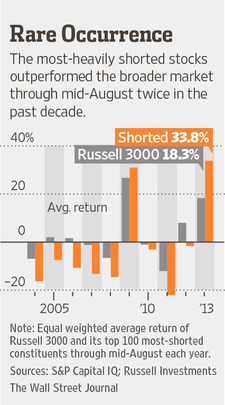
Short sellers are facing their worst losses in at least a decade, a Wall Street Journal analysis has found, as many of the rising stocks they bet against have only continued to soar. That has stung several high-profile hedge-fund managers, including William Ackman and David Einhorn, who have placed prominent short bets. In the Russell 3000 index, the 100 most heavily shorted stocks are sharply outperforming the average returns of stocks in the index, according to a Journal analysis of data provided by S&P Capital IQ. The shorted stocks are up by an average of 33.8% through Aug. 16, versus 18.3% for all stocks in the index. Read more of this post

Ripping Off Young America: The College-Loan Scandal

Ripping Off Young America: The College-Loan Scandal

The federal government has made it easier than ever to borrow money for higher education – saddling a generation with crushing debts and inflating a bubble that could bring down the economy

by MATT TAIBBI

AUGUST 15, 2013

20130814-nat-aff-306x-1376517780

On May 31st, president Barack Obama strolled into the bright sunlight of the Rose Garden, covered from head to toe in the slime and ooze of the Benghazi and IRS scandals. In a Karl Rove-ian masterstroke, he simply pretended they weren’t there and changed the subject. The topic? Student loans. Unless Congress took action soon, he warned, the relatively low 3.4 percent interest rates on key federal student loans would double. Obama knew the Republicans would make a scene over extending the subsidized loan program, and that he could corner them into looking like obstructionist meanies out to snatch the lollipop of higher education from America’s youth. “We cannot price the middle class or folks who are willing to work hard to get into the middle class,” he said sternly, “out of a college education.” Read more of this post

Medical Marijuana Spawning Pump-and-Dump Scams: Finra

Medical Marijuana Spawning Pump-and-Dump Scams: Finra

Con artists are taking advantage of the legalization of medical marijuana to lure investors into buying stock in weed-related companies, regulators said.

The scammers may be promoting the shares, then selling them to gullible investors in what’s called a “pump-and-dump” scheme, the Financial Industry Regulatory Authority said today in an e-mailed statement. The companies are touting their growth potential as more states allow pot for medical or recreational use, Wall Street’s self-funded regulator said.

“We’ve seen a rise over the last couple of months in marijuana-related potential stock scams,” Gerri Walsh, Finra’s senior vice president for investor education, said in a phone interview. “We often see with these stock-fraud scams that the next big thing, the cons tend to circle around.” Read more of this post

Italian business: No way back; Time is being called on the cross-shareholdings that have bound the top companies together

August 20, 2013 7:06 pm

Italian business: No way back

By Rachel Sanderson

Time is being called on the cross-shareholdings that have bound the top companies together

Cuccia

A finger in every pie: Enrico Cuccia, the founder of Mediobanca, who built the cross-holdings that linked Italian business

Over six decades, Cesare Geronzi ascended to the summit of Italian finance. Every step of the way, he took three scarlet chairs with him. They were in his antechamber when he was chairman of Capitalia, the Roman bank. They graced his waiting room at Mediobanca, the Milanese investment bank where, despite two fraud convictions, he became president. When he manoeuvred his way to the presidency of Generali, Italy’s largest financial group, the chairs sat in an office where Mr Geronzi’s windows opened on to a much-envied view of the Colosseum. Read more of this post

‘Work until I die’: Why older Americans are refusing to retire and how it’s changing the face of labour

‘Work until I die’: Why older Americans are refusing to retire and how it’s changing the face of labour

Tom Moroney, Bloomberg News | 13/08/20 | Last Updated: 13/08/20 2:44 PM ET
He’s on County Road 1680 moving like a black-tailed jackrabbit under the big-bowl Oklahoma sky, a tiny dot in his Ford Ranger out on the edge of the world when the flying red stinger ants show up.

One, two, now three, they invade. Jim Ed Bull swats with a big hand. “They can hurt ya bad,” he says. Read more of this post

BRIC: Is the fastest period of emerging-market growth behind us? Emerging Markets: A Contrarian Special?

BRIC: Is the fastest period of emerging-market growth behind us?

Defending the motion

Ruchir Sharma, Head of emerging markets and global macro at Morgan Stanley Investment Management

It is rare for emerging nations to sustain growth faster than 5% for even one decade, much less two or three, and only six countries have grown that fast for as long as four decades in a row.

Against the motion

Kishore Mahbubani, Dean and Professor, Lee Kuan Yew School of Public Policy, National University of Singapore

In 2013, China’s economy will grow by 7.8%, India’s by 5.6% and Brazil’s by 2.5%. In response, Western media headlines have begun screaming that the emerging-market story is over. Oh dear, here comes Western wishful thinking again.

The moderator’s opening remarks

Aug 20th 2013 | Ryan Avent

Since the early 2000s emerging markets have powered global economic growth. Emerging economies grew faster than the rich world, and from 2003 to 2011 they raised their share of global output by a percentage point each year. As a result, emerging markets now account for more of the world’s GDP than advanced economies. Yet as The Economist recently noted, a “great deceleration” seems to be under way. The Chinese and Indian economies have slowed dramatically from double-digit growth rates prior to the financial crisis; the IMF expects China to grow by just 7.8% this year and India by 5.6%. Most other large emerging economies are also slowing sharply. Read more of this post

CREDIT SUISSE: The End Of Zero Interest Rates May Create A ‘Huge Financial Disruption Akin To The End Of A War’

CREDIT SUISSE: The End Of Zero Interest Rates May Create A ‘Huge Financial Disruption Akin To The End Of A War’

ASHLEY KINDERGANTHE FINANCIALIST AUG. 19, 2013, 5:56 PM 8,665 8

It wasn’t so long ago that the challenge of making money with interest rates stuck around zero was investors’ top concern. Those days are gone. Today, they’re worried about the opposite: the threat that now-rising rates pose for fixed income investments. That, and the downturn in emerging markets that many only recently embraced in the hunt for yield caused by those near-zero rates.

It’s easy to identify the date that things changed: May 22, the day that the Federal Reserve first alerted markets that it might soon start “tapering” the $85 billion in monthly asset purchases it has been making since December to juice the economy. And soon looks to be getting even sooner. A steady improvement in U.S. employment figures—unemployment fell from 7.6 percent in June to 7.4 percent in July—has brought into focus the 6.5 percent unemployment target the Fed set as a prerequisite for raising short-term interest rates. On Thursday, the U.S. Bureau of Labor Statistics released yet another piece of good news on the employment front: New applications for unemployment benefits sank to their lowest levels in six years in July. Read more of this post