Glencore Xstrata hit by $7.7bn writedown of its mining assets following the complex merger that created the diversified commodities trader and miner

Last updated: August 20, 2013 8:42 am

Glencore Xstrata hit by $7.7bn writedown

By James Wilson

Glencore Xstrata knocked $7.7bn off the value of its mining assets following the complex merger that created the diversified commodities trader and miner this year. The hits to the value of Xstrata’s mines show the gloom surrounding the mining industry as prices for many key commodities have fallen amid oversupply and slowing growth in demand.

Glencore took over Xstrata in May following a year-long acquisition process. Ivan Glasenberg, chief executive, reiterated on Tuesday that Glencore believed it would be able to get more synergies and cost savings from the deal than the $500m originally promised. Read more of this post

‘Perverse Effects’: How green subsidies often increase carbon emissions

August 19, 2013, 7:22 p.m. ET

‘Perverse Effects’

How green subsidies often increase carbon emissions.

Anticarbon central planning was bound to distort markets, but it turns out that the planners often increase emissions as they try to engineer President Obama’s “new energy economy.” So concludes the National Academies, whose major report on energy subsidies deserves more attention than it has received since its June release.

By some miracle, Congress in 2008 created a National Research Council special committee to comb the tax code to figure out how specific provisions increase or decrease greenhouse gases. As chairman William Nordhaus of Yale and his colleagues note, there is very little empirical literature on these programs. What they did learn is that “several existing provisions have perverse effects, while others yield little reduction in greenhouse gas emissions per dollar of revenue loss.” Read more of this post

E&P Investors Fear the Oil Party Hangover; Oil-Company Stocks Disconnect from Crude Price

August 19, 2013, 1:34 p.m. ET

E&P Investors Fear the Oil Party Hangover

Oil-Company Stocks Disconnect from Crude Price

LIAM DENNING

MI-BX951_OILHER_NS_20130819170315

There comes a point in a boisterous night out when you order that drink that ensures the following day will be a write-off. Investors toasting the oil-and-gas sector this summer seem to have reached that moment of realization. Near-month crude-oil futures on the New York Mercantile Exchange have rallied almost 17% since the start of June. Goldman SachsGS -1.26% added fuel to the fire Monday by raising its Brent forecasts for this year. For much of the summer—indeed, most of the year—stocks of exploration-and-production companies have done even better than oil prices. Read more of this post

Phone Taps Considered in Malaysia’s War on Graft: Southeast Asia

Phone Taps Considered in Malaysia’s War on Graft: Southeast Asia

Malaysia may allow phone tapping and Internet monitoring as it steps up the war on corporate and government graft, which costs the country as much as $9 billion a year, a minister said.

It also plans legislation to make company directors liable for corruption involving staff and will appoint chief integrity officers in government ministries, Paul Low, the minister in the Prime Minister’s Department in charge of fighting graft, said in an interview. He said talks on electronic monitoring are in early stages and didn’t provide specifics on how sweeping powers might be or how they might be used. Read more of this post

Reinvent the Business Model, Not Journalism

Reinvent the Business Model, Not Journalism

By Anatole Kaletsky on 12:51 pm August 19, 2013.
It is now more than a week since Jeff Bezos, the founder of Amazon, announced that he was buying the Washington Post, in what could be the most exciting case of convergence between the new media and the old since the merger of AOL with Time Warner.

But how might Bezos relaunch this flagship of US journalism? And what could his ownership of the Post mean for news businesses around the world? Read more of this post

Ship Travels Arctic From China to Europe; Northern Passage Shaves Two Weeks of Travel Time Off Journey

Updated August 19, 2013, 8:12 p.m. ET

Ship Travels Arctic From China to Europe

Northern Passage Shaves Two Weeks of Travel Time Off Journey

COSTAS PARIS

MK-CF678_ARCTIC_G_20130819171505

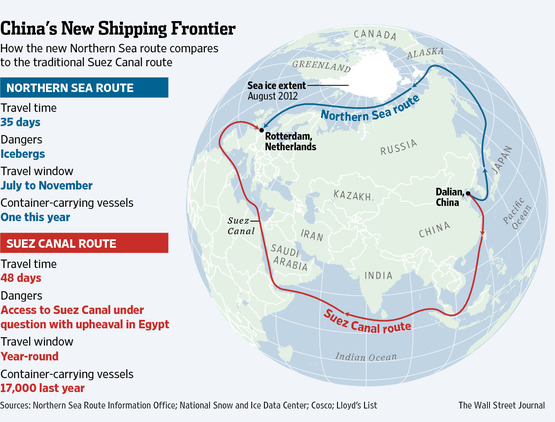
China’s Yong Sheng is an unremarkable ship that is about to make history. It is the first container-transporting vessel to sail to Europe from China through the arctic rather than taking the usual southerly route through the Suez Canal, shaving two weeks off the regular travel time in the process. The 19,000-ton Yong Sheng, operated by China’s state-controlled Cosco Group, left the port of Dalian Aug. 8 and is scheduled to reach Rotterdam, in the Netherlands, via the Bering Strait Sept. 11. The travel time of about 35 days compares with the average of 48 days it would normally take to journey through the Suez Canal and Mediterranean Sea. Read more of this post

Public Funds Take Control of Assets, Dodging Wall Street

AUGUST 18, 2013, 2:11 PM

Public Funds Take Control of Assets, Dodging Wall Street

By NATHANIEL POPPER

Investors responsible for more than $2 trillion recently gathered at a resort in the Canadian Rockies, far from the news media and, more important, far from Wall Street.

Those in attendance, including leaders of Abu Dhabi’s sovereign wealth fund and France’s pension system, were there to consider ways to put their money to work together without paying fees to private equity firms and hedge funds. Over that weekend, three of the attendees completed the details of a $300 million investment in a clean-energy company. Read more of this post

Obama Focuses on Risk of New Bubble Undermining Broad Recovery

Obama Focuses on Risk of New Bubble Undermining Broad Recovery

By David J. Lynch  Aug 19, 2013

President Barack Obama, who took office amid the collapse of the last financial bubble, wants to make sure his economic recovery doesn’t generate the next one.

Obama this month spoke four times in five days of the need to avoid what he called “artificial bubbles,” even in an economy that’s growing at just a 1.7 percent rate and where employment and factory usage remain below pre-recession highs. Read more of this post

Keeping Corporate Managements Honest; The key is to switch the allegiance of the auditor to independent directors on company boards

August 19, 2013, 7:15 p.m. ET

Keeping Corporate Managements Honest

The key is to switch the allegiance of the auditor to independent directors on company boards.

ROBERT C. POZEN

In a rare burst of bipartisanship, the House of Representatives last month voted 321 to 62 to stop a government board from forcing public companies to change auditors every six or seven years. This requirement was floated by the Public Company Accounting Oversight Board, which suggested that term limits would bolster the independence of auditors.

An overwhelming number of congressmen rejected this requirement as too costly, and they passed an amendment to the 2002 Sarbanes-Oxley corporate-accounting law that would prohibit the board from adopting such mandatory rotation. Read more of this post

German Stocks Shift Toward Home; Market may be moving toward German stocks with strong domestic exposure

August 18, 2013, 5:03 p.m. ET

German Stocks Shift Toward Home

Market may be moving toward German stocks with strong domestic exposure

ANDREW PEAPLE

MI-BX928_GERMAN_NS_20130818174806

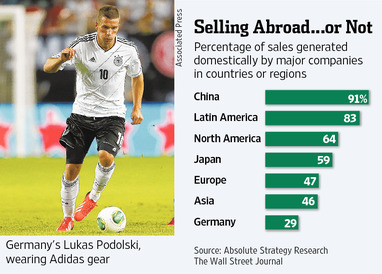
Germany may remain the powerhouse of the European economy, but you wouldn’t necessarily know it from looking at the share prices of its leading companies. Sure, the DAX 30, Germany’s benchmark stock index, is up 9.6% this year. But its rise lags other major indexes like the U.K.’s FTSE 100, France’s CAC 40 and the S&P 500 in the U.S. That is despite Germany’s relatively consistent economic performance. It grew by 0.7% quarter on quarter in the three months to June, faster than the European Union’s other major economies. The truth is that German companies aren’t all that German in one key respect. Like many leading European companies, Germany’s top firms, ranging from sportswear giant Adidas ADS.XE +0.40% to auto makers like DaimlerDAI.XE -0.36% are becoming ever more international. The country’s top 50 companies generate only around 29% of their sales domestically, according to analysts at Absolute Strategy Research. Companies in the FTSE 100 earn a similarly low level of revenue in the U.K. Top North American companies, by contrast, make 64% of their sales in their domestic market. Read more of this post

Activist Investors: A Roar or a Bark?

Aug 19, 2013

Activist Investors: A Roar or a Bark?

By Francesco Guerrera

Can a lion be confused with a dog? In Luohe, China, the answer is a resolute “no.” Visitors at the local zoo weren’t impressed last week when they found a Tibetan mastiff in the cage earmarked for the king of the jungle.

When it comes to activist investors, though, the situation is less clear-cut. On Wall Street, this breed of hedge-fund manager engenders extreme reactions. Some lionize them as intrepid champions of shareholders’ rights in the face of corporate ineptitude. Others accuse them of terrier-like aggression, snapping at executives’ heels with short-term demands that end up harming companies. Read more of this post

French vineyard sales leave bitter taste amid laundering fears by Russian and Chinese investors

August 18, 2013 9:17 pm

French vineyard sales leave bitter taste amid laundering fears

By Anne-Sylvaine Chassany in Paris

French anti-money laundering authorities have raised the alarm over recent acquisitions of vineyards by Russian and Chinese investors.

The use of multiple holding companies based in tax havens to buy French wine estates has pushed Tracfin – whose mandate is to uncover money laundering and terrorism funding schemes – to issue a warning in its 2012 report published this month. Read more of this post

End of the Options Backdating Era

AUGUST 19, 2013, 1:03 PM

End of the Options Backdating Era

By PETER J. HENNING

Before the clamor about the lack of prosecutions from the financial crisis and the current crackdown on insider trading, the practice of backdating stock options came to light seven years ago and prompted a flurry of prosecutions. The practice is now long forgotten, but it looks as if the last of those cases has finally concluded, and as the Grateful Dead put it so well, “What a long, strange trip it’s been.” Read more of this post

Dubai Sees Need for Tallest Office Tower Amid 45% Vacancy

Dubai Sees Need for Tallest Office Tower Amid 45% Vacancy

In Dubai, where almost half of the offices sit empty, the head of a state-owned business zone says there’s room to build the world’s tallest office tower.

Ahmed Bin Sulayem, chairman of the Dubai Multi Commodities Centre, said the Persian Gulf business hub can still attract tenants and investors with such a project because many of its buildings are unsuitable for large businesses. Bin Sulayem helped lead the development of the DMCC’s 68-story Almas Tower, Dubai’s tallest building when it was completed in 2007. The tower’s full and has a waiting list for tenants, he said. Read more of this post

Central Banks Risk Clash of Titans; In the U.K., Government Bonds Could Be a Bad Bet for Investors

August 19, 2013, 1:34 p.m. ET

Central Banks Risk Clash of Titans

In the U.K., Government Bonds Could Be a Bad Bet for Investors

RICHARD BARLEY

MI-BX950_BONDHE_G_20130819170310

Are central banks losing control of global bond markets?

For much of the time since 2008, bonds have danced to the tune played by the Federal Reserve, European Central Bank and Bank of England. With rates at historic lows and central banks buying bonds directly and indirectly, investors played along and have been richly rewarded as global yields plummeted. But now markets aren’t so compliant. The Bank of England looks most vulnerable in risking a head-on clash with investors. Read more of this post

Repo Market Decline Raises Alarm as Regulation Strains Debt

Repo Market Decline Raises Alarm as Regulation Strains Debt

Regulations aimed at reducing the risk of another financial crisis are starting to upend a key part of the bond market that expedites trading in everything from U.S. Treasuries to junk bonds.

The repurchase, or repo, market where banks and investors borrow and lend Treasuries and other fixed-income securities shrunk to $4.6 trillion daily outstanding last month, down 35 percent from a peak of $7.02 trillion in the first quarter of 2008, based on Federal Reserve data compiled from its 21 primary dealers. Read more of this post

Mobile-Payment Startups No Match for PayPal

Mobile-Payment Startups No Match for PayPal: Tech

The market for tools that help consumers buy goods using mobile phones is getting crowded, inundating small businesses, putting off venture capitalists and making it hard for many payment startups to make a buck.

Just ask Kristy Fassio, owner of a Fit4Mom exercise franchise near Seattle. She’s getting bombarded with pitches from mobile and web-payment companies pledging to provide low-cost, easy ways for her to accept payments for the mom-focused workout classes she teaches. Some don’t even charge fees. Read more of this post

Nestle’s Sales Slowdown Seen Leading to Slimmer Brand Portfolio

Nestle’s Sales Slowdown Seen Leading to Slimmer Brand Portfolio

Nestle SA, (NESN) the world’s biggest food company, needs to reignite sales that have disappointed investors for four straight quarters. One solution: Get smaller.

The maker of Nescafe coffee and DiGiorno pizza said Aug. 8 that it’s “actively looking” at its 8,000 brands and is seeking to identify the laggards after posting its weakest quarterly revenue growth in four years. Nestle has said it will struggle this year to meet its long-term forecast for annual sales growth of 5 percent to 6 percent, hurt by a deceleration in emerging markets, European weakness and sluggish performances from its diet products, frozen entrees and water. Read more of this post

China Trading Error Reduces Investor Confidence in Stocks

China Trading Error Reduces Investor Confidence in Stocks

The biggest swing in China’s benchmark equity index since 2009 threatens to further erode confidence in the nation’s stock market after it lost more money for investors than any in the world during the past four years.

China’s shares were roiled Aug. 16 by a trading error at Everbright Securities Co. (601788) that spurred a 53 percent surge in volumes and a swing of more than 6 percent in the Shanghai Composite Index. The gauge jumped from a loss of as much as 1 percent to a gain of 5.6 percent in two minutes during the morning session, then ended the day with a 0.6 percent drop. Erroneous buy orders from Everbright’s proprietary trading group sparked the early rally, the securities regulator said. Read more of this post

Indonesia Rupiah, Stocks Plummet on Current-Account Gap

Indonesia Rupiah, Stocks Plummet on Current-Account Gap

Indonesia’s rupiah fell to 10,500 per dollar for the first time since 2009, stocks dropped by the most in 22 months and government bonds plunged after the current-account deficit widened to a record last quarter.

The Jakarta Composite Index of shares has fallen 8 percent in two days, and is now the world’s worst performer this quarter. The yield on 10-year notes surged to the highest since March 2011 after Bank Indonesia said late Aug. 16 the current-account shortfall was $9.8 billion, the largest in data compiled by Bloomberg going back to 1989. Inflation quickened to a four-year high and economic growth slowed to the least since 2010, figures showed last week. Read more of this post

India Markets Plunge Pressures Singh as Economy Teeters

India Markets Plunge Pressures Singh as Economy Teeters

India’s biggest stock market slide in almost two years, surging bond yields and an unprecedented plunge in the rupee are pressuring officials for fresh steps to stem capital outflows and revive a struggling economy.

The S&P BSE Sensex (SENSEX) Index sank 4 percent on Aug. 16 as the rupee touched an all-time low of 62.005 per dollar and the yield on the government bond due May 2023 rose 39 basis points to 8.88 percent, the highest on a 10-year note since 2011. Read more of this post

Investors Ditch Ratings for Returns in Bond Boom: Nordic Credit

Investors Ditch Ratings for Returns in Bond Boom: Nordic Credit

Norway is about to share its European dominance in unrated bonds with the rest of the Nordic region.

Issuance of bonds ignored by Moody’s Investors Service, Standard & Poor’s and Fitch Ratings has surged in Sweden and Finland. Many of the companies selling, such as Skanska AB and Finnair Oyj (FIA1S), are finding the lack of a credit rating is no impediment to attracting more local buyers. Read more of this post

How Einstein Thought: Fostering Combinatorial Creativity and Unconscious Connections

How Einstein Thought: Fostering Combinatorial Creativity and Unconscious Connections

“Combinatory play seems to be the essential feature in productive thought.”

For as long as I can remember – and certainly long before I had the term for it – I’ve believed that creativity is combinatorial: Alive and awake to the world, we amass a collection of cross-disciplinary building blocks – knowledge, memories, bits of information, sparks of inspiration, and other existing ideas – that we then combine and recombine, mostly unconsciously, into something “new.” From this vast and cross-disciplinary mental pool of resources beckons the infrastructure of what we call our “own” “original” ideas. The notion, of course, is not new – some of history’s greatest minds across art, science, poetry, and cinema have articulated it, directly or indirectly, in one form or another: Arthur Koestler’s famous theory of “bisociation” explained creativity through the combination of elements that don’t ordinarily belong together; graphic designer Paula Scher likens creativity to a slot machine that aligns the seemingly random jumble of stuff in our heads into a suddenly miraculous combination; T. S. Eliot believed that the poet’s mind incubates fragmentary thoughts into beautiful ideas; the great Stephen Jay Gould maintained that connecting the seemingly unconnected is the secret of genius; Gutenberg’s invention of the printing press embodied this combinatorial creativity; even what we call “intuition” is based on the unconscious application of this very mental faculty. Read more of this post

Feike Sijbesma, chief of Dutch nutrition and chemicals DSM, wants to transform global manufacturing

THE MONDAY INTERVIEW

August 18, 2013 2:20 pm

Feike Sijbesma, chief of DSM

By Matt Steinglass

sijbesma-high-res-e1361781309443

For several months now, Feike Sijbesma has been doggedly promoting an idiosyncratic vision for transforming global capitalism.

The head of DSM, the Dutch nutrition and chemicals group, is one of the chemical industry’s strongest proponents of shifting from fossil fuels to processes that use biological materials, such as enzymes produced by algae. All manufacturing should be in the process of becoming 100 per cent renewable, he says. Furthermore, Mr Sijbesma thinks companies around the world should negotiate international metrics – similar to international accounting standards – for assessing their impact on the environment and on society. And those whose impact is more detrimental should pay more tax. He has aired this idea in public and more privately with other industrial leaders and leading thinkers at the World Economic Forum in Davos. With annual revenues of €9bn, his company is a heavyweight in nutrition – it is the world’s largest vitamins maker, among other things – but a small player in the chemicals industry compared with petrochemical titans such as DuPont and BASF. Read more of this post

What If What You ’Survived’ Wasn’t Cancer?

What If What You ’Survived’ Wasn’t Cancer?

You’re feeling fine when you go for your annual physical. But your mammogram looks a little funny, or your PSA test is a little high, or you get a CT lung scan and a nodule shows up. You get a biopsy, and the doctor delivers the bad news: You have cancer. Because you don’t want to die, you agree to be sliced up and irradiated. Then, fortunately, you’re pronounced a “cancer survivor.” You’re glad they caught it early.

But maybe you went through all that pain for nothing.

For decades, the reigning theory has been that the earlier a cancer is spotted and treated, the less likely it is to be lethal, because it won’t have time to grow and spread. Yet this theory infers causality from correlation. It implicitly assumes that cancer is cancer is cancer, even though we now know that even in the same part of the body, cancer is many different diseases — some aggressive, some not. Perhaps people survive early-stage cancers not because they’re treated in time, but because their disease never would have become life-threatening at all. Read more of this post

Singapore: Man with 8cm gash waited 7 hours in vain at hospital only to faint from blood loss

17-08-2013, 05:39 PM

Man with 8cm gash waited 7 hours in vain at A&E only to faint from blood loss !
stitches
Warning, viewer discretion is advised. Pictures are graphic.
STOMPer Isaac says his friend waited seven hours in vain at Changi General Hospital for a doctors to stitch up an 8cm gash on his arm he sustained at work.
His friend’s father eventually decided to relocate him to Mt Alvernia Hospital for treatment, by which time he had passed out from blood loss.
The STOMPer wrote:
“My friend, Lim, in his thirties, suffered a workplace-related accident on Aug 7, at around 11.30am.
“He had fallen down and his right forearm sustained a gash of approximately 8cm length due to a cut from a steel bar.
“His co-workers immediately rushed him to the CGH and they arrived at the Accidents & Emergency department at around noon.
“The staff nurses were quick to administer basic wound dressing and bandage to his wounds, and also an intravenous drip was also given to him.
“Lim’s father also arrived at the hospital at 2pm that day.
“However, even at 3pm, they were told by nurses that doctor was unavailable.
“Every time they asked for a doctor, the nurses would reply the doctor will ‘attend to them in half an hour’.
“To their horror, the doctor still hadn’t come and performed the stitching operation even at 5pm, and the nurses could only ‘top up’ the bandages when the blood seeped through the dressing.
“It was only at 7pm, when Lim said he was feeling faint and going to pass out, that a doctor finally came.
“To their shock, the doctor said there were still four patients waiting in line, and that Lim would have to wait until midnight before he could perform the operation on him.
“Worse still, the doctor even said that he might have to wait until the next morning.
“Upon hearing this, the Lims wanted an immediate transfer to another hospital.
“Much to their chagrin, they were told that ambulances were also unavailable.
“While having to deal with tough luck, the father managed to get his son transferred to Alvernia Hospital, at MacRitchie using his personal vehicle.
“The father was appalled by the doctor’s attitude.
“He said the doctor even shooed them away when he requested to have an immediate transfer.
“He said his son went unconscious as soon as they arrived at Alvernia Hospital, where he finally received the long awaited stitching operation by another surgeon. He received between 15 to 20 stitches.
“The father did receive a ‘concerned’ telephone call from a CGH officer on Aug 16.
“The father reprimanded the hospital staff for their behavior and for having insufficient medical personnel on duty as well as equipment such as ambulances.
“He said the Ministry of Health should look into this matter and seek to improve our hospital’s standards, before someone’s life is lost.”

Love Your Job? Thank Your Country

Love Your Job? Thank Your Country

It is widely assumed that people in economically “advanced” countries do not differ significantly in how satisfied they are with their jobs. Because they are about equally productive, the reasoning is, they must produce things the same way, and so their work experience must be the same, too. In fact, there are striking differences in job satisfaction within the West. The U.K., with very low wages relative to the country’s wealth, reports a pretty decent level of job satisfaction. Yet Germany, with its fairly high wages relative to wealth, reports an undistinguished level of job satisfaction — below Italy and Spain.  Read more of this post

Innovation drives growth for exporters to emerging economies

August 19, 2013 12:03 am

Innovation drives growth for exporters to emerging economies

By Mark Wembridge

In the battle to attract customers in emerging markets and compete with lower-cost economies, British manufacturers have discovered that brains trump brawn. Unable to compete with commoditised goods churned out in cut-price countries, new research shows that UK manufacturers are increasingly targeting innovative niche products which can be exported to emerging economies. According to a study published on Monday by the EEF manufacturers’ association, 71 per cent of British businesses polled said they were planning to use innovative ideas and services to bolster their revenues – up from 54 per cent three years ago. Read more of this post

Wary Investors Turn to Lie Pros

December 29, 2010

Wary Investors Turn to Lie Pros

Deception Detectors Find a New Niche

KYLE STOCK

When screening a fund manager, investors like to see experience and a consistent record or returns. Elizabeth Prial, however, looks for dilated pupils and uneven breathing. Ms. Prial, a psychologist and former Federal Bureau of Investigation agent, has spent most of her career looking for lies in the statements of mafia hitmen and terrorists. Now, she is on the hunt for the next Bernard Madoff, selling her deception-detection skills to institutional investors and others with large pools of money who want to know if prospective fund managers are telling the truth. “It’s usually very clear,” she said. “I’m 90% confident in most of the things that I can see.” Amid the rush to fortify the nation’s still-rickety regulations in the wake of the financial crisis, affluent investors are turning to behavioral specialists, looking to find things in faces and phrases that may not be revealed in financial statements. Read more of this post

Liespotting: Proven Techniques to Detect Deception

Liespotting: Proven Techniques to Detect Deception Paperback

by Pamela Meyer  (Author)

51sfVbS8loL

GET TO THE TRUTH

People–friends, family members, work colleagues, salespeople–lie to us all the time.  Daily, hourly, constantly. None of us is immune, and all of us are victims. According to studies by several different researchers, most of us encounter nearly 200 lies a day. Now there’s something we can do about it. Liespotting links three disciplines–facial recognition training, interrogation training, and a comprehensive survey of research in the field–into a specialized body of information developed specifically to help business leaders detect deception and get the information they need to successfully conduct their most important interactions and transactions. Some of the nation’s leading business executives have learned to use these methods to root out lies in high stakes situations. Liespotting for the first time brings years of knowledge–previously found only in the intelligence community, police training academies, and universities–into the corporate boardroom, the manager’s meeting, the job interview, the legal proceeding, and the deal negotiation.

WHAT’S IN THE BOOK?

Learn communication secrets previously known only to a handful of scientists, interrogators and intelligence specialists.

Liespotting reveals what’s hiding in plain sight in every business meeting, job interview and negotiation:

• The single most dangerous facial expression to watch out for in business & personal relationships

• 10 questions that get people to tell you anything

• A simple 5-step method for spotting and stopping the lies told in nearly every high-stakes business negotiation and interview

• Dozens of postures and facial expressions that should instantly put you on Red Alert for deception

• The telltale phrases and verbal responses that separate truthful stories from deceitful ones

• How to create a circle of advisers who will guarantee your success Read more of this post