“Sync is the new save”; Dropbox’s ambitious bid to “replace the hard drive” by making it easy for users to sign into Dropbox from many other apps

August 18, 2013 3:50 pm

Dropbox hopes to exploit tech rivalries

By Tim Bradshaw in San Francisco

“Sync is the new save,” declared Drew Houston, chief executive of Dropbox, at the cloud storage company’s first developer conference in San Francisco last month,writes Tim Bradshaw.

Mr Houston made an ambitious bid to “replace the hard drive” by making it easy for users to sign into Dropbox from many other apps. His hope is that this will make users more likely to pay for extra storage and, crucially, make them less prone to switch to Apple or Google’s rival products. Read more of this post

Beauty boxes by The Lilac Box sells like hot cakes in Malaysia

Beauty boxes by The Lilac Box sells like hot cakes in Malaysia

By Jacky Yap 19, Aug 2013

Malaysia-based The Lilac Box’s beauty boxes are a hit with consumers, selling out fast for each edition.

Earlier this year, there was a lot of hype around the beauty box subscription business. In January, we saw Australia-based bellabox closing an A$1.3 million (US$1.2 million) Series A round. Indonesia’s Lolabox was also launched by former Rocket Internet executives, with the backing of GRUPARA, one of Indonesia’s most active private equity fund.

Around the same time, Taiwan’s online beauty industry has also seen some activities. Japanese venture capital firm CyberAgent Ventures has put their skin in the game by investing in Taiwan based Fashionguide, a beauty and cosmetics social networking platform. Beauty sampling platform VanityTrove also commenced its consolidation in the Southeast Asia market with itsacquisition of Rocket Internet’s Glossybox in Taiwan. Read more of this post

Pemandu CEO: Innovation is not dead in Malaysia; Lim Kon Liang makes better hospital beds much more cheaply than the established manufacturers and they are sold to more than 40 countries world wide

Updated: Monday August 19, 2013 MYT 9:05:12 AM

Innovation is not dead in Malaysia

TRANSFORMATION UNPLUGGED BY IDRIS JALA

While innovation happens, we need it to happen much more often

WE can all certainly appreciate that one of the most difficult of things to teach – and to learn – is without doubt innovation, the ability to do things differently from how it was done before to bring about beneficial change for a person, organisation or country.

It’s almost a state of mind, an attitude which encourages the creative process in solving problems by looking at things from different angles and taking unconventional but effective measures in a holistic manner to bring about desired change. Read more of this post

Viacom to let Sony stream its programs, bypassing traditional pay TV providers

Viacom to let Sony stream its programs

BLOOMBERG

AUG 16, 2013

SAN FRANCISCO – Sony Corp. has reached a preliminary accord to stream cable television programming from Viacom Inc. over the Internet to TVs, game consoles and Blu-ray players, a source said.

Under the deal, Sony would use the Web to deliver shows such as “SpongeBob SquarePants” and “Teen Wolf” to homes with those products, bypassing traditional pay TV providers, said the source. The service also would sell Viacom shows and movies on demand. Read more of this post

Captive Audience: The Telecom Industry and Monopoly Power in the New Gilded Age

Captive Audience: The Telecom Industry and Monopoly Power in the New Gilded Age [Hardcover]

Susan P. Crawford J.D. (Author)

Book Description

Publication Date: January 8, 2013

Ten years ago, the United States stood at the forefront of the Internet revolution. With some of the fastest speeds and lowest prices in the world for high-speed Internet access, the nation was poised to be the global leader in the new knowledge-based economy. Today that global competitive advantage has all but vanished because of a series of government decisions and resulting monopolies that have allowed dozens of countries, including Japan and South Korea, to pass us in both speed and price of broadband. This steady slide backward not only deprives consumers of vital services needed in a competitive employment and business market—it also threatens the economic future of the nation. This important book by leading telecommunications policy expert Susan Crawford explores why Americans are now paying much more but getting much less when it comes to high-speed Internet access. Using the 2011 merger between Comcast and NBC Universal as a lens, Crawford examines how we have created the biggest monopoly since the breakup of Standard Oil a century ago. In the clearest terms, this book explores how telecommunications monopolies have affected the daily lives of consumers and America’s global economic standing. Read more of this post

What Jiu Jitsu teaches us about media companies

What Jiu Jitsu teaches us about media companies

BY BRYAN GOLDBERG 
ON AUGUST 8, 2013

For a brief period of time, I studied Brazilian Jiu Jitsu. And I wasn’t very good at it.

Nevertheless, I put in a real effort and put up with the not-so-appealing aspects of it — having some dude squash my face into the ground, gasping for breathe while a normally-stoic Korean teenager choked me, etc.

At a time when martial arts, and the UFC in particular, has grown in popularity, the very act of fighting has changed, both in reality and in the popular consciousness.

Gone are the days when 80s action stars traded punches with German terrorists. Today, we understand that fighting usually takes place on the ground, with a lot more grappling than striking. You are just as likely to win a fight by choking your opponent with your legs (i.e. a triangle choke) as you are through a good old-fashion nose break. Read more of this post

Start the Presses! It’s How You Sell Newspapers; As iconoclastic as it may sound, it’s time to stop chasing the digital ghost.

August 18, 2013, 5:32 p.m. ET

Start the Presses! It’s How You Sell Newspapers

As iconoclastic as it may sound, it’s time to stop chasing the digital ghost.

ERIC SPITZ

This month has seen a couple of successful businessmen with no newspaper experience acquire two of America’s storied media institutions. Many people are wondering why.

I cannot answer for these new owners, but I may be able to shed some light. A year ago my business partner, Aaron Kushner, and I bought Freedom Communications, which includes the Orange County Register, the nation’s 14th-largest daily newspaper. Neither Aaron nor I came from the newspaper industry, but we are both entrepreneurs inclined to question the conventional wisdom. Read more of this post

TV’s Unnatural Monopolies; The rationale for government regulation is collapsing in the face of technological change

August 18, 2013, 5:25 p.m. ET

Crovitz: TV’s Unnatural Monopolies

The rationale for government regulation is collapsing in the face of technological change.

L. GORDON CROVITZ

The big loser in the battle between Time Warner Cable TWC -0.24% and CBSCBS -0.56% is not the cable company, the network or the viewers who lost access to their favorite shows. The big loser is Washington, whose efforts to regulate what used to be called television grow more futile with every new video technology.

Lawmakers and regulators still treat broadcasters and cable operators as “natural” monopolies. That gives them a rationale to layer on bureaucratic rules setting out how the industry should be run. Read more of this post

Book-publishing giant Penguin Random House is trying its hand at television, expanding a media diversification that began a few years ago when Bertelsmann’s Random House started a movie unit to spur sales of its titles

August 18, 2013, 7:51 p.m. ET

Publisher Makes TV Play

JEFFREY A. TRACHTENBERG

Book-publishing giant Penguin Random House is trying its hand at television, expanding a media diversification that began a few years ago when Random House started a movie unit to spur sales of its titles.

Penguin Random House’s first TV co-production, “Heartland Table,” will make its debut Sept. 14 on the Food Network, starring little-known chef Amy Thielen. Ten days later, Ms. Thielen’s first cookbook, “The New Midwestern Table,” will be published by Clarkson Potter, a Penguin Random House imprint. Read more of this post

U.S. Stocks Beat BRICs by Most Ever Amid Emerging Market Flight

U.S. Stocks Beat BRICs by Most Ever Amid Emerging Market Flight

Investors are favoring U.S. stocks over emerging markets by the most ever as fund flows and volatility measures show institutions are increasingly seeking the relative safety of American equities.

Almost $95 billion was poured into exchange-traded funds of American shares this year, while developing-nation ETFs saw withdrawals of $8.4 billion, according to data compiled by Bloomberg. The Standard & Poor’s 500 Index (SPX) trades at 16 times profit, 70 percent more than the MSCI Emerging Markets Index. A measure of historical price swings indicates the U.S. market is the calmest in more than six years compared with shares from China, Brazil, India and Russia. Read more of this post

Twilight of Bernanke Years Shows No Sign of Buyer’s Rem

Twilight of Bernanke Years Shows No Sign of Buyer’s Rem

U.S. markets are backing up Ben S. Bernanke’s assertion that he has the best inflation record of any Federal Reserve chairman since World War II.

Since Bernanke took office in February 2006, inflation as measured by the personal-consumption-expenditures price index has averaged 1.9 percent. Criticism from Republicans, including House Speaker John Boehner of Ohio, that the Fed’s stimulus would spark a rapid acceleration in prices is unfounded, bond yields show. Traders anticipate prices will rise at a 2.17 percent rate in the next decade, near the Fed’s 2 percent goal. Read more of this post

The glut of capital that desperately requires guidance; Capital demands solutions that the world currently lacks

August 18, 2013 4:32 pm

The glut of capital that desperately requires guidance

By John Authers

Capital demands solutions that the world currently lacks

What happens when there is too much capital? It may be a good problem to have, but it demands solutions that the world currently lacks.

Measure capital as the sum of all financial assets and, according to the management consultants Bain & Company, global capital tripled between 1990 and 2010 – driven by financial wizardry, and increasing leverage. As financial services groups introduced new products, and populations looked for new ways to save, the supply of financial assets outstripped growth in the underlying economy. Read more of this post

Tapering plan drives investors into riskier debt

August 18, 2013 6:21 pm

Tapering plan drives investors into riskier debt

By Stephen Foley and Vivianne Rodrigues in New York

The Federal Reserve’s plan to end quantitative easing, in part to prevent financial bubbles, is in fact driving investors into riskier corners of the debt markets.

While the safest bonds have sold off hardest since Ben Bernanke, Fed chairman, set a timetable for tapering its monetary stimulus, the best-performing fixed-income assets have been the lowest-rated junk bonds. Read more of this post

More than 100 mutual funds have 80% of their assets in ETFs, which are cheaper and more efficient to trade. So why are the mutual funds that invest in them more expensive?

SATURDAY, AUGUST 17, 2013

Mutual Funds Use ETFs as a Shortcut

By STEVE GARMHAUSEN | MORE ARTICLES BY AUTHOR

ETFs have become increasingly popular with all sorts of investors—including mutual fund managers. More than 100 mutual funds have 80% of their assets in ETFs, which are cheaper and more efficient to trade. So why are the mutual funds that invest in them more expensive?

File under: If you can’t beat ’em, join ’em. The popularity of the $1.5 trillion exchange-traded-fund industry is indisputable. But what’s surprising is how popular ETFs have become with mutual-fund managers. In fact, the past five years have seen the launch of about 100 funds that hold at least 80% of their assets in ETFs, according to Morningstar. And it’s becoming more and more common for managers of conventional mutual funds to use ETFs here and there for “tactical” purposes. Read more of this post

Inverse ETFs in the Hot Seat

SATURDAY, AUGUST 17, 2013

Inverse ETFs in the Hot Seat

By BRENDAN CONWAY | MORE ARTICLES BY AUTHOR

Leveraged ETFs have a bad rap—as they should. But while they could be disastrous for your portfolio, they probably won’t damage the health of the market. Probably.

For individual investors, leveraged exchange-traded funds present a number of dangers, most prominently the chance to lose a lot of money very quickly. But are they dangerous to the health of the market, as well? These niche ETFs are built specifically for traders: They aren’t meant to be held, even overnight. If you own, say, a Direxion triple inverse Chinese-stock fund for more than a day, your investment moves in unpredictable directions, since the strategies used to create the leverage are reset every single day. So, if you hold one of these leveraged or inverse ETFs—and there are now some 250 of them—your return over time will bear little relation to the underlying index. It’s for this reason the Financial Industry Regulatory Authority has come down on the industry, and fined four big-name brokerages last year, for wrongly selling these ETFs to buy-and-hold clients. Read more of this post

Govts face extra debt costs as stimulus dries up

Updated: Monday August 19, 2013 MYT 6:51:22 AM

Govts face extra debt costs as stimulus dries up

PARIS: Governments face a rise in their borrowing costs due to the winding down of monetary stimulus programmes and as investors bet on central banks hiking interest rates sooner than promised. Moody’s Analytics warned last week that “US rates could rise as the Fed moves to slow its purchases of long-term debt, which in turn could push up the yields on European government bonds.” Read more of this post

Chinatown buses: Driving them out of business; For some 15 years “Chinatown bus” lines have shuttled thrifty folk between east-coast cities for a fraction of the price of name-brand carriers

Chinatown buses: Driving them out of business

Regulators nobble cheap travel

Aug 17th 2013 | WASHINGTON, DC |From the print edition

FRUGAL travellers in America’s north-east have heard the stories. There was the bus that rolled over from going too fast. There was the one that, somehow, lost its rear wheels. A few others burst into flames. Yet potential passengers still gather near the Chinese gate in Washington, DC to catch a cheap ride to New York. A one-way ticket costs around $20, against a whopping $150 on the train. It is far from luxurious, but you can watch films on your iPad or flirt with the other young travellers.

For some 15 years “Chinatown bus” lines have shuttled thrifty folk between east-coast cities for a fraction of the price of name-brand carriers. Chinese immigrants were first to hop aboard, followed by college students and other cash-strapped Americans. Read more of this post

Brazil tries to fill the potholes in its path to growth; Potholed roads among the worst in the world

August 18, 2013 12:25 pm

Brazil tries to fill the potholes in its path to growth

By Joe Leahy in São Paulo

Fernando Atisto has one of the most dangerous jobs in Brazil. He delivers fresh produce to São Paulo’s central market. “The roads getting here are terrible and, aside from that, dangerous. There are a lot of potholes even on the privately run ones,” said the truck driver, who has just delivered a haul of apples to the Ceagesp market from São Joaquim in Santa Catarina state, more than 800km away. When people in South America’s biggest city shop at the supermarket, they rarely spare a thought for the sacrifice required to ensure there is food on the shelves. In a country with some of the world’s poorest infrastructure and most congested cities, every apple or piece of meat that reaches a supermarket must undergo a journey that is as perilous for truck drivers as it is tedious. Read more of this post

Audit the auditors; Rule changes will make the profession serve investors better

August 18, 2013 4:52 pm

Audit the auditors

Rule changes will make the profession serve investors better

There has been plenty of blame to go around for the financial crisis and the scandals it exposed. Until recently, some of it stuck to auditors who had signed off on company accounts that were quickly exposed as wishful thinking or worse. But efforts to improve the value of audits to investors have produced mixed results in the face of resistance from the profession. Read more of this post

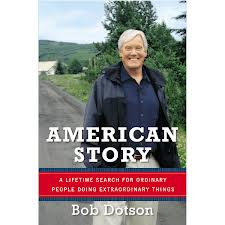
American Story: A Lifetime Search for Ordinary People Doing Extraordinary Things

American Story: A Lifetime Search for Ordinary People Doing Extraordinary Things Hardcover

by Bob Dotson  (Author)

images (36)

Release date: March 26, 2013

For the six million people who watch the Emmy Award–winning “American Story with Bob Dotson” on NBC’s Today Show, Bob Dotson’s reports celebrate the inspirational stories of everyday Americans. Dotson has been crisscrossing the country for more than forty years—logging more than four million miles—in search of people who have quietly but profoundly changed our lives and our country for the better. Now, in American Story, he presents a road map to the unsung heroes with thoughtful solutions to problems we all face, incredible ideas that work, and blueprints to living our dreams.

*The boss who came out of retirement to start a new company for his former employees who could not find work
*The truck driver who taught microsurgery
*The man you’ve never heard of who has 465 profitable patents, second only to Thomas Edison
*The doctor who developed the vaccine to prevent whooping cough, who didn’t retire until age 104

In the tradition of Tom Brokaw’s New York Times bestseller The Time of Our LivesAmerican Story is a deeply moving and endlessly fascinating alternative narrative for everyone who yearns to feel good about America. Read more of this post

Richard Feynman’s Love Letter to His Wife Sixteen Months After Her Death

Richard Feynman’s Love Letter to His Wife Sixteen Months After Her Death

by SHANE PARRISH on AUGUST 13, 2013

Via: Quantum Man: Richard Feynman’s Life in Science

7294111_121592638235

Richard and Arline were soul mates. They were not clones of each other, but symbiotic opposites – each completed the other. Arline admired Richard’s obvious scientific brilliance, and Richard clearly adored the fact that she loved and understood things he could barely appreciate at the time. But what they shared, most of all, was a love of life and a spirit of adventure.

Richard and Arline exchanged frequent letters, a lot of which appear in Perfectly Reasonable Deviations from the Beaten Track. Perhaps none better than the one Richard wrote to Arline sixteen months after her death.

October 17, 1946

D’Arline,

I adore you, sweetheart.

I know how much you like to hear that — but I don’t only write it because you like it — I write it because it makes me warm all over inside to write it to you.

It is such a terribly long time since I last wrote to you — almost two years but I know you’ll excuse me because you understand how I am, stubborn and realistic; and I thought there was no sense to writing.

But now I know my darling wife that it is right to do what I have delayed in doing, and that I have done so much in the past. I want to tell you I love you. I want to love you. I always will love you.

I find it hard to understand in my mind what it means to love you after you are dead — but I still want to comfort and take care of you — and I want you to love me and care for me. I want to have problems to discuss with you — I want to do little projects with you. I never thought until just now that we can do that. What should we do. We started to learn to make clothes together — or learn Chinese — or getting a movie projector. Can’t I do something now? No. I am alone without you and you were the “idea-woman” and general instigator of all our wild adventures.

When you were sick you worried because you could not give me something that you wanted to and thought I needed. You needn’t have worried. Just as I told you then there was no real need because I loved you in so many ways so much. And now it is clearly even more true — you can give me nothing now yet I love you so that you stand in my way of loving anyone else — but I want you to stand there. You, dead, are so much better than anyone else alive.

I know you will assure me that I am foolish and that you want me to have full happiness and don’t want to be in my way. I’ll bet you are surprised that I don’t even have a girlfriend (except you, sweetheart) after two years. But you can’t help it, darling, nor can I — I don’t understand it, for I have met many girls and very nice ones and I don’t want to remain alone — but in two or three meetings they all seem ashes. You only are left to me. You are real.

My darling wife, I do adore you.

I love my wife. My wife is dead.

Rich.

PS Please excuse my not mailing this — but I don’t know your new address.
Who: The A Method for Hiring

Who: The A Method for Hiring Hardcover

by Geoff Smart  (Author) , Randy Street  (Author)

Who-by-Geoff-Smart-and-Randy-Street-190x300

In this instant New York Times Bestseller, Geoff Smart and Randy Street provide a simple, practical, and effective solution to what The Economist calls “the single biggest problem in business today”: unsuccessful hiring. The average hiring mistake costs a company $1.5 million or more a year and countless wasted hours. This statistic becomes even more startling when you consider that the typical hiring success rate of managers is only 50 percent.
The silver lining is that “who” problems are easily preventable. Based on more than 1,300 hours of interviews with more than 20 billionaires and 300 CEOs, Who presents Smart and Street’s A Method for Hiring. Refined through the largest research study of its kind ever undertaken, the A Method stresses fundamental elements that anyone can implement–and it has a 90 percent success rate.
Whether you’re a member of a board of directors looking for a new CEO, the owner of a small business searching for the right people to make your company grow, or a parent in need of a new babysitter, it’s all about Who. Inside you’ll learn how to
• avoid common “voodoo hiring” methods
• define the outcomes you seek
• generate a flow of A Players to your team–by implementing the #1 tactic used by successful businesspeople
• ask the right interview questions to dramatically improve your ability to quickly distinguish an A Player from a B or C candidate
• attract the person you want to hire, by emphasizing the points the candidate cares about most
In business, you are who you hire. In Who, Geoff Smart and Randy Street offer simple, easy-to-follow steps that will put the right people in place for optimal success. Read more of this post

The Seven Deadly Sins of Storytelling

Wednesday, July 3, 2013

Jennifer Aaker: The Seven Deadly Sins of Storytelling

A Stanford GSB professor of marketing explains why engaging your audience is key to success. 

Daniel H. Pink, author of Drive: The Surprising Truth About What Motivates Us, writes, “Right-brain dominance is the new source of competitive advantage.” Tapping the right side of the brain allows for deeper engagement by uniting an idea with an emotion. The best way to do this? Tell a compelling story.

Before you craft your story, ask yourself: “Who is my audience and what is my goal in engaging them?” Are you persuading someone to invest in your company? Are you trying to sell an idea to your co-workers? Do you want to inspire people to help a cause or save someone’s life? Start with a deep understanding of your audience, and ensure your story has a clear and powerful meaning — to them. Then you can set to work honing it for maximum impact. Read more of this post

Master’s Degree Is New Frontier of Study Online; The master’s degree offered by the Georgia Institute of Technology through massive open online courses has the potential to disrupt higher education

August 17, 2013

Master’s Degree Is New Frontier of Study Online

By TAMAR LEWIN

Next January, the Georgia Institute of Technology plans to offer a master’s degree in computer science through massive open online courses for a fraction of the on-campus cost, a first for an elite institution. If it even approaches its goal of drawing thousands of students, it could signal a change to the landscape of higher education.

From their start two years ago, when a free artificial intelligence course from Stanford enrolled 170,000 students, free massive open online courses, or MOOCs, have drawn millions and yielded results like the perfect scores of Battushig, a 15-year-old Mongolian boy, in a tough electronics course offered by the Massachusetts Institute of Technology. Read more of this post

Suddenly everyone wants New Yorker style in-depth article content. Only one catch: Who is going to write it? “We need to do what so few publications have done for recent years: Teach.”

Suddenly everyone wants New Yorker style content. Only one catch: Who is going to write it?

BY SARAH LACY 
ON OCTOBER 12, 2012

One of our most popular stories all week has been David Holmes’s report about how Tumblr wants topay for journalism. And not just cat pictures, re-written press releases, or 300 word snark-fests by junior reporters paid $12 a post. This isn’t another content farm. They want real, actual New Yorker-style long form journalism.

This is great news….mostly.

For a long time, I’ve said that I thought the reason journalism was reeling was its own fault. Daily papers had a de facto monopoly — on news, classifieds, movie listing, stock quotes, sports scores, and all types of content. And yes, the Internet destroyed it. But if daily newspapers in aggregate, had been good stewards of that role in the community, people would still have read them. Most daily papers, instead, were like the one from my hometown: more daily than a newspaper. Like paying with the cable company, no one particularly loved reading it, but there wasn’t another option for getting all those things I describe above delivered to you daily. Read more of this post

Slow media: Google announced that it will start integrating links to in-depth articles into its search results; This Is What Happens When Publishers Invest In Long Stories

A small but significant victory for slow media

BY HAMISH MCKENZIE 
ON AUGUST 6, 2013

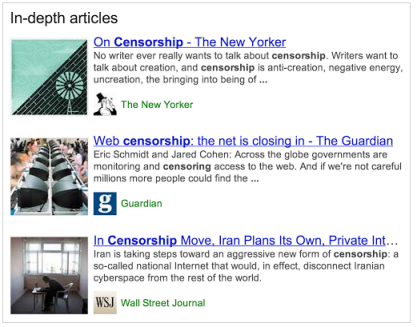
Google announced today that it will start integrating links to in-depth articles into its search results. So, if you search for “censorship,” says Google’s Pandu Nayak, “you’ll find a thought-provoking article by Salman Rushdie in The New Yorker, a piece by our very own Eric Schmidt and Jared Cohen in the Guardian, and another great article about Iran.” That means longform journalism will be treated almost the same as news, which is already featured in many search results courtesy of Google News. This is good news for people who care about “slow media” – the type of journalistic content that is not tied to a specific moment, that resists the eroding forces of faddism, and that favors quality over quantity. Not only does it unlock the power of the archive, but it sends a message that this sort of content, usually more nourishing than the “first draft of history” or slap-dash blog posts (such as this one!), deserves a pedestal that is different from, but equal to, that given to more time-sensitive information. Now that we live in an age of Twitter, we are vulnearble to automatically placing a higher value on content that gets to us the fastest. Because of its ability to instantly satisfy this thirst for “newness,” Twitter emphasizes the now while eschewing the timeless. Until now, Google’s default settings have pretty much done the same. Type “Obama” into a Google search box right now and you’ll be delivered links to his Wikipedia entry, White House bio, and then three news articles relevant to today. Nowhere on that first page is there a link to, say, Dave Remnick’s biography of the President, or Michael Lewis’s inside look at the Presidency, published by Vanity Fair.

google-indepth

An example of Google’s results for “in-depth articles.” Read more of this post

The Next Web sheds key staff amid shift in editorial strategy to one that depends less on breaking news and more on reviews and analysis; Waywire CEO Nathan Richardson Departs As Company Shifts Focus From Content Creation To Curation

The Next Web sheds key staff amid shift in editorial priorities

BY HAMISH MCKENZIE
ON AUGUST 15, 2013

The Next Web, a leading tech blog, has fired or farewelled five of its top editorial staff in recent weeks as it shifts its editorial strategy to one that depends less on breaking news and more on reviews and analysis. In the last month, deputy managing editor Alex Wilhelm left to join TechCrunch, European editor and former TechCrunch writer Robin Wauters was laid off, and both features editor Harrison Weberand news editor Matthew Panzarino have left the company. Brad McCarty, who variously held positions as managing editor, director of business development, and head of TNW Academy, has also parted ways with the company. (Update: McCarty has since been in touch via Twitter to clarify that his departure was not related to the other personnel changes; the timing was coincidental.) Read more of this post

If it’s not broke, break it: How David Marcus is dismantling PayPal to save it

If it’s not broke, break it: How David Marcus is dismantling PayPal to save it

BY SARAH LACY 
ON AUGUST 12, 2013

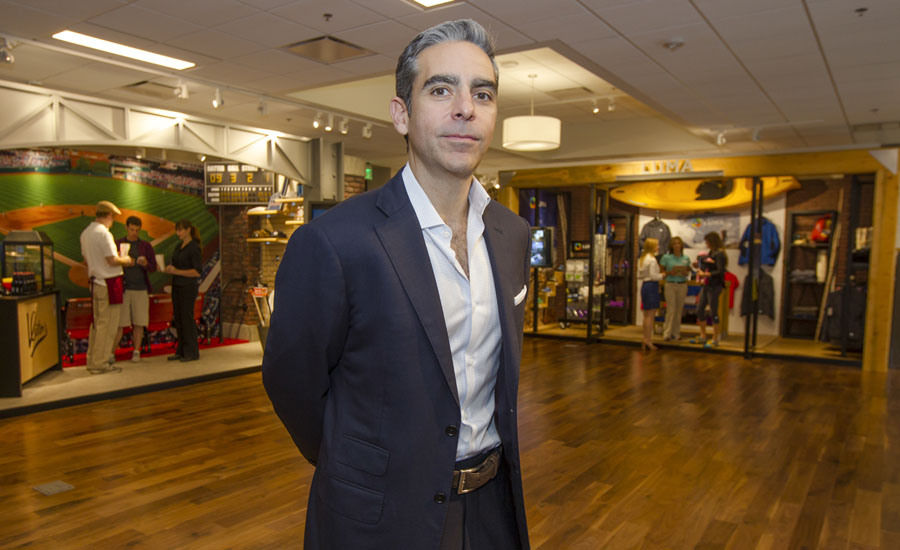
david_inside

These days, if you go up and down the elevator at PayPal’s headquarters, get out on each floor and look around. You’ll see the perfect metaphor for PayPal’s past, present, and future.

On the third floor, PayPal President David Marcus shows me a sea of high-walled beige and grey hexagonal cubicles. The kind you stared at for 16 hours a day if you worked at a Peninsula-based, late-1990s tech company. They look identical to Yahoo’s except no purple and yellow. The walls block out most of the natural light in the room and any sign of coworkers. Even “Cubicle Guy” would have to stretch to prairie dog over them. Marcus can’t hide his contempt looking at them. Read more of this post

Garages of the Rich and Famous

Garages Read more of this post

Why Innovation Is Still Capitalism’s Star

August 17, 2013

Why Innovation Is Still Capitalism’s Star

By ROBERT J. SHILLER

18-VIEW-popup

CAPITALISM is culture. To sustain it, laws and institutions are important, but the more fundamental role is played by the basic human spirit of independence and initiative.

The decisive role of the “spirit of capitalism” is an old concept, going back at least to Max Weber, but it needs refreshing today with new evidence and new thinking. Edmund S. Phelps, a professor of economics at Columbia University and a Nobel laureate, has written an interesting new book on the subject. It’s called “Mass Flourishing: How Grassroots Innovation Created Jobs, Challenge and Change” (Princeton University Press), and it contains a complex new analysis of the importance of an entrepreneurial culture.

Professor Phelps discerns a troubling trend in many countries, however, even the United States. He is worried about corporatism, a political philosophy in which economic activity is controlled by large interest groups or the government. Once corporatism takes hold in a society, he says, people don’t adequately appreciate the contributions and the travails of individuals who create and innovate. An economy with a corporatist culture can copy and even outgrow others for a while, he says, but, in the end, it will always be left behind. Only an entrepreneurial culture can lead. Read more of this post