AmBev Weathering Brazil’s First Beer Drop-Off in Decade

AmBev Weathering Brazil’s First Beer Drop-Off in Decade

Brazilians are drinking less beer for the first time in a decade. Cia. de Bebidas das Americas, Latin America’s biggest brewer, says it can still boost profit.

AmBev, as the Anheuser-Busch InBev NV (ABI) unit is known, is promoting higher-margin premium beers and repackaging cheaper offerings to make them more affordable after a surprise volume drop, Chief Executive Officer Joao Castro Neves said last week in a conference call. It’s also expanding in Brazil’s North and Northeast, where sales aren’t slowing as in other regions.

“Even though we’re expecting volumes to be down, that’s a volume number, not a profit number,” Lauren Torres, an HSBC Holdings Plc analyst, said by telephone from New York. “They could actually still grow their company, still generate cash and pay dividends.” Read more of this post

CFTC subpoenas metals warehousing firm as inquiry heats up

CFTC subpoenas metals warehousing firm as inquiry heats up

2:03am EDT

By Josephine Mason

LONDON (Reuters) – The U.S. commodities market regulator has subpoenaed a metals warehousing firm, seeking all of its documents and communications related to the London Metal Exchange since January 2010, as an inquiry into complaints about inflated metals prices gathers steam.

The U.S. Commodity Futures Trading Commission (CFTC) sent the subpoena last week, a source with direct knowledge of the matter said, after a letter from the regulator last month ordered the warehouse firm to preserve emails, documents and instant messages from the past three years. Read more of this post

Oil Sands Industry Turns to Algae to Appease Obama

Oil Sands Industry Turns to Algae to Appease Obama

Canada’s response to President Barrack Obama’s challenge to reduce emissions of global-warming gases from the oil sands starts with sewage and algae.

The paste-like crude extracted from the oil sands is softened by heat and steam to make it flow though pipelines. Burning natural gas to process the fuel creates carbon dioxide that researchers believe can be combined with waste water and fed to algae, which can be processed into cattle feed and other useful products.

“We’re taking CO2 and making it into a valuable product,” said John Parr, vice president at Canadian Natural Resources Ltd. (CNQ), the country’s third-largest oil-sands producer by market value, in a phone interview. “There’s a business case that can be made for it.” Read more of this post

Yes Bank Loses Almost Half Its Market Value on India Crunch; Indian Banks to Drop on Record Yield Inversion

Yes Bank Loses Almost Half Its Market Value on India Rate Surge

Yes Bank Ltd. (YES), the best-performing Indian bank stock last year, has lost almost half its market value in less than a month on investors’ concern that a record surge in interest rates will erode profits and boost defaults.

The stock has tumbled 43 percent, the most in the S&P BSE Bankex Index, since the Reserve Bank of India on July 15 began taking emergency steps to tighten liquidity and bolster the rupee. Mumbai-based Yes Bank, which gets 69 percent of its funding from bulk deposits and debt, is among lenders that are most vulnerable if rates remain high, according to Espirito Santo Securities India Pvt. Read more of this post

Catalogue shopping finds new life in digital age

August 11, 2013 12:43 pm

Catalogue shopping finds new life in digital age

By Andrew Bounds

In the vast reception area of Express Gifts’ head office in Accrington, Diana, Princess of Wales, beams down from the wood panelled wall with her trademark Mona Lisa smile. The princess opened the building in June 1983, while catalogue shopping was in its heyday.

Today more than half its sales are online. But the group, part of listed conglomerateFindel, has adapted and returned to growth.

It joins NBrown, established in 1859, and the biggest of all, Shop Direct, founded as Littlewoods in 1932, in proving there is life in the oldest form of remote shopping in its northwest heartland.

NBrown, which employs 3,500 in Manchester, has become a model stock market performer, with the shares doubling in a year after five years of rising sales and dividends. It made £96.4m in pre-tax profit on revenues of £784.7m in the year to March 2.

Angela Spindler, the new chief executive, admits stepping into the retiring Alan White’s shoes will not be easy. She also cannot step into the company’s products – it caters for size 14 and above only, a growing market with little competition.

“It is a great place to be in terms of our relationship with customers. They are at best ignored and at worst actively alienated by the fashion industry,” she said.

Some 57 per cent of sales to its 6m customers are online, with 10 per cent still by post and the rest over the telephone. It sends out 70m publications a year. Ms Spindler, who arrived from the Original Factory Shop chain, said: “We are not a catalogue retailer. We are a multi-channel retailer.” But a catalogue arriving can still be a “trigger” to purchase, even if that is done online.

NBrown has launched a series of brands such as SimplyBe for women and Jacamo for men, promoted by cricketer Andrew “Freddie” Flintoff, to attract younger customers. It has learnt lessons, says Ms Spindler, chiefly that high street retail is about “location, location, location”.

Its next push could be international. It has trial sites in Germany and the US. While the rate of returned goods in Germany has been high – they “order four sizes and send three back” – Ms Spindler says in the US SimplyBe is “really resonating, we are seeing strong growth there”.

It may follow where Tesco retreated, with Ms Spindler set to unveil her strategy at the interim results announcement in October.

Express Gifts, which owns the Studio catalogue business, added 8 per cent more customers in the year to March 29. Sales were up 13.4 per cent from £231.9m to £263m and operating profit grew by 15.9 per cent from £18.8m to £21.8m.

It has two advantages. A 375,000 sq ft Accrington facility, fully automated, allows it to make money on even small items such as mop heads and can openers. It also services Kleeneze, Findel’s army of door to door salesmen.

But the main one is its ability to personalise its products by adding names or initials to everything from dolls houses to dressing gowns for “free”.

“It’s a point of difference. People are so price sensitive. You can’t go on the web and compare prices directly,” Phil Maudsley, chief executive, said. Some 40 per cent of goods are personalised, with a 48 hour turnround.

The catalogue retailers have another secret weapon: credit. Express has a 48 per cent APR, which is not atypical. Shop Direct, where 90 per cent of customers buy with credit, has hired Alex Baldock from Lombard, the asset-based lender, as chief executive to develop its offering still further.

Shop Direct, which is owned by the Barclay brothers and has merged with Great Universal Stores, its Manchester based rival, is also back on the path to profitability.

“It was like merging Liverpool and Manchester United,” Mr Baldock says of the challenge of bringing together the two biggest competitors in the market. “But it is done now.”

Mr Baldock is also talking about personalisation. But to him, it means using the vast amount of data the business has on its customers to tailor its selection of the 50,000 products it stocks, especially as more people buy through mobile devices with smaller screens.

It could suggest curtains to match a sofa bought last year, for example.

It is working with IBM to perfect the offering. “We intend to be a world class digital retailer. We have a strong foundation, a very clear strategy based on unique strength and support from our shareholders.”

He says the typical customer is an “aspirer and striver, female, aged 25-55”.

“This business has been focused on her for 80 years. We know her better than anyone else.”

India’s Path to Prosperity Doesn’t Run Through Cities

India’s Path to Prosperity Doesn’t Run Through Cities

Indian leaders often warn that they need to shift the majority of their country’s population — almost 70 percent — from rural to urban areas. “Our salvation,” Prime Minister Manmohan Singh claims, “lies in moving people out of agriculture.” Finance Minister P. Chidambaram confirms, “My vision is to get 85 percent of India into cities.”

These dedicated urbanizers claim to have history on their side: the shift from agriculture to urban industry and manufacturing is how Europe, the U.S. and, more recently, China enhanced their productivity and created capital for broader investments to modernize their economies. Read more of this post

Freedom of Expression: Indians are Becoming Increasingly Intolerant; Instead of nurturing the spirit of debate, we have become aggressive, bigoted and abusive

Freedom of Expression: Indians are Becoming Increasingly Intolerant

by Salil Tripathi | Aug 12, 2013

Instead of nurturing the spirit of debate, we have become aggressive, bigoted and abusive

In 1999, the BJP-led National Democratic Alliance honoured the scholar, economist, and philosopher Amartya Sen with India’s highest honour, the Bharat Ratna, a year after his Nobel Prize. One of Sen’s more interesting books is The Argumentative Indian (2006), celebrating our propensity to challenge views we disagree with. Indians argue with one another, he says, and from those dynamic encounters new ideas synthesising different viewpoints emerge, making unity in diversity possible in this complicated nation.
In July this year, in response to a question from a journalist, Sen said he would not support Narendra Modi, Gujarat’s chief minister, to be India’s Prime Minister; he believes Modi fails the secularism test, which he sees as a necessary precondition to govern a country as diverse as India. Read more of this post

What Korean and Japanese literatures tell about countries

2013-08-11 13:55

What Korean and Japanese literatures tell about countries
By Yoon Sung-won, Kim Da-ye
John Treat, a professor of East Asian languages and literature at Yale University, is a rare Western scholar with extensive insight into Korean literature, especially that from the Japanese colonial period. His association with Korea was formed almost accidentally, partly because he had long hair in his youth. In 1971, Treat was sent to Vietnam to serve as a civilian employee in a military hospital. After six months of service, he went to Japan for “rest and recreation” where he witnessed a stark contrast between the war-torn Vietnam and the peaceful, affluent and liberated Japan. Treat went back to Japan as a student, and his girlfriend and he planned to travel to Taiwan during the summer vacation. He wasn’t granted a visa because of his lengthy hair. The couple decided to visit Korea instead, taking a boat from Kobe to Kyushu and then to Busan. They spent a week in Korea, hitchhiking around. More than 20 years later, Korea revisited Treat’s life. The scholar specialized in Japanese literature back then, and a Japanese colleague recommended him to study Korean writers under the Japanese colonial rule who wrote both in Korean and in Japanese. Treat found the idea interesting and began learning the Korean language in his 40s. The author of several works of fiction  and non-fiction is now an authority in the study of pro-Japanese Korean writers under the colonial rule. Last year, he published a paper on Yi Kwang-su, a prominent writer whose reputation has been tainted for having collaborated with the Japanese regime, in the Journal of Asian Studies. In the abstract, Treat wrote, “Yi Kwang-su, Korea’s most distinguished modern novelist as well as one of its more notorious pro-Japanese partisans during the colonial period, offers a compelling test case for how we might attempt to not only understand, but also morally adjudicate, his support of Japan’s occupation of his country. With the ongoing debate over collaboration with the German Reich in mind, I contend that the case of colonial Korea presents us with important first-order ethical issues to resolve.” The professor is now working on a book dealing with the same subject, “Collaboration, Conversion and Modernity: Korean Writers under Japanese Rule.” Treat visited Korea this summer for a special purpose — teaching at Ewha Womans University. He taught an unusual subject, “Same Sex Desire in East Asian Literature.” He said he had a “wonderful experience” at Ewha. On the day of the interview, he was going to grade final papers. He said he previewed the papers in class and he found the level of analysis was as high as he would get at Yale. The professor talked to The Korea Times further about how Japanese and Korean literature differ from each other; why Korea hasn’t won a Nobel Prize in literature; and what he thinks of pro-Japanese Korean writers during the colonial period. The following questions and answers have been edited. Read more of this post

Korean Companies Struggle to Gain Traction in Japan

August 11, 2013

Korean Companies Struggle to Gain Traction in Japan

By ERIC PFANNER

TOKYO — Brandishing a new Sony Xperia as she left a mobile phone shop in a trendy part of Tokyo, Nisako Hanawa, a 17-year-old student, explained that she had chosen that brand “because of its cool design and its good reputation.”

Asked about another leading smartphone maker, Samsung Electronics of South Korea, she and a friend exchanged quizzical looks. “Samsung?” Miss Hanawa asked. “I haven’t heard of it.”

Samsung Electronics may be the largest consumer electronics company in the world, selling one out of every three smartphones and one in five televisions. LG, the other giant electronics maker in Korea, has a significant share of TV and washing machine markets in Europe and the United States. But here in trend-obsessed Japan, consumers have not caught on that elsewhere in the world some Korean products are knocking Japanese rivals off the shelves.

Many Japanese explain away the absence of Korean brands by claiming the quality is inferior. “South Korean products are still affected by a ‘cheap and nasty’ image, which remains prevalent among Japanese above a certain age,” wrote Hidehiko Mukoyama, an economist at the Japan Research Institute, in a research paper about Japan-South Korea trade relations.

The evidence says otherwise. Korean-made TVs, phones, washers and cars rate higher than many Japanese brands in independent tests by Consumer Reports, CNet and others. LG TVs have been getting favorable reviews in Japan. A local magazine, HiVi, recently rated a 32-inch, high-definition, 3-D-capable LG set-top ahead of televisions in its category from Mitsubishi and Sharp.

The unfamiliarity is not because tariffs make Korean products costlier. Japan eliminated the import duty on many Korean electronics products, including TVs and smartphones.

But this last holdout is finally being cracked open. In 2008, LG stopped selling its televisions in Japan, but it reintroduced them two years later. Now many of the biggest electronics retailers in Japan, including the No. 1 player, Yamada Denki, and the second-biggest chain, Biccamera, sell LG TVs.

At a suburban Tokyo branch of Nojima, a major Japanese retail chain, LG televisions are displayed prominently alongside sets from domestic brands like Sony, Sharp, Panasonic and Toshiba.

Kohei Tomizawa, a sales clerk, said LG TVs were selling briskly, though not as well as those from Sony. LG sets “tend to be more popular with younger people, and younger people don’t buy as many televisions as older customers, who tend to prefer well-known Japanese brands, like Sony,” Mr. Tomizawa said.

The quality myth may be less believable to a younger generation of consumers. With South Korean food and television shows popular in Japan, LG has latched on to the popularity of K-pop music across Asia and beyond. It has run ads for its smartphones in Japan that feature Kara, a Korean group that is popular in Japan.

“I think things have improved compared to the old days, thanks to the influence of Korean popular culture,” said Byoung-Uk Lee, assistant director of the Korea Trade-Investment Promotion Agency in Japan.

LG said it sold about $675 million worth of TVs, smartphones, washing machines, vacuum cleaners and other goods in Japan last year, up about 45 percent from 2010.

Samsung also pulled out of Japan in 2007, after failing to make much of a dent here. (The biggest Korean carmaker, Hyundai Motor, also beat a retreat from Japan shortly thereafter.)

But Samsung has come back for a second shot in Japan, starting with its smartphones. NTT Docomo, the largest mobile phone carrier in Japan, has turned to Samsung to try to fend off rising competition from two rival network operators, SoftBank and KDDI.

Those two companies have been poaching customers from Docomo, which does not offer the popular iPhone. “Docomo needs Samsung, and that is giving it an opening,” said Michito Kimura, an analyst at IDC, a research firm.

Starting in May, Docomo plastered Japanese cities with advertising posters featuring the flagship Samsung Galaxy S4 smartphone alongside a Sony Xperia A. The campaign, for what Docomo bills as its “summer collection,” is the first time that any Japanese carrier has given such prominence to a Samsung phone.

So far, the results of Docomo’s embrace of Samsung have been mixed. Analysts say Samsung smartphones have been a tougher sell in Japan than in other countries where consumers are familiar with the brand through the televisions and other goods.

Docomo said that under its summer promotion, it had sold 400,000 Galaxy S4 phones through mid-July, but that was less than half the total of Sony Xperia A handsets.

Apple dominates the Japanese smartphone business, holding a 40 percent market share in the first quarter, according to IDC. Sharp, with 15 percent, and Sony, with 13 percent, follow. Samsung has not cracked the top five vendor ranks.

Japanese and Korean news media have reported that Samsung is considering re-entering the Japanese television market. Samsung declined to comment.

To succeed in Japan, Samsung will have a lot of work to do changing a mind-set. But some analysts, like Sea-Jin Chang, the author of “Sony vs. Samsung: The Inside Story of the Electronics Giants’ Battle for Global Supremacy,” are convinced that South Korean companies have a brighter future in Japan.

“Japanese customers favor domestic producers,” said Mr. Chang, executive director of the Center for Governance, Institutions and Organization at National University of Singapore. “No Korean or Western firms were good enough for them, except Apple. But you will find more Korean firms accepted in the Japanese mainstream in the future.”


Falsified Reports After Fukushima Fan Anti-Nuclear Korea

Falsified Reports After Fukushima Fan Anti-Nuclear Korea

For Seoul residents, South Korea’s decision to keep four nuclear reactors offline because of faked safety reports means power shortages, and a summer of sweltering homes and offices. Lee Jin Gon has bigger concerns.

“We feel unsafe day and night,” Lee said, pointing at the cause of his nervousness, one of the closed reactors in the town of Yangnam, a four-hour journey southeast of the capital. “We became worried about nuclear safety after the Fukushima accident. Now it’s worse,” he said, adding that locals have held protests to close the whole plant. Read more of this post

Mantra to Expand in Indonesia Amid Tourism Boom: Southeast Asia

Mantra to Expand in Indonesia Amid Tourism Boom: Southeast Asia

Mantra Group, the Australian hotel operator controlled by CVC Asia Pacific Ltd., plans to open 20 hotels in Indonesia in the next three years and manage about the same number of properties in Thailand in six years.

The closely-held company, which opened its first resort under its four-star Mantra brand in March in Bali, is in talks to add six more hotels in the resort province, Chief Executive Officer Bob East said in an interview in Sydney. The Gold Coast, Queensland-based company, which is also in initial talks to run a hotel in Jakarta, will either sign management agreements or take minority stakes in properties in the country, he said. Read more of this post

Indonesia: A delicate succession; In next year’s presidential election, all eyes will be on the governor of Jakarta

August 11, 2013 4:30 pm

Indonesia: A delicate succession

By Ben Bland

In next year’s presidential election, all eyes will be on the governor of Jakarta, writes Ben Bland

Almost every Thursday for the past six years, Maria Katarina Sumarsih has stood outside Indonesia’s presidential palace with a group of other victims of human rights abuses, calling for justice. Some protest about the hundreds of thousands who were killed in the anti-leftist purges of the late 1960s, which cemented the rise to power of General Suharto, who ruled Indonesia from 1966 to 1998. Ms Sumarsih is mourning the loss of her son, who was one of more than a dozen student protesters shot dead by the army while calling for political and economic reforms in central Jakarta during the chaotic period that followed the ousting of Suharto. Read more of this post

Taiwan struggles to win over Chinese students

August 11, 2013 1:45 pm

Taiwan struggles to win over Chinese students

By Sarah Mishkin in Taipei

When Taiwan opened its universities to mainland Chinese students two years ago, many in the Taipei government hoped the decision might help the small democracy to influence its authoritarian neighbour. Many of the hundreds of mainland students who have since arrived say their studies have been an eye-opening look at how democracy and an open civil dialogue can work in Chinese society. But Taiwan’s anxiety about its growing economic dependence on China, which has never relinquished its claim to the island, is hampering its soft power push, say students and professors. Read more of this post

Watch Out Publishers: Here Comes LinkedIn, With Original Content; The World’s Largest Rolodex Is Becoming a Go-To Spot for Information

Watch Out Publishers: Here Comes LinkedIn, With Original Content

The World’s Largest Rolodex Is Becoming a Go-To Spot for Information

Published: August 09, 2013

SHAFQAT ISLAM

Publishers, there’s a new sheriff in town. Yesterday, LinkedIn was a social network. Today, it is a powerhouse publishing brand. And with the kind of scale and audience targeting that it’s built, it will be an advertising juggernaut that can’t be stopped. This past year LinkedIn rolled out a game-changing feature, theInfluencer program, which has made it a go-to site that offers far more than just the world’s largest virtual Rolodex. The Wall Street Journal, Financial Times and other top-tier business publishers should be worried. LinkedIn is arguably the world’s largest business publication (or any publication for that matter). With a registered audience of more than 230 million, LinkedIn has more than 50 times the number of registered users as the Financial Times. LinkedIn drives around 10 billion page views per month, compared to 133 million for The Wall Street Journal. LinkedIn had 116 million unique visitors last quarter, compared to 13 million average monthly uniques for The Journal. Read more of this post

Even Dead Feel the Weight of Debt Crisis in Spain; Funeral services carry the highest VAT tax rate, alongside entertainment like nightclubs, and luxury products

Even Dead Feel the Weight of Debt Crisis in Spain

By Alexandra Di Stefano Pironti on 12:05 pm August 10, 2013.
Barcelona,Spain. Even in death, people in Spain cannot escape the economic crisis. Funeral services carry the highest VAT (value added tax) rate, alongside entertainment like nightclubs, and luxury products. “I paid over 7,000 euros ($9,300) for my husband’s funeral, and it was a simple service, with one of the simple coffins, which cost 2,600 euros ($3,450), without mementos or music, and only a few flowers. Besides, instead of a burial, we had him cremated, which is even less expensive,” Ana Mara Robles, a 66-year-old pensioner, told IPS. “For a middle-class family, that price is abusive,” said Robles, who retired a few months ago after working for years in the Barcelona traffic department. Jordi Valmana general manager of the “Cementiris de Barcelona” municipal company that administers the cemeteries in this city in northeast Spain, said: “Funeral services are essential for society and the public.” “The fact that VAT was raised from eight to 21 percent in late 2012 is appalling, and I think it’s a political mistake for funeral services to be charged the same tax as discotheques,” he told IPS. Read more of this post

They come for the politics, but stay for the money; Washington transforms political believers into members of the get-rich club

August 11, 2013 6:58 pm

They come for the politics, but stay for the money

By Jacob Weisberg

Washington transforms political believers into members of the get-rich club, says Jacob Weisberg

It’s a funny thing about Washington: everyone complains about it, but no one ever seems to leave. Take former House leader Richard Gephardt. The Missouri Democrat twice ran for president as a voice of organised labour. Today he pockets $7m a year to lobby on behalf of corporate clients and advise them on busting unions. Or consider former journalist Jeffrey Birnbaum, who used to write exposés of the lobbying trade for The Wall Street Journal. Today he works for Haley Barbour, Mississippi’s Republican former governor who is now one of the most influential lobbyists in Washington. Read more of this post

Bond Hubris Overwhelms Fed in Riskiest Sectors of Credit Markets

Bond Hubris Overwhelms Fed in Riskiest Sectors of Credit Markets

Bond investors trying to divine when the Federal Reserve will reduce its unprecedented monetary stimulus are increasingly looking to the riskiest parts of the debt market, which are booming like before the financial crisis.

The amount of loans made this year that lack standard protections for lenders exceed the all-time high set in 2007, and only one other time have investors pumped more money into funds that buy lower-rated loans than they did last week. Bonds rated in the lowest category of junk accounted for the greatest percentage of speculative-grade offerings last month since 2011. Read more of this post

The Next Private-Equity Investors: Mom and Pop

 | SATURDAY, AUGUST 10, 2013

The Next Private-Equity Investors: Mom and Pop

By LAWRENCE C. STRAUSS | MORE ARTICLES BY AUTHOR

Private-equity holdings, which are illiquid and usually take many years to bear fruit, normally aren’t associated with mutual funds, which provide daily liquidity. But the day is fast approaching when mom-and-pop investors will be able to invest in private-equity holdings, says David M. Rubenstein, co-CEO

The Carlyle Group’s David Rubenstein sees mutual funds eventually offering small investors a chance to get a piece of the action. The Carlyle Group (ticker: CG), a Washington, D.C.–based private-equity firm that went public in 2012. Since Rubenstein, now 64, helped found the firm in 1987, its assets have gone from $5 million to about $180 billion. Carlyle is one of the industry’s behemoths, along with rivals such as Blackstone Group (BX) and KKR (KKR). Carlyle’s portfolio includes stakes in TCW Group, an asset manager; HCR ManorCare, which owns and operates nursing homes and assisted-living facilities; and Accudyne Industries, whose products include air compressors. Rubenstein says that while flows from institutional investors, such as pension funds, haven’t returned to pre-financial-crisis levels, more money now is pouring in from sovereign wealth funds and private banks. Last week, while announcing a disappointing second-quarter loss of seven cents a unit, the firm disclosed that it had raised $7 billion for future investments. Although Carlyle invests all over the world, the U.S. “is by far the most attractive place in which to invest, certainly for the types of things that we do,” Rubenstein adds. Barron’s spoke with him recently in his midtown Manhattan office. Read more of this post

Deutsche Börse’s News Service for Traders Draws Scrutiny of Investigators; A look at Need To Know News sheds light on growing concerns about data releases

August 11, 2013, 10:38 p.m. ET

Deutsche Börse’s News Service for Traders Draws Scrutiny of Investigators

A look at Need To Know News sheds light on growing concerns about data releases

BRODY MULLINS  and SCOTT PATTERSON

Need To Know News was formed in 2004 by a Chicago investment firm, Allston Trading, whose traders thought they sometimes weren’t getting economic data as fast as some competitors. John Harada, pictured here, is an Allston co-founder who later became the news service’s owner.

P1-BM656A_NEWS_G_20130811180035

WASHINGTON—Several times a month, the Labor Department invites news reporters to a sealed room for an early look at soon-to-be-released reports such as the unemployment rate. One organization attending in recent years stands out from the rest. Founded by an investment firm and now owned by the Deutsche Börse stock exchange, Need To Know News has operated with an overriding mission: sending data directly from the government through high-speed lines to financial firms that are able to trade on it instantly. Some have paid $375,000 a year for the service. The ability of such an organization to gain a position at the heart of the government’s system for releasing economic reports turns on its head an embargo arrangement created decades ago to give writers time to digest complex data and produce reports for broad public dissemination. Read more of this post

Money managers trying to gauge the stock market’s direction have started looking to the buyout business for signals, and they don’t like what they are seeing

Aug 11, 2013

Stock Investors Take a Cue From Private Equity

By E.S. Browning

Money managers trying to gauge the stock market’s direction have started looking to the buyout business for signals, and they don’t like what they are seeing. With the Dow Jones Industrial Average up 18% this year and the Federal Reserve planning to cut back on the bond-buying it uses to stimulate markets, some investors worry that the stock market has gotten pricey and could pull back. They see evidence in the behavior of buyout firms that specialize in taking companies private. “There are a lot of people who think this is a better time to sell than to buy,” and in particular the buyout firms, said David Joy, chief market strategist at Ameriprise Financial Inc., which oversees $700 billion for its clients. When sophisticated investors pull back, some analysts believe, it is a sign that the smart money is growing skeptical on the outlook for stocks. Read more of this post

Insider Case Highlights Ties of Friends, Family; Prosecutors Allege a U.S. Couple Made More Than $1 Million on Tips From a Banker

August 11, 2013, 5:42 p.m. ET

Insider Case Highlights Ties of Friends, Family

Prosecutors Allege a U.S. Couple Made More Than $1 Million on Tips From a Banker

JEAN EAGLESHAM

Married in 2007, millionaires in 2012, fugitives in 2013—now, Shawn Hegedus and Danielle Laurenti sit in Mecklenburg County jail in North Carolina, awaiting federal trial.

In one hot week last summer, prosecutors allege, the couple made more than $1 million from insider trading, spent most of it on 550 gold bars in midtown Manhattan and laundered $100,000 in a Las Vegas casino. Read more of this post

Emerging World Loses Growth Lead

August 11, 2013, 9:46 p.m. ET

Emerging World Loses Growth Lead

Global-Trade Decline Dulls Developing Markets as Outlook Brightens in More-Established Economies

ALEX FRANGOS in Hong Kong, SUDEEP REDDY in Washington, and JOHN LYONS in São Paulo

Momentum in the global economy is shifting to the developed world, away from the emerging economies that had led growth since the financial crisis. For the first time since mid-2007, the advanced economies, including Japan, the U.S. and Europe, together are contributing more to growth in the $74 trillion global economy than the emerging nations, including China, India and Brazil, according to an estimate by investment firm Bridgewater Associates LP. The turnabout may reshape world capital flows and upend forecasts that corporations had built around ebullient hopes for emerging markets. Read more of this post

Orchid entrepreneur Koh Keng Hoe makes failure a blooming success, mastering the full cycle of orchid growing through trial and error.

He makes failure a blooming success

Sunday, Aug 11, 2013

Judith Tan, The New Paper

20130809_Kohkenghoe_tnp

SINGAPORE – Life had thrown Mr Koh Keng Hoe lemons and instead of wallowing, he grew orchids. He has gone from an unemployed man in his 20s with a bleak future to one of the top growers worldwide. The Kovan boy, whose nursery did not even have a proper road, is now living in a bungalow in Dunearn Road. But back in 1954, life was tough as he had just been sacked from his job in The Straits Times after taking part in a Singapore Printing Employees’ Union strike. “I only had that one skill, nothing else,” he said of his $160-a-month job as a linotype operator. So he sold his BSA motorcycle for $100 to buy a Vanda merrillii, a red jungle orchid with a distinctive scent, from a Simon Road grower. “I had no money. I had to ride a bicycle there,” he said. “I knew nothing (then) about growing orchids. I was told that they grow well on coconut husks. People throw out the husks, making that a zero investment for me,” he added. Mr Koh applied whatever little knowledge of vegetable farming he had and his plants blossomed. That was the start of his six-decade love affair with the flower. He even mastered the full cycle of orchid growing – from cultivation and pollination, to the preparation and perfecting of nurturing seedlings – through trial and error. Read more of this post

“At its best, the sensation of writing is that of any unmerited grace. It is handed to you, but only if you look for it. You search, you break your heart, your back, your brain, and then — and only then — it is handed to you.”

Annie Dillard on Writing

“At its best, the sensation of writing is that of any unmerited grace. It is handed to you, but only if you look for it. You search, you break your heart, your back, your brain, and then — and only then — it is handed to you.”

What does it really mean to write? Why do writers labor at it, and why are readers so mesmerized by it?

From Annie Dillard’s timelessly wonderful The Writing Life (public library) – which also gave us her vital reminder that presence rather than productivity is the key to living richly and her meditation on what a stunt pilot teaches us about creativity and the meaning of life – comes her infinitely resonant insight on the magic and materiality of writing, a fine addition to famous writers’ collected wisdom on the craft. Read more of this post

NZ PM John Key Says Fonterra Scare Affected All of New Zealand’s Exports

Key Says Fonterra Scare Affected All of New Zealand’s Exports

New Zealand’s entire export industry has suffered from the contamination scare that prompted China to halt imports of milk powder made by Fonterra Cooperative Group Ltd., Prime Minister John Key said.

Damage from the incident would be hard to quantify as it affected all of New Zealand’s exports around the world, rather than just dairy sales to China, Key said in an interview with Television New Zealand yesterday. In a separate interview, Fonterra Chief Executive Officer Theo Spierings put the cost at “tens of millions” of New Zealand dollars. Read more of this post

Cronies and capitols: Businesspeople have become too influential in government

Cronies and capitols: Businesspeople have become too influential in government

Aug 10th 2013 |From the print edition

20130810_WBD000_1

IN 1994 many Italians voted for Silvio Berlusconi in the hope that he could use his skills as a businessman to revive a sclerotic economy. He had built a property-and-media empire out of thin air. He had reinvigorated one of the country’s great football clubs, AC Milan. Surely he would do a better job of running the country than the old guard of corrupt politicians and introverted bureaucrats? Well, si monumentum requiris, circumspice. Mr Berlusconi was prime minister of Italy for eight of the ten years between 2001 and 2011. During that time Italy’s GDP per head fell by 4%, its debt-to-GDP ratio rose from 109% to 120%, taxes rose from 41.2% of GDP to 43.4%, and its productivity stagnated. Rather than using his business skills to revive the Italian economy, Mr Berlusconi used his political skills to protect his business interests. The great seducer is an extreme example. And with luck Italy’s long Berlusconi-themed nightmare is drawing to a close. But the problem at the heart of Mr Berlusconi’s Italy—the commingling of power and business—is a growing worry around the world. In “Can Capitalism Survive?” (1947) Joseph Schumpeter argued that the answer to that question was probably “no”. The great battle of the 20th century was between the state and business. And the state was likely to win because the thinkers and bureaucrats at its service were better at occupying the moral and intellectual high ground. “A genius in the business office may be, and often is, utterly unable outside of it to say boo to a goose—both in the drawing room and on the platform,” he said. Times have changed. Most politicians now believe that businesses are better than bureaucracies at generating growth. Prime ministers and finance ministers flock to Davos not to lay down the law to businesspeople but to court their favours. Businesspeople have learned not just to say boo to a goose but to put a ring through its beak. Today the problem is often the very opposite of the one that Schumpeter imagined: not the marginalisation of business but its excessive influence.

Read more of this post

Why Founders Fail: The Product CEO Paradox

Why Founders Fail: The Product CEO Paradox

BEN HOROWITZ

posted 12 hours ago

Editor’s note: Ben Horowitz is co-founder and partner ofAndreessen Horowitz. He was co-founder and CEO of Opsware (formerly Loudcloud), which was acquired by HP, and ran several product divisions at Netscape. He serves on the board of companies such as Capriza, Foursquare, Jawbone, Lytro, Magnet, NationBuilder, Okta, Rap Genius, SnapLogic, and Tidemark. Follow him on his blog and on Twitter@bhorowitz.

If I knew what I knew in the past
I would have been blacked out on your a** —Kanye West, Black Skinhead

Because I am a prominent advocate for founders running their own companies, whenever a founder fails to scale or gets replaced by a professional CEO, people send me lots of emails. What happened, Ben? I thought founders were supposed to be better? Are you going to update your “Why We Prefer Founding CEOs” post? In response to all of these emails: No, I am not going to rewrite that post, but I will write this post. There are three main reasons why founders fail to run the companies they created:

The founder doesn’t really want to be CEO. Not every inventor wants to run a company and if you don’t really want to be CEO, your chances for success will be exceptionally low. The CEO skill set is incredibly difficult to master, so without a strong desire to do so the founder will fail. If you are a founder who doesn’t want to be CEO, that’s fine, but you should figure that out early and save yourself and everyone else a lot of pain.

The board panics. Sometimes the founder does want to be CEO, but the board sees her making mistakes, panics and replaces her prematurely. This is tragic, but common.

The Product CEO Paradox. Many founders run smack into the Product CEO Paradox, which I explain below. Read more of this post

Christians, Muslims and Jesus: How two global monotheisms view the same prophet

Christians, Muslims and Jesus: How two global monotheisms view the same prophet

Aug 10th 2013 |From the print edition

Christians, Muslims and Jesus. By Mona Siddiqui. Yale University Press; 285 pages; $32.50 and £20. Buy from Amazon.comAmazon.co.uk

RELIGION is a tricky subject for scholarship. Even the most professional academic is bound to have personal feelings about the faith under scrutiny. Some see this as cause for concern. Indeed Reza Aslan, one of America’s best-known writers on religion, recently came under fire for his new book about Jesus (“Zealot”, reviewed in the July 27th issue of The Economist). Because he is a Muslim who once embraced Christianity and then dropped it, Lauren Green of Fox News accused him of writing with a “clear bias”. No, Mr Aslan replied, he was writing as a scholar. His response was articulate and dignified, and the interview has helped sell quite a few books, but it will hardly sway those who believe Mr Aslan is writing with a Muslim agenda. Read more of this post

The perils of sitting down: Real science lies behind the fad for standing up at work

The perils of sitting down: Real science lies behind the fad for standing up at work

Aug 10th 2013 |From the print edition

20130810_STP001_0

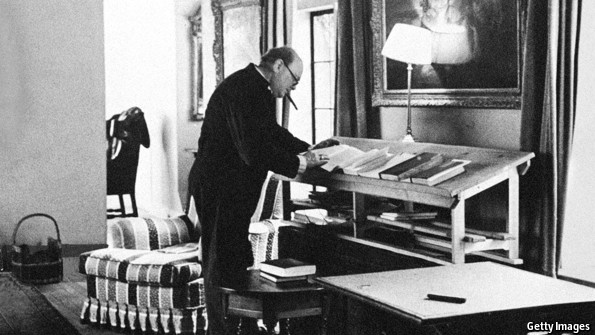
WINSTON CHURCHILL knew it. Ernest Hemingway knew it. Leonardo da Vinci knew it. Every trendy office from Silicon Valley to Scandinavia now knows it too: there is virtue in working standing up. And not merely standing. The trendiest offices of all have treadmill desks, which encourage people to walk while working. It sounds like a fad. But it does have a basis in science. Sloth is rampant in the rich world. A typical car-driving, television-watching cubicle slave would have to walk an extra 19km a day to match the physical-activity levels of the few remaining people who still live as hunter-gatherers. Though all organisms tend to conserve energy when possible, evidence is building up that doing it to the extent most Westerners do is bad for you—so bad that it can kill you. Read more of this post

Commercialising neuroscience: Cognitive training may be a moneyspinner despite scientists’ doubts

Commercialising neuroscience: Cognitive training may be a moneyspinner despite scientists’ doubts

Aug 10th 2013 | NEW YORK |From the print edition

“OUR primary goal is for our users to see us as a gym, where they can work out and keep mentally fit,” says Michael Scanlon, the co-founder and chief scientist of Lumos Labs. For $14.95 a month, subscribers to the firm’s Lumosity website get to play a selection of online games designed to improve their cognitive performance. There are around 40 exercises available, including “speed match”, in which players click if an image matches a previous one; “memory matrix”, which requires remembering which squares on a matrix were shaded; and “raindrops”, which involves solving arithmetic problems before the raindrops containing them hit the ground. The puzzles are varied, according to how well users perform, to ensure they are given a suitably challenging brain-training session each day.

Read more of this post