Unrated bond issues double in Europe

August 1, 2013 5:11 pm

Unrated bond issues double in Europe

By Christopher Thompson

The number of European companies without investment ratings tapping capital markets for funding has doubled as investors throw caution to the wind in their hunt for yield.

Bond issuance by unrated companies -–or those without investment ratings which measure credit quality – has totalled about €108bn since the beginning of 2010, driven by yield-hungry investors, low interest rates and a dearth of bank finance, according to research by Fitch. Read more of this post

With An Astounding $6 Billion Valuation, ServiceNow Has Become ‘The Next Salesforce.com’

With An Astounding $6 Billion Valuation, ServiceNow Has Become ‘The Next Salesforce.com’

JULIE BORT AUG. 2, 2013, 4:32 PM 2,648

It’s been over a year since ServiceNow’s IPO practically saved the post-Facebook IPO market single-handedly. In June 2012, with an opening share price of $18, the company had a jaw-dropping valuation of over $2 billion. (It was originally priced at $17 the night before the IPO.) And it and hadn’t even hit annual revenues of $100 million. Fast forward to this week: ServiceNow’s shares are trading at about $45, giving it a nearly $6 billion valuation. That makes it the fifth most valuable company in Bessemer Venture Partners new “Cloud Index” that tracks the 30 biggest software-as-a-service public cloud companies. At the time of its IPO, ServiceNow, which offers cloud apps that automate the help desk function for enterprises, was considered proof that the tech industry was in another bubble. But, it turns out, it was proof that ServiceNow is the next Salesforce.com, CEO Frank Slootman told Business Insider. Read more of this post

One Of The World’s Biggest Mobile Ad Companies Is In Huge Trouble And Has Stopped Paying Its Bills

One Of The World’s Biggest Mobile Ad Companies Is In Huge Trouble And Has Stopped Paying Its Bills

JIM EDWARDS AUG. 2, 2013, 10:46 AM 5,244 2

We first told you that Velti, the little-known but relatively massive mobile ad company, was in trouble back in June, when we demoted CEO Alex Moukas to 10th place on our annual ranking of the most important people in mobile advertising. The reason? The company cut about 300 of its 1,100+ jobs after Q1 2013 revenue collapsed 20% to $41 million. Velti is in the middle of a restructuring. Its stock, which once traded above $10, is now at $1.08. Its COO, Christos Kaskavelis, has been terminated. The company’s market cap is now less than its projected annual revenues. Read more of this post

The New York Times Company did the world of journalism a big favor today by finally disclosing the exact revenues of its digital business.

IT’S OFFICIAL: We Never Need To Worry About The Future Of Journalism Again!

HENRY BLODGET AUG. 1, 2013, 6:15 PM 10,620 24

The New York Times Company did the world of journalism a big favor today. The company finally disclosed the exact revenues of its digital business. The numbers were impressive. And they made clear that no one ever needs to fret about the future of journalism again. Specifically, the New York Times reported that the revenue of its digital business is now about $360 million a year. That’s composed of about $200 million of advertising revenue, which is basically flat, and another $150 million of digital subscription revenue, which is growing nicely. Assuming the digital subscription revenue continues to grow as the company rolls out new subscription products, which it will start to do next April, the New York Times Company should soon have a $400 million digital business. Why does that mean we never have to worry about the future of journalism again? Because a $400 million digital business is a healthy business, one that will support a large, talented newsroom. Even if the New York Times’ print paper, which still generates most of the company’s overall revenue of about $2 billion a year, were to shut down tomorrow, the company would still be able to fund an excellent newsroom. Read more of this post

Movie fans who were intrigued by director Peter Jackson’s use of high frame rates in “The Hobbit” are now getting a chance to see the superclear format online.

High frame rates debut online with special player

BY RYAN NAKASHIMA

AP

AUG 2, 2013

BURBANK, CALIFORNIA – Movie fans who were intrigued by director Peter Jackson’s use of high frame rates in “The Hobbit” are now getting a chance to see the superclear format online. The second season of the YouTube Web series “Video Game High School” is being released online at 48 frames per second (fps), double the 24 fps that has been standard in movie theaters for the past century. The season’s second episode debuted Thursday after the premiere episode attracted nearly 2 million viewers. Online video programming is growing fast as major networks and small upstarts go after young audiences who increasingly watch shows on laptops, tablet computers and mobile phones. Laying claim to the high-frame-rate niche could help “Video Game High School” stand out in a crowded field. By capturing moving objects on camera at higher frame rates, filmmakers are able to cut down on blurriness because the camera’s shutter opens and closes much faster. That reduces the amount of time that an object moves across an open lens and gives each image, or frame, more clarity. The experiment is partly a way to explore how to use high frame rates creatively while also pioneering a new business model online. Read more of this post

Why Chinese Stocks Perform Poorly? They had cooked books before IPO, often with the assistance of local governments

Why Chinese Stocks Perform Poorly?

08-02 17:56 Caijing

Companies’ engagement in bad business practices and high inflation levels are among the reasons.

Summary:
(1) They had cooked books before IPO, often with the assistance of local governments,
(2) They engaged in bad business practices,
(3) They sold too many new shares,
(4) They suffered cost explosion as inflation surged. Read more of this post

America’s Engineering Hubs: The Cities With The Greatest Capacity For Innovation

America’s Engineering Hubs: The Cities With The Greatest Capacity For Innovation

By Joel Kotkin

Created 07/31/2013 – 12:01

America has always been a nation of tinkerers. Our Founding Fathers, notes author Alec Foege, [1] were innovators in areas ranging from agriculture (George Washington, Thomas Jefferson) and electricity (Benjamin Franklin) to the swivel chair (Jefferson).

Engineering advances drove America’s quest for industrial supremacy in the 19th century, many of them borrowed (sometimes illegally) from the then very resourceful British Isles. By the early 19th century, the U.S. was producing its own major inventions, including the steamboat and cotton gin. By the end of that century, the U.S. was clearly on the way to industrial preeminence. The growth of engineering schools — MIT, the Case Institute, Stevens Institute of Technology, as well as departments at the great land grant universities — generated a steady supply of engineers. For much of the last 70 years, America, has been the world’s leading center of engineering excellence, dominating markets from steel and cars to energy and aerospace. Read more of this post

Kevyn Orr: How Detroit Can Rise Again; Motown’s ‘benevolent dictator’ talks about his fight with creditors and unions, and what the city’s leaders can learn from Miami and Atlanta about revival

Updated August 2, 2013, 7:12 p.m. ET

Kevyn Orr: How Detroit Can Rise Again

Motown’s ‘benevolent dictator’ talks about his fight with creditors and unions, and what the city’s leaders can learn from Miami and Atlanta about revival.

ALLYSIA FINLEY

What do northwest Washington, D.C., South Beach Miami and upper Manhattan have in common? Less than 50 years ago, the now vibrant communities didn’t look much different from most of Detroit, says emergency manager Kevyn Orr—whom Gov. Rick Snyder tapped in March to revive the broken Motor City. This is what gives him hope that Detroit can stage a comeback. Read more of this post

Building a Speedy Supply Chain for Fast Fashion

August 2, 2013, 5:09 PM ET

Building a Speedy Supply Chain for Fast Fashion

Emily Chasan

Senior Editor

At vintage-style online retailer ModCloth, Chief Financial Officer Jeff Shotts is using customer analytics to speed up the supply chain. Mr. Shotts oversees an analytics team as well as the finance operations at the venture-backed online retailer, which sells retro-style dresses, jewelry and apartment accessories. “Understanding customers and what they’re telling us is a critical area for us,” Mr. Shotts said. “Our analytics team is essentially looking at customer behavior, customer demographic and customer responses. Ideally there’s an early warning if a trend starts to deviate.” Rather than buy hundreds of items months in advance and try to sell them as traditional retailers do, Mr. Shotts says the company is using the information it gets from customers before and after it launches an item to predict supply, adjust inventory and understand what type of products will do well as quickly as possible. “We have a very rapid supply chain,” Mr. Shotts said. “We buy shallow quantities up front, and then, as customers purchase we think about doubling or tripling down on our inventory position for what’s selling well.” Read more of this post

Culture of Mass Strikes Suffocates Bangladesh’s Economy; ‘Hartals’ occurring at a time when Bangladesh is already struggling to rebuild its reputation with apparel companies

August 2, 2013, 9:16 p.m. ET

Culture of Mass Strikes Suffocates Bangladesh’s Economy

‘Hartals’ occurring at a time when Bangladesh is already struggling to rebuild its reputation with apparel companies

PATRICK BARTA and SYED ZAIN AL-MAHMOOD

DHAKA, Bangladesh—Amid the fallout of a deadly garment-factory collapse in April, Bangladesh faces a more immediate economic threat from the massive strikes known as “hartals,” which are bringing the country to its knees with disturbing, and rising, frequency. In one such strike last month, protesters attacked buses, blockaded roads and detonated homemade bombs, while at least five people died in clashes with police. Dhaka businesses saw revenue nosedive as shoppers stayed home. Even mango vendors suffered, as supplies from the countryside dwindled with roadways under threat of violence. Read more of this post

China’s Sinovel Wind Group Sets Rules to Prevent Accounting Errors; One-Time Wind-Energy Champion Has Suffered Series of Setbacks

Updated August 2, 2013, 1:55 p.m. ET

China’s Sinovel Wind Group Sets Rules to Prevent Accounting Errors

One-Time Wind-Energy Champion Has Suffered Series of Setbacks

WAYNE MA

BEIJING—A Chinese company accused by U.S. prosecutors of stealing trade secrets outlined new measures to respond to separate accounting problems, as China’s onetime wind-energy champion struggles to recover from a series of setbacks.

Sinovel Wind Group Ltd. 601558.SH -0.74% said in a filing on Friday that it appointed a longtime official with its financial-planning department to the new post of chief auditor. The company also announced new rules and procedures to prevent future accounting errors, including more frequent inventory checks, on-site interviews and inspections, better training for middle managers and enhanced document verification. Read more of this post

Seeking Capital, Some Companies Turn to ‘Do-It-Yourself I.P.O.’s’

July 31, 2013

Seeking Capital, Some Companies Turn to ‘Do-It-Yourself I.P.O.’s’

By AMY CORTESE

Flying back to California, empty-handed, after one last investor pitch in late 2011, Brahm Ahmadi was ready to call it quits. Despite a track record, a clear market opportunity and a loan pledge, he had not been able to attract a single investor. He called his lawyer and told her, “We hit a wall.”

Mr. Ahmadi , the founder of People’s Grocery, a nonprofit focused on food justice issues, hoped to open a commercial grocery store that would offer fresh produce in West Oakland, Calif., a so-called food desert, meaning its 25,000 residents have few healthy food options. A public-private loan fund, California FreshWorks Fund, had issued a letter of intent to lend Mr. Ahmadi two-thirds of the $3.6 million he needed to open the People’s Community Market. There was just one condition — he would first have to raise the remaining $1.2 million from investors. Mr. Ahmadi spent a year pitching to angels, social investors and private equity firms, but most were looking for double-digit returns and a clear exit strategy. Read more of this post

How US economy grew US$560b overnight; Revamped GDP calculation includes spending on R&D and production of original artistic and literary works

A larger, more innovative US economy

Robin Bew

The US government has just comprehensively revised its GDP data, leading to some fascinating results. By counting spending on R&D and the production of artistic works such as films as productive investment, the new data show an economy that is US$560bn larger than previously estimated. In effect, a country roughly the size of Sweden has been added to GDP. Investment in intellectual property goes hand in hand with innovation, which suggests that the US is even better equipped than previously thought to flourish in the knowledge economy. However, as my team of analysts notes slightly ruefully, the latest data revisions play havoc with economic forecasts. Look for changes in our US growth and fiscal projections in the near future.

August 1st 2013

New data reshape picture of US economy

Economic growth, especially in Western countries, has been difficult to come by in recent years. But the US government has found a new way to look at companies and what they spend, and the result is a larger US economy than had been previously estimated–by some US$560bn. In effect, a country slightly larger than Sweden has been added to the US economy in a single stroke. Read more of this post

SGX says bye to offshore AGMs, show of hands; Beginning Jan 1, 2014, all Singapore Exchange (SGX) primary-listed companies and trusts must hold their general meetings in Singapore

SGX says bye to offshore AGMs, show of hands

Saturday, Aug 03, 2013

Kenneth Lim

The Business Times

SINGAPORE – Singapore Exchange-listed companies will have to hold their general meetings in Singapore soon and conduct poll voting in two years’ time, according to new rules introduced by the market operator on Wednesday. The move tackled two items at the top of many governance wish lists and was welcomed by observers. They wondered, nevertheless: what took them so long? “We have been asking for this for the longest time,” said David Gerald, president of the Securities Investors Association (Singapore) (SIAS). “Well, better late than never.” Beginning Jan 1, 2014, all Singapore Exchange (SGX) primary-listed companies and trusts must hold their general meetings in Singapore. Read more of this post

South Korea’s bold plan to become a global gambling hub is falling apart; The Incheon Free Economic Zone has scrapped a $280 billion plan to develop a gambling center that would rival Macau

August 2, 2013, 4:19 PM

Incheon’s Casino Dreams Fall Apart

By Kwanwoo Jun

South Korea’s bold plan to become a global gambling hub is falling apart. The Incheon Free Economic Zone of South Korea said Thursday it scrapped a $280 billion plan to develop a fishing village off the country’s west coast into a gambling enclave that would rival the Chinese territory of Macau. The plan collapsed because Eightcity–the business consortium that includes the South Korean unit of luxury hotel operator Kempinski AG–failed to attract enough investment, officials at the Incheon economic zone said. Read more of this post

Shale-Boom Profits Bypass Big Oil; Shell, Exxon Came Late to the Party, Then Made Massive Investments

August 1, 2013, 8:14 p.m. ET

Shale-Boom Profits Bypass Big Oil

Shell, Exxon Came Late to the Party, Then Made Massive Investments

DANIEL GILBERT, JUSTIN SCHECK and TOM FOWLER

MK-CF226_BIGOIL_G_20130801183607

Billion dollar write downs and falling profits from two of the biggest oil companies could mean a limit to how big oil companies can get. Heard on the Street’s Liam Denning joins MoneyBeat. Photo: AP.

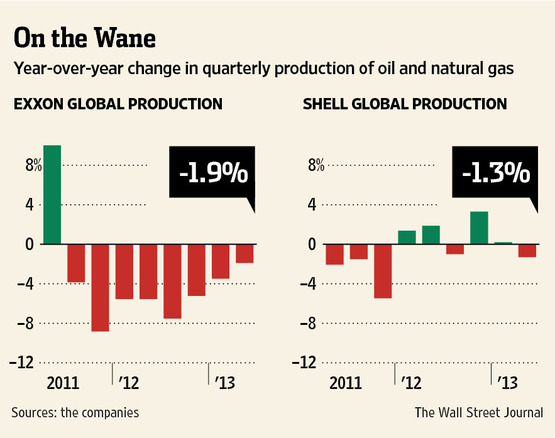
Some of the world’s biggest energy companies are struggling to make money from massive bets on the shale boom in North America, where deposits of oil and gas are proving abundant but not always profitable. Royal Dutch Shell RDSB.LN -0.36% PLC, which has had a tough time coaxing crude oil from dense rock formations, said Thursday its shale holdings in the U.S. are worth $2.2 billion less than it had previously determined. The write-down helped push the Anglo-Dutch oil giant’s second-quarter earnings down 60% from a year earlier. The company said it would explore selling some of its U.S. shale properties. Read more of this post

Strategies for Firm Growth

Strategies for Firm Growth

Alex Coad University of Sussex – Science and Technology Policy Research Unit (SPRU)

July 24, 2013
Palgrave Encyclopedia of Strategic Management, Forthcoming

Abstract: 
Strategies for firm growth vary in terms of their degrees of novelty, uncertainty, and synergy. Modes of firm growth include replication (growth by ‘more of the same’), diversification, and internationalization. Growth strategies can be implemented using organic growth or through acquisitions. Desire to grow is a necessary but insufficient condition for growth – what also counts is the availability of growth opportunities. Empirical work has shown that growth is largely random – hence, hard to predict. Sustained growth is rare. Firms cannot always translate their ambitions into growth, but should pay attention to critical ‘decision points.’

Investor Attention, Visual Price Pattern, and Momentum Investing

Investor Attention, Visual Price Pattern, and Momentum Investing

Li-Wen Chen National Chung Cheng University

Hsin-Yi Yu National University of Kaohsiung

July 12, 2013

Abstract: 
Since investor attention is limited, stocks that attract attention are more likely to be chosen, while stocks that do not attract attention are often ignored. Given that a visual mode of analysis is more conductive to human cognition than algebraic numbers, we propose that the visual pattern of past prices is a salient signal that attracts investor attention, and thereby boosts returns. The stocks in the winner and loser groups are further classified based on their visual patterns of past prices. We construct a long-short portfolio including the stocks which are more likely to grab investor attention by their discernible visual patterns of past prices. Our long-short portfolio commands a compounded annual risk-adjusted return of 23.1%, almost double the conventional momentum profit. The outperformance holds under various alternative specifications. Moreover, the sheer size of these profits poses a further, significant challenge to the asset pricing literature and the market efficiency hypothesis.

Analysts’ Cash Flow Forecasts are Not Sophisticated: a Rebuttal of Call, Chen and Tong (2013)

Analysts’ Cash Flow Forecasts are Not Sophisticated: a Rebuttal of Call, Chen and Tong (2013)

Dan Givoly Pennsylvania State University – Mary Jean and Frank P. Smeal College of Business Administration

Carla Hayn University of California at Los Angeles – Anderson School of Management

Reuven Lehavy University of Michigan – Stephen M. Ross School of Business

July 2013

Abstract: 
Call, Chen and Tong (2013) claim that the conclusion we reached in Givoly, Hayn and Lehavy (2009) that analysts’ forecasts of cash flow from operations are unsophisticated (in the sense that they can be replicated by a naïve extension of analysts’ own earnings forecasts) is wrong. They conclude that these forecasts are, in fact, sophisticated. Call et al.’s claim is based on inappropriate and contradictory tests and their interpretation of their own evidence suffers from serious logical flaws. In fact, rather than raising doubts about our conclusions, the evidence in Call et al. reinforces them.

Are Analysts’ Cash Flow Forecasts Naive Extensions of Their Own Earnings Forecasts?

Andrew C. Call Arizona State University (ASU) – School of Accountancy

Shuping Chen University of Texas at Austin – Red McCombs School of Business

Yen H. Tong Nanyang Technological University (NTU) – Nanyang Business School

March 1, 2012

Abstract: 
We examine the sophistication of analysts’ cash flow forecasts to better understand what accrual adjustments, if any, analysts make when forecasting cash flows. As a preliminary step, we first demonstrate that prior empirical tests used to evaluate the sophistication of analysts’ cash flow forecasts are not diagnostic. We then present three sets of evidence to triangulate our conclusion that analysts’ cash flow forecasts incorporate meaningful accrual adjustments. First, we review a stratified random sample of 90 analyst reports and find that the majority of these analysts include explicit adjustments for working capital and other accruals in their cash flow forecasts. Second, using a large sample of analysts’ cash flow forecasts from 1993-2008, we find that these forecasts outperform time-series cash flow forecasts in correctly predicting the sign and magnitude of accruals. Finally, we find a significant market reaction to analysts’ cash flow forecast revisions, suggesting that investors find these revisions informative. Collectively, our findings demonstrate that analysts’ cash flow forecasts are not simply naïve extensions of their own earnings forecasts, but that they reflect meaningful and useful accrual adjustments. These findings are relevant to researchers who examine analysts’ cash flow forecasts in a variety of settings, and to investors and practitioners who employ these forecasts for valuation purposes.

4 Things That Keep Employees Loyal (Hint: It’s Not Money Or Perks): The opportunity to do great work. A decent, non-toxic manager. Decent people. Remember them?

4 Things That Keep Employees Loyal (Hint: It’s Not Money Or Perks)

LES MCKEOWNINC. AUG. 1, 2013, 11:52 AM 3,287 2

You can ditch the esoteric interview questions; skip the outlandish benefits and uber-hip working conditions; and forget building an awesome brand. When it comes to hiring– and more importantly, keeping– great employees, not even paying well above market compensation guarantees success. In a recent survey of companies with the highest amount of employee turnover, guess which trailblazing exemplars of world-class employee-centricity came in second and fourth, respectively? None other than Google and Amazon. All of which just goes to show, as the Beatles once said, money can’t buy you love. If resource-rich employers like Wynn Resorts and Berkshire Hathaway Inc. (#6 and #18 on the list of companies with the least loyal employees) can’t build loyalty in their workforce, what chance does the average, resource-constrained, small- and medium-sized business have? Well, the truth is, quite a lot. Despite the fact that most small business founder/owners feel that they are in a David and Goliath-like battle for talent with mega-employers, the reality is that great employees are all looking for an environment that any business, large or small can provide. Here are the four key ways to ensure that, so long as you’re paying at or near market compensation, your employees will remain engaged and loyal, irrespective of the size of your business: Read more of this post

Collaboration: How Leaders Avoid the Traps, Build Common Ground, and Reap Big Results

Collaboration: How Leaders Avoid the Traps, Build Common Ground, and Reap Big Results [Hardcover]

Morten Hansen (Author)

collaboration-how-leaders-avoid-traps-create-unity-reap-morten-hansen-hardcover-cover-art

Publication Date: April 14, 2009

In Collaboration, author Morten Hansen takes aim at what many leaders inherently know: in today’s competitive environment, companywide collaboration is an imperative for successful strategy execution, yet the sought-after synergies are rarely, if ever, realized. In fact, most cross-unit collaborative efforts end up wasting time, money, and resources. How can managers avoid the costly traps of collaboration and instead start getting the results they need?
In this book, Hansen shows managers how to get collaboration right through “disciplined collaboration”– a practical framework and set of tools managers can use to:
· Assess when–and when not–to pursue collaboration across units to achieve goals
· Identify and overcome the four barriers to collaboration
· Get people to buy into the larger picture, even when they own only a small piece of it
· Be a “T-Shaped Manager,” collaborating across divisions while still working deeply in your own unit
· Create networks across the organization that are not large, but nimble and effective
Based on the author’s long-running research, in-depth case studies, and company interviews, Collaboration delivers practical advice and tools to help your organization collaborate–for real results. Read more of this post

The Innovation Mindset in Action: an illiterate woman from Tamil Nadu, India. Her story is at once heartbreaking and inspiring, showing that game changers can come from all walks of life, all over the world

The Innovation Mindset in Action: Shantha Ragunathan

by Vijay Govindarajan and Srikanth Srinivas  |   9:00 AM August 1, 2013

This January, we met Shantha Ragunathan, an illiterate woman from Kodapattinam, a remote village in Tamil Nadu, India. Her story is at once heartbreaking and inspiring, showing that game changers can come from all walks of life, all over the world. At six, Shantha lost her parents. By her twenties, she was stuck in a seemingly dark pit without a glimmer of hope: with two children and little financial support from her husband, she could not afford even one square meal a day. Although she was poor in resources, she possessed the innovation mindset shared by many game changers: they see and act on opportunities, use “and” thinkingto resolve tough dilemmas and break through compromises, and employ their resourcefulness to power through obstacles. Innovators maintain a laser focus on outcomes, avoid getting caught in theactivity trap, and proactively “expand the pie” to make an impact. Regardless of where they start, innovators persist till they successfully change the game. Read more of this post

Apprenticeship Good for Ben Franklin Closes Skills Gap

Apprenticeship Good for Ben Franklin Closes Skills Gap

Toby Wofford learned his way around United Tool and Mold Inc. maintaining machines his last two years of high school in Easley, South Carolina. Now he’s graduating to an advanced apprenticeship program that includes free classes at a nearby technical college. The United Tool apprenticeship is one of more than 500 such programs added in South Carolina since 2008. They range from certified nursing assistants in senior-care facilities to pharmacy technicians at CVS Caremark Corp. (CVS) These federally registered programs are part of an effort by states to adapt such on-the-job training to close a skills gap in technical jobs. “It’s the best of both worlds,” 18-year-old Wofford said in an interview at the shop, which makes and repairs molds for plastic parts such as auto-fuel tanks. “You get the on-hand experience, but you also need the knowledge of education from college.” The apprentice system, which helped founding fathers Benjamin Franklin become a printer and John Hancock learn silversmithing, faded in the U.S. during the next 200 years until it was concentrated primarily in construction trades, said Joseph Fuller, a senior lecturer at Harvard Business School in Boston who is studying work-training programs. Read more of this post

The eighth generation brothers who run Aspall Cyder see their product as a rival to champagne and talk about the black art of cider-making and taking advice from maharajahs.

CORE BUSINESS

ARTICLE | 1 AUGUST, 2013 12:52 PM | BY JEREMY HAZLEHURST

There was a lovely moment just after I’d sat down with the Chevallier Guild brothers when Barry was having a little trouble with a coffee pot. Henry walked over to help out and, as they both grappled with the plunger, it was a rather sweet scene of fraternal cooperation: “It’s got a bit…”, “Just press the…” “How do you…?” After some delicate coaxing, the blockage was removed, the handle depressed and the coffee was served. Some siblings in family businesses have fractious, antagonistic relationships, but it’s blindingly obvious that these two are totally and utterly at home in each others’ company. You can hardly imagine them not working together. Read more of this post

Getting people on and off an airplane quickly is so complicated that even an astrophysicist couldn’t figure it out

Mysteries of boarding bedevil airlines

BY DAVID KOENIG AP

AUG 1, 2013

DALLAS – Getting people on and off an airplane quickly is so complicated that even an astrophysicist couldn’t figure it out. The astrophysicist, Jason Steffen of Northwestern University, normally contemplates things such as axionlike particles. But after waiting in one boarding line too many, he turned to the mysteries of airline seating. “I thought there had to be a better way,” he says. So, after a series of calculations, he deduced that the best system would be a combination of filling window seats first, then middle and aisle ones, while spacing the boarding passengers two rows apart. There was just one problem — passengers would have to board in precise order. Good luck with that. “Well,” Steffen observes, “I understand why airline people aren’t calling me.” But the search for the perfect boarding process goes on. Read more of this post

Tyrrells, the premium snacks and crisps business, has been sold to private equity investor Investcorp for a price of £100m; Tyrrells was founded by farmer Will Chase, who first started the business as a sideline on his farm

Tyrrells sold to Investcorp for £100m

Tyrrells, the premium snacks and crisps business, has been sold to private equity investor Investcorp for a price of £100m, it can be revealed.

Tyrrells was founded by farmer Will Chase, who first started the business as a sideline on his Herefordshire farm, Tyrrells Court Farm, in 2002.

By James Quinn, Financial Editor

1:02PM BST 01 Aug 2013

images (26)

The business, which has expanded from making crisps to a range of snacks in recent years, was put up for sale by private equity owner Langholm Capital earlier this year. Investcorp is an investor well versed in growing premium brands, with past investments including Gucci, Tiffany and Helly Hansen. Read more of this post

Handicaps of sector and name fail to check Lanxess; The once-spurned chemicals group has been transformed; judicious CEO Axel Heitmann eliminated several layers of executives and business segments are free to conduct its operations without interference from headquarters to a degree uncommon at large German companies

August 1, 2013 4:04 pm

Inside Business: Handicaps of sector and name fail to check Lanxess

By Tony Barber

Lanxess

The once-spurned chemicals group has been transformed

The ugly duckling of Leverkusen turned this week into the swan of Cologne. Lanxess, a German speciality chemicals company spun off in 2004 from Bayer, had few admirers at its birth. Conventional opinion derided it as a ragtag collection of low-margin chemicals and polymers businesses. It existed, so it was said, for no better reason than that Bayer, like some cold-blooded, profit-hungry giant, had decided to dump old-fashioned chemicals and place its bets on healthcare, nutrition and high-tech materials. Yet the last laugh is with Axel Heitmann, chief executive of Lanxess from day one. He swiftly reorganised the newborn company, selling off a quarter of its portfolio and making astute acquisitions such asthe 2008 purchase of Petroflex of Brazil, Latin America’s largest synthetic rubber producer. After years of steady growth and improved margins, Lanxesswas promoted last September to Germany’s blue-chip Dax-30 index. Read more of this post

Bacteria ‘Invest’ Their Resources To Seek Evolutionary Success

Bacteria ‘Invest’ Their Resources To Seek Evolutionary Success

August 2, 2013

Researchers have recreated and analyzed the complex interplay between bacterial investment strategies and their outcomes for the first time. Asian Scientist (Aug. 2, 2013) – The complex interplay between bacterial investment strategies and their outcomes has been recreated and analyzed for the first time by researchers in Australia and the UK. Since the 1960s, theories have been floated on how decision-making by organisms is related to their survival on one hand or to rapid growth on the other. It is not possible to do both simultaneously because of insufficient resources. Bacteria, like humans, have limited resources and are constantly faced with decisions on how to invest in their future. In their study, published in Ecology Letters, the researchers developed a mathematical model to predict the best way for bacteria to invest resources in a trade-off between growth and stress resistance. The researchers modeled how, like humans investing in cash, bacteria trade in costly proteins to reduce their stress levels or to increase consumption and so grow faster. Evolution can be seen as a decision making process where different choices are encoded in the genes. Each bacterium makes an investment decision; the bad investors fall by the wayside, the good ones survive. Read more of this post

Our Hotter, Wetter, More Violent Future

Our Hotter, Wetter, More Violent Future

Earth’s atmosphere seems to have found a way to get back at the human race. For almost three centuries, we humans have been filling the air with carbon dioxide, methane and other greenhouse gases. Now, it turns out, the climate change these emissions have wrought is turning people against one another. So says a review, published today, of 60 studies on how climate change helps spark conflict throughout the world. The researchers found a surprisingly close link between climate change and civil wars, riots, invasions and even personal violence such as murder, assault and rape. Rising temperatures are especially provocative. A shift toward greater warmth of one standard deviation caused personal violence to increase by 2.5 percent and intergroup conflict by 24 percent. (One standard deviation varies from place to place; in an African country, for example, it could amount to a warming of 0.6 degrees Fahrenheit for a year.) Read more of this post

N.Y. Resort Owners Charged With $96 Million Ponzi Fraud

N.Y. Resort Owners Charged With $96 Million Ponzi Fraud

A money manager and a real estate developer already facing a regulator’s fraud lawsuit were charged with running a $96 million Ponzi scheme and diverting the proceeds to their New York beachfront resort. Brian R. Callahan, 43, and his brother-in-law Adam J. Manson, 41, were charged in a 24-count indictment unsealed today in federal court in Central Islip, New York. They pleaded not guilty and were released on bond. The men are accused of telling investors that their money was going into hedge funds and other investment vehicles while actually much of it was going to the unprofitable 117-unit Panoramic View Resort & Residences in Montauk. Read more of this post