Tea prices have plunged more than a third over the past year as the crisis in Egypt, the world’s fifth largest importer, has cut demand
September 2, 2013 Leave a comment
September 1, 2013 9:29 pm
Trouble brews for tea growers in wake of Egypt crisis
By Javier Blas in Nairobi
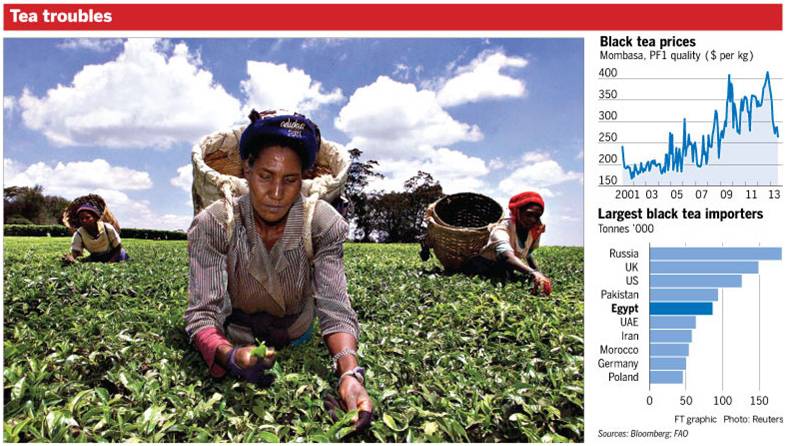
Tea prices have plunged more than a third over the past year as the crisis in Egypt, the world’s fifth largest importer, has cut demand just as global production has rebounded after several years of bad crops. The commodity, which is critical to several east African economies, is now selling at its lowest price in more than three years. Kenya is the world’s largest exporter of black tea, followed by Sri Lanka and India. The wholesale cost of Kenyan medium-quality tea, known as best Pekoe Fanning 1, last week fell to $2.64 a kilogramme, down roughly 34 per cent from a year ago and the lowest since mid-2010. Traders said prices could fall further if the crisis in the north African nation of tea drinkers results in lower sales. “We see absolutely no reason to be bullish,” Van Rees, the Netherland-based tea traders, said in a report.Mcleod Russel, the India-based plantation group that is the world’s largest tea grower, told investors in its latest market update that greater production in Africa following favourable growing weather combined with less demand from Egypt had had a “negative impact on prices”.
Medium-quality tea prices hit a record high of $4 a kilogramme in 2009 when droughts in key exporting countries significantly reduced supplies. Unlike coffee, tea does not trade in a futures exchange and the business is based on physical deals at regular auctions. The weekly auction at the Kenyan port city of Mombasa sets global benchmark prices.
Tea is, together with tourism and horticulture, the biggest earner of hard-currency in Kenya, bringing in $1bn annually. Other east African countries such as Malawi, Uganda and Tanzania are also top tea exporters.
The crisis in Egypt, which started two months ago when the country’s powerful military deposed President Mohamed Morsi and triggered a violent crackdown on the Muslim Brotherhood, has aggravated a glut due to bumper crops in key exporting countries. In the first five months of the year, Kenya has harvested its biggest crop since at least 2003. Output surged in the January to May period to 194.9m kg, up 52 per cent from the same period in 2012. Tea production in Sri Lanka, the world’s second-top exporter, has hit a five-year high.
Some tea-addicted nations, including the UK, are unlikely to benefit, however, as the crisis in Egypt hits mostly the price of medium-quality and lower-quality teas, rather than higher-quality leaves appreciated by British consumers.
Njau Kiarie, chairman of Kenya Tea Buyers Association, told local media in Kenya that “deepening political crisis [in Egypt] is one of the reasons the auction prices for lower medium quality grade tea came down sharply”.
The price of top quality black teas, known as Best Broken Pekoe 1, has suffered far less, traders said.
 About bambooinnovator
 Bamboo Innovator