The mysterious corruption scandal engulfing PetroChina, China’s largest oil company, is a reminder of why shares in the country’s state-owned enterprises are a thorny asset class.
September 3, 2013 Leave a comment
Updated September 2, 2013, 7:24 a.m. ET
Investors Left Hanging in PetroChina Saga
State-Owned Companies Enjoy Some Advantages—but Aren’t Run In Shareholders’ Interest
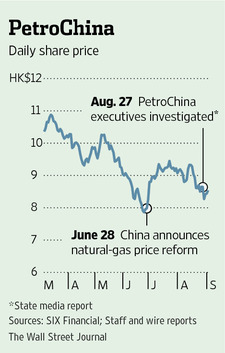
The mysterious corruption scandal engulfing PetroChina, 601857.SH -0.13% China’s largest oil company by production, is a reminder of why shares in the country’s state-owned enterprises are a uniquely thorny asset class. Last week, state media named three executives at PetroChina and one at its parent company, China National Petroleum Corp., as targets of a corruption probe. All four stepped down from their posts. On Sunday, Beijing announced that the former chairman of CNPC, Jiang Jiemin, is also under investigation. Mr. Jiang left CNPC in March to become the head of a powerful government body that oversees China’s state-owned companies. PetroChina shareholders are suffering whiplash. The company’s shares had been buoyed by news that Beijing was set to increase government-controlled prices for natural gas. The stock dropped 4.4% in one session last week on news of the corruption investigation and, despite recovering slightly, has underperformed Hong Kong’s Hang Seng Index since.That is hardly surprising: There have been no details about the alleged infractions and it is impossible for ordinary investors to understand what is really happening to the company. As in so many corruption cases in China, full details of the case may never be known.
Many analysts believe the motivation behind the investigations is partly political. At least three of the targeted executives, including Mr. Jiang, have career ties to Zhou Yongkang. Mr. Zhou, a powerful former Politburo member and security chief, and before that himself a CNPC executive, is now out of favor for supporting disgraced politician Bo Xilai.
PetroChina has confirmed that its executives have resigned and are under investigation; the executives could not be reached for comment.
Even in the absence of scandals, shareholders in Chinese state-owned companies are at the mercy of unpredictable political forces. Two years ago, for instance, Beijing abruptly shuffled the leadership of the three top oil companies. The CNPC vice general manager became the chairman of competitor China National Offshore Oil Corp., whose widely admired chairman became the head of China Petrochemical Corp. No reasons were given for the swap.
This helps explain why PetroChina shares trade at 9.2 times forecast earnings for the next 12 months, a discount to the likes of Exxon Mobil, XOM -0.13% at 11.1 times, and Chevron, CVX +0.05% at 9.8 times, according to S&P Capital IQ. State-owned companies in China enjoy some advantages, including access to cheap capital. But they are not run with shareholder interests in mind.
As PetroChina indicates, government links can carry risks as well as perks.
 About bambooinnovator
 Bamboo Innovator