Nokia Sale Marks End of an Era; Former Tech Giant Has Long History of Reinventionk
September 4, 2013 Leave a comment
September 3, 2013, 5:23 a.m. ET
Nokia Sale Marks End of an Era
Former Tech Giant Has Long History of Reinvention
JOHANNES LEDEL
Nokia Corp.’s NOK1V.HE +33.94% decision to sell its handset business to MicrosoftCorp. MSFT -4.55% and focus on wireless-network equipment is the Finnish company’s latest attempt in its 148-year history to reinvent itself during a crisis. It also marks the effective end of a national champion and onetime global tech giant. “This is end of an era in Finland,” Jan Vapaavuori, the country’s minister of economic affairs said Tuesday. The deal with Microsoft will have a “mental effect,” he said, since Nokia long has been an important international brand with Finnish roots.Founded in 1865, when engineer Fredrik Idestam set up a wood-pulp mill in southwestern Finland, Nokia has had a history of radical shifts in its business. The first was at the turn of the 20th century, when the company moved into making rubber boots and other products.
In 1967 the company merged with partner Finnish Cable Works, which had been developing radio telephones for the country’s army. Nokia in the early 1980s went on to become one of the first players in the cellphone industry
It introduced the Mobira Senator car phone in 1982, only a year after the creation of the Nordic Mobile Telephone service, the world’s first international cellular network.
Nokia unveiled its first hand-held phone in 1987, the Mobira Cityman, the same year that GSM was adopted as the European standard for mobile networks.
But Nokia ran into financial trouble at the end of the 1980s after acquiring unprofitable television-set factories in Europe.
In 1992 Jorma Ollila, a former Citibank executive, became chief executive and decided to focus on telecommunications. That worked—for a while. Nokia’s success boosted its share price, and at its peak in 2000, the company was valued at €303 billion ($400 billion at today’s exchange rate).
But misplaced bets would change Nokia’s fortunes.
Nokia executives predicted that producing traditional cellphones would be unprofitable by 2000, so the company in the 1990s started spending billions of dollars to research mobile email, touch screens and faster wireless networks. Nokia introduced its first smartphone, the Nokia 9000, in 1996—more than a decade before the first iPhone was released.
U.S. rival Motorola Inc. scored a world-wide hit with the thin Razr flip phones, however, and Nokia faced criticism from investors over its focus on high-end smartphones.
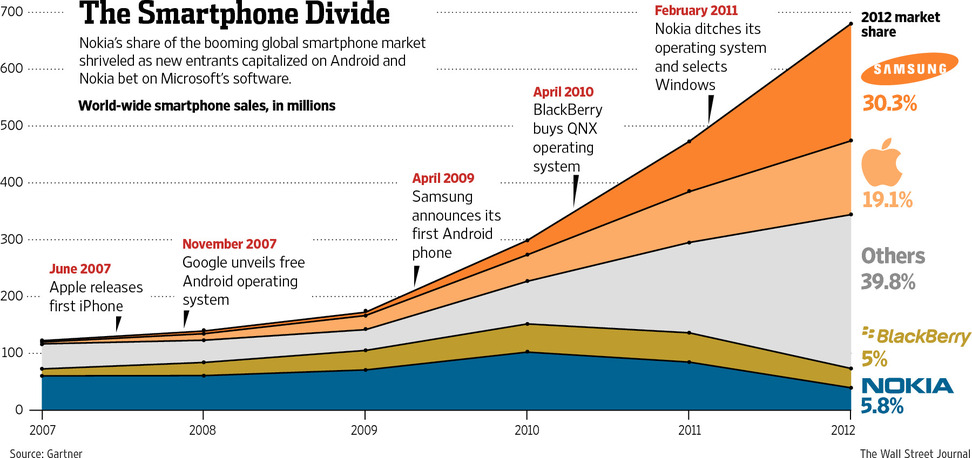
Former Nokia finance chief Olli-Pekka Kallasvuo took the helm from Mr. Ollila and merged Nokia’s smartphone and basic-phone operations, with the result that the more-profitable basic-phone business started calling the shots. Returning to a focus on traditional phones, Nokia found itself at a disadvantage when the iPhone was unveiled in 2007. As Apple Inc.’s AAPL +0.28% phone gained popularity, Nokia tried to play catch-up.
Nokia’s relationship with Microsoft began as Canadian Stephen Elop took the reins of the Finnish company in 2010 and decided to scrap the company’s effort to revamp its aging Symbian operating system, opting instead for Microsoft’s Windows platform. Nokia cut tens of thousands of jobs, sold its elaborate seaside headquarters in Espoo, Finland, and scaled back research and development, the company’s onetime jewel. Last year the company closed its last remaining phone factory in Finland.
Meanwhile, the handset business has struggled.
While Nokia’s flagship Lumia series has received good reviews, the company has failed to make a dent on its main competitors, Apple and Samsung Electronics Co. Nokia’s second-quarter revenue from phone sales was less than 25% what it was in the first quarter of 2011, when Nokia’s tie-up with Microsoft was announced.
Now, with the handset operation gone, what remains is network-gear business Nokia Solutions and Networks. Nokia bought Siemens AG’s SIE.XE -0.51% stake in the operation, formerly Nokia Siemens Networks, this summer for about $2.2 billion. Nokia also has a business that provides maps to Microsoft Windows devices and in-car navigation systems.
Nokia sells to Microsoft, closing chapter in Finland’s source of national pride
September 4, 2013
Once the world’s most popular mobile phone maker, Nokia has sold its handset division to Microsoft for €3.8 billion ($5.6 billion), marking the end of an era in the consumer mobile phone market.
When the mobile phone boom hit in the 1990s, Finnish company Nokia dominated the market with its range of reliable and easy-to-use handsets.
But it missed a series of fashion and technical changes and was gradually overtaken by other companies, analyst for Gartner Carolina Milanesi said.
Nokia missed the clam-shell phone fad and was late to 3G, but it did release one of the first smartphones, the N95. While the N95 was technologically superior to Apple’s iPhone, it used Nokia’s unpopular operating system Symbian and Apple’s iPhone took over the market. Nokia dumped Symbian in favour of Microsoft Windows in 2011, a year too late, Ms Milanesi said.
Advertisement
”Nokia always had the vision, but executing on that vision was impossible for them,” she said.
News Nokia has sold its handset division was sad news for Finns, who found its popularity a source of national pride. Its decline since the mid-2000s had seen jobs and manufacturing move out of the Scandinavian country, the deputy head of mission at Finland’s embassy in Canberra Juha Parikka said.
”Nokia has always been a top-10 company in Finland with 150 years of industrial tradition,” he said. ”It has always been big and important and huge, but when the real breakthrough came with the mobile phones it was a driving force of the Finnish economy and expertise and, at the same time, an enormous reason for [national] pride.
”But it is, of course, sad to hear that they are selling their mobile phones business, which was the No.1 global brand for a long period of time. ”
Mr Parikka added ‘‘we would not have had Angry Birds’’ without Nokia, because the mobile phone maker created a culture of technical expertise and innovation in Finland. Angry Birds, the world’s most popular smartphone app, was created by Finnish company Rovio Entertainment in late 2009.
Professor of Organizational Studies at the University of Sydney Business School, David Grant, said moving the handset division to Microsoft was ‘‘an important development, but both of them independently have been battling to produce products that satisfy consumer needs.’’‘‘It could work in their favour, but one has to ask whether consumers have lost confidence and they are so far behind that can’t make up.’’
Nokia has kept its mobile broadband business, NSN, and research arm Advanced Technologies and will remain in Finland.
Global sales for the second quarter of 2013 show Nokia sits second, selling 61 million handsets, according to Gartner. However, most of those sales were low-cost units sold in developing countries. Samsung and Apple dominate the smartphone market, selling 71.4 million and 32 million handsets respectively in the quarter.
 About bambooinnovator
 Bamboo Innovator