As Return of Chinese Gov’t Bond Futures Nears, Experts Pore over Details; Nearly two decades after market was suspended because of short sellers’ scam, traders and analysts wonder if new approach will protect investors

09.03.2013 17:09

As Return of Gov’t Bond Futures Nears, Experts Pore over Details

Nearly two decades after market was suspended because of short sellers’ scam, traders and analysts wonder if new approach will protect investors

By staff reporters Fan Junli, Zheng Fei and Cao Wenjiao

(Beijing) – Securities traders and analysts are going over the details of the new government bond futures that will hit the market soon – after a hiatus of nearly two decades – to see if they can better protect investors against fraud and other risks. The first batch of three contracts, all based on five-year government bonds, will be opened for trading from September 6 on the China Financial Futures Exchange (CFFEX), the securities regulator said last month. Read more of this post

“Tiny Times 2,” a popular film about four Shanghai students who celebrate the luxe life, is causing consternation in China

September 3, 2013

A Film-Fueled Culture Clash Over Values in China

By SHEILA MELVIN

TINY1-articleLarge-v2

“Tiny Times 2,” a film about four Shanghai students who celebrate the luxe life, is causing consternation in China

BEIJING — Amid the usual crop of Western-imported blockbuster fare (see “Jurassic Park 3D,” “Monsters University,” “Pacific Rim”), two homegrown movies about four fashion-obsessed girlfriends at a Shanghai university have unexpectedly made their way to the top of China’s box office here this summer. The first, “Tiny Times 1,” beat Hollywood’s “Man of Steel” when it opened here in late June, grossing more than $43 million its first week, according to Entgroup, a film industry research company. The sequel, “Tiny Times 2,” which opened on Aug. 8, grossed more than $47 million in its first three weeks. (“Tiny Times 1” opened in select North American markets in July, and its sequel opened in New York on Friday.) Ticket sales for both movies qualified them as major hits in China. Read more of this post

Samsung to Install Antivirus Software from Lookout in Android Phones

Updated September 4, 2013, 12:09 a.m. ET

Samsung to Install Antivirus Software in Android Phones

DANNY YADRON

MK-CG011_ANTIVI_NS_20130903183312

Now even telephones come with antivirus software. Programs that flag viruses and keep out intruders have been fixtures for decades on desktop computers. On Wednesday, Samsung Electronics Co., 005930.SE +1.20%the world’s largest smartphone maker by sales, is expected to announce that it will install security software from Lookout Inc. on all new phones running Android software from Google Inc. GOOG +1.59%. Behind the move, say Samsung and some firms in the security industry, is a reality that phones have become a lot more like always-online computers, and now face thousands of their own viruses. Hackers have found ways to steal corporate data off of mobile devices, and Eastern European organized-crime rings scam users by charging them for premium text messages.

Read more of this post

Tongyang Group is facing deeper financial trouble as it will have difficulty in rolling over maturing debts worth 200 billion won due in the coming months

2013-09-03 17:49

Tongyang burrows deeper into trouble

By Kim Tae-jong
Tongyang Group is facing deeper financial trouble as it will have difficulty in rolling over maturing debts worth 200 billion won due in the coming months. The situation became worse after two credit ratings agencies recently lowered their ratings on affiliates of the mid-tier conglomerate, following the issuance of corporate bonds worth 75 billion won by Tongyang Inc., the holding company of the group, on Aug. 29. With restructuring efforts delayed, the group’s affiliates have issued corporate bonds worth 576 billion won this year ― 426 billion won for Tongyang Inc. and 150 billion won for Tongyang Cement & Energy ― to secure liquidity for business operations and repayment of maturing corporate bills and bonds. Read more of this post

Subaru’s Anti-Crash Feature Lures Japanese Seeking Safety

Subaru’s Anti-Crash Feature Lures Japanese Seeking Safety

Inching forward in heavy traffic toward the ski slopes of Niigata, Japan, Tomohiro Azuma cursed as the car in front stopped suddenly, forcing him to slam on the brakes of his Subaru Legacy. “There was a voice in my head saying, ‘Damn, too late!’” Azuma, 46, said of the near-collision in February. “Then my car stopped with a jerk and for a moment I didn’t know what had happened.” The information technology manager from Tokyo had averted a pileup thanks to a feature called EyeSight, which stopped his car when the gap with the vehicle ahead became perilously small. The technology has helped Subaru build a reputation as a leader in safety — typically the domain of high-end brands like Mercedes-Benz and Volvo (VOLVB) — and buck falling sales in its home market. Read more of this post

Overseas Equity Investors Head to Japan for ‘Abenomics’ Clues

September 4, 2013, 12:31 PM

Overseas Equity Investors Head to Japan for ‘Abenomics’ Clues

By Kana Inagaki

Following a sleepy August, a record number of foreign investors are now flocking to Japan in search of fresh clues to whether “Abenomics” is still a good reason to buy Japanese stocks. While the stock-market rally from mid-November has recently flagged, with trading volumes low, foreign investors remain focused on whether Prime Minister Shinzo Abe’s economic policies can really lift the economy out of deflation. Both Japanese and foreign brokers are tailoring their investor conferences to address this increasing demand for a better understanding of Japanese politics by inviting members of Mr. Abe’s Cabinet and his close advisers as keynote speakers. Read more of this post

Kao’s Kanebo continued shipping skin-whitening cosmetics even after its top managers endorsed a decision to recall the products following consumer complaints of white blotches

Kanebo shipped cosmetics after recall decision

KYODO

SEP 3, 2013

Kanebo Cosmetics Inc. continued shipping skin-whitening cosmetics even after its top managers endorsed a decision to recall the products following consumer complaints of white blotches, sources said. The subsidiary of Kao Corp. delayed halting shipments for almost a week through July 4, when the company announced the recall, a delay that increased the number of people affected, the sources said Monday. Cosmetics retailers were alerted to the recall only on the day of its announcement. Read more of this post

Almost half of Japanese charitable foundations, some of which have sizable assets, think Abe will need to increase his economic stimulus measures to get the country onto a sustainable recovery path

Japan foundations see limited economic boost from Abenomics: survey

2:10am EDT

TOKYO (Reuters) – Almost half of Japanese charitable foundations, some of which have sizable assets, think Prime Minister Shinzo Abe will need to increase his economic stimulus measures to get the country onto a sustainable recovery path, according to a survey. A survey by Mizuho Securities of more than 400 such non-profit foundations, a relatively little known group of investors, also showed they were eager to boost foreign stocks while planning to cut holdings in structured notes and Japanese investment trusts called toshins. Read more of this post

Abe Seen Facing Stock Rout in Case of Suspending Japan Tax Rise

Abe Seen Facing Stock Rout in Case of Suspending Japan Tax Rise

Japanese shares could plunge 10 percent or more if Prime Minister Shinzo Abe fails to carry through on a plan to raise a sales tax in April. Postponing an increase would have a large and negative impact on Japan’s financial markets, said 22 of 32 economists in a Bloomberg News survey. JPMorgan Chase & Co. Senior Economist Masamichi Adachi said a delay could push stocks down 10 percent, wiping out $418 billion in market capitalization, while UBS AG Economist Daiju Aoki predicted a sell-off as steep as 12 percent in the Nikkei 225 Stock Average. Read more of this post

Once-Hot Indonesia Loses Allure as Prices Chill Buyouts

Once-Hot Indonesia Loses Allure as Prices Chill Buyouts (1)

By Klaus Wille September 04, 2013

Indonesia has lost much of its allure for private equity as steep valuations restrain buyouts in a country that two years ago was, in the words of one investor, “probably the sexiest destination in the emerging markets.” International private-equity firms have acquired stakes in four Indonesian companies this year, down from 10 in 2011 and seven last year, according to data compiled by Bloomberg and the Asian Venture Capital Journal. Total transaction values fell from $649 million for the nine deals in 2011 where terms were disclosed to $324 million for the six deals last year for which prices were available, the data show. Read more of this post

Low Cash, Slowing Sales: Double Whammy for Indonesia’s Retailers

Low Cash, Slowing Sales: Double Whammy for Indonesia’s Retailers

By Janeman Latul & Andjarsari Paramaditha on 1:01 pm September 4, 2013.
As Indonesia’s economy boomed in recent years, its retailers had a simple formula: open more stores. And more. And more. Minnows became leviathans. That strategy is now haunting them as the rupiah currency tumbles, inflation accelerates, interest rates rise and growth slows. The country’s three biggest retailers are in their weakest cash position since the 2008 global financial crisis, just as consumers are tightening their wallets. Strains on cash flow at Indonesia’s biggest high-end retailer Mitra Adiperkasa, its largest low-end department store group Ramayana Lestari Sentosa and top mid-tier retailer Matahari Department Store, along with interviews with shoppers and store managers, suggest a significant slowdown in consumer spending, the main engine of Southeast Asia’s biggest economy. Read more of this post

KPK Delves Into Public Servants’ Wealth, Begins Demanding Proof; Indonesia has about five million civil servants, some of whom live in conspicuous luxury way above that which could be afforded on their official incomes

KPK Delves Into Public Servants’ Wealth, Begins Demanding Proof

By Novianti Setuningsih & Carla Isati Octama on 11:05 am September 3, 2013.

By making proactive use of money laundering and anti-corruption laws, Indonesia’s graftbusters are managing to snare a greater number of corrupt officials, and just as importantly, return to the public purse a fortune in stolen funds. Prosecutors in corruption cases are comparing officials’ compulsory personal wealth reports (LHKPN) and personal bank account data collected by the Financial Transaction Reports and Analysis Center (PPATK) with official wage income, often finding wild discrepancies. Read more of this post

India’s scientists return as opportunities beckon

India’s scientists return as opportunities beckon

Wednesday, September 4, 2013 – 03:00

Krittivas Mukherjee

The Straits Times

INDIA – In returning to India to work as a scientist two years ago, Dr Praveen Kumar Vemula achieved two things in one stroke: one, to work in the virtually virgin market for biomedics and the other, to repay a debt to his motherland. “I came back with a scientific vision,” says the 39-year-old former Harvard Medical School-Massachusetts Institute of Technology fellow, who left India in 2006 to research biomedical technologies. Read more of this post

India Moves Bill Favoring FDI in Pension Funds for First Time

India Moves Bill Favoring FDI in Pension Funds for First Time

India’s Finance Minister Palaniappan Chidambaram moved a bill allowing overseas investment in the country’s pension funds for the first time, as the government tries to revive economic growth and stem the rupee’s slide. He introduced an amendment in parliament today recommending 26 percent ownership by foreign companies in local businesses selling pensions. The threshold for foreign direct investment in pensions will be kept in line with the cap for insurance, which was opened to overseas companies in 2000. The legislation needs the approval of the lower and upper houses. Read more of this post

A Kinder, Gentler South China Morning Post

A Kinder, Gentler South China Morning Post

Written by Our Correspondent

TUESDAY, 03 SEPTEMBER 2013

New Chinese language Web site won’t make any waves

William Zheng Wei, a former Singapore Press Holdings business editor, has been named the chief editor of the South China Morning Post’s new Chinese-language Web site. His mandate? Don’t carry anything controversial.
Zheng’s appointment was announced Monday in an internal company release by Robin Hu, the 55-year-old chief executive officer of the SCMP Group, himself a former Singapore Press Holdings executive. Hu replaced Kuok Hui Kwong last July after serving for six years as regional director in China for the Singapore Economic Development Board, a government agency, and as a senior vice president for an Internet startup. Read more of this post

Germans Hide Cash in Diapers as Swiss Secrecy Crumbles

Germans Hide Cash in Diapers as Swiss Secrecy Crumbles

Germans who avoided taxes by keeping money in Switzerland are bringing wads of cash home and hiding it in odd places. With Swiss banks the target of an international crackdown against tax evasion, the government wants the industry to stop managing undeclared funds. This requirement, combined with high-profile cases such as Bayern Munich President Uli Hoeness, who is charged with using a Swiss account to evade paying taxes, and the purchase of client data by German officials, has frightened tax cheats into action, according to customs agents. Read more of this post

One insight from Jeff Bezos’s Washington Post interview that bodes well for the future of media; “The key thing about a book is that you lose yourself in the author’s world. Great writers create an alternative world.”

One insight from Jeff Bezos’s Washington Post interview that bodes well for the future of media

BY HAMISH MCKENZIE 
ON SEPTEMBER 3, 2013

Amazon founder Jeff Bezos finally granted an interview to the newspaper he just bought. He evidently didn’t spend much time on the phone with the Washington Post reporters, but he provided enough fodder to keep the “Is Bezos going to save newspapers?” meme in the headlines for another couple of weeks. (Case in point: This post.) I just wanted to zero in on one of his comments, which I believe signals why the media industry has a brighter future than its current state would seem to imply. To me, the most important thing is not that Bezos has lots of money to fund business model experiments – it’s his recognition of the power of the story. Bezos made that point inadvertently while discussing why printing on paper is not crucial to a newspaper’s future, a realization driven by his experience with ebooks and the Kindle.

“The key thing about a book is that you lose yourself in the author’s world,” Bezos told the Post. “Great writers create an alternative world.” It doesn’t matter if you find your way into that world through print or digital, Bezos added. Read more of this post

Hollywood’s Tanking Business Model; After a series of big-budget bombs at the box office, Hollywood could learn a thing or two from economists?

September 3, 2013

Hollywood’s Tanking Business Model

By CATHERINE RAMPELL

Nearly 40 years ago, a great white dorsal fin sliced through American cinemas with its ominous, minor-second-interval leitmotif, and a new business model was born. “Jaws,” which cost $7 million to make, was deemed a good fit for a June release in 1975 partly because it took place at a beach around Independence Day. But its extraordinary success — the movie went on to earn $471 million at box offices worldwide — subsequently helped spawn Hollywood’s now-conventional wisdom that if you’re going to make a blockbuster, then summer, when kids are out of school and people are in search of industrial-strength air-conditioning, is the best time to release it. After “Star Wars” became a huge hit two summers later, all the big studios seemed to take notice. Read more of this post

Emerging Nations Save $2.9 Trillion Reserves in Rout

Emerging Nations Save $2.9 Trillion Reserves in Rout: Currencies

Developing nations from Brazil to India are preserving a record $2.9 trillion of foreign reserves and opting instead to raise interest rates and restrict imports to stem the worst rout in their currencies in five years. Foreign reserves of the 12 biggest emerging markets, excluding China and countries with pegged currencies, fell 1.6 percent this year compared with an 11 percent slump after the collapse of Lehman Brothers Holdings Inc. in 2008, data compiled by Bloomberg show. The 20 most-traded emerging-market currencies have weakened 8 percent in 2013 as the Federal Reserve’s potential paring of stimulus lures away capital. Read more of this post

Myanmar’s 2015 Stock Exchange Deadline at Risk: Southeast Asia

Myanmar’s 2015 Stock Exchange Deadline at Risk: Southeast Asia

Myanmar is running behind schedule for starting a stock exchange by 2015 after delays in getting the legal framework in place, said an executive at Japan Exchange Group Inc. (8697), which is assisting on the project. “We’re pressed for time,” Koichiro Miyahara, senior executive officer at Japan Exchange, said in an interview in Tokyo on Aug. 27. He said the late approval of a capital markets bill has delayed the project, and it’s up to the Myanmar government as to how fast it can set up related organizations such as a securities regulator. Read more of this post

Thousands of Thai rubber farmers, reeling from steep price declines of 50% since Feb 2011, vowed to continue protests now in their second week after the government’s latest financial aid measures fell short of their demands

September 3, 2013, 2:38 p.m. ET

Rubber Farmers in Thailand to Continue Protests

Thai Exporters Report Cargo Delays

NOPPARAT CHAICHALEARMMONGKOL and HUILENG TAN

int_rubber_0904

BANGKOK—Thousands of rubber farmers, reeling from steep price declines, vowed to continue protests now in their second week after the government’s latest financial aid measures fell short of their demands. Slowing growth in China and other major economies has sapped demand for rubber, resulting in a 50% price decline since February 2011 that has stirred unrest in major commodity exporters. Read more of this post

Vietnam’s power grid is under strain. All kinds of fuses may blow

Vietnam’s power grid is under strain. All kinds of fuses may blow

Aug 31st 2013 | HANOI |From the print edition

IN 1894 Prince Henri d’Orléans published a book of his journey through France’s then-sprawling empire. His florid account was largely upbeat. Yet it soured along the northern coastline of Vietnam, where he lamented the “dilatory attitude of a red-tape administration” when it came to exploiting the area’s coal reserves. Now red tape is again impeding foreign investment in Vietnam’s energy sector. The country’s electricity supply is fairly reliable—if compared with Myanmar and Pakistan. But daily life is punctuated by brownouts which analysts say will intensify unless officials reform a state-dominated power market and entice foreign companies to build more power plants. That also has sobering implications for the ruling Communist Party, which is trying to revive a slow economy and boost its sagging legitimacy. Read more of this post

Bank Leverage Tax? Bank Leverage Is the Defining Debate of Our Time

Bank Leverage Is the Defining Debate of Our Time

Every age has great debates on its defining questions. Sometimes these disputes are on a grand scale: capitalism versus communism. Sometimes they concern details that puzzle later generations: Summarize the main points of contention in the Thirty Years’ War, without consulting Google.

The defining conflict of our time is over what might seem to be a relatively arcane and technical detail: leverage, meaning the extent to which financial institutions should be allowed to borrow relative to their total balance sheets. The question won’t be decided on the battlefield, in the courts or by the public. The Board of Governors of the Federal Reserve System will make the call. Read more of this post

The big trade switch is on as emerging markets export less; global expansion will slow until emerging countries develop stable sources of internal demand to replace their sales abroad

The big trade switch is on as emerging markets export less

By Tim Fernholz @timfernholz September 3, 2013

trade-trends-highlight-global-growth-worries-world-trade-volume-advanced-economies-emerging-economies_chartbuilder

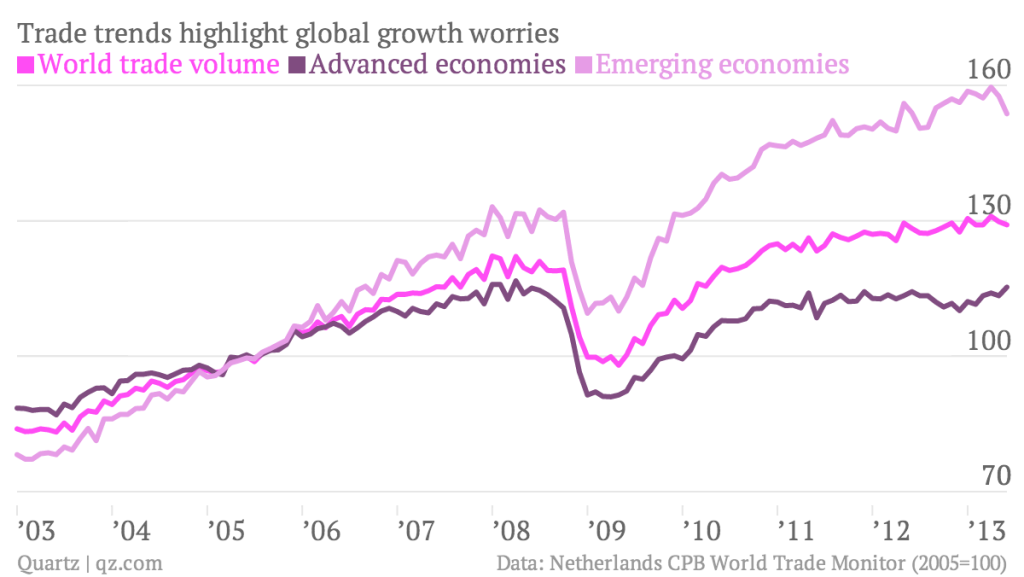
This chart shows a trend that has economists worried about the pace of economic recovery: the slowing growth of overall worldwide trade, and the drop in exports from emerging markets even as the advanced economies sell more goods abroad. The OECD released an interim forecast of global growth today, showing a continued slow recovery in the US, Japan and Germany that is being undermined by slowing growth in emerging markets, including China, Brazil and India. This is a reversal from recent years, when emerging markets drove global growth as Europe stumbled through a double-dip recession and the US slowly emerged from the wreckage of its housing bubble. But in 2013, industrial production has slowed in emerging economies even as manufacturing grows in wealthier Western nations. Another data point out today that reflects this trend: US factories reported the largest increase in orders in the last two years. This is all part of the great rebalancing, as wealthier citizens in emerging marketsseek access to more imported Western goods, while Western economies re-tool tocompete with cheaper workforces abroad. That’s all well and good, but because emerging markets make up such a huge share of worldwide economic activity, global expansion will slow until these countries develop stable sources of internal demand to replace their sales abroad.


How 37-Year-Old Teacher Imperils Pimco’s Bond Bet: Mexico Credit

How 37-Year-Old Teacher Imperils Pimco’s Bond Bet: Mexico Credit

For Pedro Hernandez, a striking elementary-school teacher from the southern state of Oaxaca, his union’s protests disrupting Mexico’s capital aren’t just about education. They’re about stopping President Enrique Pena Nieto. “We’re against all the structural reforms,” the 37-year-old said last week as he walked down Mexico City’s central boulevard as part of an organized march of 15,000. Hernandez held a sign that read, “Mexico has no president.” Read more of this post

Here’s The Key Thing You Should Know About Ronald Coase, The Great Economist Who Died Yesterday At 102

Here’s The Key Thing You Should Know About Ronald Coase, The Great Economist Who Died Yesterday At 102

JOSH BARRO SEP. 3, 2013, 4:43 AM 4,308 12

Ronald Coase, 1910-2013

Ronald Coase was one of those economists whose contributions were so significant and so longstanding that you assumed he had to be dead. But he wasn’t, until yesterday, when he died at the age of 102. Coase’s most famous contribution is the Coase Theorem, which holds that the problem of externalities—that is, me taking an action that imposes a cost on you—can be fixed without government action so long as property rights are clearly defined and transaction costs are low. My favorite example of the Coase Theorem in action relates to airline seats. A lot of people like to complain about airline passengers who recline, taking away precious knee-room. But Coase would have said there’s a simple solution to this problem: pay the person in front of you not to recline. If you value your knee space more than he values the option to lean back, the seat will stay upright where it belongs. There’s no need for the government, or the airline, to intervene to protect your knees. Read more of this post

Factoring Draws Attention of China’s Bank Regulator

September 3, 2013, 6:43 a.m. ET

Factoring Draws Attention of Bank Regulator

Regulator Seeks Better Monitoring of Innovative Lending

BEIJING—China’s banking regulator has instructed banks to better monitor a type of lending particularly popular with small firms as demand burgeons and banks relax their oversight standards. According to a document from the China Banking Regulatory Commission seen by The Wall Street Journal, loans made against companies’ accounts receivable—those sales for which a company has yet to receive payment—must be recorded as nonperforming loans if they turn bad. Banks also need to be sure that such loans are in fact backed by receivables. Read more of this post

China Arrests Bosera’s Ex-Fund Manager Ma Le on Suspected Insider Trading in front-running of fund clients

September 3, 2013, 7:04 a.m. ET

China Arrests Ex-Fund Manager on Suspected Insider Trading

Bosera Fund Management: Activities Were Ma Le’s ‘Personal Actions’

BEIJING—China has arrested a former manager with a major securities fund-management company on suspicion of insider trading, the nation’s legal supervisory body said Tuesday. Ma Le, a former fund manager at Bosera Fund Management, has been arrested on suspected front-running of fund clients, the Shenzhen People’s Procuratorate said in a statement on its website. Front-running, a form of trading on privileged information, entails purchases of securities by a broker or fund manager for resale to clients—or the fund itself—at a profit. The procuratorate is responsible for criminal investigations and prosecutions. Read more of this post

Publishing Hears Echoes of Netflix Business Model; Digital Startups Prepare to Offer E-Book Subscription Services

September 2, 2013, 6:59 p.m. ET

Publishing Hears Echoes of Netflix Business Model

Digital Startups Prepare to Offer E-Book Subscription Services

JEFFREY A. TRACHTENBERG

Offering unlimited television shows and music for a flat monthly fee has worked forNetflix Inc. NFLX +1.06% and Spotify AB. Will it work in the book industry? It is a question of intensifying debate in the publishing industry right now, as two digital startups plan launches of rival e-book subscription services this fall. If successful, the new services could pose fresh challenges for brick-and-mortar bookstores already struggling to cope with the growth of e-book sales and low prices of physical books offered online. Read more of this post

It’s all in the wrist – Who has vision to crack the “smartwatch”?

It’s all in the wrist – Who has vision to crack the “smartwatch”?

7:08am EDT

By Jeremy Wagstaff

SINGAPORE (Reuters) – The smartwatch could be as revolutionary as the smartphone – an intelligent device on our wrist that connects our bodies to data and us to the world – but only a handful of companies have the heft and vision to be able to pull it off. It’s not through lack of trying. Watchmakers and others have been adding calculators, calendars and wireless data connections to wrist-straps for at least 30 years. Read more of this post