Thousands of Thai rubber farmers, reeling from steep price declines of 50% since Feb 2011, vowed to continue protests now in their second week after the government’s latest financial aid measures fell short of their demands
September 4, 2013 Leave a comment
September 3, 2013, 2:38 p.m. ET
Rubber Farmers in Thailand to Continue Protests
Thai Exporters Report Cargo Delays
NOPPARAT CHAICHALEARMMONGKOL and HUILENG TAN
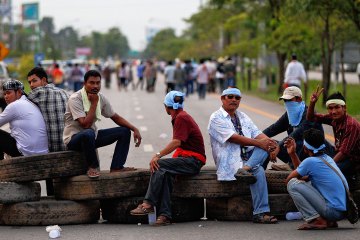
BANGKOK—Thousands of rubber farmers, reeling from steep price declines, vowed to continue protests now in their second week after the government’s latest financial aid measures fell short of their demands. Slowing growth in China and other major economies has sapped demand for rubber, resulting in a 50% price decline since February 2011 that has stirred unrest in major commodity exporters.The Thai protests have largely been in the south, the main rubber-producing region, where farmers are demanding greater state support for their industry. Their primary demand is for the government to guarantee a price for smoked rubber sheet, a form of crude natural rubber, of 120 baht ($3.70) per kilogram.
The government has rejected that demand, and Prime Minister Yingluck Shinawatra‘s cabinet on Tuesday approved a subsidy for farmers, five billion baht to help them invest in rubber processing and another 15 billion baht to help rubber businesses upgrade their machinery. The measures go into effect without further government approval.
Farmers had a mixed reaction to the measures, according to Perk Lertwangpong, chairman of the Rubber Growers Cooperative Federation of Thailand.
“While some farmers may be satisfied with what the government just offered, most of us are not,” Mr. Lertwangpong said.
Deputy Prime Minister Kittiratt Na-Ranong will meet representatives of the protesting farmers on Wednesday.
Police officials said about 10,000 farmers were continuing their protest in the province of Surat Thani, about 400 miles south of the capital Bangkok. At least 3,500 others were picketing and blocking roads and rail lines in adjacent Nakhon Si Thammarat province. Thai exporters said they are seeing cargo delays of about a week or two as a result of the protests.
The rubber farmers, who generally back the opposition Democrat Party, complain that the prime minister favors aid to rice farmers because they tend to vote for her. Bolstering this view is the Shinawatra government’s decision to spend about $18 billion to fund a rice-subsidy program, in keeping with an election campaign promise to improve the livelihood of one of her key constituencies.
Thailand is the world’s largest producer and exporter of natural rubber, accounting for about one-third of the world’s supply. Rubber production has more than doubled to 3.8 million metric tons from 1.6 million in the past two decades, about 90% of which is for export.
Arguing for more aid, rubber farmers say their crop is more valuable than rice, with the export value of natural rubber averaging $9.3 billion a year, compared with rice at $5.3 billion.
The government has already taken steps to help rubber farmers. Last year Thailand joined Indonesia and Malaysia in cutting rubber exports by 300,000 tons in a bid to boost prices. This year, the government spent 20 billion baht to buy 200,000 tons of rubber at above-market prices from farmers. The program ended around midyear after failing to increase prices.
 About bambooinnovator
 Bamboo Innovator