“Tiny Times 2,” a popular film about four Shanghai students who celebrate the luxe life, is causing consternation in China
September 4, 2013 Leave a comment
September 3, 2013
A Film-Fueled Culture Clash Over Values in China
By SHEILA MELVIN
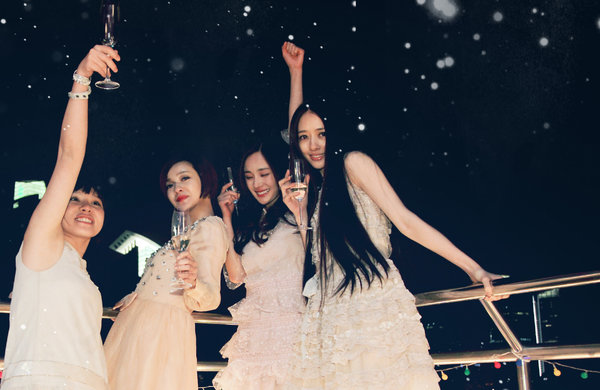
“Tiny Times 2,” a film about four Shanghai students who celebrate the luxe life, is causing consternation in China
BEIJING — Amid the usual crop of Western-imported blockbuster fare (see “Jurassic Park 3D,” “Monsters University,” “Pacific Rim”), two homegrown movies about four fashion-obsessed girlfriends at a Shanghai university have unexpectedly made their way to the top of China’s box office here this summer. The first, “Tiny Times 1,” beat Hollywood’s “Man of Steel” when it opened here in late June, grossing more than $43 million its first week, according to Entgroup, a film industry research company. The sequel, “Tiny Times 2,” which opened on Aug. 8, grossed more than $47 million in its first three weeks. (“Tiny Times 1” opened in select North American markets in July, and its sequel opened in New York on Friday.) Ticket sales for both movies qualified them as major hits in China.But the films, made by the fledgling director Guo Jingming and based on his series of best-selling novels, have also made an impact beyond the box office. They have become a lightning rod for this nation’s evolving view of its growing youth culture. Many established Chinese cultural commentators are outraged by these works’ overt celebration of materialism, and this anger has spurred a surprisingly robust counterattack by the movies’ many young fans.
Film critics have described the first movie as being like “The Devil Wears Prada” meets “Sex and the City” (without the sex). The Chinese critic Raymond Zhou denounced “Tiny Times” in The Beijing Evening News and in a subsequent appearance on the China Central Television show “Crossover,” faulting its undercurrent of “crass” materialism and “bad taste.” The New York-based media scholar Ying Zhu, writing with Frances Hisgen in The Atlantic online in an article widely cited in China, condemned the film’s “twisted male narcissism.”
Others leapt to the defense of both movie and maker. The Global Times editor Hu Xijin called Mr. Guo “superman,” while the critic Teng Jimeng, speaking on “Crossover,” lauded “Tiny Times” as a “feminist film.” The People’s Daily jumped into the scrum with a package of three articles that offered varying assessments of the movie, followed later by a fourth that was largely critical.
Meanwhile, Mr. Guo’s fans, primarily young and female, have rallied with the fervor of groupies, inundating critics like Mr. Zhou with tens of thousands of condemnatory online posts and flocking to theaters.
“The controversy is bigger than I anticipated,” Mr. Guo said.
His books are stuffed with English-language brand names like Chanel and Gucci and choice phrases. (“Economy class kills me!” and “I hate Beijing!”) His films show the actual designer goods and include dialogue that has also riled commentators, like this exchange in “Tiny Times 1” between two star-crossed young lovers:
“I like you,” the young man says, “not because you’ve had a driver since you were little, and not because you have designer bags, and definitely not because you gave me expensive boots. Even if you didn’t have a cent, I would still like you.”
The woman then turns on him: “Let me tell you, love without materialism is just a pile of sand!”
The movies are “like a product-placement commercial,” said the opera and film director Chen Shi-Zheng, whose credits include the Chinese version of “High School Musical.” “But Guo Jingming is a brand for Chinese youth.”
Mr. Guo’s films spotlight the growing cultural influence of social and economic shifts brought about by longstanding government policy, namely the success of China’s urbanization effort, which has increased the urban population to 53 percent today, from 19 percent in 1979. This shift has created a vast new cohort that can afford cultural experiences like movie theaters: China has more than 13,000 film screens, according to the Xinhua news service, with new ones added in 2012 at a rate of 10.5 a day. The demographic change is leading moviemakers and other cultural content providers to start catering to the tastes of these “new urbanites,” which often differ from those of longtime residents of major cities.
The franchise also reflects how wealth has become such a standard measure of value. Many articles about “Tiny Times” note Mr. Guo’s ranking on the Chinese Writers Rich List — he topped it in 2011 and came in fourth in 2012 — without a trace of irony.
“Everything is measured by money,” Mr. Chen said. “Thirty years ago, we had ideology, but now people are brought up with materialism. Consumer culture is what’s valuable to them. Maybe some day, they’ll come back to the meaning of life.”
In Mr. Chen’s view, much of the controversy over “Tiny Times” stems from the comparative newness of youth culture in China. “People don’t know how to take it,” he said. “China is catching up with the rest of the world.” Since China has about 450 million people under the age of 25, and the average age of a moviegoer here is 21.2, this catching up is likely to be fast.
The 30-year-old Mr. Guo seems ideally placed to understand new urbanites because he is one. Born to a middle-class family in Zigong, Sichuan, he moved to Shanghai when he won the New Concept Writing Competition in 2001. He attended college and wrote a novel in his spare time. His book, “City of Fantasy,” sold more than 1.5 million copies. In 2004, Mr. Guo, still a student, followed up with a second novel, which sold 600,000 copies its first month.
Scandal erupted, however, when he was accused of plagiarism; in 2006, a court ruled that the second book shared major plot elements and other similarities with another author’s work and ordered Mr. Guo to pay damages. He did so, albeit without apologizing or acknowledging error, and was castigated in the Chinese press.
The incident, though, did little to harm his career. His 2007 novel, about a pregnant high school student who kills herself, sold a million copies in 10 days. Mr. Guo then wrote the “Tiny Times” series, which includes a third book; became an editor at Changjiang Literature and Art Publishing House; and founded a magazine to publish other young novelists. Today, he has a publishing and entertainment empire that includes ZUI Book and the magazines ZUI Fiction, ZUI Novel, and ZUI Comic. (ZUI stands for “zestful, unique, ideal.”)
“I never thought this movie would lead to so much discussion,” Mr. Guo said. “But this state of affairs in which everyone can explain his own viewpoint is good.”
Jo Lusby, the managing director of Penguin North Asia, who has worked with Mr. Guo on several projects, said, “It takes an awful lot of courage to do this.” She added, “It’s not a given that these won’t be censored,” referring to the movies. “There are no easy choices in China. Everything has risks.”
Mr. Guo said he had studied the “technically useful comments” about his filmmaking, but “when it comes to ‘Tiny Times,’ the work itself, I feel that I will stick with my own ideas.” He added, “After all, I am the person who best understands ‘Tiny Times.’ ”
The debate is not over: “Tiny Times 3” is due out next year.
 About bambooinnovator
 Bamboo Innovator