Indonesia Faces Price Rise as Currency Weakens; At malls across Jakarta, a small Caffè Americano at Starbucks is up 9% since early August; taxi has raised minimum fares by more than 16%
September 5, 2013 Leave a comment
Updated September 3, 2013, 7:41 p.m. ET
Indonesia Faces Price Rise as Currency Weakens
Weakening Currency After Fund Exodus Compounds the Problem
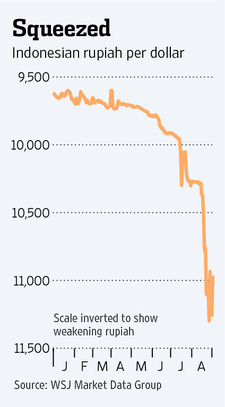
JAKARTA—Indonesia’s currency weakened to its lowest level in more than four years against the dollar Tuesday, underscoring the reality that consumers in Southeast Asia’s largest economy are facing after a harrowing summer slide: Inflation is taking hold and prices are rising. The rupiah has been in decline since last year, but an exodus of cash in the recent emerging-markets selloff led to a 6% slide in August alone. Meanwhile, prices were already beginning to increase after the government raised the cost of fuel this year, and a weaker rupiah has compounded the trend by making the country’s many imports more expensive. Recently, the government has tightened monetary policy, making concessions on growth in order to contain inflation.To help draw the foreign investment needed to counter the trillion-dollar economy’s trade imbalance and stabilize the currency, government officials said in an interview that Indonesia has chosen a new head for its investment board, Dino Patti Djalal, a career diplomat and current ambassador to Washington. He couldn’t be reached to comment.
Hatta Rajasa, the coordinating minister for the economy, declined to confirm or deny the posting, but one official said Mr. Djalall, who would succeed Chatib Basri, who assumed the post of finance minister in May, would take his new position this month.
In the past few years, Indonesia has brought in records amounts of foreign investment—much of it in the key mining sector—but Mr. Djalal would take over as investment growth has started to slip, with some slowing in economic activity—growth fell below 6% last quarter—and as foreign companies continue to highlight vague and changing rules for their operations.
After several benign years, inflation is suddenly at its highest level since the height of the global financial crisis in 2009. The rupiah has slid 13% against the dollar this year and crashed Tuesday through the 11,000 threshold to 11,050, making it one of the worst-performing currencies in the world.
At malls across Jakarta, a small Caffè Americano at Starbucks SBUX -0.27% goes for 22,000 rupiah ($2), up 9% since early August. The city’s premier taxi group raised minimum fares this week by more than 16% to 7,000 rupiah following similar increases by budget taxi groups last month. Toyota has said that it would likely raise prices for cars next month.
“If the exchange rate stays at 11,000 rupiah [per dollar] then the price of a car will definitely go up, because we had it set at 9,500,” Johnny Darmawan, president director of Toyota Astra Motor, said this week.
Indonesian’s consumer-growth story, fed by a burgeoning middle class amid a population of 240 million people, has drawn global retailers like Ace Hardware, Uniqlo and, soon, IKEA. Until recently, consumption kept the country humming, cushioning it even when Chinese demand for exports waned.
Now, growth is slipping below 6%, and foreign investors are watching for any signs of uncertainty and political paralysis ahead of national elections that will replace President Susilo Bambang Yudhoyono next year.
Another deterrent for investors is Indonesia’s struggles to contain corruption. Yet in a political milestone unthinkable just a few years ago, the capital’s corruption court wrapped up one of its highest-profile cases ever Tuesday. Djoko Susilo, the highest-ranking police official ever to be convicted of graft, was sentenced to 10 years in prison. He has denied wrongdoing and his lawyer said he would appeal. The case required Mr. Yudhoyono to intervene last year to stop feuding between the anticorruption agency that brought the case and the powerful police.
For ordinary Indonesians, the view is increasingly on how far their money will stretch.
Edo, a mobile-phone seller at a mall in Jakarta, said customers were passing up his Apple iPhone 5 for less-expensive brands after he raised prices by more than 10% in August to around $725. “I usually sell 10 a month, but since the price increase it’s just been five,” said Edo, who like many Indonesians goes by one name.
But retailer Mitra Adiperkasa, which acts as a franchisee or carrier for more than 100 international brands including Zara, Burger King, Starbucks and more than 100 international brands, says it believes Indonesia’s middle and upper class will be unfazed by price increases of up to 10%. It has already raised prices at least 5% at many of its stores. Corporate Secretary Fetty Kwartati said that prices in its stores were still competitive compared with neighboring Singapore.
The country on Monday announced a $2.3 billion trade deficit for July, its largest since new record-keeping began in 2008. But market players have said that even if it loses a step, Indonesian’s growth story should remain intact.
“The key is more about whether Indonesia can maintain its stability, which has been its main competitive advantage compared to other economies,” said Sandiaga Uno, head of Saratoga Capital, one of Indonesia’s largest private-equity funds. “We remain optimistic mid-to-long term, as nothing structural has changed in Indonesia. In the short term, there will be volatility.”
September 4, 2013, 8:13 a.m. ET
India, Indonesia Currencies Continue to Fall
SUDEEP JAIN And BEN OTTO
Indian and Indonesian currencies were battered Wednesday, with both the rupee and the rupiah continuing a recent downtrend, reflecting investors’ concerns over growing trade imbalances and slowing emerging-market economies.
India’s currency slumped to within a whisker of a record low before the central bank—according to traders—aggressively intervened, while Indonesia’s currency fell to its lowest level in more than four years.
The two countries have taken the brunt of a selloff in Asia, as their widening trade deficits and rising inflation leave them especially vulnerable to the impact of global fund managers withdrawing investments from Asia amid signs of accelerating growth in the U.S. and Europe. The Reserve Bank of India and Bank Indonesia have pursued a variety of strategies to reverse the trend, including raising interest rates and intervening in foreign-exchange markets, but so far they have failed to stem the slide.
India’s rupee was at 67.10 to the U.S. dollar on Wednesday afternoon after reaching 68.60 earlier in the day—close to a record 68.80 hit on Aug. 28.
Dealers said India’s central bank has sold dollars several times in recent weeks. The RBI says it intervenes in the currency market only to curb volatility and not to target a particular exchange rate.
The rupee’s slide—it is down 19% in the year to date—comes amid a change in leadership at the Reserve Bank of India, with former International Monetary Fund Chief Economist Raghuram Rajan set to commence his duties as governor on Thursday. His first order of business will likely be to stabilize the currency.
Indonesia’s rupiah reached 11,125 against the dollar in the interbank market on Wednesday, its lowest level since April 2009. It is down 14% in the year to date, and the outlook is for the downtrend to continue, with one-month non-deliverable forwards pricing in a further 6% decline.
For people looking to buy dollars from money changers and banks, the rupiah is looking even weaker. The difference between the levels that banks use with each other and posted rates at exchange counters have widened to as high as an extra 900 rupiah per dollar compared with about 200 under normal conditions. Analysts say this is a sign of fear that the supply of U.S. notes is low and indicative of a large appetite to exchange rupiah for dollars.
Signs on Wednesday that the U.S. is moving closer to military action against Syria could make the situation worse for both India and Indonesia’s currencies. Although crude-oil prices have slipped since President Barack Obama said over the weekend that he would seek Congress’s approval for a strike, support from Republican politicians increases the likelihood of congressional assent, which could spur prices higher. That is bad news for both India and Indonesia, as it threatens to boost their already-high energy-import bills.
Outflows from Asia, especially Indonesia and India, picked up last week to the most since June, when markets were roiled by the first signs that the Federal Reserve was poised to end aggressive bond buying sooner than previously anticipated. Global investors withdrew $104 million from Indonesia’s bond markets in the week ending Aug. 28, the most of any Asian debt market, according to research from Australia & New Zealand Banking Group Ltd. In India, fund managers have been exiting stock markets in greater numbers, with $213 million leaving the nation’s equities over the same period.
 About bambooinnovator
 Bamboo Innovator