Samsung Unveils Galaxy Gear Smartwatch; Electronics Giant Opens New Front in Tech Battle Over ‘Wearable’ Devices
September 5, 2013 Leave a comment
Updated September 4, 2013, 7:18 p.m. ET
Samsung Unveils Galaxy Gear Smartwatch
Electronics Giant Opens New Front in Tech Battle Over ‘Wearable’ Devices
JONATHAN CHENG And MIN-JEONG LEE
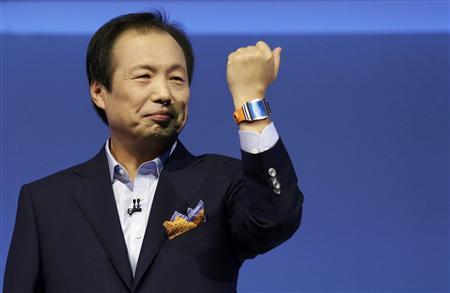
Samsung have launched their much anticipated Galaxy Gear smartwatch. Ben Rooney assesses whether the device will simply become a fashion accessory or an essential piece of technology as ubiquitous as the smartphone. Samsung Electronics Co. 005930.SE +1.87% planted its flag in the battle over wearable devices Wednesday, unveiling a digital watch that can run apps and interact with its own family of smartphones. Samsung, which raced ahead of AppleInc. AAPL +2.07% last year to become the world’s biggest maker of smartphones, is attempting to shake off long-running criticism that it has been a follower rather than an innovator in the competitive market for high-end devices.The release of the Galaxy Gear, which is slated to go on sale Sept. 25 for $299, comes ahead of an expected smartwatch from Apple. But the technological limitations of Samsung’s device, and of others like it on the market, raise questions as to whether this category will take off with consumers.
As Samsung showed off the Galaxy Gear at a trade show in Berlin,Qualcomm Inc. QCOM +0.79%announced plans to ship a new color-display smartwatch, the Toq, in the fourth quarter. The company said the gadget, which works as a companion to smartphones with Google Inc.’s Android operating system, will be available in a “limited edition” for about $300. In June,Sony Corp. 6758.TO +1.12% unveiled its own Android-based smartwatch expected to start selling this month.
Neil Mawston, an executive director at research firm Strategy Analytics said smartwatch manufacturers are “clearly still in the experimental phase today of trying to figure out what consumers and businesses really want.”
“The first generation of smartwatches this year, from Samsung and others, is likely to see modest global sales in the near-term,” Mr. Mawston said, forecasting 1.2 million smartwatches to be shipped world-wide in 2013, rising to 7 million in 2014.
The Galaxy Gear, which has a 1.6-inch screen and weighs 2.6 ounces, looks relatively similar to other smartwatches on the market. But it does have some unique features, such as a 1.9 megapixel camera embedded in the strap and a built-in speaker that allows users to conduct hands-free calls.
“Galaxy Gear isn’t just a cool device that complements the Note 3 [smartphone]—I believe it will become a new fashion icon around the world,” J.K. Shin, head of Samsung’s mobile communications business said at the launch event in Berlin.
He said the device could eventually pave the way for the smartwatch to become a part of daily life, in the same way that smartphones—once seen as a niche luxury product—broke through to become a mainstream product.
However, the relatively limited functionality of Samsung’s smartwatch and small rectangular screen likely will disappoint those who had expected a watch with a full slate of functions and a bendable display that would conform to a human wrist.
The Galaxy Gear also is limited to working in tandem with Samsung’s own line of phones. It will be pitched as a companion device to its latest generation smartphone-tablet called the Galaxy Note 3, which the company also announced Wednesday.
Users who buy both devices will be able to read messages, check the weather and take photos on the smartwatch, which will be synchronized to the smartphone and which will run on Android software.
The device will also come preloaded with more than 60 apps, including a step-counting pedometer and S Voice, a voice-activated app akin to Apple’s Siri.
But this isn’t a device for conducting complex tasks like composing emails or downloading music. It also requires a separate battery charger and isn’t yet compatible with Samsung’s flagship Galaxy S4 smartphone, though the company says it is working on that.
In a nod to the Galaxy Gear’s initial hurdles, Samsung remained guarded about how well the device would be received by the market, saying that at first, the company sees the Galaxy Gear as a niche product targeting younger, tech-savvy early adopters.
Mr. Shin offered a rough benchmark of about two to three watches sold for every 10 units of the Galaxy Note 3, though he cautioned that this wasn’t an official sales projection or target.
Though the Galaxy Gear is Samsung’s first smartwatch, the company released a watch-phone, the SPH-WP10, in 1999, to limited success. Samsung claims that the device was the first in the world to combine the functions of a cellular phone and a digital watch.
More recently, in 2009, Samsung launched a watch phone with a 1.8-inch touch screen. But that device, which targeted customers in Europe, sold poorly in part due to the hefty price tag of €450 ($593).
For all of the hoopla around the smartwatch, Samsung’s broader fortunes will rest more heavily on how quickly consumers take to the Galaxy Note 3 phablet, the hybrid phone-tablet. The new version of the Note will test whether Samsung’s strategy of launching multiple products in different sizes remains a viable strategy.
Based on data from IDC, Samsung’s smartphone market share in the second quarter was 30.4% ahead of Apple’s 13.1%. But like its competitors, Samsung has seen a slowdown in its mobile business with margins being squeezed by high marketing costs despite a record profit in the second quarter. The company has been spending billions of dollars on marketing annually including expenses for lavish product launches. The Berlin event has gathered just as much hype as the Galaxy S4 launch at Radio City Music Hall in New York in March.
The new Galaxy Note, which is slightly larger than its predecessor, is better equipped for multitasking, the company says, allowing users to open multiple frames at once. But it also gives the device’s stylus, called the S Pen, a more prominent role, testing users’ historical resistance to relying on the tool.
Steve Jobs, the late co-founder of Apple, which featured a stylus in its 1990s-era Newton devices, famously mocked the idea of a stylus in 2007, dismissing the tool with a simple “Yeechh.” In 2010, he said of competitors’ devices: “If you see a stylus, they blew it.”
Mr. Shin, speaking ahead of the new Galaxy Note’s launch, said: “We see the S Pen as not just a simple writing tool, but a new communication driver.”
Samsung $299 Galaxy Gear Tests Demand for Smart Watches
Samsung Electronics Co. (005930) set the price of its Galaxy Gear at $299 as the biggest maker of smartphones beats Apple Inc. (AAPL) in unveiling a wristwatch device that can make phone calls, surf the Web and take photos.
Featuring a 1.63-inch (4.1-centimeter) screen and 1.9-megapixel camera, the Gear will go on sale Sept. 25, Shin Jong Kyun, head of Samsung’s mobile business, said at the company’s headquarters in Suwon, South Korea. The device will sync with tablets and smartphones using Google Inc.’s Android software.
Samsung showed the Galaxy Gear today at IFA, Europe’s largest consumer-electronics show, as it races Apple and Sony Corp. (6758) to carve a share of the market for wearable technology amid slowing growth in smartphones. The first companies to sell devices that multitask could lock customers into their platform and boost device sales, with researcher Strategy Analytics expecting Samsung to ship 500,000 Galaxy Gears this year.
“Device makers like smartwatches because they are personal devices that are highly visible to consumers,” Neil Mawston, an executive director at Strategy Analytics, said in an e-mail. “If you see your friend wearing a cool smartwatch on their wrist, you will probably want one, too.”
The Gear weighs 74 grams (2.6 ounces), is available in six colors — including orange, gold and lime green — and has an ultra-thin screen using organic light-emitting diode, or OLED, technology. It has a fitness tracker and works with about 70 applications, according to Samsung. The device has a 4-gigabyte internal memory and 512 megabytes of RAM. It links wirelessly to a user’s smartphone to make calls.
Apple IWatch
Apple, based in Cupertino, California, has a team of designers working on a watch-like device, two people familiar with the matter said in February. The company sought trademark protection for the “iWatch” name in Japan, according to a June 3 filing. Sony already has its Smartwatch that syncs with Android handsets. The Smartwatch 2 will reach stores this month, and can be used as a second screen for the Xperia Z1 smartphone, Sony said today at IFA.
“We expect Samsung Galaxy Gear to sell reasonably well, but it is most likely to be Apple that catalyzes the smartwatch industry,” Mawston said. “Apple should be able to blend the iWatch into its iOS ecosystem in a much tighter way than the fragmented Android community.”
Qualcomm Inc. (QCOM), the biggest maker of chips for mobile phones, will begin selling a connected wristwatch called Toq, the company said today.
Sales of wearable gadgets, including the Galaxy Gear and Google Inc.’s SmartGlass eyewear, will grow to 70 million units in 2017 from 15 million this year, according to Jupiter Research. The watch industry will generate more than $60 billion in sales this year.
Note 3
Samsung also unveiled its Galaxy Note 3 today, a combination smartphone and tablet computer with a 5.7-inch screen, improved software and more accessories than its predecessor introduced at IFA a year ago.
Running on third-generation networks as well as the faster long-term evolution, the new Note has a 13-megapixel camera and allows users to simultaneously juggle two apps on the same screen with a digital pen, Samsung said.
“We’ve moved from delivering devices that offer productivity and creativity to everyday wonders,” Lee Young Hee, executive vice president for the mobile unit, said in an interview. “Together with the main device it will set a different level of ‘smart’ experiences.”
The Note 3 will be released Sept. 25, the same day the Galaxy Gear goes on sale, the company said.
Mobile Business
Samsung, also the biggest maker of televisions and chips, is trying to reduce its reliance on its mobile business, which accounts for 70 percent of operating earnings. The market for high-end handsets is nearing saturation and prices are falling as consumers in emerging markets gravitate toward cheaper models.
“We expect the Note 3 to be an evolution from the previous models,” said Carolina Milanesi, an analyst at Gartner Inc. “I do not expect the Note 3 to change Samsung’s future as far as margins and profits.”
Samsung said in March it will release three top-end smartphones this year. They include the flagship Galaxy S4 that went on sale in April, the Note 3 and a device using the Intel Corp.-backed Tizen operating system that has yet to be revealed.
Apple yesterday sent out invitations to a Sept. 10 event. Apple will announce new iPhones at the event, a person familiar with the plans has said.
To contact the reporters on this story: Jungah Lee in Seoul at jlee1361@bloomberg.net; Cliff Edwards in San Francisco at cedwards28@bloomberg.net
September 4, 2013 11:23 pm
Only time will tell for Samsung smartwatch
By Tim Bradshaw in San Francisco
Samsung’s launch of its Galaxy Gear smartwatch was trailed as a new beginning for wearable technology after a decade of false starts.
“Our time is a time for crossing boundaries,” gushed Pranav Mistry, head ofSamsung’s “think tank”, as he showed off the device in Berlin on Wednesday. “Welcome to the future.”
Sony has already launched a smartwatch, albeit to mixed reviews, and Apple, Google and LG are allworking on devices of their own
. Mobile chipmakers such as Qualcomm and Broadcom are championing the technology as the next big thing and venture capitalists are investing tens of millions of dollars in hardware start-ups.
However, initial reaction to the Galaxy Gear from analysts and gadget reviewers on Wednesday was decidedly mixed, just as Google’s Glass headset has suffered a recent backlash from privacy campaigners and fashionistas alike.
Despite all the wearables hype, consumers’ appetite for bulky, $300 devices that require frequent recharging and replicate many of their smartphones’ functions is still far from proven.
Sarah Rotman Epps, analyst at Forrester Research, said the Gear improved on its predecessors – from 2003’s Microsoft Spot watch to last year’s Kickstarter-funded Pebble – but “still doesn’t give consumers a convincing reason to buy one”.
“Samsung is pursuing a spaghetti-on-the-wall product strategy: Launch a smartwatch and maybe it will stick,” she wrote in a blogpost on Wednesday.
“My bet is that smartwatches are sci-fi inventions that are already anachronisms in this modern world.”
Chetan Sharma, a mobile industry consultant, said on Twitter that smartwatches were “the netbooks of 2013” – a reference to the shortlived popularity of cheap, low-powered laptops that were quickly superseded by tablets such as the iPad.
Studies show that consumer awareness of wearable gadgets is high but purchase activity is low.
A survey of over 1,500 smartphone owners in the US and UK by On Device Research for analyst firm CCS Insight found that 65 per cent of respondents had heard of smartwatches and almost half of Americans surveyed had heard about Google Glass. “This is very high for a product that isn’t even commercially available at the moment,” said Siim Teller, marketing manager at On Device Research.
However, while 20 per cent said they would buy, give or receive a smartwatch by Christmas, fewer than 5 per cent own such a device today – and of those who do, more than a third were no longer using it.
“There is an interaction issue that is very challenging” with wrist-based computing, said Robert Brunner, founder of San Francisco design agency Ammunition Group, which has worked on the popular Beats by Dr Dre headphones and 2011’s Wimm smartwatch, which was acquired by Google last year after underwhelming sales.
“There’s a certain size of thing that people will put on their arm – it’s a small piece of real estate,” Mr Brunner said, limiting what the device can do.
The Galaxy Gear offers touchscreen controls as well as inbuilt motion sensors for gesture controls, and the ability to issue voice commands to a Bluetooth-tethered smartphone. That usability, alongside a colour screen, makes it more sophisticated than most of its predecessors, but battery life of just 25 hours and relatively large size may limit its appeal.
“It clearly puts the wearables business into second gear,” said Christian Lindholm, a former Nokia designer now developing wearable technology at his start-up, Koru. But he believes that curved screens will be the “tipping point” for smartwatches that touchscreens were for smartphones. Both Apple and Samsung have already filed patents for putative devices with curved displays.
Strategy Analytics, a research group, predicts that 15m wearable devices will be sold globally in 2013, rising to 75m by 2017: a small fraction of the smartphone market, which already runs into hundreds of millions of units every year.
Others are more optimistic.
“My intuition is that this is going to be a very big market in the next five years,” said Broadcom’s chief executive, Scott McGregor, with many wearable-tech start-ups likely to flourish, in contrast to the handful of large companies that dominate smartphones. “The initial investment will be much lower, which will enable a huge growth of innovation like we haven’t seen in a while. Some will be cool, some will be left in a drawer.”
Amit Daryanani, hardware analyst at RBC Capital Markets, estimates that up to 30 per cent of today’s 850m smartphone owners might buy a connected device within 18 months, by which time the iWatch and others are expected to launch.
“The potential of this is phenomenal,” he said. “If I had to predict the next breakthrough product, it’s absolutely wearable technology.”
 About bambooinnovator
 Bamboo Innovator