Trihatma Haliman’s lesson: The roots of failure lie in fear, greed
September 5, 2013 Leave a comment
Trihatma’s lesson: The roots of failure lie in fear, greed
The Jakarta Post | Business | Tue, September 03 2013, 12:36 PM
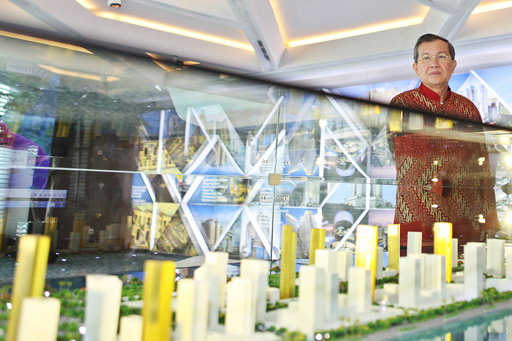
Sixty one-year-old property mogul Trihatma Haliman values the principal of prudent management highly, as after more than four decades it has kept his Agung Podomoro Group empire immune from tribulations such as financial crises in 1998 and 2008.
The group’s aggressive expansion in the business, which includes the Rp 50 trillion (US$5 billion) flagship construction of a city islandnorth of Jakarta, hinges on such a principal. “If you ask me how we managed to get through all the troubles and expand, the answer is simple. Don’t be greedy,” said Trihatma in a recent interview at his office in the 44th floor of the APL Tower in West Jakarta. “Don’t force yourself to launch two or three big projects at the same time. If something happens, you will put your financial capabilities at risk.” “In the property business, if you have excessively high expectations, the result usually won’t turn out good. So it’s important to remain prudent,” Trihatma said.Agung Podomoro is known for its colossal projects with massive investment. The group, which has more than 4,000 employees, has completed more than 70 projects since 1973, presenting low-cost and high-end apartments, shopping malls, shop houses, hotels and office towers.
Having developed more than 500 hectares of areas, from the grandeur Podomoro City shopping, residential and business center in West Jakarta to Plaza Balikpapan super block in East Kalimantan, Trihatma has not seen the recent financial turmoil as a reason to scale back.
“We should not fear the crisis. There’s always an opportunity there. When people dump their assets and businesses, we can get them for lower prices and later sell them at a high rate,” said Trihatma.
During the 2008 crisis, when prices of building materials declined and property companies limited their expansions, Trihatma remained on track to continue the construction of Central Park shopping mall in Podomoro City.
When the mall was opened in late 2009, it tapped soaring middle class consumption that eventually drove the economy to grow by above 6 percent in 2010.
“My key advice is to build and build during the hard times and open it while the conditions are already good,” said Trihatma.
His prudent principal also salvaged his empire during the 1998 crisis, in which he never sought massive loans to finance his projects.
He suggested that a company with rupiah revenue should limit exposure to dollar-assets and loans in order to keep trouble away during a crisis.
“We were not on the black list following 1998 crisis. Therefore, we could still get loans, which were at a very high interest rate at the time,” he said.
“But it didn’t matter as long as we could continue our business. We then consolidated our business, purchased land at low prices, developed it and sold it when the crisis was over,” he said.
His confidence in the business today, amid financial turmoil, also hinged on the abundant cash Indonesians had, including those living in the resource-rich provinces of Kalimantan and Sumatra.
“In business nowadays, there is no limit to prices. People are willing to pay a very expensive price. This is just insane. Everyone seems to be flushed with cash. And they don’t use mortgages.”
He said most of Agung Podomoro’s buyers made cash installments to the company instead of seeking mortgages from banks. The company uses the funds to finance its projects.
Trihatma said there was still a lot of room to grow as only 2 percent of consumers purchased property through mortgages, far lower than 35 percent in Singapore and Malaysia.
Property remains a lucrative business as prices surge over growing demand backed by the rising middle class. According to figures from Bank Indonesia, which surveyed 14 big cities nationwide, houses were sold at a price of more than 11 percent higher in the first quarter of the year compared to the same period last year.
The group’s publicly listed company, PT Agung Podomoro Land (APLN), recorded a 22.6 percent jump in 2012 sales to Rp 4.68 trillion (US$468 million) and a 48 percent rise in gross profit to Rp 2.08 trillion.
But despite the success stories, Trihatma also recalled the bad days in his venture.
He gave an example of the development of the superblock called Seasons City in West Jakarta, which was designed to tap the market of middle-high income consumers.
However, it was later realized that the market was actually suited for the middle-low segment. Although the project was already completed, the profit was not as the company initially expected, he said.
Another example was the extension of The Plaza Balikpapan. APLN is expanding the shopping center into a big superblock, hosting a hotel, apartment and office tower.
Trihatma said his company previously planned to build small space apartments for the expansion project. However, demands show that a unit with three bedrooms is the best selling.
“So, we twisted the design and built more units with three bedrooms. It’s not fatal, but even we can make mistakes.”
Inheriting the property business from his father, Anton Haliman, Trihatma said his core business remained in apartment development.
“Our business model is a fast churn. We have, for example, hotels, but the yields are not so good and we cannot develop thousands of units,” he said.
“But for apartments, we can develop, for example, 20,000 units and build malls and hotels for residents and visitors.”
The group has recently teamed up with French hotel group Accor SA to operate the upscale Pullman Hotel in Jakarta.
Fast land acquisition instead of having large land banks for future development is another strategy in Trihatma’s fast churn business model.
“There are plus and minuses in every strategy. With a large land bank, we can have the benefit by selling it when land prices soar. However, I am a developer, not a speculator,” he said.
Big projects worth trillions of rupiah, goals to earn quick income and acquisitions have raised questions about the high-risks they entailed.
However, Trihatma simply said that “survival won’t last without courage.”
While optimism remains high in the domestic market, Trihatma would not focus expansion overseas.
The group is aggressively expanding outside of Java, with an apartment project worth around Rp 5 trillion in Medan, North Sumatra and a Rp 3 trillion project in Balikpapan.
But of all the projects, nothing could compare to the grandness of Trihatma’s ongoing Pluit City project — islands in northern Jakarta.
APLN intends to create three islands in the Java Sea and connect each with bridges and a highway to Jakarta.
Thousands of houses, apartment units and other supporting facilities will be built on the three islands, which will be able to host around 700,000 people.
APLN will also develop dikes and brick walls to protect Jakarta’s mainland from future floods.
The project, which will require 10 years before it is completed at a cost of around Rp 5 trillion annually, will become the group’s first city-concept development.
“This will be APLN’s flagship project. In Jakarta we can only develop a complex rather than a complete zone,” Trihatma said.
“On this reclamation area, we can develop what we want perfectly based on our own concept.”
Given the massive undertaking, Trihatma believed the group was not in the position of over expansion and that investors were still highly confident about the sustainability of the project.
“Again, the principal we hold dearly is prudent management. We will never forget the lesson we learned in 1998,” Trihatma said.
 About bambooinnovator
 Bamboo Innovator