Jakarta Governor Joko Widodo may have stolen the spotlight from senior politicians eyeing the presidency in 2014, but his deputy, Basuki Tjahaja Purnama, has proven to be a more popular figure in addressing Jakarta’s chronic woes
September 6, 2013 Leave a comment
Basuki More Popular Than Joko, Poll Finds
By SP/Yeremia Sukoyo on 9:25 am September 6, 2013.
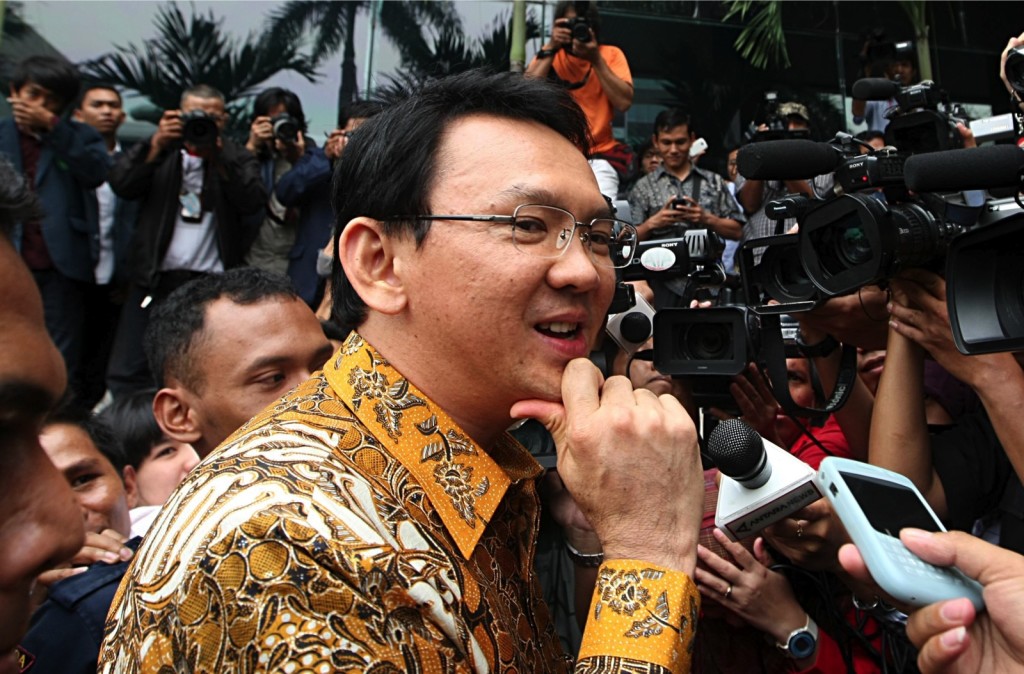
Jakarta Deputy Governor Basuki Tjahaja Purnama speaking to reporters. (JG Photo/Afriadi Hikmal)
Jakarta Governor Joko Widodo may have stolen the spotlight from senior politicians eyeing the presidency in 2014, but his deputy, Basuki Tjahaja Purnama, has proven to be a more popular figure in addressing Jakarta’s chronic woes, according to the results of a survey released on Thursday. Basuki rated favorably with 98.3 percent of the 8,280 respondents polled by the Indonesia Network Election Survey, slightly ahead of Joko, who got 96.9 percent.
“In our findings, the public sees Basuki as the one who has been doing most of the work in solving Jakarta’s issues, as well as the person who is moving fast in working on the problems such as the Pluit dam and the relocation of street vendors in Tanah Abang market, among others,” Sutisna, the head of data for INES, said at a press conference to announce the findings.
He added that the respondents were all people eligible to vote in the 2014 elections, in which most polls paint Joko as the firm favorite ahead of other more established political figures.
Among those overshadowed by Joko is Prabowo Subianto, the co-founder and chief patron of the Great Indonesia Movement Party (Gerindra), of which Basuki is a member.
The latter’s recent high profile and growing popularity has fueled speculation that his no-nonsense leadership style that has led to tangible results may be engineered by Gerindra to undermine Joko and thus boost Prabowo’s chances at winning the presidency next year.
But Basuki said he fully supported Joko as governor.
“The instructions are clear: to help Joko be a successful governor. There are no other instructions,” he said on Wednesday as quoted by Merdeka.com.
He added he had no problems with the idea of Joko pursuing a presidential bid.
“That’s a good thing. I think the majority of Indonesians believe in a leader who is honest and hard working,” he said.
However, Basuki recently indicated that he was not ready to take over as governor should Joko decide to run for the nation’s highest seat in 2014.
“I’m not ready to move my office downstairs. The view is better from up here, I can see the National Monument,” he said last week, in reference to his office being one floor above Joko’s at City Hall.
Meanwhile, tensions are mounting between Gerindra and the Indonesia Democratic Party of Struggle (PDI-P), of which Joko is a member, following calls by Gerindra deputy chairman Fadli Zon for the PDI-P to support Prabowo in the presidential election.
“In the 2009 election, we supported Megawati,” Fadli said on Tuesday, referring to the decision by Prabowo to stand as running mate to PDI-P chairwoman Megawati Sukarnoputri.
“So in 2014, we hope that Megawati will support Prabowo.”
The PDI-P has refuted the notion that it is beholden to Gerindra, saying the choice of its presidential candidate did not hinge on what other parties wanted.
However, an anonymous source quoted by Merdeka.com said there was an actual deal made to that effect prior to Prabowo allying with Megawati in 2009.
“The meeting took place a day before the window for registering presidential candidates for the 2009 election closed,” the source said.
The coalition was reportedly agreed upon by both parties under the condition that Megawati would support Prabowo in the 2014 election. The source said that Fadli was among the senior Gerindra and PDI-P officials present at the meeting.
However, Suhardi, the Gerindra chairman and another of those said to have attended the meeting, denied the claim and said relations between the two parties were fine.
Jakarta’s Youth Like Basuki’s Hand-On Approach, But Recommend Softer Touch
By Jane Yuwono on 10:46 am September 5, 2013.
Ten months since his inauguration, Jakarta Deputy Governor Basuki Tjahaja Purnama has gained a reputation of being a bold, practical and down-to-earth leader through his highly publicized take on the capital city’s issues.
In a country where intolerance can be problematic, a leader being of Chinese heritage has caused some tension, but his tough stance on such prejudice is winning him popular support, especially amongst young people.
Jakarta State University student Rahma said she admired Basuki’s boldness, but was aware of voices of dissent in the community because of his Chinese origin.
“I like Ahok’s [Basuki’s] work ethic because he is firm and not racist. Although he is of Chinese descent, he does not differentiate between people. If you are wrong, then you are wrong,” Rahma said.
Amanda Witdarmono, the 25-year-old editor in chief of children’s news organization Berani, who recently interned at City Hall, said Basuki’s leadership was exactly what Jakarta needed.
“Jakarta is a tough city. In general, people are quick to anger because of the many pressures of living here. We need a leader who is tougher than all those people, but more importantly, brave enough to face the pressure that a city like Jakarta imposes,” Amanda told the Jakarta Globe.
She said Basuki’s authenticity and dedication to his constituents made him well-suited to the job.
“Basuki is definitely not the most easygoing person, that’s for sure. He is straightforward, what you see is what you get. I think it’s fitting to Jakarta,” she said. “But here there is no time for small talk, there are plenty of problems to solve and many solutions to implement.”
Amanda said she thought Basuki’s leadership wasn’t perfect, but that his principles and character contributed to his strong leadership.
Enda Nasution, a prominent Indonesian blogger and Internet guru, said he thought Basuki was a practical man of action.
“Jakarta needs real leaders who can talk, work, and inspire people. Jakarta needs leaders who know the rules and want to uphold those rules. Men like Basuki and [Jakarta Governor] Joko Widodo are long overdue in this city,” he said.
The softer side
But Enda said Basuki needed to show his softer side to the public.
“I trust and have faith in his leadership model. I am just sometimes afraid he will be accumulating too many enemies who could harm or conspire against him. It would help if Basuki showed his softer side more often,” Enda said.
Winner of the US Department of State’s second annual Democracy Video Challenge Adhyatmika said Basuki’s hands-on leadership was admirable.
“His leadership methods are very democratic and effective because he inspects the field himself and is very hands-on in doing things,” he said. “The NATO [no action, talk only] style of leadership is getting very outdated.”
Adhyatmika sees Joko and Basuki’s time in office as an era of reformation because they have managed to slowly change the system, instead of merely alleviating the symptoms.
Other young residents of Jakarta see Basuki as a bold but down to earth leader.
Imam, a 19-year-old who has been selling souvenir shirts at the National Monument (Monas) in Central Jakarta, for the past five years, said he is fond of Basuki’s approach to the vendors there.
“Mr. Basuki is a firm but relational man. He acts like family with the vendors around here,” he said.
Imam said while he had never spoken directly with the deputy governor, he occasionally sees Basuki when he is at Monas on routine visits.
“Unlike [former Jakarta Governor] Fauzi Bowo, Joko and Basuki take the time to talk with the vendors in Monas and listen to us,” he added.
At Tanah Abang where a street vendor relocation program is underway, Basuki has been tough in taking action against the area’s notorious thugs as well as in facing its Betawi leaders.
Taxi driver Aidin said Basuki was similar in his leadership style to Sukarno, the first president of Indonesia.
“It is okay to be stern. Look at Sukarno, even the United Nations feared him,” he said. “Let those who are bitter to Basuki be bitter, but his approach is the only way to solve Jakarta’s problems. The city is already chaotic,” he said.
The 27-year-old taxi driver admitted he was inspired by Basuki’s bluntness, and referenced one of the Youtube videos the government had posted showing the deputy governor admonishing his secretary during a meeting about efficiency within public office and encouraging her to use her computer instead of pen and paper.
“He shows that you shouldn’t be afraid,” he said. “If something needs changing, you just have to act.”
Adhyatmika hopes Basuki mentors the city’s youth to be the successors of what he says is the “Joko-Basuki movement.”
He believes that for lasting change, reform must not stop with Joko and Basuki, but the younger generation must follow in their footsteps.
Basuki’s Closest: No Manufactured Image and No Angry Man
By Jane Yuwono on 10:49 am September 5, 2013.
Jakarta Deputy Governor Basuki Tjahaja Purnama has become a regular fixture in national headlines and front pages with his often controversial remarks and straightforward personality earning him plenty of supporters and detractors.
Perhaps surprisingly, it appears this is no gimmick for the cameras: Those closest to him attest that his public persona is no different from the man he really is behind closed doors.
Yayasan Cinta Anak Bangsa (YCAB) founder and chief executive Veronica Colonda, a good friend of Basuki, said she was accustomed to Basuki’s frank and casual manner, apparent in his day-to-day interactions with government officials.
“Basuki would interact with people with ‘lu-gue,’ [‘personability,’ addressing as a peer] regardless of their position, [he’d] lead a meeting while eating a papaya and even conduct important discussions over lunch where he would eat and talk at the same time,” she told the Jakarta Globe.
To Veronica, Basuki’s authentic way of communicating is similar to that of Indonesia’s past President Abdurrahman Wahid, popularly known as Gus Dur.
She said Basuki’s election to office in Jakarta was a breath of fresh air to a people tired of government officials who often appeared convoluted and overly conscious of their public persona, an issue whose consequences include not only a lack of frank and personable communication with the people but a lack of ability to uphold transparency and/or the perception of doing so.
Nonetheless, according to Veronica, Basuki’s leadership is not without room for improvement.
“As a leader, if he wants to see himself in a higher place in government, I think it will be useful for him to work on his diplomacy,” she said, adding that his media coverage seems to have given the impression that he was a stern and temperamental person.
As such, she suggested that Basuki should learn to hold back his temper and prove to the public that he is capable of self control.
“[Jakarta Governor] Joko Widodo and Basuki’s partnership is great because they can both fill in for each other. Joko can learn from Bauski’s up-front leadership, and Basuki can also learn the art of diplomacy from Joko,” she said.
Idealist
To Basuki’s admiring son, 14-year-old Nicolas Sean, his courage in fighting corruption was the characteristic he admired most about his dad, saying this courage runs in the blood.
“I admire this characteristic from my dad because it is a pattern that I have seen in his sisters, brothers and especially his dad,” Nicholas said.“My dad told me stories about how his father was a brave man who stood up against corruption and was ready to face a gun unarmed just to prove he was not afraid to die for his principles.
“His position has motivated me to aim higher, work harder, trust in the Lord and follow in his footsteps.”
Fifi Lety Tjahja Purnama, Basuki’s sister, is a practicing lawyer in Jakarta for big companies including Philips Indonesia, Energizer Indonesia and Drill Cool System. She runs a blog and is dedicated to improving the credibility of public office in Indonesia.
Meanwhile, Basuki’s brother — Basuri Tjahaja Purnama — is the district head of East Belitung, a position Basuki himself once held before becoming a legislator in the House of Representatives.
Sean said his father was a man who would do anything for the sake of truth and justice, even if it meant being the “bad cop” or risking his life.
“We all see Joko with a nice and friendly personality, which is true, while my dad as being more serious and strict,” he said. “Despite of all this, I would just have to say that my dad is doing this because he knows it is the only way.”
“He is doing this not because he wants to, but because he has to. It’s some kind of duty and the only way to really make things work and get things done,” Sean said, citing the recent issue with street vendors in Central Jakarta’s Tanah Abang market. They have been relocated to a dedicated area, freeing up space for vehicles on the road.
“My dad is an inspiration especially to me because of his daily actions that I observe,” he said. “I have always seen him to be honest, generous, and great leader to be followed upon. The way that he played the bad cop and Jokowi [Joko’s nickname] the good cop in the Tanah Abang situation really inspired me personally.”
Basuki is generally very busy with day-to-day tasks at the city administration, which often comes with the risk of losing family time, but Sean said his father was fully committed to his position as deputy governor. This means that he is responsible not only for his family, but for all Jakartans.
Basuki’s personal assistant at City Hall, Michael Victor Sianipar, said despite his boss being notorious for media outbursts, he was someone who always had a reason for his anger, often triggered by sincere concern and care.
“Like when he sees an unattended sick person, people who are oppressed by gang members or bad traffic. Justice always has something to do with anger — anger at injustice. It is a drive that should force us to move forward. If we respond with only being upset with a situation, then we will stop there,” Michael said.
The 22-year-old admitted that he held Basuki in high esteem for the strength of his beliefs and his way of standing up for what is right.
“He [Basuki] doesn’t care whether people agree with him or not. If he thinks what he believes is right, then he will stand by it,” he said.
Michael calls himself a big believer in Basuki’s sincerity and dedication to serving the residents of Jakarta.
“There was one time while we were campaigning, we met a woman who was had been an invalid in her home for three months. Basuki would usually ask his staff to cater to their [unfortunate residents’] needs, but that time he told them ‘you don’t have to take care of this woman. You all seem tired,’ ” Michael recalled. “Basuki immediately called an ambulance and worked out the details himself.”
He explained that Basuki thinks people — his staff included — should work because they believe in their task, “that if you do something merely because it is your duty, then it is better for you not to do it altogether.”
Veronica of YCAB emphasized thatBasuki’s election as deputy governor of the capital was a great step for Indonesia. Despite being from a minority religious and racial background, Protestant and Chinese, he managed to appeal to the larger majority.
“Basuki’s position now gives us hope — we are talking about real diversity, we are talking about the real ‘Bhinneka Tunggal Ika’ [the national motto, ‘Unity in Diversity’] at its best, ever since our independence in 1945,” Veronica said.
 About bambooinnovator
 Bamboo Innovator