TV Makers Track What Viewers Watch Seeking Access to Ads

TV Makers Track What Viewers Watch Seeking Access to Ads

Televisions reaching consumers this year will be able to tell what audiences are watching and relay the information to marketers over the Web, opening the door to new ad revenue as well as privacy concerns. Coming Web-connected units from LG Electronics Inc. (066570) and other manufacturers contain digital sleuthing technology that tracks live and recorded programs as they’re shown on-screen. Sets being demonstrated by Seoul-based LG in Berlin this week at IFA, Europe’s largest consumer electronics show, will use software from San Francisco-based Cognitive Networks Inc. Read more of this post

Orlando tourism industry plugs into electric car experience

Orlando tourism industry plugs into electric car experience

7:48pm EDT

By Barbara Liston

ORLANDO, Florida (Reuters) – Promoters of electric cars are hoping to entice a few of Orlando’s 56 million annual visitors to rent one at the airport and plug in at strategically placed charging stations at tourist hotels, theme parks and the convention center. The goal of Drive Electric Orlando, which officially kicked off on Thursday with 15 Nissan Leaf cars, is to encourage broader adoption of electric vehicles by providing visitors with what amounts to an extended test drive during their stay. Read more of this post

Living up to the hype surrounding three-dimensional printing may prove to be a tall order for 3D Systems

September 5, 2013, 4:30 p.m. ET

Reading the Fine Print on 3D Systems

Living Up to the Hype Surround Three-Dimensional Printing May Prove a Tall Order for the Company

ROLFE WINKLER

MI-BY301_3DHERD_G_20130905174805

Three-dimensional printing could be as big as the steam engine, the computer or the Internet. So says Abraham Reichental, chief executive of three-dimensional printer maker 3D Systems DDD -0.37% . If that is so, it seems odd that he recently sold a fifth of his own shares in the company. 3D Systems’ stock remains near an all-time high a week after CitigroupC +0.52% issued a “buy” rating. The stock is up more than tenfold in the past three years and trades at more than 90 times expected 2013 earnings. The company says Mr. Reichental sold shares to diversify his holdings and to settle tax expenses. Read more of this post

Google is waging war on apps that attack, infiltrate and steal from your phone

Google is waging war on apps that attack, infiltrate and steal from your phone

By Leo Mirani @lmirani September 5, 2013

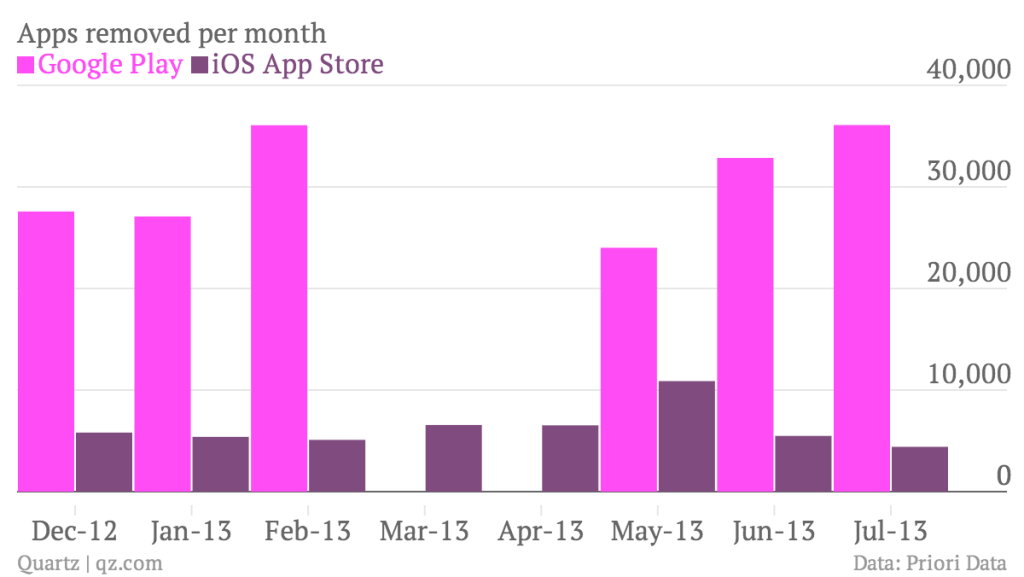
Android’s open platform means its must police its app store very carefully. (Note: Android data for March and April were unavailable.)

apps-removed-per-month-google-play-ios-app-store_chartbuilder-21

Late last month, Google made sweeping changes to its policies for developers on Play, the official store for apps that run on Android, Google’s smartphone operating system. The changes, which among other things affect how ads are displayed and permissions sought, are meant to make Android safer so users can download and use apps with confidence. Developers have until later this month to make the changes. Those that run afoul of the new rules after the deadline will find their apps deleted. Read more of this post

Asha to Ashes: Microsoft’s emerging market conundrum

Asha to Ashes: Microsoft’s emerging market conundrum

9:22pm EDT

By Jeremy Wagstaff and Devidutta Tripathy

SINGAPORE/NEW DELHI (Reuters) – Microsoft Corp’s acquisition of Nokia’s handset business gives the software behemoth control of its main Windows smartphone partner, but leaves a question mark over the bigger business it has bought: Nokia’s cheap and basic phones that still dominate emerging markets like India. Microsoft Chief Executive Steve Ballmer has said he sees such phones – of which Nokia shipped more than 50 million last quarter – as an entree to more expensive fare. Read more of this post

Cancer Vaccine Setback. Failed product is one of therapeutic cancer vaccines. Unlike typical vaccines given to healthy people to prevent disease, therapeutic cancer vaccines are given to patients already diagnosed with cancer

September 5, 2013, 6:34 p.m. ET

Cancer Vaccine Setback

Failed Glaxo Trial Is Unlikely to Dampen Drug Firms’ Interest in Hot R&D Area

JEANNE WHALEN and RON WINSLOW

LONDON—An experimental cancer vaccine failed to help skin-cancer patients in aGlaxoSmithKline GSK.LN -0.81% PLC clinical trial, a setback for a hot area of medicine that seeks to harness the body’s immune system to fight tumors. When compared to a placebo, the vaccine, called MAGE-A3, didn’t increase the amount of time melanoma patients lived without their disease returning, Glaxo said Thursday. The 1,345 patients in the late-stage trial were given either the vaccine or a placebo after their tumors were surgically removed. Read more of this post

Cheung Kong Group Denies Li Ka-shing Pulling back from China and HK

Cheung Kong Group Denies Li Ka-shing Pulling back from China

09-06 10:34 Caijing

Guo Ziwei, a Cheung Kong director, called the shift a cautious investment decision by “putting eggs in more than one basket.”

Board of director of Cheung Kong Group, the leading HK-based multi-national conglomerate, has denied its chairman Li Ka-shing is giving up on investments in China following reports of his groups selling Chinese assets while shopping in Europe. Li’s conglomerate, Hutchison Whampoa, has put the supermarket chain ParknShop in HK up for sale while the Cheung Kong is selling an office building in Shanghai for at least 6 billion yuan, triggering speculations that the Asia’s richest man is withdrawing investments in China, both the mainland and HK. Read more of this post

The Winners and Losers of China’s Anticorruoption Drive

September 6, 2013, 12:43 a.m. ET

The Winners and Losers of China’s Anticorruoption Drive

Probes Hurt Small, Private Companies More Than State-Owned Enterprises

WEI GU

AM-BA144_WEICOL_G_20130905061807

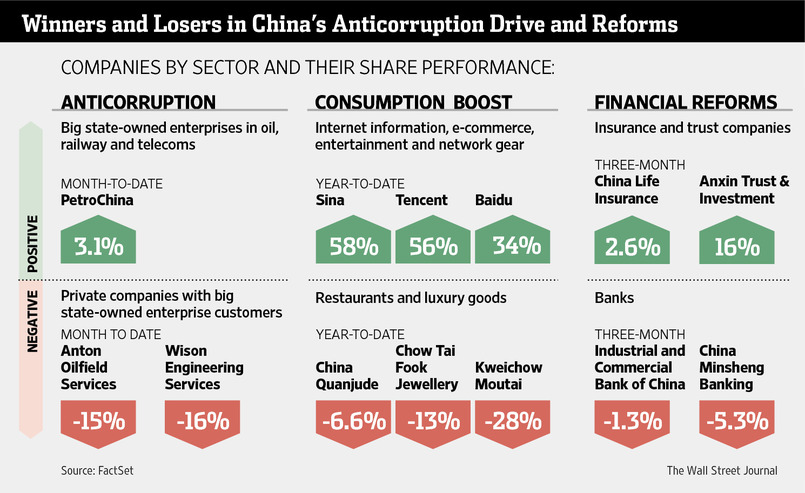
China’s anticorruption drive and the country’s economic overhaul expected this fall are likely to guide stock-market performance this year. But the winners and losers might surprise you. The investigation into high-ranking officials at China National Petroleum Corp. and its listed unit, PetroChina601857.SH -0.25% is likely to hurt small private companies that have tight business relationships with the state-owned enterprise more than it hurts Petrochina, some analysts say. PetroChina’s shares in Shanghai have hardly budged since news of the investigation broke last week. The same was true in past corruption probes into the banking and railway industries. The state-owned enterprises are powerful machines, and their favored position in China’s economy counts for more than whoever happens to be at the top. Read more of this post

Say what? China says 400 million can’t speak national language

Say what? China says 400 million can’t speak national language

6:49am EDT

BEIJING (Reuters) – More than 400 million Chinese are unable to speak the national language Mandarin, and large numbers in the rest of the country speak it badly, state media said on Thursday as the government launched another push for linguistic unity. China’s ruling Communist Party has promoted Mandarin for decades to unite a nation with thousands of often mutually unintelligible dialects and numerous minority languages, but has been hampered by the country’s size and lack of investment in education, especially in poor rural areas. Read more of this post

Powerful Oil Clique at Center of Chinese Probes; Some See Party Struggle Behind Investigations Targeting Central Pillar of State Sector

September 5, 2013, 7:50 p.m. ET

Powerful Oil Clique at Center of Chinese Probes

Some See Party Struggle Behind Investigations Targeting Central Pillar of State Sector

JEREMY PAGE, BRIAN SPEGELE and WAYNE MA

WO-AP304_COIL_G_20130905182708

BEIJING—In November of 2009, China’s internal security chief visited the Khartoum Refinery, a joint venture between the state-run Chinese oil company he used to run and the Sudanese government. By his side was one of his protégés, the then-head of China National Petroleum Corp., Jiang Jiemin. At the time, the visit by Zhou Yongkang—then one of China’s top nine leaders—seemed to encapsulate the international ambitions of China’s oil industry. It also was an illustration of the political clout Mr. Zhou wielded as patron of a powerful network of current and former oilmen in the Communist Party’s top ranks. Read more of this post

No Swift China Breakthrough Seen by Mao-to-Xi Scholar of Economy

No Swift China Breakthrough Seen by Mao-to-Xi Scholar of Economy

Zhang Shuguang, who’s studied China’s economy for more than 50 years, is skeptical that Communist Party leaders will unveil significant breakthroughs in an economic plan due in November. “It will mention rural reform, it will mention fiscal reform, it will mention financial reform — but obstacles hindering these reforms are still there,” Zhang, 73, an economist and senior fellow with the Chinese Academy of Social Sciences, said in an interview in Beijing last week. “Hopes for breakthroughs shouldn’t be too high.” Read more of this post

Mixed blessings for investors as China lets some firms recapitalize

Mixed blessings for investors as China lets some firms recapitalize

5:02pm EDT

By Lu Jianxin and Pete Sweeney

SHANGHAI (Reuters) – China’s shakey economic growth over recent months has helped persuade regulators to let select listed companies top up balance sheets through rights issues and private placements. The relaxation will ease the pain for some cash-strapped firms but equity analysts worry that the recapitalizations will draw money away from other scrips in an already wobbly stock market. Read more of this post

China for the first time joined the ranks of the most-traded international currencies, underscoring the rise of the world’s second-largest economy and the growth of the global foreign-exchange market.

Updated September 5, 2013, 7:53 p.m. ET

Milestone for Yuan Marks Rise of China

Yuan Rises to Ninth-Most-Actively-Traded Currency Globally

NICOLE HONG, CLARE CONNAGHAN and TOM ORLIK

EM-AX011A_YUAN_G_20130905090008

China for the first time joined the ranks of the most-traded international currencies, underscoring the rise of the world’s second-largest economy and the growth of the global foreign-exchange market. The Chinese yuan vaulted to ninth in the Bank for International Settlements’ latest report on foreign-exchange turnover, surpassing the Swedish krona and New Zealand dollar, among other widely used currencies. Trading in the Chinese currency, also known as the renminbi, has more than tripled over the past three years, to $120 billion a day in 2013, the BIS said, referencing survey data from April. Daily U.S. dollar trading in 2013 has averaged $4.65 trillion. Read more of this post

Bitcoin Mania Grips China; There are about 11.6 million Bitcoins in circulation and the total number that can be mined is capped at about 21 million; 10 million Bitcoins yet to be mined have a value of $1.44 billion

Bitcoin Mania Grips China

By Lulu Yilun Chen September 05, 2013

Sun Minjie, a 28-year-old Internet worker who lives in Beijing, has invested more than $3,000 in 796 Xchange, a website where people buy and sell shares of companies that deal in Bitcoins, the digital currency. The stock of 796 Xchange, which also deals in Bitcoin futures, returned about 57 percent from Aug. 1, when it started trading on the company’s website, through Sept. 3. The benchmark Shanghai Composite Index gained about 4.6 percent during the same period. “In China, the stock market, property, and bond market are all not so good, so people get really excited when they hear of a new investment that generates high returns,” says Peter Pak, head of trading at BOCI Securities in Hong Kong. Read more of this post

Scientists around the world are racing to find a solution to a deadly disease that is spreading through shrimp farms in South-east Asia, killing shrimp en masse and causing annual losses of more than US$1 billion

Race on to fight deadly shrimp disease

Friday, September 6, 2013 – 03:00

Nirmal Ghosh

The Straits Times

ASIA – -Scientists around the world are racing to find a solution to a deadly disease that is spreading through shrimp farms in South-east Asia, killing shrimp en masse. Earlier this year, the Global Aquaculture Alliance estimated that Early Mortality Syndrome (EMS), which emerged in China in 2009 and reached Thailand this year, is causing annual losses of more than US$1 billion (S$1.3 billion) across China, Vietnam, Malaysia and Thailand. Thailand, the largest shrimp exporter in the world with last year’s exports worth 95.3 million baht (S$3.8 million), is being increasingly hit by a virus-triggered toxin which kills the shrimp. Read more of this post

Asean economies facing sharp slowdown

Asean economies facing sharp slowdown

Paolo G. Montecillo, Philippine Daily Inquirer/ANN, Manila | Business | Fri, September 06 2013, 7:59 AM

Southeast Asian economies like the Philippines face a sharp deceleration in growth as a result of a credit crunch brought on by a shift in the monetary policy of the US Federal Reserve. The Institute of Chartered Accountants in England and Wales (Icaew) also warned that, although Southeast Asian economies have more stable economic foundations, the countries might also have to deal with the slowdown in China—Southeast Asia’s largest trading partner. Read more of this post

Coca-Cola, Kirin eye hot fizzy drinks; Kirin also intends to sell Kirin no Awa, a hot fruit-flavored drink, exclusively at convenience stores, targeting mainly women in their 20s and 30s

Coca-Cola, Kirin eye hot fizzy drinks

KYODO

SEP 5, 2013

COCA-COLA – Co. will release the U.S. beverage giant’s first hot carbonated drink Oct. 21, making Japan the first country to taste it. Kirin Beverage Co. is set to follow suit Nov. 5. Canada Dry Hot Ginger Ale took four years to develop, Tim Brett, president of Coca-Cola’s Japan unit, said at a press conference Wednesday. The product came about after Coca-Cola came up with a technique for containing bubbles when the drink is heated. The company is hoping the new drink will shore up sales in winter, when demand for cold sodas typically fizzles. The suggested retail price for a 180-milliliter can is ¥120. Kirin Beverage meanwhile intends to sell Kirin no Awa, a hot fruit-flavored drink, exclusively at convenience stores, targeting mainly women in their 20s and 30s, the company said. A 275-milliliter can will cost ¥130.


Lego Sales Rise on Asia Growth, Now 2nd Biggest Toymaker

Lego Sales Rise on Asia Growth, Now 2nd Biggest Toymaker

By Agence France-Presse on 6:19 pm September 5, 2013.
Danish toy maker Lego on Thursday reported an 18 percent rise in first-half net profit as revenue grew 13 percent, fuelled by growth in Asia as developed markets stalled. Lego, now the world’s second-biggest toy manufacturer behind Mattel of the US, said its largest markets North America, Europe and Japan had experienced a slow start to the year. “Despite this tough dynamic, our data indicates that consumer sales of Lego products for the first half of 2013 grew nine percent globally,” chief executive Joergen Vig Knudstorp said in a statement. Revenue of 10.3 billion kroner ($1.83 billion) was also boosted by low stocks of Lego products in many stores due to a strong holiday season last year. Read more of this post

Japan’s Suntory closing in on deal to buy GSK drinks brands Lucozade and Ribena for more than $1.6 billion

Suntory closing in on deal to buy GSK drinks brands: sources

8:58am EDT

By Anjuli Davies and Ben Hirschler

LONDON (Reuters) – Japan’s Suntory Beverage & Food (2587.T: QuoteProfileResearchStock Buzz) is in advanced talks to buy GlaxoSmithKline’s (GSK.L: Quote,ProfileResearchStock Buzz) Lucozade and Ribena drinks for more than 1 billion pounds ($1.6 billion), in a deal that would pre-empt an auction of the brands, two people close to the process said. A deal could be announced in the next few days, one of the sources said on Thursday. GlaxoSmithKline (GSK) – Britain’s biggest drugmaker – announced plans in April to sell Lucozade and Ribena, which are big sellers in Britain but lack global reach, as the company seeks to make its consumer health business more focused. Read more of this post

Rise Is Seen in Students Who Use E-Cigarettes

September 5, 2013

Rise Is Seen in Students Who Use E-Cigarettes

By SABRINA TAVERNISE

06ecigs-articleLarge

E-cigarettes, battery-powered devices that deliver nicotine in an aerosol mist, are becoming increasingly popular among middle and high school students.

WASHINGTON — The share of middle and high school students who use e-cigarettes doubled in 2012 from the previous year, federal data show. The rise is prompting concerns among health officials that the new devices could be creating as many health problems as they are solving. One in 10 high school students said they had tried an e-cigarette last year, according to a national survey by the Centers for Disease Control and Prevention, up from one in 20 in 2011. About 3 percent said they had used one in the last 30 days. In total, 1.8 million middle and high school students said they had tried e-cigarettes in 2012. Read more of this post

Greek Yogurt Latecomer Danone Eats Chobani’s Lunch; Marketing muscle helps the French food giant cut into Chobani’s lead

Greek Yogurt Latecomer Danone Eats Chobani’s Lunch

By Julie Cruz September 05, 2013

Just two years after releasing its first product in 2007, Chobani became the biggest U.S. seller of Greek-style yogurt, which has more milk solids and a sharper taste than the conventional variety. This is not the kind of success that goes unnoticed by Danone (DANOY), the world’s largest yogurt maker. After being blindsided by the upstart, the French food giant has fought to take back the dairy section with Greek-style products from its own Dannon Oikos brand. A marketing blitz included a pricey Super Bowl ad, and it’s given out samples at store promotions. The success of Danone’s belated push to slow Chobani’s momentum and narrow its lead in Greek yogurt is a testament to how an established player’s marketing heft can trump a newcomer’s first-mover advantage. Read more of this post

The Plastic-Bag Paradox; Despite Cheap Natural Gas, Raw-Materials Prices Remain High

September 5, 2013, 8:15 p.m. ET

The Plastic-Bag Paradox

Despite Cheap Natural Gas, Raw-Materials Prices Remain High

JAMES R. HAGERTY

MK-CG068A_PLAST_G_20130905175712

LOGAN TOWNSHIP, N.J.—Heritage Bag Co., which makes plastic trash bags around the clock at a factory here, should be sitting pretty. Heritage’s main raw material, polyethylene, is derived from natural gas. As the U.S. ramps up production of gas released from underground shale formations, output of polyethylene is expected to soar too, creating the potential for lower prices. “I think it’s our duty to use this gift of shale gas to rebuild our industrial infrastructure,” says Jim Morris, a bluff Texan who serves as chief operating officer of privately owned Heritage. Read more of this post

Energy security: Strength in reserve; The shale boom will strengthen US diplomatic influence but will not allow it to disengage from the Middle East

September 5, 2013 7:19 pm

Energy security: Strength in reserve

By Ed Crooks and Geoff Dyer

The shale boom will strengthen US diplomatic influence but will not allow it to disengage from the Middle East

“When word of a crisis breaks out in Washington, it’s no accident that the first question that comes to everyone’s lips is: ‘Where’s the nearest carrier?’” President Bill Clinton, aboard the USS Theodore Roosevelt, 1993.

Twenty years after Mr Clinton’s tribute to the might of America’s fleet, the location of its carriers still reveals much about US foreign policy priorities. Of the US navy’s 10 operational aircraft carriers, three are in foreign waters: one in Japan and two with the Bahrain-based 5th Fleet in the Gulf. One of the two, the USS Nimitz, sailed into the Red Sea on Monday, moving into position for possible air strikes on Syria. The other, the USS Harry S Truman, remains in the Arabian Sea, launching missions to support US troops in Afghanistan. Both are also positioned to keep watch over the oil-producing countries of the Middle East, and in particular the Strait of Hormuz at the mouth of the Gulf, the conduit for a fifth of the world’s supply. Read more of this post

Protecting India’s Linguistic Riches

Protecting India’s Linguistic Riches

In New Delhi this week, the findings of an ambitious and methodologically inventive survey of Indian linguistic plenitude were made available to the public. The project, called the People’s Linguistic Survey of India, establishes the number of languages currently in circulation at an astonishing 780. The survey, headed by the scholar Ganesh Devy, and drawing on hundreds of scholars and research workers, is impressive not just for its findings but also for the principles it applied in thinking about India’s languages. They dramatically extend, for instance, the official view of India’s languages in the Constitution of 1950, which recognizes 22 official languages, or Scheduled Languages. All have their own script and print cultures, and are now sanctified as the “high languages” of modern India. Read more of this post

India’s Middle Class Hit Hard as Rupee Pushes Up Prices

India’s Middle Class Hit Hard as Rupee Pushes Up Prices

Mumbai taxi driver Saiyad Ahmed Ali has cut back on fruit and fish, from about twice weekly to once a month these days as prices surge. He’ll tell you the culprit: India’s weakening currency. “The rupee’s value has been falling, gas is getting more expensive and fewer people want to take cabs,” said Ali, who has seen his daily income fall by about a third, to less than 400 rupees ($6.05) after the costs of running his taxi. “Life here in the big city has become more difficult.” Read more of this post

Darkest before dawn: Why some foreign investors are buying India

Darkest before dawn: Why some foreign investors are buying India

5:07pm EDT

By Subhadip Sircar and Suvashree Dey Choudhury

MUMBAI (Reuters) – Newspaper headlines spew doom and gloom about India. Analysts are topping each other with ever-more-dire pronouncements on the country’s prospects. And yet some foreign investors are not only ignoring the warnings, they are buying more shares. It flies in the face of conventional wisdom to bet on a country with a currency tumbling to record lows and a government that is clutching at straws to deal with India’s worst economic turmoil since its balance of payment crisis in 1991. Read more of this post

Indonesia’s Grab for Tin Roils Market; World’s Top Supplier Forcing Export Customers to Buy on Local Exchange

Updated September 5, 2013, 3:47 p.m. ET

Indonesia’s Grab for Tin Roils Market

World’s Top Supplier Forcing Export Customers to Buy on Local Exchange

BEN OTTO, ANDREAS ISMAR and TATYANA SHUMSKY

Indonesia last week began requiring tin exporters to sell through local exchanges in an effort to gain more control over the price of the valuable commodity. But many buyers haven’t signed up to trade locally, raising concerns about supply and sending prices soaring.

MI-BY308A_INDOT_G_20130905193306

Indonesia’s efforts to control the tin trade reverberated through the market for the metal, sending prices soaring as mining companies halted shipments and some investors bet on a global supply shortfall. Indonesia, which produces more than one-third of the world’s tin, on Friday began requiring exporters to sell through local exchanges. By steering trading away from London, the center of the global tin trade for almost 140 years, Indonesia hopes to gain more control over the price of one of its most valuable commodities. Read more of this post

Jakarta Workers Rally for 50% Minimum Wage Increase; Employers Say No

Jakarta Workers Rally for 50% Minimum Wage Increase; Employers Say No

By SP/Edi Hardum, SP/Hotman Siregar, SP/Mikael Niman & Bayu Marhaenjati on 9:00 pm September 5, 2013.
Some 20,000 Greater Jakarta workers rallied on Thursday to demand a 50 percent increase in regional minimum wage for 2014. “We refuse the Presidential instruction that increasing the 2014 minimum wage would violate the 2003 law on manpower,” said Teguh Maianto of the All-Indonesian Workers Trade Union. The protestors, drawn from several union and labor groups, gathered at the Hotel Indonesia traffic circle, the State Palace, the Ministry of Manpower  and the Ministry of Health. The wage increase was necessary, Teguh said, because of increases in commodity and subsidized-fuel prices. Read more of this post

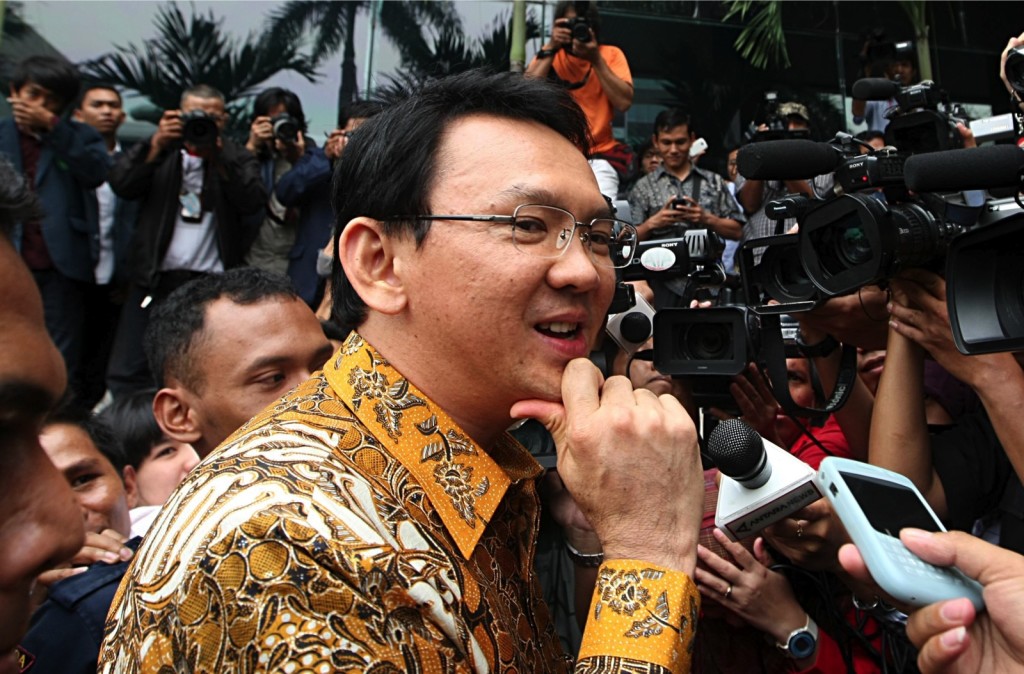
Jakarta Governor Joko Widodo may have stolen the spotlight from senior politicians eyeing the presidency in 2014, but his deputy, Basuki Tjahaja Purnama, has proven to be a more popular figure in addressing Jakarta’s chronic woes

Basuki More Popular Than Joko, Poll Finds

By SP/Yeremia Sukoyo on 9:25 am September 6, 2013.

IMAL9034_preview-1024x674

Jakarta Deputy Governor Basuki Tjahaja Purnama speaking to reporters. (JG Photo/Afriadi Hikmal)

Jakarta Governor Joko Widodo may have stolen the spotlight from senior politicians eyeing the presidency in 2014, but his deputy, Basuki Tjahaja Purnama, has proven to be a more popular figure in addressing Jakarta’s chronic woes, according to the results of a survey released on Thursday. Basuki rated favorably with 98.3 percent of the 8,280 respondents polled by the Indonesia Network Election Survey, slightly ahead of Joko, who got 96.9 percent.

Read more of this post

Japan’s shrinking shinkin: Small banks left behind by Abenomics

Japan’s shrinking shinkin: Small banks left behind by Abenomics

5:05pm EDT

By Taiga Uranaka

WAKKANAI, Japan (Reuters) – First the commercial fisheries began shutting down in this hardscrabble corner of Japan’s northern coast. Then tourism fizzled. Now, the small-town bank that serves Wakkanai, at the tip of Hokkaido, is grappling with a problem common throughout Japan’s financial system: to survive years of deflation it has had to stray far from its core mission of making loans, and the easy investment income it has come to rely on is looking shaky. “There’s no demand for productive loans,” says Masatoshi Masuda, president of the town’s Wakkanai Shinkin bank. Read more of this post