Korea’s Instructive Non-Crisis; Reforms and free trade help Seoul avoid capital flight

Updated September 5, 2013, 4:26 p.m. ET

Korea’s Instructive Non-Crisis

Reforms and free trade help Seoul avoid capital flight.

Seoul’s markets used to be highly sensitive to contagion from other markets. The country was among the hardest hit by the 1997 Asian Financial Crisis, and when Lehman Brothers went bankrupt in 2008 it was the first place fearful investors looked for signs of impending Asian doom (which fortunately never came). So it’s worth asking why Korea has been a haven for growth and stability as former star Asian performers such as India and Indonesia suffer from capital flight and currency depreciation. In July, as the broader departure of capital from Asia was gathering pace on speculation about U.S. Federal Reserve tapering, Korea saw inflows into its bond market, while flows out of equity markets slowed. Growth was 2.3% year-on-year in the second quarter, a two-year high. Manufacturing and exports are both picking up again. Read more of this post

Korean Pension Stealth Rule Clears Path to Buy 60 Stocks

Pension Stealth Rule Clears Path to Buy 60 Stocks: Korea Markets

South Korea is putting as many as 60 companies from Cheil Industries Inc. (001300) to Samsung C&T Corp. (000830) on the National Pension Service’s buying list after clearing the way for the $367 billion fund to boost holdings of local stocks. Relaxed disclosure requirements that took effect on Aug. 29 will help NPS increase stakes in some local companies above the 10 percent threshold, the nation’s biggest investor said in an e-mailed response to questions on Aug. 21. The rules lengthen the timing of public filings for transactions above that level to once a quarter from within five days. The fund said it had positions of 9 percent to 10 percent in 60 stocks as of June. Read more of this post

Seoul No Singapore as Korea Housing Bears Raise Rents; “[By renting], at least, I can avoid a nightmare of losing money from the house financed with debt.”

Seoul No Singapore as Korea Housing Bears Raise Rents

Kim Joon Hyung met more than 20 realtors and searched for months to find a place to rent in Seoul. In July, he finally signed a two-year contract on a two-bedroom apartment that requires him to make monthly payments, a rarity in South Korea where landlords and tenants have favored a century-old method of lump-sum deposits to lease homes. “I finally gave up,” said 34-year-old Kim, a marketer at a home-appliance company who’s getting married this month. “This monthly charge rent home was the only thing available.” Read more of this post

Singapore Overtakes Japan as Asia’s Biggest Foreign-Exchange Hub

Singapore Overtakes Japan as Asia’s Biggest Foreign-Exchange Hub

Singapore overtook Japan as Asia’s biggest foreign-exchange center for the first time as trading surged in the past three years, the city’s central bank said, citing a survey by the Bank for International Settlements. The city-state’s average daily foreign-exchange volume increased 44 percent to $383 billion as of April from $266 billion in the same month in 2010, the Monetary Authority of Singapore said in a statement. The average interest-rate derivatives volume climbed 6 percent to $37 billion over the same period, the highest in the region after Japan, it said. Read more of this post

In the new Myanmar, an old junta’s laws survive and adapt

In the new Myanmar, an old junta’s laws survive and adapt

6:42pm EDT

By Jared Ferrie and Aung Hla Tun

YANGON (Reuters) – It was once the feared weapon of a military junta, ruthlessly deployed to restrict Myanmar’s nascent Internet and throw journalists, students, monks and other political opponents behind bars. The junta is gone, but the Electronic Transactions Law and other draconian legislation remain on Myanmar’s books. Attempts to revamp them are stirring debate over the reformist credentials of the semi-civilian government that took power in 2011 and how far it will loosen tough state controls. Read more of this post

Legoland Malaysia, which is celebrating its first anniversary on Sept 15, has exceeded its expectations of gettting one million visitors in the past 12 months

Legoland doing better than expected

Friday, September 6, 2013 – 09:27

The Star/Asia News Network

JOHOR BARU – Legoland Malaysia, which is celebrating its first anniversary on Sept 15, has exceeded its expectations of gettting one million visitors in the past 12 months. General manager Seigfried Boerst said the theme park in Nusajaya, surpassed its target by 70 per cent some months ago. Read more of this post

Univision’s English-Language News Network, Fusion, Targets Millennials; Since Univision first went on-air in 1962, many Hispanic viewers have treated it like a shadow government, to the point of calling up the station when their homes are on fire

Univision’s English-Language News Network, Fusion, Targets Millennials

By Graeme Wood September 05, 2013

feat_univision37chart_630

Isaac Lee, the Colombia-born 42-year-old in charge of news at the Spanish-language network Univision, is a traitor: first to his native tongue, and second to his generation. As the architect of the forthcoming all-news channel Fusion, Lee is plotting the first English-language broadcast for a network whose main draw for the last half-century has been that it’s en Español. In that niche, which has long since grown into a mass market, Univision has dominated its rivals, styling itself, with just a hint of hubris, as “the Hispanic heartbeat of America.” When Fusion goes live on Oct. 28, Univision’s programming will suddenly be bilingual, with 24 hours of English to match its 24 hours of Spanish. Read more of this post

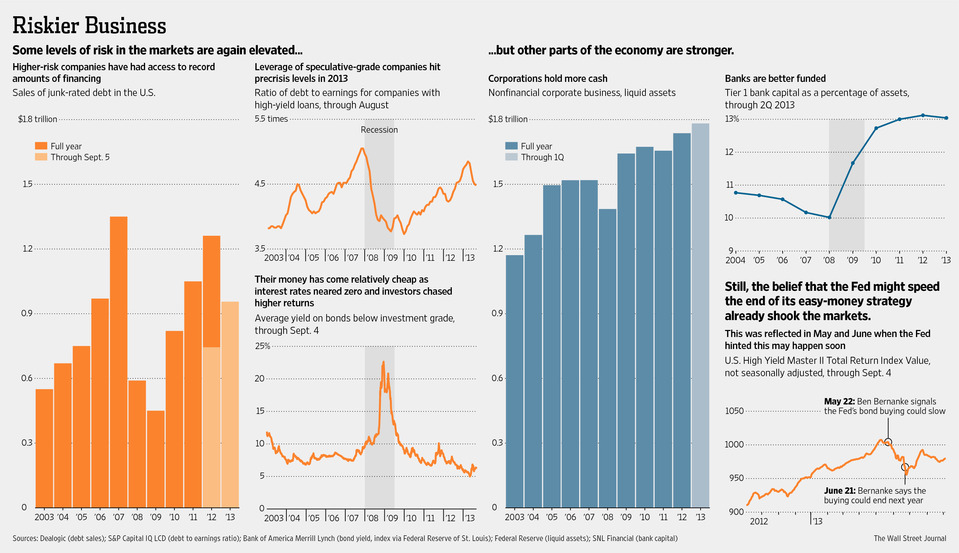
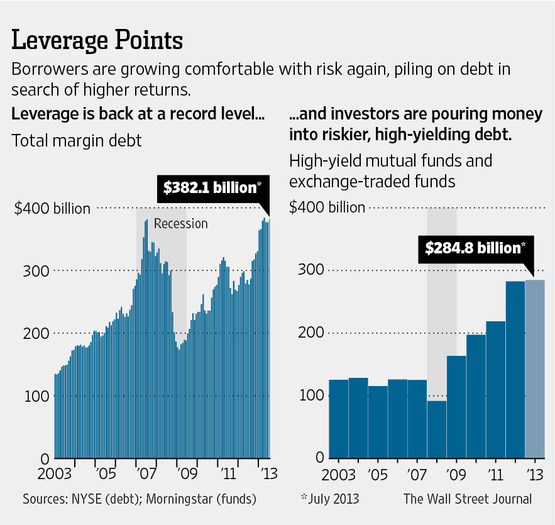
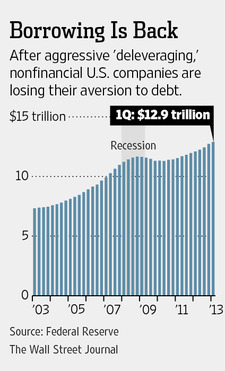
Financial Crisis Anniversary: For Corporations and Investors, Debt Makes a Comeback

Updated September 5, 2013, 9:38 p.m. ET

Financial Crisis Anniversary: For Corporations and Investors, Debt Makes a Comeback

JAMES STERNGOLD and MATT WIRZ

P1-BM982_LEVERA_NS_20130905190010 P1-BM983A_LEVER_G_20130905184209 P1-BM991_LEVERA_G_20130905183304 P1-BM985B_STAND_G_20130905202119

Oil worker Jeremy Barnett positions a pipe Wednesday at a well site near Hennessey, Okla., that belongs to Gastar Exploration, which financed the site’s purchase with junk bonds. Looking back, J. Russell Porter said his company was “almost at death’s door” when the U.S. economy hit bottom. With credit markets near frozen, he said, Gastar Exploration in 2009 couldn’t find banks or investors willing to provide the $35 million the oil-and-gas producer needed to refinance its crushing debt. Read more of this post

The Next Emerging Market Crisis

SEPTEMBER 5, 2013, 12:01 AM

The Next Emerging Market Crisis

By SIMON JOHNSON

Simon Johnson, former chief economist of the International Monetary Fund, is the Ronald A. Kurtz Professor of Entrepreneurship at the M.I.T. Sloan School of Management and co-author of “White House Burning: The Founding Fathers, Our National Debt, and Why It Matters to You.”

Do the world’s middle-income countries – known in the investment business as “emerging markets” – face a serious risk of crisis? If such a crisis unfolds in one country, could there be contagion, with panic spreading around the world? My answer is a cautious “no” on both questions. But it would be a mistake to dismiss or ignore these questions, in part because they are being asked by smart people in financial markets and in part because sometime in the not-too-distant future the answer could be a decisive “yes” – with disastrous consequences. There are three main sources of concern. Read more of this post

Shiller Warns of Housing Bubble in Brazil After 225% Surge

Shiller Warns of Housing Bubble After 225% Surge: Brazil Credit

Robert Shiller, who predicted the collapse of the U.S. housing market, is warning that a bubble is emerging in Brazil at a time when a sluggish economy and persistent inflation are eroding investor confidence. Since January 2008, home prices in Sao Paulo have soared 181 percent and jumped 225 percent in Rio de Janeiro, according to the FIPE Zap index. That’s as much as twice the increase in rent prices, signaling that the housing market has become overheated, according to Shiller, a Yale University professor who helped create the S&P/Case-Shiller Index (SPCS20) of U.S. home prices, which has dropped 13.7 percent since 2007. Read more of this post

London’s extraordinary lead in FX; London accounted for almost 41 per cent of global FX turnover vs 19% for US, 5.7% for Singapore

London’s extraordinary lead in FX

Paul Murphy

| Sep 05 14:43 | 4 comments | Share

The triennial central bank survey of foreign exchange and derivatives market activity from the BIS is out. FX details are here and OTC IR derivatives are here. Oh, and the Bank of England’s parochial summary is here. But if you are interested in how financial centres stack up against each other you’ll need to consult this table: London accounted for almost 41 per cent of global FX turnover at the survey point (April this year). That compares with 19 per cent for the US and 5.7 per cent for Singapore, the third largest financial centre as far as FX goes. London’s dominance is even more extreme when it comes to IR derivatives.

Screen-shot-2013-09-05-at-2.24.32-PM Read more of this post

Latest bond market rout unhinges U.S. short-term yields

Latest bond market rout unhinges U.S. short-term yields

8:08pm EDT

By Richard Leong

NEW YORK (Reuters) – The punishing sell off in the U.S. Treasury market has taken a surprising turn, with yields on shorter maturities getting swept higher at a startling pace. The rise defies a widely held view that they would remain anchored at historic lows by the Federal Reserve’s pledge to keep a lid on short-term rates. In what some see as investors second-guessing the Fed’s resolve, the 2-year Treasury note yield on Thursday jumped above 0.50 percent for the first time since June 2011. Read more of this post

JPMorgan to stop making student loans: company memo

JPMorgan to stop making student loans: company memo

7:05pm EDT

By David Henry

NEW YORK (Reuters) – JPMorgan Chase & Co (JPM.N:QuoteProfileResearchStock Buzz) has decided to get out of the student loan business, after the biggest U.S. bank concluded that competition from federal government programs and increased scrutiny from regulators had limited its ability to expand the business. Read more of this post