The Winners and Losers of China’s Anticorruoption Drive
September 6, 2013 Leave a comment
September 6, 2013, 12:43 a.m. ET
The Winners and Losers of China’s Anticorruoption Drive
Probes Hurt Small, Private Companies More Than State-Owned Enterprises
WEI GU
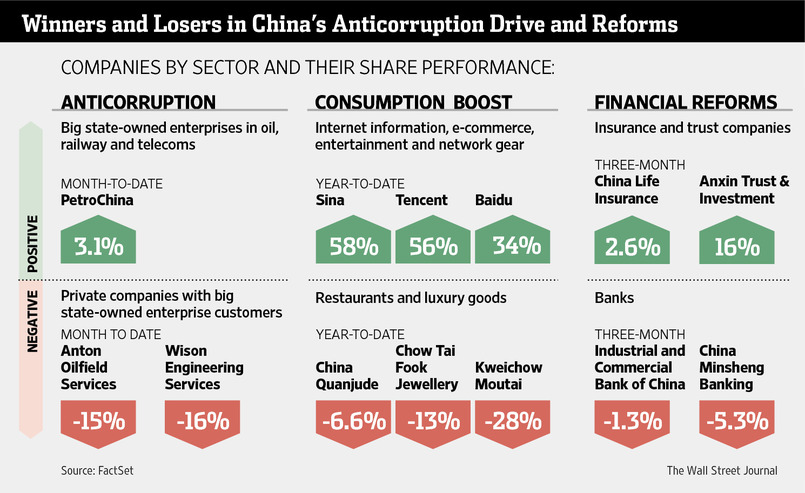
China’s anticorruption drive and the country’s economic overhaul expected this fall are likely to guide stock-market performance this year. But the winners and losers might surprise you. The investigation into high-ranking officials at China National Petroleum Corp. and its listed unit, PetroChina, 601857.SH -0.25% is likely to hurt small private companies that have tight business relationships with the state-owned enterprise more than it hurts Petrochina, some analysts say. PetroChina’s shares in Shanghai have hardly budged since news of the investigation broke last week. The same was true in past corruption probes into the banking and railway industries. The state-owned enterprises are powerful machines, and their favored position in China’s economy counts for more than whoever happens to be at the top.“The bulk of the damage from the continued anticorruption measures may fall most heavily over the private space,” said Wendy Liu, head of China equity research at Nomura Holdings Inc. Large state-owned companies “targeted in past probes actually emerged stronger as procurement process and procedures do become more transparent and disciplined.”
Meanwhile, China’s economic overhaul is expected to boost consumption and lower spending on infrastructure and heavy industry. But the way to play the shift isn’t by buying shares of food producers, car companies or shoemakers. Instead, investors should look at Internet companies that are likely to benefit from improvements in telecom infrastructure and rising demand.
Last year, according to the Ministry of Commerce, revenue for China’s dining industry grew by the slowest rate since 2003, when many restaurants suspended business during the epidemic of severe acute respiratory syndrome. The industry suffers from overcapacity, as do China’s shoe and auto industries.
The anticorruption drive, which includes restrictions on banquets involving government and state-owned enterprise officials, are another headwind for several consumer industries, especially restaurants, luxury-goods makers and wine and liquor companies. Demand for banquets and gifts has been scaled back significantly.
Internet players, though, have been seeing robust demand as consumers go online for cheap entertainment and goods. And they have government support—telecom is still an area Beijing is willing to invest in. In August, the State Council raised targets for broadband network coverage and upgrades. After China Mobile Group announced an aggressive 4G investment plan for 2013, China Telecom Group said it will also increase capital spending.
The beauty of all those telecom investments, said Oliver Barron, head of the Beijing research office for London-based investment bank North Square Blue Oak, is that they boost gross domestic product immediately and also create assets that are more likely to be used productively over time than yet more new roads and bridges would be. The likely beneficiaries are Internet-services companies that have a big mobile presence, as well as telecom-gear makers.
Financial changes will be bad for lenders but positive for insurers and brokers. The expected liberalization of bank-deposit rates will likely squeeze profits by forcing banks to offer better deals. Banks are also losing depositors to trust companies and insurers, which with more freedom to choose investments will be able to offer higher rates.
China’s 67 trust companies have already done well. Their assets in the second quarter were up 70% from a year earlier, to $1.5 trillion. As Chinese savers think more long term than short-term bank deposits, which are earning roughly 3% a year, and wealth-management products, small and midsize insurers are likely to gain.
“We should be able to offer 6% annual return for clients next year after being allowed to broaden our investment channels this year,” said Larry Wan, deputy general manager at Zhongrong Life Insurance Co. Ltd. “This will further attract funds from banks.”
 About bambooinnovator
 Bamboo Innovator