For Michael Dell, Saving His Deal Is Just First Step; His Legacy Hinges on Recasting Company as a “Solutions” Provider
September 13, 2013 Leave a comment
September 11, 2013, 8:13 p.m. ET
For Michael Dell, Saving His Deal Is Just First Step
His Legacy Hinges on Recasting Company as a “Solutions” Provider
Michael Dell DELL +0.04% is set to win a bruising, yearlong battle for control of his company. His next task—getting Dell Inc. growing again—may be even tougher. Mr. Dell’s proposal to buy the computer company for nearly $25 billion is expected to win approval in a stockholder vote that ends Thursday, according to people familiar with the matter. Dell has said it expects to be a private company by the end of October.So Dell, for the first time since it went public 25 years ago, will largely become a one-man show, just as it was when Mr. Dell started the company in his college dorm room in 1984. He is set to own about 75% of the company and remain CEO, while private-equity firm Silver Lake will be a minority owner.
Now, Dell’s success and Mr. Dell’s legacy hinge on whether he can recast the company into what the tech industry terms a “solutions” provider, serving as a trusted technical adviser to businesses and providing them with services and software—not simply shipping them low-price PCs and servers.
Three specific areas are due for more attention, people familiar with Dell’s strategy say.
One is security software, which corporations use to prevent unauthorized use of their computing networks or thefts of data. Another is tools to help companies take an analytical approach to business decisions, a software niche known by the term Big Data. The third area is a plan to offer “IT in a box,” or all-in-one bundles of hardware and software that companies can cheaply and easily deploy.
Dell executives previously have singled out roughly $3.3 billion in potential cost cuts, but didn’t specify in what areas.
A spokesman for the company declined to comment. Mr. Dell has declined interview requests while the buyout is pending. But he has continued to make the case that taking the company private is the best path.
“We need to transform, and we need to do it quickly,” he wrote in a July letter to Dell stockholders.
The company continues to churn out new hardware designs. At an Intel Corp. event on Wednesday, for example, a Dell executive gave a sneak preview of a new line of tablets it plans to formally unveil on Oct. 2.
Yet some former executives and people who work with the company are skeptical. They question the value of Dell’s technology assets, its ability to keep pace with the problems facing its business customers and Mr. Dell’s own grasp of the company’s challenges.
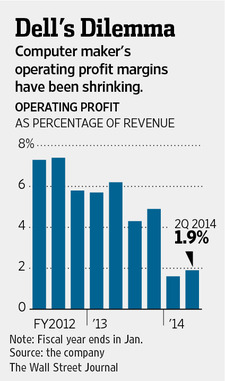
The planned makeover comes as the PC market is contracting as spending shifts to tablets and smartphones. Moreover, new Asian competitors are winning sales among big website operators like Google Inc. and Amazon.com Inc. The company has managed to hang on to its market share in PCs and servers recently, but largely through price-cutting strategies that have hurt its profit margins.
At the same time, Dell’s plan to become a broader provider to corporations faces tough competition from International Business Machines Corp., IBM -0.07% Cisco Systems Inc. CSCO -0.24% andHewlett-Packard Co., HPQ -2.00% while upstarts are attacking individual technology niches Dell is targeting.
“Dell is stuck,” said Matt McIlwain, a managing director with venture-capital firm Madrona Venture Group, which invests in emerging business-tech companies. “They don’t have the ear or the wallet of enterprises like H-P or IBM do, nor are they innovative enough to keep pace with emerging tech leaders like Amazon Web Services.”
Dell has spent more than $13 billion on acquisitions, but the company says those new businesses have fallen short of its financial expectations.
While the company’s historic strength is in sales of computing gear to small-and-medium-sized businesses, Dell’s own internal financial metrics show sales to those businesses has slipped for the last four years, according to board presentations made public in recent months.
PCs have provided a gateway for Dell to sell business customers additional products and software. But its PC revenue slipped about 7% in the six months ended Aug. 2.
Taking the company private won’t address the strategic problems, Mr. Dell’s critics say. They believe he is mainly reacting to what he sees as years of unfair criticism and Wall Street’s failures to appreciate Dell’s strengths, according to people who talk to Mr. Dell regularly.
Amid intense scrutiny in recent months, Mr. Dell has stepped up private communications with a network of analysts and other confidantes, sometimes surprising callers with weekend conversations that last up to two hours, according to people familiar with the conversations. In the calls, Mr. Dell has aired his views on deal tactics, or his thoughts on Dell’s PC product lines for consumers, these people said.
Mr. Dell also has stepped up his chest-thumping about the company’s prospects. Just before rival Hewlett-Packard reported quarterly earnings in August, Mr. Dell emailed analysts and others nine data points showing Dell eating into H-P’s sales of computer servers, according to correspondence reviewed by The Wall Street Journal. Hours later, he sent another message with more bullet points about Dell’s market position versus H-P’s.
Dell was the only well-known server provider to gain market share in the second quarter. Dell had about 19% of the server-industry revenue, up from 16% a year earlier, according to research firm IDC. But that was largely due to price-cutting needed to court high-volume server buyers, Dell’s operating profit in the division that includes those machines, networking and data-storage gear fell more than 9% in the most recent quarter.
 About bambooinnovator
 Bamboo Innovator