Japan’s Companies Shun China for Southeast Asia; Trend Means Beijing May Miss Out on Fresh Wave of Overseas Japanese Expansion
September 13, 2013 Leave a comment
September 12, 2013, 2:43 p.m. ET
Japan’s Companies Shun China for Southeast Asia
Trend Means Beijing May Miss Out on Fresh Wave of Overseas Japanese Expansion
YUKA HAYASHI And MAYUMI NEGISHI
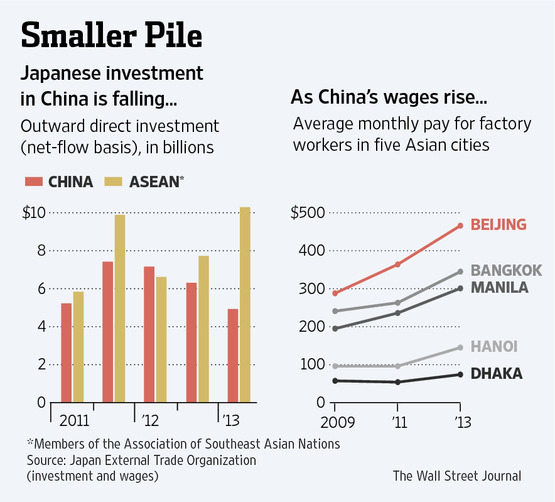
TOKYO—Japanese investment in China is falling amid political tensions between the nations, a trend that means Beijing could be missing out on a fresh wave of overseas expansion by Japanese companies. Japanese businesses are turning their attention instead to Southeast Asia, signing a number of deals in recent months to purchase insurance firms, banks and factories. In part, the shift reflects rising wage costs in China. Some Japanese firms say they also are concerned about anti-Japanese sentiment. They point to mob violence a year ago against Japanese businesses in China, as tensions rose over a group of uninhabited islands in the East China Sea.Showa, a Japan-based precision-parts maker that supplies Toyota Motor Corp.7203.TO -0.80% and Nintendo Co.,7974.TO -1.01% said those attacks swayed it to opt for a site outside Thailand’s capital, Bangkok, over China for its first overseas factory.
“To the last, I wondered if China wasn’t the better choice. China is the larger market by far, and our customers had many more factories there than in Thailand,” said Kazumasa Hirano, Showa’s president. In the end, he decided, “you might as well go to a place where people like you, not hate you.”
Japanese investment in Southeast Asia jumped 55% in the first six months of 2013 from the year before, to $10.29 billion, while outlays in China tumbled 31% to $4.93 billion, according to statistics from the Japan External Trade Organization, a government agency.
The decline could mean that China is missing an opportunity at a time when Japanese businesses—flush with cash and facing tepid demand at home—continue to push abroad.
Japan’s net foreign direct investment totaled $122 billion in 2012, up 12% from the previous year and 67% higher than in 2007. A recent survey by the state-owned Japan Bank for International Cooperation found that 84% of company respondents planned to strengthen overseas operations within the next three years, compared with 65.8% in 2009.
The trend is occurring alongside geopolitical shifts in the region caused by China’s increased economic and military might. The U.S. recently based Marines in Australia as part of its “rebalancing” toward Asia and has also backed talks toward a trade pact in the Asian-Pacific region that Japan recently joined but that doesn’t include China—though China has signaled some desire to join the talks.
Japanese Prime Minister Shinzo Abe is enthusiastic about the renewed focus on ties with the Association of Southeast Asian Nations, or Asean.
“Asean and Japan are twin engines,” Mr. Abe said in a speech in Singapore in July, one of his seven trips to the region since taking office in December. “Asean will play an enormously important role for the Japanese economy.” During the same period, the territorial tensions have kept Mr. Abe from holding any meetings with Chinese leaders.
Japanese firms have looked to Southeast Asia as a site for manufacturing since the 1960s. They turned in the 1990s to China, which began attracting a larger share of the investment pie. But last year, Japanese investment into China began to decline.
Other factors are at play. Japanese service providers are increasingly attracted by Southeast Asia’s 600 million population and growing middle class. Mitsubishi UFJ Financial Group 8306.TO -0.16% in July said it would pay $5.6 billion for a 75% stake in Thailand’s Bank of Ayudhya BAY.TH +0.66% . In May, Sumitomo Mitsui Financial Group 8316.TO 0.00% signed a $1.5 billion deal to acquire a 40% stake in Indonesian lender PT Bank Tabungan Pensiunan Nasional BTPN.JK -2.48% .
To be sure, China remains Japan’s largest trading partner and Japan is still the second-largest source of foreign direct investment into China, after Hong Kong. Japan also is negotiating a free-trade arrangement with China and South Korea. Some Japanese officials contend the shift is about Japanese companies spreading risk, not fleeing China.
“Many companies already have factories in China,” said Akira Kajita, director of international economic research at the Japan External Trade Organization. “Those who need a second and a third factory are now saying they’d rather go to places like Vietnam to diversify their risks.”
But some companies have moved almost all production out of China.
Tokyoin Co., a Japanese producer of cotton kimonos, six years ago depended on China for 100% of output.
Rising costs pushed the Tokyo-based company to open a facility in Indonesia in 2009. Last year, it expanded into Vietnam. Today, China accounts for only 10% of its output. Plans for a new investment in Myanmar would lower that portion further still.
Japanese auto makers, whose production in China was severely disrupted during last year’s riots, also are increasing investments in Southeast Asia.
Last month, Honda Motor Co. 7267.TO -0.65% started building a new $550 million factory in Thailand that is set to boost its output capacity by 50%. Toyota announced in July it would spend $230 million to build a new engine plant in Indonesia.
Toyota’s output in China, meanwhile, shrank 10.4% from a year earlier in the first six months of this year, while Honda’s fell 3.7%. Recovery in Chinese demand for Japanese cars is still bumpy, nearly a year after diplomatic tensions flared up in the form of nationwide anti-Japanese demonstrations, and China’s economic slowdown has further weighed on sales. Lower demand, coupled with fierce competition for good workers, makes further capacity expansion in China less attractive.
Japan’s government is encouraging the trend toward Southeast Asia. Tokyo is using billions of dollars of development aid to fund projects involving Japanese firms, including industrial parks in Vietnam and Myanmar, a railway in Cambodia and an airport in Laos.
Japan’s government also is helping Japanese firms find local partners in countries such as Myanmar, Vietnam and Indonesia.
In the Philippines, Japanese investments have diversified recently to sectors such as medical devices and prefabricated housing.
“The investments used to be concentrated on electronic products, but now it’s become much more diverse,” Gregory Domingo, the nation’s trade minister, said in an interview.
 About bambooinnovator
 Bamboo Innovator