Pot and Kettle: China Mobile Exec Bemoans WeChat ‘Monopoly’

September 12, 2013, 7:10 PM

Pot and Kettle: China Mobile Exec Bemoans WeChat ‘Monopoly’

If you’re going to defend yourself against being a monopoly, it’s good to be able to name a few competitors. Unfortunately for China Mobile Communications Corp. Vice President Li Zhengmao, his memory failed him just as he was contending that there is in fact a fair bit of competition to the Chinese telecom carrier space from Internet companies offering telecom-like services. “Many people claim there’s a monopoly,” Mr. Li said Thursday in response to a comment by Peking University economist Zhang Weiying at a panel during the World Economic Forum in Dalian. During a discussion aboutTencent Holdings Ltd.TCEHY +1.26%’s wildly successful WeChat mobile-messaging application, Mr. Zhang said the monopoly of China’s telecom sector needs to be broken up to spur more innovation. Read more of this post
Multinationals Feel the Pressure in China; The extent to which Chinese authorities have recently focused on commercial corruption is unprecedented.

September 12, 2013, 1:34 p.m. ET

Multinationals Feel the Pressure in China

The extent to which Chinese authorities have recently focused on commercial corruption is unprecedented.

ANGELA MANCINI AND BLISS KHAW

China is in the middle of a major anticorruption drive and foreign companies risk finding themselves in the crosshairs soon—if they’re not there already. The clock is ticking for executives to make sure their firms won’t fall afoul of the crackdown. Although Beijing has talked tough on corruption in the past, this time all indications are that serious action will result. The rhetoric from the top, led by Chinese President Xi Jinping, is backed by an ongoing campaign against commercial corruption by the State Administration of Industry and Commerce (SAIC), an investigation of corporate criminal behavior by the Public Security Bureau (PSB), as well as a crackdown on inflated pricing and market dominance by the National Development and Reform Commission (NDRC). On Aug. 28, the Politburo launched a broad five-year anticorruption plan to extend from 2013-17. Read more of this post

Mr Clean catches China’s graft tigers by the tail; “I would say that Wang Qishan is the second most powerful person next only to Xi Jinping”

Mr Clean catches China’s graft tigers by the tail

Thu, Sep 12 2013

By John Ruwitch

SHANGHAI (Reuters) – Behind China’s aggressive drive to root out corruption is Wang Qishan, a historian-turned-economist who once felt so bad about getting free parking that he reportedly sent a colleague back to pay the fee. President Xi Jinping launched the anti-corruption campaign after becoming Communist Party chief in November. So far the party has announced the investigation or arrest of eight senior officials, including three from the 376-member elite Central Committee. Among them, former executives from oil giant PetroChina are being investigated in what appears to be the biggest graft probe into a state-run firm in years. Wang, 65, heads the Central Commission for Discipline Inspection and ranks sixth in the party hierarchy. His power far exceeds this, said Cheng Li, a fellow at the Brookings Institution in Washington and an expert on Chinese politics. Read more of this post

How China’s Homegrown Biz Is Threatening Hollywood’s Payday

How China’s Homegrown Biz Is Threatening Hollywood’s Payday

SEPTEMBER 12, 2013 | 04:20AM PT

Country’s evolving movie biz shows an increasing sophistication and diversity that challenges U.S. studios to rethink their approach

Patrick Frater

Asia Bureau Chief

In the past few years, Westerners have exulted in the country’s box office boom, which included hefty grosses for major-studio films such as “Iron Man 3,” “Pacific Rim” and “The Croods.” With the liberalization of access to the market and a greater share of distribution money, Hollywood began to seeChina as the land of opportunity after decades of feeling thwarted by tight quotas for imported movies. Read more of this post

‘Tiger hunts’ revisit a bloody era in China’s history

September 12, 2013 2:35 pm

‘Tiger hunts’ revisit a bloody era in China’s history

By Frank Dikotter

As in the 1950s, malicious ideas such as democracy must be erased, writes Frank Dikotter

On a wintry day in February 1952, two victims, their hands tied behind their backs, were marched off to the execution grounds of Baoding, the provincial capital of Hebei, just south of Beijing. They were shot in the heart rather than in the head. Hundreds of thousands of enemies of the regime had faced the firing squad since the red flag was hoist above Tiananmen Square in October 1949 but this case was different. Both victims were central actors in the local party hierarchy. It was the defining moment of a campaign against corruption Mao Zedong had unleashed against the party itself. There were mere “flies” who needed to be swatted, the chairman explained, and there were “tigers”. Everywhere tiger-hunting teams tried to outdo each other, encouraged from above by Mao. Read more of this post

DBS to Maybank Return Least on Expansion Spree: Southeast Asia; “If you can’t make money at home, why do you think you can make money in another market where you don’t have the brand name, you don’t have the local knowledge”

DBS to Maybank Return Least on Expansion Spree: Southeast Asia

Southeast Asia’s biggest lenders including DBS Group Holdings Ltd. (DBS) have performed the worst among the region’s bank stocks in the past five years on concern overseas expansion plans will fail to boost earnings. Singapore’s DBS and Malaysia’s Malayan Banking Bhd. (MAY), which get at least 30 percent of revenue outside their home markets, have given annualized returns including dividends of no more than 15 percent in the five years to Sept. 6, data on 15 banks compiled by Bloomberg show. Krung Thai Bank Pcl (KTB), which gets all its revenue in Thailand, returned the most with 28 percent. Read more of this post

S. Korea’s top 6 family-owned conglomerates enjoy high-flying growth amid fall of ‘legendary salary men’

S. Korea’s top 6 family-owned conglomerates enjoy high-flying growth amid fall of ‘legendary salary men’

2013.09.12 17:04:07

South Korea’s six largest family-owned conglomerates have witnessed accelerating growth even amid the fall of Woongjin Group chairman Yoon Seok-geum and STX’s former Chairman Kang Deok-soo, once dubbed as ‘legendary salarymen.’ Of the total assets held by 51 largest conglomerates with assets of five trillion won ($4.6 billion) or more, which are subject to limitations on total equity investment, Samsung Group, Hyundai Group, LG Group, SK Group, Lotte Group and Hyosung Group took up 67.7 percent late last year, up 8.2 percentage points in five years from 59.5 percent in late 2007. The nation’s 18 companies belonging to the six family-owned business groups doubled (100.8 percent) from 525 trillion won in 2007 to one quadrillion late last year. Over the corresponding period, the combined assets owned by the six large conglomerates grew merely 76.4 percent from 883 trillion won to 1.5 quadrillion. The combined assets of the remaining conglomerates went up 40.7 percent, accounting for less than half of the combined assets of the six conglomerates. 
The nation’s gross domestic production (GDP) grew 30.5 percent during the cited period. Net asset of the six largest family-run companies climbed sharper than their assets. 
Their net profit added 63.3 percent from 37 trillion won to 60 trillion won, the share also expanded a startling 25.4 percentage points from 65.6 percent to 91 percent. The six largest groups generated 60 trillion won profit, dwarfing other group’s six trillion won. 

Tong Yang asks for financial help from Orion

Tong Yang asks for financial help from Orion

Lee Jin-myung, Hong Jong-sung

2013.09.13 17:20:20

Hyun Jae-hyun, Chairman of Tong Yang Group, has asked for financial help from Dam Chul-gon, Chairman of Orion, in efforts to overcome a cash crunch. Tong Yang Group is the former parent company of Orion, South Korea’s major confectionery maker. According to Tong Yang Group on Thursday, the two businessmen, brother-in-laws to each other, met recently to discuss Tong Yang Group’s liquidity crisis. Hyun asked Dam to provide collateral to help the troubled Tong Yang to issue asset-backed securities worth up to 1 trillion won ($919.87 million). Tong Yang wants the money to repay debts that will mature late this year. But sources said Dam did not make his answer immediately. Tong Yang Group plans to issue ABSs based on assets of the group’s key subsidiaries – Tong Yang Cement and Tong Yang Power and Tong Yang Securities – and to liquidate them with Orion’s backing. This plan was recently discussed with the nation’s financial regulators.

South Korea grapples with fiscal deficit

Updated: Friday September 13, 2013 MYT 12:30:21 PM

South Korea grapples with fiscal deficit

SEOUL: South Korea says it faces a 2013 revenue shortfall of up to 8 trillion won (US$7.37bil), a challenge for President Park Geun-hye’s administration as it prepares to submit its first full-year budget to parliament next month. The previous South Korean government was unable to have a balanced budget in its last years, and a wider-than-expected deficit this year may signal that Park, who became president early this year, could struggle to achieve a goal of balancing the budget by the end of her five-year term. Read more of this post

Japan’s Companies Shun China for Southeast Asia; Trend Means Beijing May Miss Out on Fresh Wave of Overseas Japanese Expansion

September 12, 2013, 2:43 p.m. ET

Japan’s Companies Shun China for Southeast Asia

Trend Means Beijing May Miss Out on Fresh Wave of Overseas Japanese Expansion

YUKA HAYASHI And MAYUMI NEGISHI

MK-CG238_JASIA_G_20130912181204

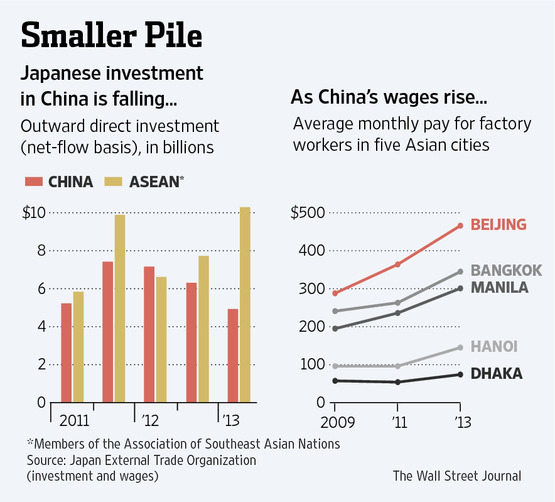
TOKYO—Japanese investment in China is falling amid political tensions between the nations, a trend that means Beijing could be missing out on a fresh wave of overseas expansion by Japanese companies. Japanese businesses are turning their attention instead to Southeast Asia, signing a number of deals in recent months to purchase insurance firms, banks and factories. In part, the shift reflects rising wage costs in China. Some Japanese firms say they also are concerned about anti-Japanese sentiment. They point to mob violence a year ago against Japanese businesses in China, as tensions rose over a group of uninhabited islands in the East China Sea. Read more of this post

Nuclear freeze chills Japan’s cash-strapped utilities

September 13, 2013 11:29 am

Nuclear freeze chills Japan’s cash-strapped utilities

By Ben McLannahan in Tokyo

Japan’s cash-strapped utilities are facing increased pressure to bring down the cost of replacement fossil fuels as the country shuts its last operating nuclear reactor. Kansai Electric’s 1,180-megawatt No 4 reactor at the Ohi plant in Osaka will be idled from Sunday for safety inspections. Before the Fukushima crisis of March 2011, nuclear power accounted for about 30 per cent of Japan’s electricity generation. Read more of this post

Japan Braces for Rise in Capital-Gains Tax; Investors Worry Over Impact on Stock Market; a Special Deal for Retail Investors

September 12, 2013, 1:07 p.m. ET

Japan Braces for Rise in Capital-Gains Tax

Investors Worry Over Impact on Stock Market; a Special Deal for Retail Investors

KANA INAGAKI

TOKYO—As it works its way back toward a five-and-a-half year high reached in May, Japan’s stock market faces a new headwind as the government moves forward with a planned doubling of tax rates on capital gains and dividends. Government officials and brokerages are betting that a new program will offset any negative impact from the higher rates, as well as aiding the economy by encouraging more people to invest in shares. The initiative—heavily marketed with images of cuddly dogs and the endorsement of baseball star Ichiro Suzuki—allows smaller retail investors to buy stocks tax-free, albeit with a number of strings attached. Read more of this post

Fukushima “not under control”, says TEPCO official

Fukushima “not under control”, says TEPCO official

POSTED: 13 Sep 2013 7:27 PM
The Japanese government and TEPCO were scrambling to reassure people on Friday that they have a lid on Fukushima after a senior utility executive said the nuclear plant was “not under control”. TOKYO: The Japanese government and TEPCO were scrambling to reassure people on Friday that they have a lid on Fukushima after a senior utility executive said the nuclear plant was “not under control”. Read more of this post

Abenomics hits Yakult, the lunchtime tipple of 3 million Japanese schoolchildren and salarymen

September 12, 2013 12:58 pm

Abenomics hits lunchtime tipple of schoolchildren and salarymen

By Jennifer Thompson in Tokyo

Inflation may be the holy grail of “Abenomics” but it has made an unwelcome appearance in lunch boxes and delivery trolleys across Japan: the popular Yakult milk drink is raising prices for the first time in more than two decades. Yakult, whose probiotic drink is doled out to schoolchildren and drunk by salarymen at their desks, follows McDonald’s burgers, soy sauce and mayonnaise among other foodstuffs and beverages that have upped their sticker prices.

Read more of this post

Jakarta will be underwater by 2030: National Council on Climate Change

Jakarta will be underwater by 2030: National Council on Climate Change

Friday, September 13, 2013 – 09:10

The Jakarta Post/Asia News Network

The National Council on Climate Change (DNPI) predicts that half of Jakarta will be under water by 2030 due to global warming. DNPI executive chairman Rachmat Witoelar said on Thursday that global warming could cause sea levels to increase significantly. “If we allow this situation to continue, then by around 2030, half of Jakarta, specifically areas such as Ancol, will be under water,” he said in Jakarta on Thursday, as quoted by Antara news agency. Read more of this post

Indonesia’s borrowing costs are surging toward those of Vietnam, rated five levels lower by Moody’s Investors Service, as a plunging rupiah spurs inflation

Indonesia Yield Nears Vietnam’s on Inflation Risk

By Bloomberg on 2:59 pm September 13, 2013.
Indonesia’s borrowing costs are surging toward those of Vietnam, rated five levels lower by Moody’s Investors Service, as a plunging rupiah spurs inflation. The extra yield investors demand to hold Vietnam’s 10-year local-currency government bonds over Indonesia’s narrowed five percentage points from this year’s high on Jan. 7 to a record low 12 basis points this week. The yield on the Indonesian notes has risen 3.3 percentage points to 8.49 percent in 2013 and Standard Chartered says it will reach 9.25 percent by Sept. 30. The rate on the Vietnamese paper dropped 110 to 9.1 percent. Read more of this post

Weak Rupee, Economic Slowdown Hit India’s Ship Recyclers who pay in U.S. dollars for the ships they buy to break down. They often take bank credit, to be repaid in three to nine months. Most in this low-margin business don’t hedge

September 13, 2013, 4:45 a.m. ET

Weak Rupee, Economic Slowdown Hit India’s Ship Recyclers

Local Currency’s Steep Fall Drives Up Cost, Weak Economy Hurts Demand

BIMAN MUKHERJI

NEW DELHI—The world’s largest ship-breaking yard at Alang on India’s western shore is hit by a double whammy. The rupee currency’s deep dive has driven up their cost, while a slowdown in the local economy has sapped demand for scrap steel. “About 90% of the industry is in trouble because of the rupee’s slide,” said Nitin Kanakia, joint secretary of the Ship Recycling Industries Association of India. Read more of this post

Asia’s Second Biggest Slum Hurts Mumbai Airport Expansion

Asia’s Second Biggest Slum Hurts Mumbai Airport Expansion

India’s airlines are desperate to get space in Mumbai as travel demand surges. Standing between the carriers and their growth plans are a million people living in slums around the airport. Years of efforts to clear the tin-roofed shanties that surround the aerodrome in India’s financial capital hit a road block when a company tasked with the job had its project terminated, prompting a court battle. A more than decade-old plan to build a second airport in the city that’s home to billionaires such as Mukesh Ambani, has also gone nowhere. India ranked below Ethiopia and Namibia in the World Economic Forum’s 2012 score for quality of air transport infrastructure. Read more of this post

Craving for a chocolate fix? Prepare to pay more; cocoa butter prices nearly double to more than $7,000 a tonne from $4,000 a tonne six months ago

Craving for a chocolate fix? Prepare to pay more

9:46am BST

* Butter ratios at highest since 2008 in Asia, Europe, U.S.

* Global confectionary sales set to rise nearly 2 pct in 2013

* Chocolatiers scramble to stock up on butter

By Lewa Pardomuan and Marcy Nicholson

SINGAPORE/NEW YORK, Sept 13 (Reuters) – Chocoholics may have to dig deeper to pay for their favorite treat this festive season as sweet makers face sky-high prices for cocoa butter, the special ingredient that gives chocolate its melt-in-the-mouth texture. Increased demand from Asia’s expanding middle class and a turnaround in sales in big consuming countries have seen butter prices nearly double to more than $7,000 a tonne from $4,000 a tonne six months ago. Read more of this post

Thrifty spending habits seen dying hard even as economy lifts

Thrifty spending habits seen dying hard even as economy lifts

Thu, Sep 12 2013

* Price more important to Millennials – Wal-Mart’s Simon

* Consumers won’t loosen belts quickly – Sainsbury CFO

* Private label seen at 50 pct of food sales by 2025

* More products offered at 1 pound, 1 euro

* “Lipstick effect” helps demand for luxury, treats

* Value and premium products set to steal more share

By Emma Thomasson and Dhanya Skariachan

LONDON/NEW YORK, Sept 12 (Reuters) – Consumers are sticking to frugal shopping habits developed in the recession even as developed economies show signs of recovery, suggesting some behaviour changes could be permanent, industry executives say. With household budgets under pressure since the financial crisis of 2008, consumers have flocked to discount stores, shifted from branded goods to private-label alternatives and shopped more often at convenience stores or online rather than spending on expensive fuel to drive to out-of-town hypermarkets. Read more of this post

America Drinks So Much Soda, They Literally Had To Expand This Chart To Fit It In

America Drinks So Much Soda, They Literally Had To Expand This Chart To Fit It In

MATTHEW BOESLER SEP. 12, 2013, 4:17 PM 9,560 16

This chart – taken from a new study by Credit Suisse titled “Sugar consumption at a crossroads” – shows a general correlation between GDP per capita and soda consumption per capita. In other words, as countries get richer, they tend to increase their soda consumption. The U.S. is clearly the most extreme outlier. Soda consumption per capita in America is way more than the relationship to GDP per capita would suggest. Note that the U.S. is such an outlier that Credit Suisse literally had to expand this chart to include it. Without the U.S., the range of the y-axis wouldn’t even have to go up to 160.

screen shot 2013-09-12 at 4.09.32 pm-1

Manila Water tumbled by a record in Philippine trading after the nation’s regulator rejected its petition for a rate increase and ordered the company to cut tariffs

Manila Water Plunges by Record on Rate-Cut Order: Manila Mover

Manila Water Co. (MWC) tumbled by a record in Philippine trading after the nation’s regulator rejected its petition for a rate increase and ordered the company to cut tariffs.

The shares sank 16 percent to 26.1 pesos at 10:57 a.m. local time, heading for the sharpest loss since the stock began trading in March 2005. The stock was the biggest drag on the benchmark Philippine Stock Exchange Index, which dropped 1 percent. Read more of this post

Zoellick: How Emerging Markets Can Get Their Mojo Back; Only productivity-boosting reforms, not short-term stimulus, will ensure sustained economic growth

September 12, 2013, 7:15 p.m. ET

How Emerging Markets Can Get Their Mojo Back

Only productivity-boosting reforms, not short-term stimulus, will ensure sustained economic growth.

ROBERT B. ZOELLICK

Over the past five years, developing economies have been responsible for over two-thirds of global economic growth. Over the past decade, the share of developed-country exports bought by their developing partners has increased to almost 50% from 25%. In recent years China alone has consumed about half the world’s cement, iron ore, steel, coal and lead, lifting commodity prices. Read more of this post

Financial fraud is rampant but most people can’t spot it; Report finds people find outsized return pitches “appealing”

Financial fraud is rampant but most people can’t spot it: Survey

Report finds people find outsized return pitches “appealing”

By Michael Shagrin

Sep 12, 2013 @ 3:08 pm (Updated 4:10 pm) EST

Most people in the United States have been targeted by financial fraudsters, while nearly half are unable to spot classic red flags of fraud. For example, more than 40% of people surveyed for the Financial Fraud and Fraud Susceptibility in the United States report, which was released today, found an annual return of 110% for an investment to be appealing, while 43% felt that way about “fully guaranteed” investments. “These outsized returns are highly improbable, as are any sort of guaranteed returns,” said Gerri Walsh, president of the Finra Investor Education Foundation, which issued the report. Read more of this post

Fed Message Muddled as Misunderstood Taper Meets Slowing Growth

Fed Message Muddled as Misunderstood Taper Meets Slowing Growth

Federal Reserve Chairman Ben S. Bernanke and his colleagues meeting next week are poised to take two steps that appear inconsistent. They will probably lower their estimates for growth for this year and next for the third consecutive time. Simultaneously, they are forecast to start scaling back the $85 billion in monthly bond purchases they have been relying on to stoke the recovery. What’s more, annual inflation has been running at least a half percentage point below the Fed’s goal since December. And while the unemployment rate, at 7.3 percent in August, is falling, that’s mainly because some Americans are leaving the labor force. Read more of this post

At Wells Fargo, a Bear Among Bulls; Contrarian Analyst Sees S&P 500 Falling to Finish Year

September 12, 2013, 8:01 p.m. ET

At Wells Fargo, a Bear Among Bulls

Contrarian Analyst Sees S&P 500 Falling to Finish Year

ALEXANDRA SCAGGS

Gina Martin Adams is out on a limb. The strategist at Wells Fargo WFC -0.56%Securities is the only stock-market guru at a major Wall Street firm calling for U.S. shares to slump. She is sticking with a call made earlier this year that the S&P 500-stock index will end 2013 at 1440. That would mean a 14% decline over the next 31/2 months, all but wiping out this year’s gains. Ms. Adams reasons that once the Federal Reserve begins to pull back on its stimulus efforts, the stock market will lose a crucial source of support amid soft earnings growth. In contrast, most other analysts predict that for the year, the S&P 500 will keep or exceed the 18% gain it has posted in 2013 to date. Read more of this post

Brazil Index to Drop Penny Stocks; Plan to Remove Shares Trading for Less Than One Real Could Mean OGX Is Ejected From Ibovespa

Updated September 12, 2013, 4:56 p.m. ET

Brazil Index to Drop Penny Stocks

Plan to Remove Shares Trading for Less Than One Real Could Mean OGX Is Ejected From Ibovespa

ROGERIO JELMAYER

MI-BY450_IBOVES_NS_20130912180303

SÃO PAULO—Brazil’s stock-exchange operator said it planned to remove penny stocks from the Ibovespa index as part of a change in methodology, a move that could result in the exclusion of shares in troubled oil firm OGX Petróleo e Gás ParticipaçõesSA OGXP3.BR +2.63% from the country’s benchmark index. The rapid slide in shares of companies controlled by Brazilian businessman Eike Batista was a factor, but not the only reason behind the decision by South America’s largest stock-exchange operator to remove penny stocks from the index,BM&FBovespa SA’s BVMF3.BR -2.14% chief executive said Thursday. Read more of this post

Banks Allying With Hedge Funds as Capital Rules Bite

Banks Allying With Hedge Funds as Capital Rules Bite

Breezing into a sunlit conference room near London’s Hyde Park Corner wearing an open-collared white shirt that frames his square jaw, Loic Fery exudes the confidence of a soccer club owner who’s enjoyed success on the pitch and with the team’s account ledgers. FC Lorient, the French soccer club Fery and his family rescued from the brink of bankruptcy in 2009, has under his ownership had some of the best seasons in its 87-year history; for the past four years, it has been the only profitable team in Ligue 1, France’s top league. Read more of this post

A Toxic Subprime Mortgage Bond’s Legacy Lives On; The story of CWABS 2006-7—its borrowers, its investors and others touched by it—is the financial crisis seen from inside

Updated September 12, 2013, 9:07 p.m. ET

CRISIS PLUS FIVE

A Toxic Subprime Mortgage Bond’s Legacy Lives On

The story of CWABS 2006-7—its borrowers, its investors and others touched by it—is the financial crisis seen from inside

MICHAEL CORKERY and AL YOON

P1-BN103_DEALTR_NS_20130912182106 P1-BN106_DEALTR_G_20130912182706

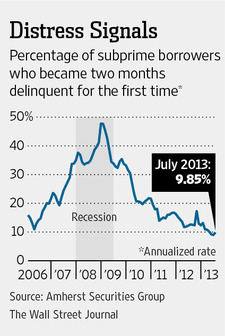
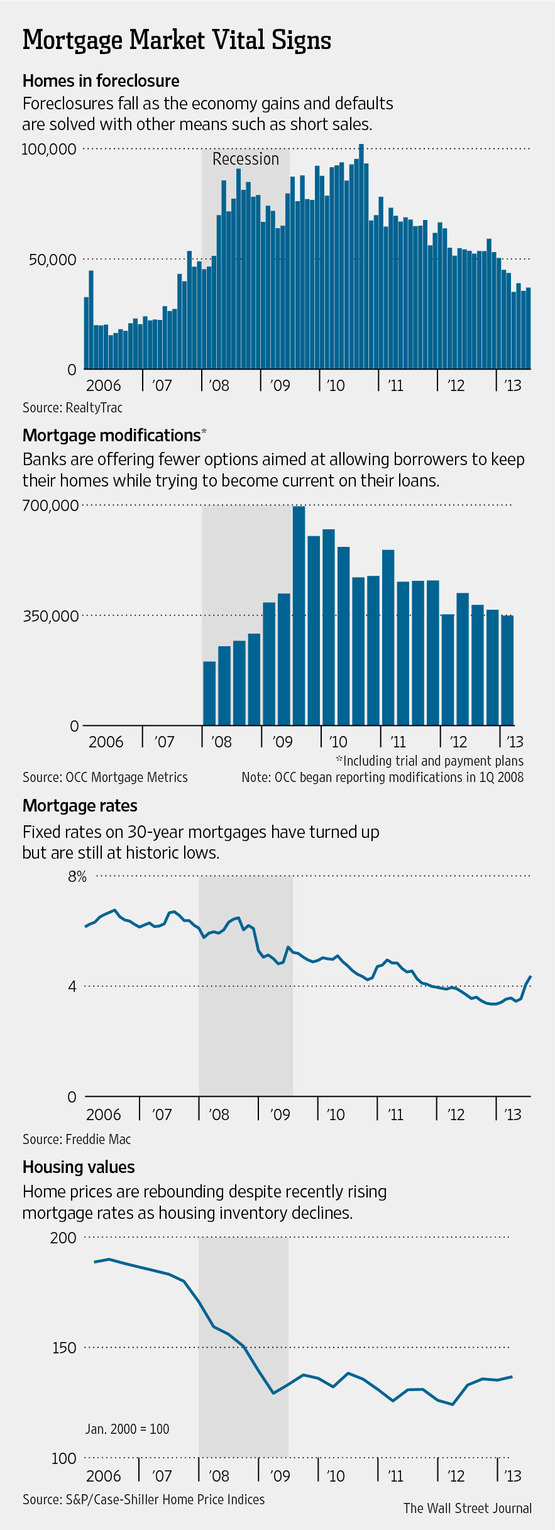
At the core of the financial crisis was a creature called a subprime mortgage bond, and among the more toxic was one with the bland name of CWABS 2006-7. Made entirely out of loans from Countrywide Financial Corp., the bond was so battered by delinquencies in 2009 it appeared that nearly all of the thousands of mortgages inside the bond could default. One might think that today, such a relic of misbegotten lending would be as dead as orbiting space junk. Instead, CWABS 2006-7 is alive and well, a sought-after asset that has made big profits for savvy investors. A senior slice of it now trades at 91 cents on the dollar, having come nearly all the way back. Read more of this post

US investors would have best slept through crash after Lehman; Rich Man’s Recovery; Insane financial system lives post-Lehman

September 12, 2013 6:56 pm

US investors would have best slept through crash after Lehman

By James Mackintosh

Recrimination and regret still haunt banks

Five years on from Lehman’s last day, recrimination and regret still haunt banks. But for investors in US equities, it is as though the crash never happened. It would have been best to ignore it all, sleeping through financial battles like a latter-day Rip van Winkle. Like the fictional character, the modern sleeper would be shocked by the changes of the past half-decade; the iPhone is now available in colour, for example. Today’s investor would have to look hard to spot the impact of the crisis on his portfolio, though. Read more of this post