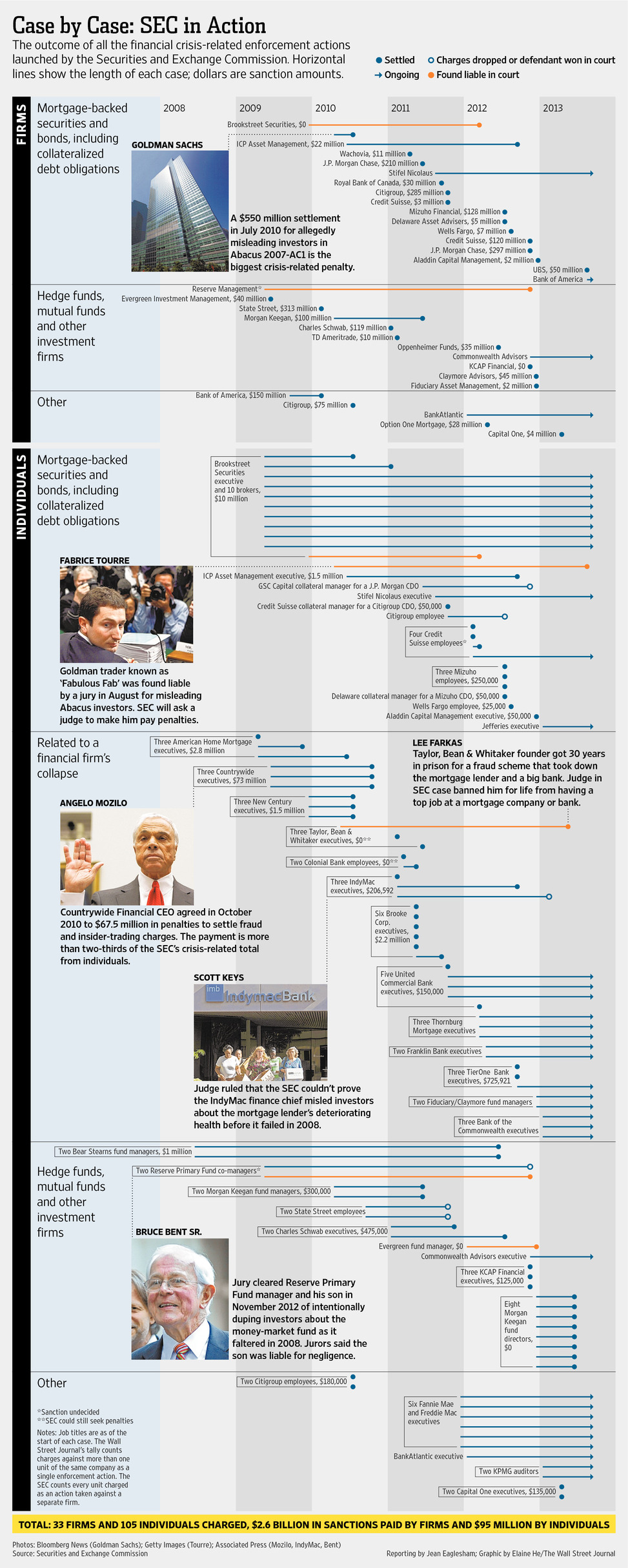
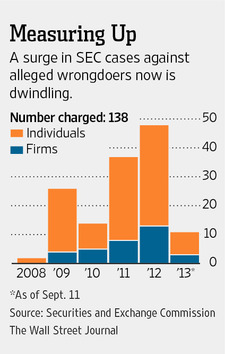
The Slow Rise And Quick Fall Of The SEC’s Enforcements

Updated September 11, 2013, 8:46 p.m. ET

CRISIS PLUS FIVE

SEC Tries to Rebuild Its Reputation
JEAN EAGLESHAM

P1-BN088_NEWSEC_NS_20130911184507 P1-BN090_NEWSEC_G_20130911185112

The Securities and Exchange Commission is ending its push to punish financial-crisis misconduct in the same way it started—with a new chairman vowing that Wall Street’s top cop will be tougher in the future. In 2009, at the depths of the recession,Mary Schapiro took the reins at the SEC promising to “move aggressively to reinvigorate enforcement” at the agency. She created teams to target various types of alleged misconduct, including one focused on the complicated mortgage bonds that helped set off a global financial panic. Read more of this post
The Next Top Model: Kiwis

The Next Top Model: Kiwis

11 SEP 2013 – ASHBY MONK

When governments set out to launch sovereign funds or public pension funds, they are often biased with an assumption that these funds will never be able to compete with the private sector. Over time, this assumption is given credibility by the fact that the sponsors of these funds under-resource the teams in charge, while over-paying external asset managers and service providers. This creates a vicious downward cycle whereby pensions become increasingly dependent on external managers (who increasingly over-charge them for services they claim are beyond their capabilities). As a result, an awful lot of people genuinely believe that investment management is something that only the private sector can do; that public sector organizations are inevitably dysfunctional and should be protected from themselves… And then this happens: A sovereign fund drops some science on the investment management industry with a 26% year and a 9% decennial IRR. That SWF is the New Zealand Superannuation Fund, and it is fundamentally challenging the notion that public funds can’t compete with the private sector. As such, I think it may be time that we coin a new “top model” of institutional investment. But before we get there, let’s review some of the existing models: Read more of this post

BRIC Markets Sink to Worst Place for Investors in Global Poll

BRIC Markets Sink to Worst Place for Investors in Global Poll

The largest developing nations for the first time have the worst market opportunities as optimism for stronger growth shifts to the U.S. and Europe, according to a Bloomberg Global Poll. India fared the poorest, followed by Brazil, Russia and China, a worldwide poll of investors, analysts and traders who are Bloomberg subscribers showed this week. The number of respondents who see the European Union as one of the two best opportunities rose to 34 percent, its best showing in the poll dating to 2009, with the U.S. at 51 percent. Read more of this post

The “Real” America: Near Record 20% Struggle To Afford Food, Highest Since Crisis Began; Years after recession, many in U.S. still struggling

The “Real” America: Near Record 20% Struggle To Afford Food, Highest Since Crisis Began

Tyler Durden on 09/12/2013 10:00 -0400

With US equity markets on a 7-day roll and excited TV anchors proclaiming the worst over and new all-time highs must signal recovery as they ‘celebrate’ five years on from Lehman, the following two charts of the state of real America should open a few eyes to just how blinded American has become to the truth (unless you live it). A stunning 20.0% of Americans were found to have struggled to afford food in the last year – surging in recent months to its highest since the peak of the crisis in 2008 – as American’s ability to consistently afford food has notrecovered to pre-recession levels. Furthermore, Americans access to basic needs (13 factors including housing, healthcare, and food) hovers near record lows – dramatically lower than pre-recession levels. The Gallup polls point to a very different image of American than Dow 15,000 – and is set to get worse as the food stamp program is set to be cut in November. Read more of this post

What Makes the Bonding Stick? A Natural Experiment Involving the U.S. Supreme Court and Cross-Listed Firms

What Makes the Bonding Stick? A Natural Experiment Involving the U.S. Supreme Court and Cross-Listed Firms

Amir N. Licht Interdisciplinary Center (IDC) Herzliyah – Radzyner School of Law; European Corporate Governance Institute (ECGI)

Christopher Poliquin Harvard Business School

Jordan I. Siegel Harvard Business School

Xi Li Hong Kong University of Science & Technology

August 27, 2013
Harvard Business School Strategy Unit Working Paper No. 11-072 

Abstract:      
On March 29, 2010, the U.S. Supreme Court signaled its intention to geographically limit the reach of the U.S. securities antifraud regime and thus differentially exclude U.S.-listed foreign firms from the ambit of formal U.S. antifraud enforcement. We use this legal surprise as a natural experiment to test the legal bonding hypothesis. This event nonetheless was met with positive or indifferent market reactions based on matched samples, Brown-Warner, and portfolio analyses. These results challenge the value of at least the U.S. civil liability regime, as currently designed, as a legal bonding mechanism in such firms.


The Struggle for Work-Life Balance in China; Some Stressed-Out Chinese Are Re-Evaluating Their Priorities

September 12, 2013, 12:57 p.m. ET

The Struggle for Work-Life Balance in China

Some Stressed-Out Chinese Are Re-Evaluating Their Priorities

WEI GU

The public disclosure by one of China’s best-known technology entrepreneurs that he has cancer, and how that has changed his view of life, has caused some businesspeople to re-evaluate their aggressive pursuits of wealth and success. Kai-Fu Lee recently revealed his lymphoma diagnosis in a message to his 50 million followers on Sina Weibo. But what has resonated far wider is his repudiation of the work-comes-first mentality that drives so many Chinese businesspeople. “It’s only now, when I’m suddenly faced with possibly losing 30 years of life, that I’ve been able to calm down and reconsider,” wrote the 52-year-old founder and CEO of technology incubator Innovation Works and former president of Google China. He said macho efforts like seeing who could sleep less were “naive.” Read more of this post

China’s New Spin on a Turbo Tax; Its Consumers Must Contend With Steep Taxes on Everything From iPhones to SUVs, but Some Car Makers Are Turning This to Their Advantage

September 12, 2013, 12:21 p.m. ET

China’s New Spin on a Turbo Tax

Its Consumers Must Contend With Steep Taxes on Everything From iPhones to SUVs, but Some Car Makers Are Turning This to Their Advantage

ABHEEK BHATTACHARYA

Like iPhones, cars are pricier in China because of higher taxes. Chinese consumers are complaining that the new iPhone 5C costs at least $184 more than in the U.S. Most of that difference is due to taxes. Cars face a bevy of levies, too, such as customs duties, value-added taxes and purchase taxes. A big one is a consumption tax of up to 40% based on the size of the car engine, to encourage fuel efficiency. This tax is a big reason car makers are adopting “turbo” engines. Turbocharging technology helps deliver the same power with a smaller engine, by pumping more air into it. Such vehicles accounted for 13% of all cars sold in China last year, double the proportion of the year before, and that may rise to 35% by 2020, says LMC Automotive. Read more of this post

The Chinese Billionaires Who Got Poorer

September 11, 2013, 8:21 PM

The Chinese Billionaires Who Got Poorer

Being rich one year doesn’t guarantee the same fortune the next. An economic slowdown in China that has hit some industries and firms harder than others, along with personal misfortunes, have left a minority of the country’s richest people less well-off this year: According to data from Hurun Research Institute’s annual ranking of wealthy Chinese, some 252 on its richest 1,000 list saw their wealth shrink. Misfortunes amongst the rich shouldn’t come as a surprise after equity in general has had a bad year in China; the Shanghai Composite Index is down 1.2% since the start of the year. In fact, the majority of China’s 315 people who have north of $1 billion got poorer. Read more of this post

For Michael Dell, Saving His Deal Is Just First Step; His Legacy Hinges on Recasting Company as a “Solutions” Provider

September 11, 2013, 8:13 p.m. ET

For Michael Dell, Saving His Deal Is Just First Step

His Legacy Hinges on Recasting Company as a “Solutions” Provider

SHIRA OVIDE

MK-CG210_DELL_NS_20130911183903

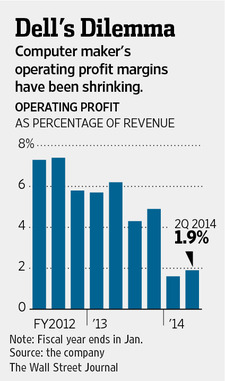
Michael Dell DELL +0.04% is set to win a bruising, yearlong battle for control of his company. His next task—getting Dell Inc. growing again—may be even tougher. Mr. Dell’s proposal to buy the computer company for nearly $25 billion is expected to win approval in a stockholder vote that ends Thursday, according to people familiar with the matter. Dell has said it expects to be a private company by the end of October. Read more of this post

Bank Indonesia Surprises With Rate Increase to 7.25%

Updated September 12, 2013, 10:03 a.m. ET

Bank Indonesia Surprises With Rate Increase

Central Bank Raises Its Overnight Policy Rate to 7.25%

FARIDA HUSNA And ANDREAS ISMAR

AI-CD516_INDORA_NS_20130912055704

JAKARTA—Indonesia’s central bank on Thursday announced a surprise increase in its policy interest rate, reflecting its commitment to protect the country’s currency, as global sentiment remains fragile. Bank Indonesia raised its benchmark rate by a quarter percentage point to 7.25%, just two weeks after raising it by a half percentage point. It also raised a key money-market rate, known as the Fasbi rate, by a quarter percentage point to 5.50%. Read more of this post

Chipotle targets Big Food, skips big branding

Chipotle targets Big Food, skips big branding

Bruce Horovitz, USA TODAY8:21 a.m. EDT September 12, 2013

Chipotle hopes that its new, anti-Big-Food video and downloadable game go viral — even with little mention of the Chipotle brand name or logo.

Chipotle is about to turn the ad world on its head — even as it smacks Big Food in the chops. On Thursday, the Millennial-friendly Mexican food chain will post “The Scarecrow,” a Big-Food-mocking 3½-minute animated video ad — and make available a free downloadable, interactive game on the topic. The twist: Both have virtually no Chipotle branding. Chipotle’s name shows up — in small print — only in the game’s introduction, and its logo is displayed only after the video is over. Read more of this post