Bubble trouble hits Hong Kong jade sales

Bubble trouble hits Hong Kong jade sales

Celine Ge 9 hours ago

Prized as a magical imperial stone, jade is a status symbol of the super rich in Asia, but rocketing prices in the top-end of the market have left traders in Hong Kong struggling to find buyers. With the cost of high-quality raw jade and jade products surging repeatedly in the past eight years, prices tags are now becoming prohibitive and experts predict the bubble must soon burst as buyers are stepping back. Driven up by the appetite of wealthy Chinese, the rising cost of jade is also being fuelled by fears of a shortage in supply from Myanmar, the key source. Read more of this post
Why Australia is Miele’s biggest market outside Germany

Caitlin Fitzsimmons Online editor

Why Australia is Miele’s biggest market outside Germany and the retail sector has reason to be cheerful

Published 16 September 2013 11:32, Updated 16 September 2013 11:34

The joint head of German appliances brand Miele has a message for the Australian retail sector: times are pretty good, actually. Given that Australia is Miele’s second biggest market outside Germany, he should know. Dr Markus Miele and Dr Reinhard Zinkann, the great-grandson of the company founders, recently spent a week in Australia to launch the new range of Miele cooking appliances and met with retail partners including Harvey Norman and Winning Appliances. Read more of this post

This time, Japan keen to learn from Fed’s policy exit

This time, Japan keen to learn from Fed’s policy exit

5:14pm EDT

By Leika Kihara

TOKYO (Reuters) – As markets tune into how the Federal Reserve is going to rein in its massive stimulus program, so is the Bank of Japan. The BOJ, the pioneer of so-called quantitative easing, is still years away from tapering off its own extraordinary stimulus program so it has the luxury of watching the U.S. central bank go first. But the more that the BOJ is able to push inflation towards its policy target of 2 percent – compared with less than 1 percent now and following years of deflation – the more attention financial markets will pay to how Japan’s exit debate is shaping up. For now, all eyes are on the Fed. Read more of this post

Singapore Banks on Asean Lure as Job Crunch Raises Angst

Singapore Banks on Asean Lure as Job Crunch Raises Angst

Singapore is counting on Southeast Asia’s economic boom to lure investment as the island’s clampdown on foreign labor raises wage costs and makes it difficult for companies to fill positions. A plan by Southeast Asian nations for a common market through the removal of tariffs and trade barriers for goods and services by 2015 will boost the bloc’s appeal as a production base, Economic Development Board Chairman Leo Yip said in a Bloomberg Television interview with Haslinda Amin. Singapore is poised to benefit as companies expanding in the region set up headquarters and research facilities here even as they build factories elsewhere, he said. Read more of this post

When market movers are the index makers; Investors have outsourced much power to the index providers

September 15, 2013 2:53 pm

When market movers are the index makers

By John Authers

Investors have outsourced much power to the index providers

Who has the power to move markets? Often some unlikely candidates. As everyone learnt during the global financial crisis, rating agencies had been given too much power. This was the side-effect of regulations that placed limits on the bonds that banks or fund managers could hold, based on their ratings. The result was to outsource due diligence to the agencies. This put far more weight on the opinion of one or two analysts than they were ever designed to bear. Read more of this post

Gross’s Trade Sours as Bonds Lose Faith in Fed Guidance

Gross’s Trade Sours as Bonds Lose Faith in Fed Guidance

Bond investors are losing confidence in the Federal Reserve’s pledge to keep benchmark interest rates at about zero into 2015 as the U.S. economy accelerates. Concern the Fed will increase its target rate for overnight loans between banks next year is showing up in wider price swings for shorter-term securities. Volatility in five-year Treasuries (USGG2YR) rose above 10-year notes for the first time since 2011 and yields on two-year notes more than doubled in the past four months. As recently as last week, Bill Gross, who manages the world’s biggest bond fund at Pacific Investment Management Co., was recommending debt with short maturities. Read more of this post

Fed Leadership Doubt Erodes Low-Rate Message as QE Taper Looms

Fed Leadership Doubt Erodes Low-Rate Message as QE Taper Looms

Federal Reserve officials will gather in their Washington board room this week to decide on policies that will unfold over the next two to three years without knowing who will lead the institution during that time. Yesterday’s announcement that Lawrence Summers has withdrawn his name from Obama’s list of candidates to succeed Fed Chairman Ben S. Bernanke threatens to weaken the central bank’s policy message by leaving the succession unsettled just as it considers scaling back record accommodation. Policy makers will decide at their Sept. 17-18 meeting whether the economy is strong enough to begin tapering $85 billion in monthly bond purchases. As they do so, they will use so-called forward guidance to convince investors they can keep interest rates low for as long as it takes to bring down unemployment so long as prices remain in check. Read more of this post

Companies Use IRS to Raise Bonuses With Earnings Goals

Companies Use IRS to Raise Bonuses With Earnings Goals

After Exelon Corp. (EXC) earned less than top executives needed to reach their annual cash bonus target last year, the company’s directors provided a way to help bridge the gap: nonexistent profits. The board tacked on 6 cents a share — equal to $85 million — that the Chicago-based power company never made, augmenting earnings solely for the purpose of calculating bonuses. Exelon said that it would have earned the sum except for a regulatory setback on electricity rates and that the pennies helped thousands of employees avoid smaller payouts. Read more of this post

Rates too low: Why housing trouble in Australiaa could be just months away

Rates too low: Why housing trouble could be just months away

Published 12 September 2013 10:04, Updated 12 September 2013 12:19

Christopher Joye

13f80a42-1ac1-11e3-92df-169c5e9f7f94_12p4eco

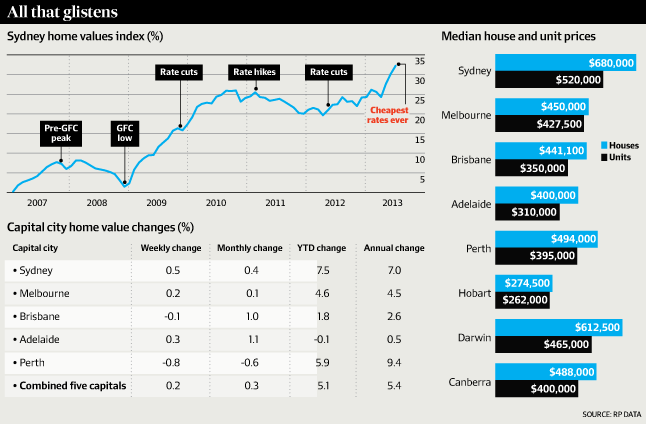
I am worried about Australia’s housing market. Very worried. Not so much about the fundamentals, which are solid. Or current performance, which is robust without raising alarm. I am concerned about what lies around the corner – and here, I am talking months, not years. I presented at a hedge fund conference during the week with notorious housing pessimist Gerard Minack. There was a fascinating role reversal. Asked about Australia’s housing prospects, Minack said he now buys into the view that house prices will track incomes. Minack was up front in admitting that he forecast striking price falls during the global financial crisis – he certainly bandied around figures in the 20 per cent range. He explained that he was wrong because it was “garbage in and garbage out”. The enormous rise in the jobless rate he anticipated never materialised. Read more of this post

Mortgage crisis looming, Bank of Israel warns; Too many borrowers are committing themselves to excessive monthly payments that could lead to widespread defaults

Mortgage crisis looming, Bank of Israel warns

Too many borrowers are committing themselves to excessive monthly payments that could lead to widespread defaults, a study has found.

By Eran Azran and Arik Mirovsky | Sep. 16, 2013 | 8:50 AM |  1

Israel’s mortgage market is at risk of collapse in the event of a major economic downturn, a study released on Sunday by the Bank of Israel warned. The average monthly mortgage repayment as a percentage of household income has risen sharply to 31%, up from 23% three years earlier – a rate that is exceptionally high by international standards. If housing prices continue to rise at their current levels, that figure could climb to 34%, the central bank warned. The percentage of total mortgage repayments made by Israelis exceeding 40% of household income – a threshold the Bank of Israel said it regards as high risk – has reached a record high of 17%. Four years ago, the figure was just 12%, the central bank said. Read more of this post