Thai Government Faces Splinter Group of Angry Rubber Farmers
September 17, 2013 Leave a comment
September 16, 2013, 9:49 PM
Thai Government Faces Splinter Group of Angry Rubber Farmers
By Nopparat Chaichalearmmongkol
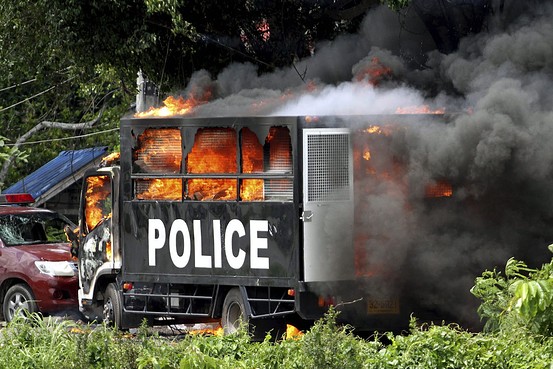
Police cars were torched as police officers clashed with rubber farmer protesters at Nakhon Si Thammarat province, southern Thailand, Monday.
BANGKOK–Splinter groups of disgruntled Thai rubber farmers continued to protest on Monday, demanding more monetary support than the government recently approved amid low global rubber prices. The protesters represented only a small part of the rubber farming community, which overall accepted the government’s recent offer of help–a doubling of the subsidy they were receiving. But not all farmers were pleased.Monday’s protesters, whose number swelled into thousands, attacked police with bricks, rocks and bottles filled with distilled acid, while officers shot tear gas into the crowd to try to contain the situation, according to a local district police officer who spoke only on condition of anonymity. Only minor injuries of protesters and police officers were sustained, the officer said.
The protests occurred in southern Thailand, where most of the country’s rubber plantations are located. Protesters blocked a highway, and police were forced to retreat.
Global rubber prices have steadily declined due to low demand from China and other emerging markets. In Thailand, the world’s largest rubber-producing country, the price of raw rubber sheet, a form of crude natural rubber, has plummeted by half since its peak in February of 2011. Raw rubber sheets currently trade at 79.22 baht ($2.29) per kilo.
The Cabinet approved a proposal by the country’s national rubber policy committee on Sept. 10 to double the subsidy for rubber farmers. Each farmer will be paid 2520 baht per one rai, or slightly more than one-third of an acre. Farmers will be given the subsidy for areas up to 25 rai, or 10 acres, for the current rubber tapping season, which runs from September to March.
That assistance would be in addition to the already approved five billion baht ($156.95 million) allocation to help farmers invest in rubber processing to add more value to the commodity and the 15 billionbaht to help rubber businesses upgrade machinery.
The protesters demanded that the government guarantee a rubber price of 90 baht per kilogram. They also want aid for rubber tappers, who generally don’t own land, being paid according to how much sap they collect. The rubber tappers weren’t included by the recently approved subsidies.
Local police said many of the protesters were believed to be children of rubber and palm oil farmers.
Rallies by rubber farmers firs broke out in Thailand last month. But demonstrations, which including blocking roads and rail lines, were called off last week after representatives from various protest groups reached the agreement with the government on aid.
Prime Minister Yingluck Shinawatra said she hopes the protests stop.
“We do not want to see the exploitation of this problem into further rallies as we are willing to discuss and find mutual solutions under the rule of law,” the prime minister said.
 About bambooinnovator
 Bamboo Innovator