Largest LBO Ever Prepares For Largest Non-Financial Bankruptcy In 30 Years
September 18, 2013 Leave a comment
Largest LBO Ever Prepares For Largest Non-Financial Bankruptcy In 30 Years
Tyler Durden on 09/17/2013 16:25 -0400
If there was one deal that epitomized the last credit bubble, aside from the Blackstone IPO of course, it was the ginormous, $45 billion 2007 LBO of TXU, now Energy Future Holdings. And while the tide for the New Abnormal credit bubble has yet to expose its megalevered monoliths swimming fully naked, as for now corporations have opted for graduated semi-MBOs in the form of ever larger stock buybacks (although as rates rise this too day of reckoning is coming), the time to pay the piper for the last credit-fuelled binge has arrived and inevitable bankruptcy of this landmark deal is now just days away. From the WSJ: “Energy Future Holdings Corp. has begun sounding out banks for financing to help it operate during expected bankruptcy proceedings, which could come as soon as November for the Texas power producer.”The losers (in addition to the thousands of company employees who were and are about to be laid off): all those who invested equity in hopes nat gas prices would rise, and even looser credit would mean a quick and profitable flip in the next 3-5 years, namely KKR, TPG, as well as Lehman (RIP), Citigroup, and Morgan Stanley. These banks were also instrumental in underwriting (and holding on to) the loans and bonds that would fund this monster deal, which ultimately led to unprecedented writedowns for all those involved. The irony: the same companies that provided the LBO financing, will also now serve as the source of the company’s $2+ billion DIP loan, so all is well with the world.
The Dallas-based company—formerly called TXU Corp. and once at the center of the largest-ever private-equity buyout—within the last week or so started discussions with Citigroup Inc., J.P. Morgan Chase & Co. and other banks in pursuit of more than $2 billion in so-called debtor-in-possession financing, said people close to the deliberations. The discussions are in early stages, and the size and the structure of the loan could change, these people said. Such loans give companies under bankruptcy protection additional money to fund operations and other obligations and are usually negotiated about four to six weeks before a Chapter 11 filing.
The company, whose org chart was a 5 by 7 foot nightmare for many a analyst, will first see its TCEH subsidiary which sells power in the wholesale market file its $32 billion in debt first. As for Energy Future, which carries more than $40 billion in debt, the WSJ says it is “racing to negotiate a prepackaged bankruptcy plan with creditors at that subsidiary and another one in an effort to avoid a prolonged stay under Chapter 11 protection. If successful, the creditors would agree to a reorganization plan ahead of a bankruptcy filing, setting Energy Future up for a speedier trip through bankruptcy court. Without a prepackaged deal, the company would have to negotiate a restructuring plan after seeking bankruptcy protection, a process that could lengthen its stay in court.”
The successful resolution of a prepack depends on the various stakeholder entities, most of which will be equitized, ultimately agreeing on just where they see the industry, and the price of nat gas going. After all, it was the plunge in natural gas prices after the LBO to record lows that led to $18 billion in losses in the five years following the LBO, and coupled with unprecedented leverage, resulted in what now appears to be the inevitable largest bankruptcy filing since 1980.
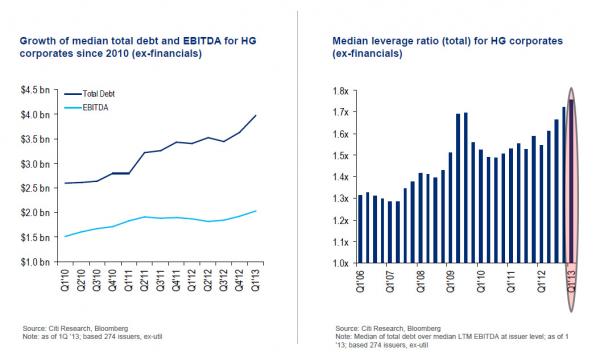
Luckily, the investing community has learned from its past mistakes and is no longer loading up quality companies with epic amounts of debt.
… Nevermind.
But who cares: after all it is all other people’s money.
Updated September 17, 2013, 8:08 p.m. ET
Creditors Circle Energy Future Holdings Before Potential Bankruptcy
Hedge Funds and Others are Jockeying for Position
Call it a game of Texas Hold ‘Em.
Some of the biggest names in finance are clashing over their holdings in Texas utility Energy Future Holdings Corp., as the company at the center of the largest private-equity buyout ever moves closer to a bankruptcy filing.
The battle among Energy Future creditors pits large hedge funds and private-equity groups such as Apollo Global Management LLC, APO +1.34% Oaktree Capital Management
LP OAK +0.90% and Centerbridge Partners LP against competitors including Avenue Capital Group, York Capital Management, Third Avenue Management LLC and GSO Capital Partners (Blackstone Group LP’s BX 0.00%credit arm), over plans for the power producer’s potential bankruptcy filing. Different approaches would mean different payouts for the various camps, which plan to meet Friday to try to break the impasse. Energy Future owes more than $40 billion to creditors.
Meanwhile, KKR KKR -0.05% & Co., TPG and Goldman Sachs Group Inc.’sGS +0.23%
private-equity arm, which led the 2007 buyout, are pushing to retain some ownership, since equity holders often lose their stakes in a bankruptcy.
Talks for several weeks between the creditor groups have largely gone nowhere, people familiar with both sides said. They say the Friday meeting could be the start of critical discussions that determine whether a deal ultimately is reached.
The clock is ticking.
On Nov. 1, Energy Future faces a deadline to pay roughly $270 million to junior bondholders at Texas Competitive Electric, an Energy Future subsidiary, the people said. Senior creditors at Texas Competitive Electric, including Apollo, Oaktree and Centerbridge, are loath to see Energy Future make that payment, because money would go to bondholders ranked behind them in the bankruptcy-repayment pecking order, said people familiar with their thinking. A bankruptcy filing before Nov. 1 would help the company avoid that payment.
In a sign the company is moving toward a filing soon, it has begun talking with banks including Citigroup Inc. and J.P. Morgan Chase & Co. about a $2-billion-plus loan that could be used during bankruptcy proceedings, according to people close to the negotiations. Those discussions are in the early stages, and the size and structure of the loan could change, the people said.
Energy Future is racing to negotiate a so-called prepackaged bankruptcy plan with creditors in a bid to avoid a prolonged stay under Chapter 11 protection. If enough creditors agree to such a reorganization plan ahead of a bankruptcy filing, Energy Future might be able to re-emerge from bankruptcy much more quickly than through a traditional process. Energy Future is pressuring the creditors with the threat of a protracted, expensive bankruptcy absent such a deal, some of the people close to the negotiations said.
KKR, TPG and Goldman’s private-equity arm bought TXU in 2007 for $32 billion plus about $13 billion in assumed debt in the hopes natural-gas prices would rise and allow the company to charge more for electricity. Instead, prices fell sharply as drillers discovered more natural gas, and the company racked up losses exceeding $18 billion from 2007 through the end of 2012. The buyout firms have written down the value of their investment in the company, originally around $8 billion, to nearly zero.
Moody’s Investors Service earlier this month said it expects parts of Energy Future to seek Chapter 11 protection before the end of this year in what could be the largest bankruptcy in the U.S., excluding financial firms, since 1980 in terms of debt.
Companies on the verge of bankruptcy usually negotiate with one set of creditors, but Energy Future has been trying to reach a deal with disparate creditor groups because of its large, tangled web of businesses.
A group of senior creditors including Apollo are owed about $25 billion from Texas Competitive Electric. Another key group, including Avenue, is made up of unsecured bondholders who are owed about $1.45 billion from Energy Future Intermediate Holding Co., a subsidiary that owns Oncor, the company’s regulated business that delivers electricity to consumers.
The unsecured bondholders of the Oncor subsidiary recently proposed being paid about $1.65 billion, an amount that would repay their debts fully with interest, the people said. The Texas Competitive Electric creditors countered with a proposal for the company to pay these bondholders about $800 million, they said.
The gulf in the negotiations is being fueled by disagreements over how to value each subsidiary and complex tax issues, the people said. Most involved in the discussions believe Oncor, for instance, is worth more than $1 billion but disagree on how much more, the people said. The bondholders at the Oncor subsidiary, meanwhile, are arguing that Texas Competitive Electric is worth far less than its creditors contend because of falling power prices.
Further muddying the waters, Energy Future faces billions of dollars in potential tax bills if these subsidiaries break apart from the parent company, the people said. The bondholders at the Oncor subsidiary have considered selling the business and using proceeds to repay their debts, the people said. But such a separation would create a large tax liability that would ultimately lower these bondholders’ financial recoveries, because they would have to share repayment with tax authorities such as the Internal Revenue Service, the people said.
In addition, Energy Future doesn’t want creditors at either subsidiary to simply forgive debts in exchange for ownership stakes in their businesses, because such a move would also trigger the taxes, the people said. Big tax bills could hurt the ability of its private-equity owners to get value from any ownership stake they retain.
 About bambooinnovator
 Bamboo Innovator