India’s Auto Makers Struggle With Sharp Shift in Economy
September 20, 2013 Leave a comment
September 19, 2013, 7:11 a.m. ET
India’s Auto Makers Struggle With Sharp Shift in Economy
NEW DELHI— For years, Udayan Banerjee’s business making automobile exhaust systems was in high gear as middle-class Indians flocked to buy cars. This summer, that came to a screeching halt. “July and August were the worst months I’ve ever seen,” Mr. Banerjee said, predicting that his Sharda Motor Industries Ltd. 535602.BY +7.38% would post a loss for this year’s third quarter. Until recently, India was seen as a potential new Asian tiger, powered by its globalized information-technology industry, and auto makers were among the biggest beneficiaries of a boom in consumer-driven growth. Now they are reeling as investors pull back from emerging markets around the world, exposing the frailties of an Indian economy that was already decelerating sharply even before the global market turmoil. The U.S. Federal Reserve’s surprise decision Wednesday to stick with easy-money policies that have been buoying developing-country economies helped lift Indian stock markets and the rupee—along with other Asian currencies—on Thursday.
But the reprieve from the Fed is unlikely to turn around the fortunes of corporate India.
Business in India faces daunting bureaucratic hurdles that have helped stifle manufacturing. The country depends on imported energy and runs huge trade deficits. Welfare programs strain public finances.
Growth slowed to 4.4% in the April-June quarter, the economy’s worst performance in four years. The government is predicting gross domestic product will expand 5.5% for the full year ended March 31.
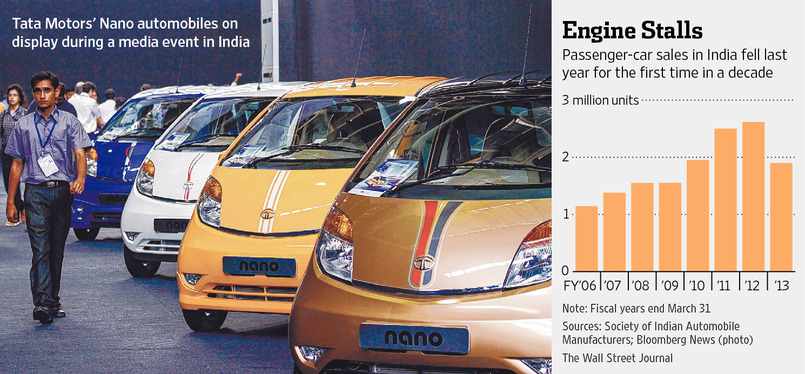
India’s $64 billion automotive industry is struggling. Sales, which grew by more than 50% between 2010 and 2012, have been slowing sharply. In the 12 months ended March 31, sales were down 6.7% from the previous year—the first decline in annual sales in a decade.
“When the car manufacturers expanded, we did as well,” said Sharda Motor’s Mr. Banerjee. The company has opened a new factory every year for the past 12 years. The company posted regular annual profits of 200 million ($3.2 million) and had hefty cash surpluses.
Two of India’s biggest domestic car makers, Mahindra and Mahindra Ltd.500520.BY +3.06% and Maruti Suzuki India Ltd., 532500.BY +5.57% which together account for two-thirds of Sharda Motor’s revenue, have been among the hardest hit by the domestic auto-sales slump.
Efforts to offset the decline by ramping up exports have so far failed to gain traction. Plagued by poor roads and ports, India has failed to become a major exporter of cars. Mahindra’s exports, for instance, currently account for only 2% of the company’s revenues.
The weak rupee is adding to Mr. Banerjee’s woes. The currency was punished more than others by the flight from emerging markets because of India’s gaping current-account deficit, a reflection of the fact that it imports far more than it exports. The currency has rebounded some after plunging to an all-time low of 68 to the U.S. dollar in August. On Thursday, it was trading at around 61.8 to the dollar.
Mr. Banerjee said Sharda, which is heavily dependent on imported materials and components, only breaks even when the rupee is at 56 to the dollar. It last traded at that level in May.
Now, Mr. Banerjee is asking his customers, including Mahindra and Maruti Suzuki, to pay more. But he says they have failed to respond. His company is looking at cutting costs by using less metal for each exhaust.
“We try our level best to convince the customer to pay more. Generally they do, but this time there is a slump in the market also,” Mr. Banerjee said. A Maruti spokesman declined to comment on its relationship with a supplier. Mahindra officials didn’t respond to requests for comment.
As economic growth slowed, India’s central bank cut its benchmark interest rate to 7.25% in May. But capital outflows and double-digit consumer price rises have stayed its hand since then. The bank even tightened the availability of funds in the interbank market this summer.
There is talk in the market that the Reserve Bank of India, the central bank, may reduce interest rates for car loans at a policy meeting Friday. But high imported fuel prices and rising unemployment are likely to cloud the sector’s outlook.
“Companies are operating at 30% to 40% below capacity. Profitability is hugely stressed,” said Vinnie Mehta, executive director of the Automotive Component Manufacturers Association of India. “Market conditions are really bad right now. Everyone is desperate to make sales.”
 About bambooinnovator
 Bamboo Innovator